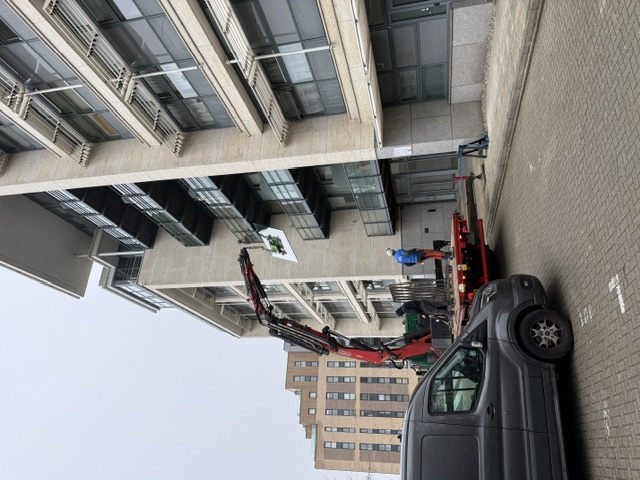
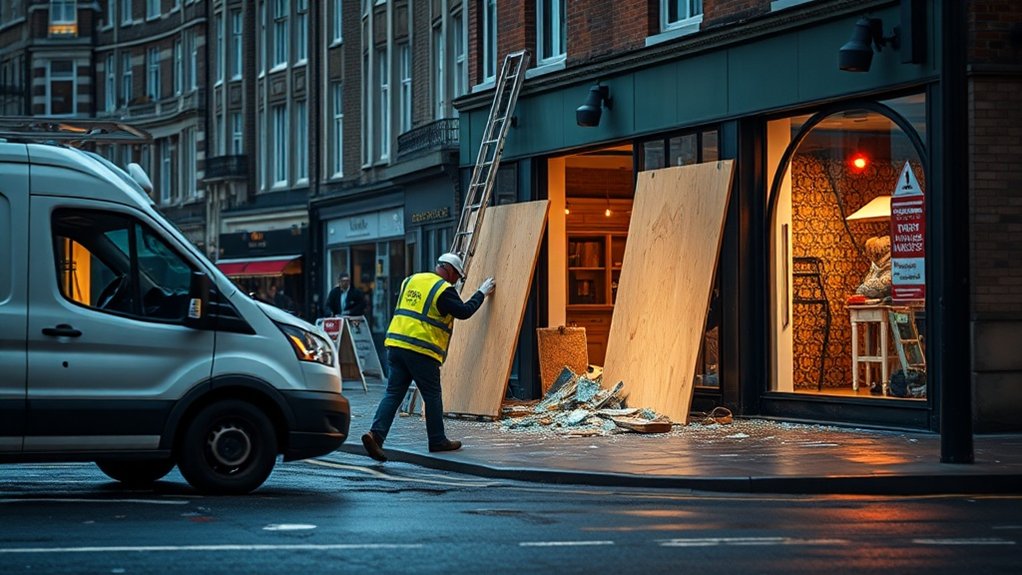
If a break-in, impact, fire or glazing failure leaves your London property exposed, you need an emergency boarding up service to reinstate the envelope fast. Vetted operatives install impact‑resistant sheeting with anti‑tamper fixings, to British Standards, maintaining security, weather‑tightness and insurance compliance. They risk‑assess access/egress, protect heritage fabric with non‑invasive fixings, and document works with time‑stamped photos for insurers. Next, you’ll see how response times, costs and provider choice affect the protection you achieve.
Key insights
- 24/7 emergency boarding up across London for break-ins, accidents, fire, and storm damage, typically attending within 30–90 minutes.
- Secure windows, doors, and shopfronts using impact-resistant boards and anti-tamper fixings, with options for insurance-approved or fire-rated materials.
- Services available for residential, commercial, industrial, and heritage properties, using non-invasive methods where façades or historic features must be protected.
- Providers supply photographs, reports, and documentation to support insurance claims and future repair or re-glazing works.
- Follow-up services can include re-glazing, security upgrades, and integration of CCTV or access control for long-term protection.
When Do You Need a Boarding Up Service in London?
Whether it’s due to criminal damage, accidental impact, or severe weather, you need a boarding up service in London whenever glazing or external openings are compromised and no longer provide a secure barrier. You should act as soon as the building envelope’s integrity is breached—shattered panes, failed frames, forced entry points, or fire-damaged apertures all demand immediate temporary works.
You also need boarding when your window security is clearly downgraded: visible cracks, loose units, or failed locking hardware invite opportunistic access. For high-risk sites, you’ll deploy boarding as part of proactive vandalism prevention, for example during void periods, post-eviction, or while awaiting specialist re-glazing.
In each case, boarding is a risk-mitigation measure , stabilising perimeter security until permanent systems are reinstated.
How Fast Can Emergency Boarding Up Services Respond?
You need to know how quickly an emergency boarding up team can reach site, because incident response time directly impacts asset protection and public safety. In London, reputable contractors typically quote defined response-time SLAs , but actual callout speed depends on variables like postcode coverage, traffic conditions, crew availability, and police or fire-service clearance. By understanding these response parameters, you can set realistic expectations and choose a provider that meets your risk-management requirements.
Typical Emergency Response Times
In London, emergency boarding up services typically deploy within 30–90 minutes of your call, depending on your borough, traffic conditions, and incident severity. You should expect an initial triage within minutes, where the dispatcher validates risk level, confirms access points, and logs any concurrent Emergency procedures (fire, police, structural engineer).
Reputable providers run GPS-tracked fleets and dynamic routing to shorten arrival times, even during peak congestion and adverse Weather impact. They’ll commit to an ETA window and update you in real time if conditions shift. On arrival, the crew moves straight to securing perimeters , removing glazing hazards, and installing temporary barriers to industry standards, so you restore security, mitigate liability exposure, and stabilise the site for follow‑on repairs or insurance assessment.
Factors Affecting Callout Speed
Response times of 30–90 minutes don’t happen by accident; several operational variables determine how fast a boarding up crew reaches your site. Your callout speed depends first on dispatcher triage—threat-to-life, unsecured perimeters, and exposed window frames are escalated. GPS-based crew allocation , live traffic telemetry, and proximity to materials depots further compress arrival times.
You’ll see delays during severe weather conditions, major incidents, or city-wide events that constrain road access. Contractor readiness—24/7 staffing, pre-loaded vehicles, and pre-cut board stock—also drives performance. Site data helps: if you provide accurate aperture dimensions, glazing types, and frame conditions, technicians can deploy the correct fixings on the first run. Digitally integrated providers typically achieve faster, more predictable callout windows across London.
What Happens During a Professional Boarding Up Visit
When a professional boarding up team arrives, they’ll start with an initial site assessment, carrying out a rapid risk evaluation , documenting damage, and identifying structural or glazing vulnerabilities. You’ll see them measure apertures, locate anchor points, and determine load paths to guarantee any temporary works comply with safety best practice. They’ll then secure doors and windows using impact-resistant sheet material, anti-tamper fixings, and correct fixing patterns to prevent forced entry and further weather or vandalism damage.
Initial Site Assessment
How does a professional boarding up visit actually unfold on site? It starts with an initial site assessment that treats your property like a live risk environment. Technicians run a rapid visual sweep, log structural damage, and pinpoint vulnerable access points to inform security upgrades and your broader emergency preparedness plan.
They’ll typically:
- Map impact zones, load paths, and debris fields to identify latent structural stresses.
- Evaluate threat vectors (street access, alleyways, roofline, sightlines) and existing perimeter controls.
- Document everything with photos, measurements, and condition reports for insurers and compliance.
You’ll see laser measures, moisture meters, and digital checklists deployed to capture accurate data fast. This assessment becomes the blueprint for a tailored, standards-compliant protection strategy that’s both reactive today and resilient for future incidents.
Securing Doors And Windows
Once the risk profile’s clear , technicians move straight to hardening doors and windows as primary penetration points. They bench-mark each opening, then cut structural-grade boards or composite panels to tight tolerances, maintaining frame integrity and sightline symmetry. Fixings are anti-tamper, corrosion-resistant, and anchored into sound substrates to resist prying and impact.
You’ll see door-sets cross-braced, letterboxes sealed, and glazing units over-clad with load-distributing sheathing. Where Historical preservation is critical, they use non-invasive anchor systems and breathable interfaces that prevent fabric damage. For premium schemes, perforated steel or polycarbonate allows natural light and temporary Decorative enhancements without compromising security. All works are documented with photographs and torque-check records, so you can evidence compliance, resilience, and insurer-aligned risk mitigation.
Safety, Security and Insurance for Boarding Up in London
Why does effective boarding up in London go far beyond simply screwing sheets over a broken opening? You’re managing risk in a dense urban environment with Historical architecture, complex insurance clauses, and strict safety codes. A professional service designs a temporary façade that’s load-aware, tamper-resistant, and compliant with insurer requirements, while minimising Environmental impact through reusable or low‑waste materials.
You should verify that your contractor:
- Uses rated fixings, anti-tamper hardware , and documented risk assessments to deter forced entry and liability claims.
- Provides photographic evidence, serial-numbered materials, and time-stamped reports to satisfy loss adjusters.
- Configures access control, signage, and emergency egress so the boarded area remains insurable and safe for responders.
This approach aligns physical security, compliance, and sustainable practice in one integrated response.
Which Properties and Damage Types Boarding Up Covers
Whether you manage a single shopfront or a mixed-use portfolio, professional boarding up in London applies to a wide range of property types and incident profiles, each with distinct risk parameters. You can deploy temporary encapsulation for Commercial properties, residential blocks, Historical buildings, industrial estates, and community assets such as schools or healthcare facilities.
Typical damage sets include ram-raids, forced entry, glazing failure, fire-compromised elevations, impact damage from vehicles, and storm-related breaches. Boarding up also stabilises voids during structural assessments, asbestos surveys, and façade remediation. For heritage assets, you’ll use non-invasive fixing methodologies to protect original fabric while maintaining conservation compliance. Across all asset classes, the objective is identical: rapid perimeter hardening, ingress mitigation, and liability reduction until permanent reinstatement is designed and executed.
How to Choose a Reliable Boarding Up Company in London
Selecting a boarding up contractor in London demands the same rigour you’d apply to appointing a principal contractor on a remediation project: you’re looking for a 24/7 operator with proven rapid-response capability , certified operatives, and robust risk controls. You should verify they can work under CDM-style methodologies, with RAMS tailored to fire, impact, and security hazards.
Prioritise firms that can protect a Historical building without compromising façades, stonework, or Artistic design features, using non-invasive fixings and temporary works engineering.
Look for:
- Accreditation (e.g., CHAS, Constructionline), DBS-vetted staff, and documented training.
- Digital reporting: time-stamped photos, secure data capture, and live job-tracking.
- Integration with your insurers, loss adjusters, and security systems for seamless incident management.
What Affects Boarding Up Costs in London?
Several key variables drive boarding up costs in London, and you need to understand them to budget accurately and avoid scope creep. Your primary cost drivers are material costs, labor expenses , access complexity, and response time.
Material costs fluctuate with specification: thickness and grade of OSB or plywood, anti-tamper fixings, security films, and temporary steel systems all sit at different price points. If you demand fire-rated or insurance-approved materials, you’ll pay a premium.
Labor expenses scale with the number of operatives, out-of-hours callouts, and site risk profile. High-level glazing, traffic management, or police-assist scenarios require more skilled engineers and longer deployment windows. Finally, geographic location, congestion, and parking charges across London postcodes impact total cost-to-serve.
After Boarding Up: Repairs and Long-Term Security Steps
Once you’ve controlled immediate risk and costed the boarding works, you need a clear plan for permanent repairs and longer-term security hardening. You should commission a fabric condition survey, moisture mapping, and structural verification before removing any sheeting. Align every intervention with insurance requirements , local authority consents, and, where relevant, historical preservation constraints.
Prioritise a phased methodology that sequences envelope reinstatement, security upgrades, and interior refurbishment to minimise downtime and disruption.
- Specify anti-intrusion glazing, PAS 24 or LPS 1175-rated doorsets, and tamper-proof ironmongery.
- Integrate CCTV, access control, and smart sensors into the repair design, not as bolt‑ons.
- Document all remediation, including fire-stopping, compartmentation, and anchor points, to future-proof compliance and asset value.
Frequently Asked Questions
Do Boarding up Services Operate on Bank Holidays and Weekends in London?
Yes, they typically operate 24/7 , including bank holidays and weekends. You can trigger an emergency response through a dedicated call-out line, and technicians deploy rapidly to secure your asset. They’ll install temporary sheathing, anti-tamper fixings, and, in some cases, security-rated boards for enhanced perimeter hardening. You should confirm SLAs, response times, and security enhancement options like CCTV integration or remote monitoring for a more innovative, resilient protection strategy.
Can I Board up Only Part of a Shopfront, Not the Whole Window?
Yes, you can. Imagine your façade as a circuit board : you don’t shield every trace, only the high‑risk zones. You’ll specify partial coverage based on threat vectors, access points, and glazing vulnerability. A competent contractor will offer window customization using modular sheathing, secure fixings, and anti‑tamper patterns. They’ll maintain egress routes, signage visibility, and compliance with BS standards, while optimising material deployment and maintaining brand exposure for an innovation‑driven frontage.
Are Eco-Friendly or Reusable Boarding Materials Available for London Properties?
Yes, you can specify eco friendly materials and Reusable boarding options for your property. You’ll typically use FSC-certified structural ply , recycled composite sheets, or modular aluminium panels with impact-rated fixings. Temporary systems with reusable anchors and tamper-resistant hardware let you deploy, remove, and redeploy boards without degrading the substrate. You’ll also reduce waste by using standardized panel sizes, edge protection, and weatherproof sealants engineered for multiple installation cycles.
Will Boarding up Affect My Business Signage or Advertising Displays?
It can, but you don’t have to lose visibility. You specify critical sign zones , and technicians design window protection to maintain sightlines and backlighting. Using clear polycarbonate panels, cut‑outs, or modular framing, they enable Signage preservation while still delivering impact resistance and anti‑intrusion performance. Installers coordinate fixing points to avoid damage to fascia or LEDs, ensuring your brand assets stay operational, compliant, and visually dominant throughout the protection period.
Can Landlords Arrange Boarding up Without the Tenant Being Present?
Yes, a landlord can usually authorize boarding up without you on-site, but they must respect tenant rights and lease covenants. You should insist on prior notification where practicable and clearly defined emergency access protocols. Specify key-holder details, smart-lock codes, and alarm integration in writing. Require photos, timestamped reports, and a method statement from the contractor to guarantee asset protection, compliance, and rapid reinstatement of normal operations once the risk window closes.
Summary
When glazing suffers “unplanned retirement ,” you need a rapid, compliant boarding up strategy to maintain asset integrity and occupant safety. By engaging a vetted, 24/7 London contractor with SBD-aligned methods, BS 8213/EN 356 awareness, and robust RAMS, you’ll stabilise the envelope, deter opportunistic entry, and satisfy insurer conditions. Once the fabric is temporarily secured, schedule permanent reinstatement, enhanced physical security, and periodic risk assessments to guarantee your property doesn’t experience similar “unscheduled interruptions” again.