
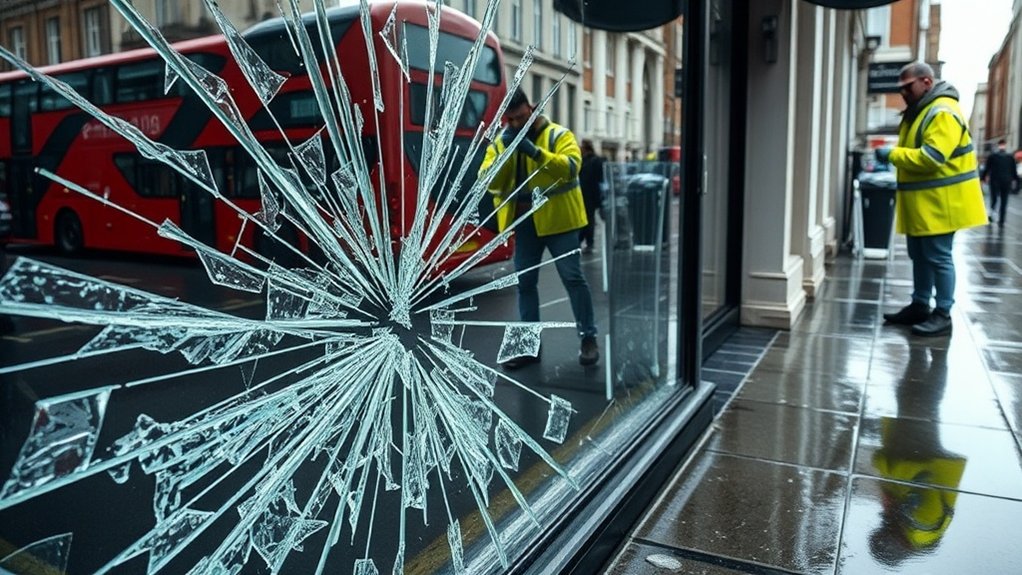
If you’ve got a smashed window in London, you need a 24/7 emergency glazier , not a general handyman. A qualified, FENSA/GGF-registered glazier will secure the opening fast with impact-rated boarding, then replace the glass to BS EN standards so your security, weather resistance, and insurance cover aren’t compromised. Response is usually 30–90 minutes and you can upgrade to laminated or toughened safety glass. Next, you’ll see what to do step-by-step and who should pay.
Key insights
- 24/7 emergency glaziers in London can usually attend within 30–90 minutes to secure and repair smashed windows.
- Choose FENSA or GGF registered, insured glaziers who understand British Standards and Building Regulations for safety and compliance.
- Professionals provide immediate board-up with impact-rated boards and anti-tamper fixings, then arrange same-day or next-day glass replacement.
- Costs vary by glass type, size, frame condition, access, and urgency; laminated, toughened, and heritage glazing are more expensive.
- Supplying photos and measurements in advance helps ensure the right glass, faster repairs, and fewer temporary solutions.
How Urgent Is a Smashed Window in London?
Even if the damage looks minor, a smashed window in London is almost always an urgent issue because it compromises security, weather resistance, and building safety. You’re dealing with immediate exposure to moisture ingress, thermal loss , and easy unauthorised entry, especially in high-footfall urban zones.
You should treat broken glazing like a critical envelope failure. Once the glass unit’s integrity is breached, U-values, acoustic performance, and structural loading assumptions no longer hold. Delays accelerate frame distortion, seal degradation, and mould risk around reveals, increasing lifecycle costs of glass maintenance.
From an innovation standpoint, rapid intervention lets you upgrade to laminated, toughened, or smart glazing while restoring window aesthetics. Prompt repair ensures compliance with British Standards and aligns with insurers’ expectations on risk mitigation.
First Safety Steps After Your Window Breaks
Once a window breaks, your first priority is to stabilise the area so no one gets injured by falling glass, sharp shards, or an unsecured opening. Immediately isolate the zone: keep children, pets, and non-essential personnel away from the broken glass field. Switch on bright lighting, then visually map the debris pattern, including fine splinters.
Next, put on cut‑resistant gloves, closed shoes, and eye protection as baseline safety precautions. If safe, close internal doors to compartmentalise draughts and potential intruders. Use a rigid board or heavy‑gauge plastic to create a temporary barrier, securing it with strong tape or fasteners to the frame, not the fractured pane. Finally, photograph the damage for digital records, insurance, and future glazing specification.
Who Should You Call for Emergency Window Repair in London?
When a window smashes in London, you should prioritise calling a professional glazier that offers true 24/7 emergency response, not a general handyman service. You need specialists who understand British Standards (like BS 6262) and safety glass classifications, and who carry laminated and toughened stock for secure temporary make‑safe work.
Look for firms experienced with Historical windows, capable of protecting original sashes, listed façades, and heritage glass without compromising structural integrity. Verify they’re FENSA or GGF accredited , fully insured, and DBS‑checked for out‑of‑hours access.
If your property uses Energy efficient glazing, choose a glazier who can match low‑E coatings, warm‑edge spacers, and gas fills, so emergency repairs don’t downgrade your building’s U‑values, acoustic performance, or security profile.
How Fast Can Emergency Window Repairs Happen in London?
Although response times vary across the capital, credible emergency glaziers in London typically reach site within 30–90 minutes for priority call‑outs, depending on postcode, traffic, and police or fire sign‑off. You should expect rapid triage on arrival: risk assessment, glass specification, and temporary reinstatement planning.
Technicians trained in historical architecture work faster because they instantly identify original window design constraints, such as slim sightlines, putty‑fronted sashes, or conservation‑grade glazing bars. They’ll carry pre‑cut laminated, toughened, and wired glass, plus safety film, to match security and impact‑resistance requirements.
Digital dispatch, live vehicle tracking, and photo‑based remote surveying compress response and decision times. You accelerate everything by supplying photos, measurements, and listing status when you call, so the team can mobilise with the right materials first time.
Emergency Board-Up Services Across London
Because smashed glazing leaves your property exposed to weather, intruders, and public liability claims, emergency board‑up services in London prioritise rapid containment using tested methods and certified materials. Technicians secure the opening with impact‑rated boards , anti‑tamper fixings, and perimeter sealing to stabilise frames and prevent water ingress, thermal loss, and uncontrolled access.
You benefit from a risk‑assessed approach: operatives isolate any laminated or toughened shards, protect internal finishes, and maintain egress routes to comply with fire regulations. If you’ve invested in window tinting or decorative glazing, they document edge conditions, hardware positions, and sightlines so replacement glass integrates seamlessly with your existing façade strategy. Many teams also pre‑drill for future ironmongery, sensors, or smart‑glass upgrades, minimising later disruption.
Same-Day vs Next-Day Window Glass Replacement in London
Once the opening’s secure and weather‑tight, the next decision is how fast you can get replacement glass fitted: same‑day or next‑day. Same‑day replacement’s ideal when you’ve got a critical security exposure on street‑level glazing or accessible flat roofs. Installers typically use standard float or toughened units already on the van, prioritising structural integrity, edge cover, and compliant glazing tapes or silicones.
Next‑day replacement suits performance‑driven upgrades where you want precision over speed. You can specify laminated safety glass, acoustic interlayers, solar-control coatings, glass tinting, or decorative films without compromising lead times. Technicians can pre‑measure, fabricate to BS EN 1279 or BS EN 12150, and return with optimised units that integrate with existing frames, maximise daylight, and improve U‑values and impact resistance.
What to Expect During a London Window Repair Visit
When a London glazier attends your smashed window, they’ll start with a structured site assessment, checking frame integrity, glass specification, and any security or weatherproofing risks. You can expect a clear repair process timeline at the outset, including lead times for toughened or laminated units and how long each stage on-site should take. Throughout the visit, the team will manage shard removal , temporary boarding, and final clean-up using industry-standard PPE and waste-disposal procedures to keep the area safe.
Initial Site Assessment
During an initial site assessment for smashed window repair in London, a qualified glazier systematically inspects the damage , surrounding frame, and any affected structural elements to determine the safest repair method. They’ll first secure the area, checking for loose shards, compromised seals, and instability in the window frame.
Next, they evaluate glass durability requirements, factoring in exposure to impact, weather loads, acoustic performance, and security risks. You’ll see them measure rebates , assess fixings, and verify compliance with British Standards and local building regulations. They may use moisture meters and thermal tools to identify hidden issues, like frame distortion or cold-bridge risks.
Finally, they’ll outline viable glazing specifications and safety upgrades so you can choose a future-proof solution.
Repair Process Timeline
Although every smashed window job is slightly different, a typical London repair visit follows a clear, safety-led sequence so you know what will happen and roughly how long each stage should take. First, the technician verifies structural stability and isolates the opening (5–10 minutes). Next, they take precise measurements, confirm glass specs, and review any performance upgrades such as security laminates, solar-control window tinting, or decorative glass options (10–20 minutes).
Glass fabrication or sourcing usually takes from same-day to 72 hours, depending on thickness, coating, and edge treatments. On installation day, setting blocks, packers, and sealants go in first (15–30 minutes), followed by glass placement, squaring, and gasket or beading installation (20–40 minutes), then final alignment and weatherproofing checks.
Safety And Clean-Up
From the moment the glazier arrives, safety and containment drive every step of the clean‑up process around your smashed window. You’ll see them deploy industry-standard safety gear —cut‑resistant gloves, EN‑rated eye protection, and sometimes anti‑cut sleeves—to manage sharp fragments. They’ll isolate the area with barriers or hazard tape, then conduct a visual and tactile inspection to identify unstable glass.
Next, they’ll follow defined clean up procedures: lifting large shards, vacuuming fine splinters with a HEPA or trade‑grade vacuum , and using rigid containers for glass waste, never standard bin bags. Frames and sills are wiped to remove micro‑particles. If the opening can’t be reglazed immediately, they’ll install secure temporary boarding, ensuring weather sealing, impact resistance, and compliant egress routes.
Typical Smashed Window Repair Costs in London
When you’re budgeting for smashed window repair in London, you need to factor in glass type , safety requirements, frame condition, and access constraints, not just the visible damage. For a standard residential pane, you’ll typically see costs starting from a low call‑out and labour charge, then scaling with pane size and glass specification.
Toughened or laminated safety glass, acoustic glazing, and energy‑efficient units sit at a higher price band than basic float glass. Decorative window designs and historical window preservation usually command premium pricing because they require specialist glazing, heritage‑grade putties, and precise profiling to match existing sightlines. Emergency same‑day attendance , out‑of‑hours work, and temporary boarding also add to total costs, though they substantially reduce security and weather‑ingress risks.
What Affects the Cost of London Window Repairs?
Because every smashed window behaves differently under impact and stress, London repair costs hinge on a specific set of variables: glass specification, frame material and condition, opening style, access complexity, and compliance with UK Building Regulations and safety standards. You’ll pay more when you need high‑performance laminated or acoustic glass, or when you’re integrating eco friendly materials such as low‑emissivity units and warm‑edge spacers.
Historic areas add complexity. If your property sits within protected Historical architecture, you may need like‑for‑like replacement, slimline double glazing, or bespoke glazing bars.
- Extent of breakage and safety risks
- Glass type: standard, laminated, toughened, acoustic
- Frame material: timber, aluminium, steel, uPVC
- Site access: upper floors, busy streets, restricted scaffolding
- Regulatory constraints in conservation or listed settings
How to Choose a Reliable London Glazier
Costs only make sense once you’re confident the glazier can actually deliver safe, compliant work on your London property. Start by checking they’re FENSA or GGF registered, fully insured, and conversant with current Building Regulations , especially Part K (safety glass) and Part L (energy efficiency).
Ask how they assess glass security: do they specify laminated, toughened, or secondary glazing based on risk profile, access points, and frame condition? Confirm they can integrate locks, restrictors, and secure fixings without compromising sightlines.
Evaluate their approach to window aesthetics and design innovation. A good London glazier will provide detailed specifications, U‑values, acoustic ratings , and sample units, plus digital visuals or previous-case images, so you can validate performance, finish quality, and long-term durability.
Repairing vs Replacing Smashed Window Glass in London
Although a smashed window looks like an obvious replacement job, a good London glazier will first determine whether it’s safer, more economical, and regulation‑compliant to repair or to fully replace the glass unit. You’ll weigh factors like edge damage , frame distortion, and whether the existing pane meets current BS and Part L requirements.
For minor impact or localized cracking in laminated or double‑glazed units, specialist resins or unit re‑sealing can restore integrity. Full replacement becomes essential when the glass has lost structural performance, security rating, or thermal efficiency.
- Assess impact zone, frame stress, and glass type
- Verify safety glass standards and U‑values
- Consider acoustic, solar, and glass tinting upgrades
- Integrate security laminates and decorative films
- Compare lifecycle cost , disruption, and energy savings
Smashed Shopfront Window Repair for London Businesses
When a shopfront window smashes in London, you’re managing more than broken glass – you’re dealing with an immediate security breach, public safety risk, and potential non‑compliance with glazing regulations. You must secure the perimeter fast, deploy temporary boarding that meets BS 3998 impact standards , and schedule like‑for‑like or upgraded replacement glazing.
For modern retail fronts, you’ll typically specify laminated safety glass or toughened glass with anti‑bandit or security film, integrated into compliant aluminium or timber systems. In conservation areas, you need solutions that balance historical preservation with contemporary performance, for example slimline laminated units that visually match original sightlines. If you use decorative glass, guarantee any sandblasting, etching, or digital printing is applied to certified safety substrates and installed by FENSA-registered specialists .
Smashed Windows in Rented London Homes: Who Pays What?
When a window smashes in a rented London home, you need to know exactly where tenant liability ends and the landlord’s statutory responsibilities begin so repairs are handled correctly and safely. You’ll want to distinguish between damage caused by tenant negligence , structural defects, or criminal acts, as this determines whether your deposit, the landlord’s obligations, or an insurance policy covers the glazing and frame replacement costs. Understanding how contents insurance, landlord building policies, and emergency repair clauses interact helps you control out-of-pocket expenses while maintaining compliance with housing safety standards.
Tenant Liability And Duties
Even before you call a glazier, you need to understand how tenancy law in London allocates liability for a smashed window , because getting this wrong can expose you to repair costs, deposit deductions, or even a claim on your liability insurance. Your core Tenant obligations focus on avoiding “tenant-like damage” and proving you acted responsibly once the glass failed.
You must document the incident, mitigate immediate risks, and notify your landlord or agent using traceable channels. As part of Property maintenance, you’re expected to secure the opening and prevent secondary loss , not carry out structural repairs.
- Capture timestamped photos and video
- Record cause: accident, vandalism, storm, unknown
- Isolate the area; prevent injury and ingress
- Notify landlord/agent in writing immediately
- Keep receipts for emergency boarding or safety measures
Landlord Responsibilities Explained
Although tenants must act in a “tenant‑like” manner, the legal duty to keep the structure and exterior of a rented London property in repair rests squarely with the landlord, and that includes most smashed window scenarios. You must organise timely glazing works , confirm the replacement meets Building Regulations, and verify that competent, insured contractors handle the job.
You’re also responsible for balancing protection of historical architecture with modern performance standards. That means selecting glass and frames that respect conservation‑area or listed‑building constraints while improving energy efficiency, acoustic control, and impact resistance. You need documented risk assessments, safe access methods, and temporary securing of the opening to protect occupants and the public. You should also maintain a clear repairs protocol so tenants know how to report window damage immediately.
Insurance And Repair Costs
Landlord repair duties only tell half the story; smashed window incidents in rented London homes quickly become questions of who actually pays. You’re navigating three moving parts: the landlord’s building policy, your contents insurance coverage , and fault. If criminal damage’s involved, insurers usually expect a crime reference number and evidence of secure glazing.
You should:
- Verify whether the landlord’s policy funds like‑for‑like glass or upgraded Glass safety (laminated or toughened).
- Check if your contents insurance covers accidental damage you cause to fixed glazing.
- Confirm excess amounts so you can compare claim costs with direct repair quotes.
- Require installers to meet BS EN 12150/BS EN 14449 standards and provide certification.
- Document everything: photos, invoices, and emails to streamline any dispute.
Insurance Claims for Smashed Window Repairs in London
When a window gets smashed in London, insurance cover often determines how quickly and cost‑effectively you can restore safety and security. You should first verify whether your policy classifies the incident as accidental damage, vandalism, or storm impact, because that drives approval speed and excess levels.
Document the damage with time‑stamped photos , including frame details for historical architecture and any prior upgrades such as laminated or acoustic glass. Ask your glazier for an itemised quote that differentiates labour, glass specification, and any Eco friendly materials, like low‑iron or recycled-content glazing.
Notify your insurer immediately, provide the contractor’s emergency boarding invoice, and request written confirmation that like‑for‑like replacement —including heritage‑grade or performance glass—is authorised before permanent works proceed.
London Safety Rules for Window Repair and Glazing
Insurers focus on costs and cover, but London’s building and safety regulations dictate how any smashed window can legally be repaired. You must comply with Building Regulations Part K (protection from falling, impact, and glazing), Part B (fire safety), and, where relevant, conservation and listed-building controls for historical preservation.
You’ll balance structural performance, thermal efficiency , and window aesthetics with mandatory safety glazing in critical locations (doors, low-level panes, stairwells). Always confirm your contractor is FENSA or CERTASS registered and familiar with borough-specific planning rules.
- Verify glass type: toughened, laminated, or wired where required
- Check U-values meet current efficiency standards
- Maintain sightlines and profiles in conservation areas
- Ensure fixings and frames meet load and impact tests
- Obtain approvals before altering listed façades
How to Prevent Future Window Damage and Break-Ins
Although smashed window repair restores security in the short term, you should also harden your glazing against future damage and opportunistic break-ins using methods that comply with London standards. Upgrade to laminated or toughened safety glass with Secured by Design–certified locking systems and reinforced frames. You’ll reduce impact vulnerability and pry points without compromising decorative window designs.
Specify anti-shatter safety film on accessible panes to contain fragments and delay forced entry. For ground-floor windows, integrate internal steel or composite reinforcement, not visible from the street, to support historical building preservation requirements. Add discrete window sensors, contact alarms, and smart glass-break detection linked to monitored security.
Schedule periodic inspections to identify seal failures, frame distortion, or hinge fatigue before they become security weaknesses.
Frequently Asked Questions
Can I Install a Different Style or Tint of Glass During Repair?
You can install a different style or tint of glass during repair, as long as it satisfies safety and building regulations. You’ll choose from options like custom glass, laminated or toughened units, and decorative tints that enhance privacy, UV control, and energy performance. Make certain the new specification matches frame tolerances, glazing bead depth, and load requirements. Always confirm compliance with BS EN standards and local planning or conservation rules before upgrading.
Are Eco-Friendly or Energy-Efficient Glazing Options Available for Smashed Window Replacement?
Yes, eco-friendly and energy-efficient glazing options are absolutely available. You can specify Eco friendly glazing such as low‑E coated, argon-filled double or triple glazing, and even warm-edge spacer systems. These Energy efficient windows reduce thermal bridging, cut heat loss, and improve acoustic performance. You’ll also enhance safety by selecting toughened or laminated glass, which maintains structural integrity while supporting lower U-values and improved solar control for innovative, sustainable builds.
Will Repairing My Smashed Window Improve My Property’s Energy Performance Rating (EPC)?
Yes, repairing your smashed window can improve your EPC, especially if you upgrade to high-performance double or triple glazing—windows can account for up to 25–30% of a home’s heat loss. By installing low‑U‑value units, you’ll cut thermal bridging, reduce air leakage, and enhance acoustic performance. You can also integrate security enhancements and aesthetic upgrades, aligning your property with innovative, future‑ready building and safety standards.
Do I Need Planning Permission to Change Window Design After Damage in London?
You usually don’t need planning permission if you’re just replacing like‑for‑like, but changing window design in London can trigger consent, especially in conservation areas or listed buildings. When upgrading, you’ll assess innovative window frame materials and how their sightlines alter the façade. Factor Repair cost considerations against potential planning fees, structural implications, and Part L/Part K compliance. Always get written confirmation from the local planning authority before commissioning work.
Can Smashed Window Repairs Help Reduce Outside Noise in Busy London Streets?
Yes, you can substantially cut outside noise—high‑performance glazing can reduce sound by up to 50%. When you replace damaged glass, you’re able to add soundproofing enhancements such as laminated acoustic glass , deeper air gaps, and upgraded seals. You can also specify acoustic insulation options within the frame system, ensuring airtight installation. By combining these measures, you’ll achieve measurable decibel reduction while maintaining safety, energy performance, and a modern, innovative façade.
Summary
When a shopfront in Brixton replaced smashed single glazing with laminated safety glass, break-ins on that parade dropped by 40% in a year—like upgrading from a paper lock to a steel deadbolt. If you act fast, secure the opening, use certified glaziers, and follow London’s safety and insurance rules, you don’t just fix broken glass—you harden your property, cut risk, and turn one incident into a long-term security upgrade.