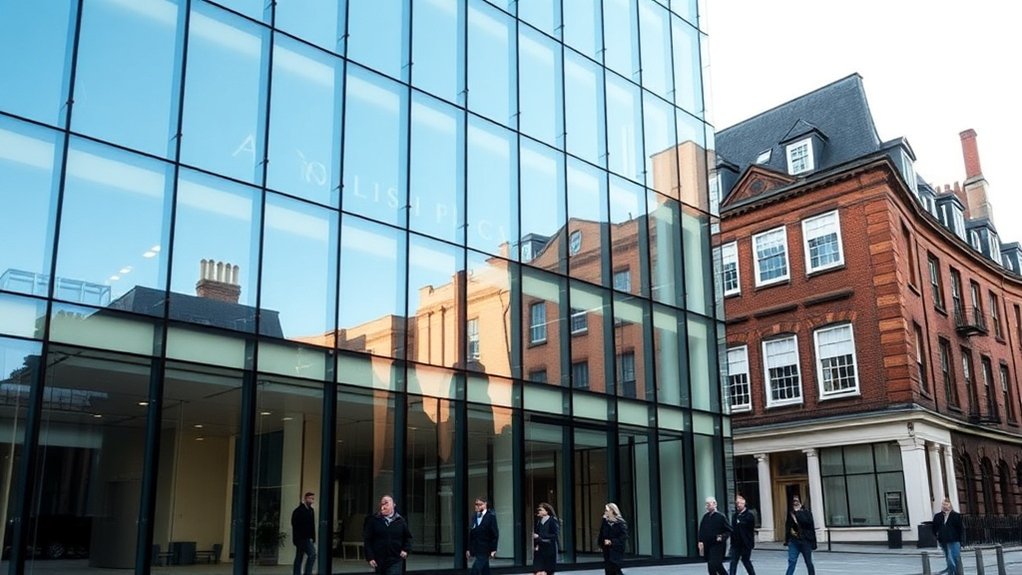
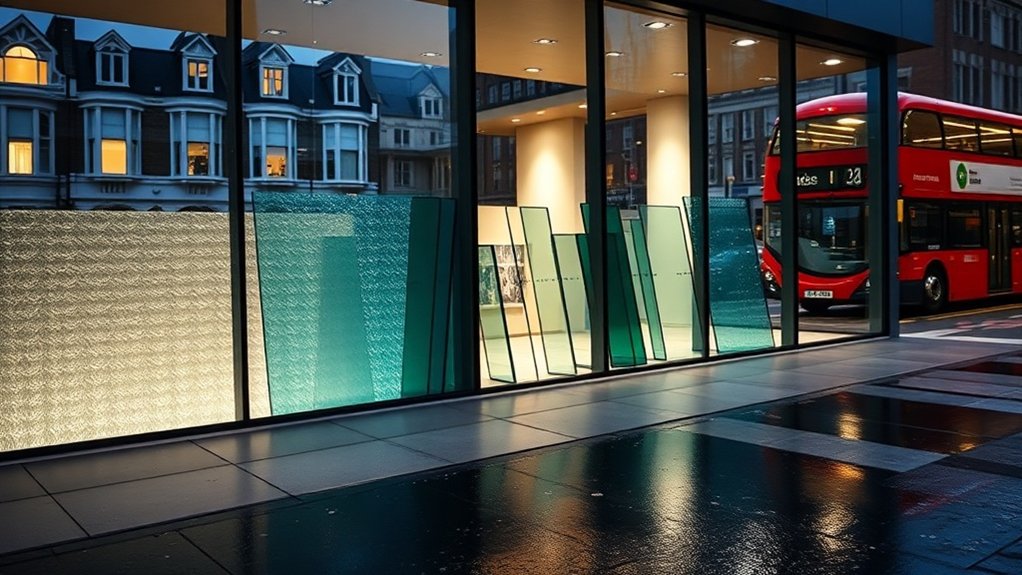
When you specify specialist glass in London, you’re choosing engineered, tested glazing that meets strict BS and EN standards for safety, security , energy, noise and privacy. You can combine toughened and laminated glass, acoustic interlayers, solar‑control and low‑E coatings, or slimline heritage units to match impact loads, fire strategy, and conservation requirements. Correct glass type, thickness, fixing, and certification keeps your project compliant, efficient, and safe—and the next sections show exactly how to achieve that.
Key insights
- Specialist glass in London includes toughened, laminated, acoustic, low‑E, solar‑control, and fire‑rated glass, engineered to BS/EN standards for safety, comfort, and energy performance.
- It is used in façades, shopfronts, skylights, structural glazing, and heritage refurbishments, matching glass type and thickness to loads, location, and design intent.
- London projects commonly require tested impact resistance, security, acoustic control, and certified fire performance (E, EW, EI), coordinated with compliant frames and fixings.
- High‑performance units often combine low‑emissivity coatings, warm‑edge spacers, gas fills, and laminated make‑ups to cut heat loss, glare, and noise in dense urban settings.
- Reputable London specialist glass suppliers provide test certificates, UKCA/CE marking, documented quality control, and experience with complex façades and conservation glazing.
What Counts as Specialist Glass in London?
When you’re evaluating specialist glass in London, you’re looking at products engineered for specific performance criteria beyond standard float glass: enhanced strength, safety, insulation, security, or aesthetics. You’re not just buying panes; you’re specifying materials designed to meet defined loads, impact classes, fire ratings, acoustic targets, or thermal values.
Specialist glass counts in this context when it’s manufactured, processed, or treated to achieve quantifiable performance metrics , verified through standards like BS and EN classifications. That applies whether you’re upgrading historical windows with discreet high-performance glazing or commissioning cutting‑edge glass art for a public domain installation. If the glass modifies light, temperature, sound, privacy, or blast/forced-entry resistance in a predictable, testable way, you’re firmly in specialist territory, not commodity glazing.
Key Types of Specialist Glass for London Projects
Across London projects, a relatively small set of specialist glass types covers most performance requirements, from safety and security through to thermal and acoustic control . You’ll typically work with toughened and laminated safety glass, specifying impact performance to BS EN standards for doors, balustrades, and overhead glazing.
For façades and skylights, you’ll combine low‑E, solar‑control, and insulated glass units to manage heat gain, reduce U‑values, and support glass sustainability targets. Acoustic laminated glass helps you control transport and nightlife noise without sacrificing transparency.
In conservation areas and historical architecture, you may deploy slimline double glazing, restoration glass, or laminated heritage units that replicate traditional aesthetics while delivering modern safety and energy performance, ensuring interventions remain reversible and planning-compliant.
How to Match Specialist Glass to Your London Project
Although London projects vary widely, you should approach glass selection as a structured design decision that balances safety, performance, and planning constraints. Start by mapping each façade, rooflight, and partition to its wind load, impact risk, and fire strategy, then align glass type, thickness, and coatings accordingly.
Prioritise solar control and low‑E options where overheating or heat loss threatens compliance. In conservation areas, verify reflectivity, colour, and light transmission against heritage and daylight assessments.
Factor lifecycle in early: specify products with clear Glass maintenance protocols, durable edge seals, and scratch‑resistant surfaces to reduce failures. Prefer systems designed for Glass recycling, with demountable framing and documented material composition, so you can future‑proof the project against tightening circular-economy and carbon regulations.
Toughened and Laminated Safety Glass for City Living
In dense London streetscapes , the most controlled glass specification still fails if it can’t protect people from impact, break‑ins, or falls from height, so you need to understand how toughened and laminated safety glass behave under real‑world loads.
You use toughened glass where high mechanical strength and thermal resistance matter: it fragments into small, less‑harmful pellets, reducing injury risk. However, it doesn’t remain in place after failure. Laminated glass sandwiches a resilient interlayer between panes; if it breaks, the interlayer retains shards, preserving the barrier and delaying intrusion.
Specialist Glass Balustrades for London Stairs and Terraces
When you design glass balustrades for London stairs, terraces, and roof gardens, you’re not just choosing a sleek aesthetic, you’re defining a primary fall‑protection system that must absorb crowd loads, wind uplift, and accidental impact without catastrophic failure. You balance structural performance with glass artistry, treating every panel as a calibrated component, not decoration.
You specify laminated safety glass with engineered interlayers, checked against edge‑loading, line‑loading, and point‑loading criteria. Fixings, channels, and brackets must control deflection, prevent glass‑to‑metal contact, and resist corrosion in London’s variable microclimates. You integrate handrails or capping profiles that add redundancy and stiffness.
You respect historical craftsmanship by aligning with heritage sightlines, yet you drive innovation through low‑iron glass, refined edges, and minimal hardware that preserve views and daylight.
Frameless Shower Glass and Enclosures in London
Beyond balustrades and terraces, you apply the same structural discipline to frameless shower glass and enclosures in London homes and hotels, treating each screen as a wet‑zone barrier that must manage impact, thermal stress, and frequent use. You specify toughened or laminated safety glass, precisely sized to prevent racking, edge‑chipping, and hardware overload.
You treat fixing points like mini façade anchors, modelling hinge and channel locations to minimise deflection and leakage pathways . Seals, thresholds, and slopes work as a coordinated drainage system, not decorative afterthoughts.
- You calibrate glass thickness to panel span, door weight, and user profile.
- You integrate Artistic techniques—acid‑etching, fritting, digital print—without compromising strength.
- You reference historical applications of bathing spaces to refine proportions and access.
Shopfront and Commercial Glazing for London High Streets
When you plan glazing for a London high street shopfront, you need solutions that synchronise modern design trends with strict safety and performance standards. You’ll specify security and safety glazing that resists impact, deters forced entry, and meets relevant British Standards for commercial premises. At the same time, you must select energy‑efficient commercial glass that reduces heat loss and solar gain, supporting both comfort and operating cost control.
Modern Shopfront Design Trends
Although High Streets across London serve very different communities, the most effective modern shopfronts now share a set of precise glazing-led design principles: maximised clear sightlines , robust security performance, and stringent compliance with British Standards and local planning requirements. You’re no longer just installing a window; you’re engineering a transparent interface between brand, public environment, and urban context.
You’ll typically combine contemporary minimalism with curated references to historical styles, using advanced glazing to reinterpret traditional proportions, mullions, and cornices. Laminated or toughened units support refined artistic techniques such as:
- Low-iron glass for colour-accurate merchandising
- Structural glazing to eliminate visual clutter
- High-performance coatings to control solar gain
Security and Safety Glazing
Modern London shopfronts don’t just showcase merchandise; they operate as primary security and life-safety barriers in a high-footfall environment. You need glazing systems that resist impact, forced entry, and fragmentation while complying with BS EN 356 and BS EN 12600 classifications. By specifying laminated security glass with interlayers engineered for controlled breakage, you reduce injury risk, protect stock, and maintain clear sightlines for CCTV.
You can integrate security glazing without compromising Historical preservation or Artistic enhancement. Specialist glass processors CNC-cut, heat-treat, and laminate panels to align with heritage frames, complex curves, and bespoke branding. Anti-bandit and anti-shatter configurations let you tailor performance to specific risk profiles along London high streets, ensuring your façade functions as a resilient, code-compliant security envelope.
Energy-Efficient Commercial Glass
Even on overcast days in London, shopfront and commercial glazing can act as a significant thermal bridge , so specifying energy-efficient glass is a core design decision rather than an upgrade. You’re balancing visual transparency, thermal performance, and occupant comfort within tight urban envelopes and regulations.
You’ll typically combine low‑emissivity coatings, warm‑edge spacers , and argon- or krypton-filled cavities to achieve low U‑values without dulling the façade. To keep control, define performance metrics early:
- Target U‑values, g‑values, and light transmittance aligned with your energy model.
- Specify eco-friendly materials and seals with proven durability and fire-safe ratings.
- Use innovative fabrication, such as structurally glazed units and integrated blinds, to reduce thermal bridging.
Robust detailing at frames and interfaces ensures the glass actually delivers its design efficiency.
Structural Glass Walls, Roofs and Extensions
When you specify structural glass walls, roofs and extensions in London, you’re effectively replacing conventional load-bearing elements with engineered glazing systems that must perform structurally, thermally and safely under local conditions. You’ll coordinate glass thickness, interlayer type and fixing geometry so each pane works predictably under wind load, impact and serviceability limits.
You can use low-iron glass for sharp transparency, then control glass aesthetics with frit patterns, ceramic coatings and selective decorative finishes that don’t compromise structural performance. Precisely detailed steel, aluminium or stainless point-fixings must manage differential movement, accommodate tolerances and maintain drainage paths. You’ll also address edge cover, laminated make-ups and barrier loads to satisfy UKCA marking , BS 5516 and relevant Eurocodes for permanent, durable transparency.
Acoustic and Privacy Glass for Busy London Streets
Although London’s constant traffic and dense footfall create a challenging acoustic environment, you can specify acoustic and privacy glass that materially reduces noise ingress and controls sightlines without compromising safety or thermal performance. By engineering laminated build‑ups, you disrupt vibration paths and achieve reliable sound insulation against Urban noise , sirens and construction activity.
You’ll typically combine:
- Asymmetrical laminated panes with acoustic interlayers tuned to target traffic‑dominated frequency ranges.
- Optimised cavity depths and gas fills in double or triple glazing to minimise resonance and flanking transmission.
- Integrated privacy technologies—acid‑etched, ceramic‑frit, switchable (PDLC) or electrochromic layers—to manage views without heavy blinds.
You coordinate glass thickness, pane weight and framing tolerances to guarantee structural integrity, user safety and long‑term acoustic stability.
Fire‑Rated Glass for Safe, Compliant London Refurbs
When you refurbish a London property, you must specify fire‑rated glass that’s correctly classified to BS EN standards and aligned with Part B of the Building Regulations. You’ll need to understand integrity and insulation ratings, compartmentation requirements, and how glazing interacts with fire doors, partitions, and escape routes. At the same time, you can integrate these safety-critical systems with slim frames, clear interlayers, and coordinated sightlines so performance and design work together.
Understanding Fire-Rated Standards
Because fire safety in London refurbishments is tightly regulated, you need to understand exactly what “fire‑rated” means before specifying any glass: it isn’t just thicker glass, it’s a tested system (glass, frame, seals, fixings) designed to maintain integrity (E), integrity and insulation (EI), or integrity and radiation control (EW) for a defined period, typically 30, 60, 90, or 120 minutes in line with UK and European standards (such as BS 476 and BS EN 13501).
You’re not just choosing performance; you’re choosing evidence. Test certificates must match :
- Orientation, fixing method, and glazing size
- Adjacent construction and fire load assumptions
- Any applied films, manifestations, or Glass art
For Historic preservation projects, insist on full classification reports, not summary data sheets, so you can prove due diligence.
Integrating Safety With Design
You’ve established what fire‑rated glass systems are and how they’re evidenced ; now you need to make them work architecturally in a London refurb without compromising compliance. You’re balancing EN fire ratings, structural limits, and sight‑line geometry with daylight, openness, and brand expression.
You integrate safety with design by treating fire‑rated glass as a primary material, not a constraint. Specify tested assemblies first, then layer aesthetics: controlled glass patterns, selective decorative etching, and interlayers that don’t disrupt the certified make‑up . You coordinate frame depth, fixing methods, and edge cover to preserve integrity and insulation ratings.
Early collaboration with the fire engineer and fabricator lets you rationalise modules, minimise visible framing, and align fire‑protected zones with your spatial concept.
Decorative, Coloured and Printed Glass for Bespoke Interiors
Although it enhances aesthetics first, decorative, coloured and printed glass also delivers precise functional performance for bespoke interiors, allowing you to control light, privacy and visual impact without compromising safety or structural integrity. You specify the degree of translucency, reflection and colour saturation, while compliant laminates, toughening and edge treatments maintain robust performance in high‑use environments.
You can treat each pane as a calibrated surface, where artistic craftsmanship aligns with strict tolerances. Colour symbolism becomes a strategic tool , guiding user behaviour and brand perception.
- Define micro‑patterns for wayfinding, screening and glare reduction
- Integrate ceramic frit or interlayers for abrasion‑resistant graphics
- Coordinate fixings and hardware to preserve load paths and impact ratings
This lets you deploy glass as a controlled, intelligent design element.
Energy‑Efficient and Solar Control Specialist Glass in London
How do you reduce solar heat gain, glare and energy loss without sacrificing clarity, safety or structural performance? You specify energy‑efficient and solar control glass engineered for London’s variable climate. Low‑emissivity coatings reflect long‑wave heat back indoors, driving Energy conservation while maintaining high visible light transmission. Select spectrally selective coatings to reject infrared solar radiation yet preserve neutral Glass aesthetics and colour rendition.
Combine laminated panes with solar control interlayers to deliver UV filtration, impact resistance and acoustic moderation in a single build‑up. Calibrated solar factors (g‑values), U‑values and light‑to‑solar‑gain ratios let you tune façade performance to orientation and occupancy patterns. When you integrate warm‑edge spacers and argon fills, you cut perimeter condensation risk and stabilise interior comfort year‑round.
Choosing a Specialist Glass Supplier in London
When you choose a specialist glass supplier in London, you need to verify measurable quality standards, certification, and compliance with relevant British and EU regulations. You should also assess realistic lead times, delivery logistics, and handling procedures to minimise on‑site risk and project delays. Finally, you’ll want a partner who can support precise customisation, technical design input, and accurate fabrication tolerances to guarantee performance and safety.
Assessing Quality Standards
Before you commit to a specialist glass supplier in London, you need to interrogate their quality standards with the same rigour you’d apply to any structural or safety-critical component. Ask how they test for impact resistance , edge stability, and coating durability, and how those tests align with BS and EN standards. Probe their understanding of Glass maintenance and lifecycle performance, not just initial aesthetics.
Look for verifiable evidence, not vague assurances:
- Certification trail: ISO, CE, and test reports for each glass type and interlayer.
- Process control : documented QC at cutting, tempering, laminating, and toughening stages.
- Specialist competence: proven track record with complex façades and Historical glazing, including compatible sealants and thermal-stress calculations.
You’re seeking accountable innovation, not experimental guesswork.
Lead Times And Delivery
Even the best glass specification fails if your supplier can’t meet programme-critical lead times or deliver to site safely and predictably. You need a specialist that can model production slots , curing times, and logistics against your build sequence, then commit to dates with contractual clarity.
Interrogate their capacity for complex glass innovation: can they maintain short lead times while producing large-format, laminated, or high-performance units at scale? Ask for evidence of OTIF (On Time In Full) metrics, contingency stock, and backup transport options.
Delivery should follow method statements aligned with CDM regulations, including lifting strategies, exclusion zones, and glazing sequencing by elevation. When lead times, delivery methodology, and design versatility are integrated, you reduce reprogramming risk, crane downtime, and costly temporary works.
Customisation And Design Support
Reliable lead times and safe delivery only add value if the glass actually achieves your architectural intent, so you need a supplier that treats design support and customisation as an engineering discipline, not a sales add-on. You’re not just buying panels; you’re specifying performance, tolerances, interfaces, and long-term safety.
Look for a London specialist that collaborates early with your design team to rationalise complex geometries, integrate fixings, and validate structural calculations. They should translate Glass artistry into buildable details while respecting Historical preservation requirements.
Expect them to provide:
- CAD/BIM-ready models and tested fixing details
- Samples and mock-ups for optical quality and slip/impact resistance
- Compliance guidance across BS/EN standards, loading, fire, and access regulations
Lead Times, Site Surveys and Installation for London Glass Projects
When you plan a specialist glass project in London, accurate lead times, rigorous site surveys , and controlled installation procedures determine whether the finished system performs to specification and complies with safety standards. You’ll want a schedule that factors in structural calculations, bespoke processing, toughening/lamination cycles, and urban logistics, so delivery slots align precisely with site readiness.
During the site survey, technicians laser-measure openings , check substrate integrity, confirm load paths, and map fixing points, especially essential for complex urban aesthetics and expressive glass artistry. They’ll verify tolerances for movement, drainage, and fire‑safety interfaces.
Installation teams then handle glass with certified lifting gear, anti‑collapse controls, and documented method statements, ensuring seals, anchors, and edge clearances meet British Standards and manufacturer requirements.
Specialist Glass Costs in London and Common Mistakes to Avoid
Accurate surveys and controlled installation only deliver their full value if the financials are scoped with the same level of discipline. In London, specialist glass costs rise fast when you underestimate structural requirements , access logistics, or compliance testing. You’re not just buying panels; you’re procuring engineered systems shaped by glass innovation and emerging sustainability trends.
Common cost failures include neglected loading studies, late design changes, and vague performance specs. To control budget and risk, you should:
- Define optical quality, acoustic, and thermal targets before tender.
- Model fixing details, access equipment, and temporary works in the cost plan.
- Include lifecycle costs for cleaning, seal replacement, and potential panel swaps.
This approach keeps performance, safety, and commercial reality aligned.
Frequently Asked Questions
Can Specialist Glass in London Be Repaired, or Does It Always Need Replacing?
It doesn’t always need replacing; you can often repair specialist glass, depending on damage, glass thickness, and safety requirements. Minor surface chips or scratches are typically polishable, but cracks, edge damage, or compromised laminates usually demand full replacement . When upgrading, you’ll reassess glass thickness for structural performance and impact resistance, plus tint options for solar control and privacy. Always use certified installers to maintain compliance with relevant glazing standards.
How Do I Maintain and Clean Specialist Glass Without Damaging Coatings or Tints?
You maintain and clean specialist glass by treating it with kid gloves yet scientific rigor. Use pH‑neutral, ammonia‑free solutions and microfiber cloths ; avoid abrasives, squeegee nicks, and paper towels to guarantee coating preservation. Apply Cleaning techniques in straight, vertical strokes, not circles, to minimize micro‑swirls. Rinse with de‑ionized water where possible, and never use high‑temperature steam on tints or low‑E layers to prevent delamination or haze.
Are There Planning Permission Issues for Using Structural or Coloured Glass in London Homes?
You’ll face potential planning permissions issues if structural or coloured glass alters your home’s external appearance, line of sight, or privacy impact. You must also meet Building regulations for load‑bearing capacity, thermal performance, safety glazing, and balustrade constraints. For rear extensions or internal floors, you’ll often use permitted development , but rooflights, full‑height façades, and overlooking features usually need pre‑application advice and a detailed glazing specification.
Can Existing Traditional Sash Windows Be Upgraded With Specialist Glass Solutions?
Yes, you can upgrade traditional sash windows with specialist glass. Imagine preserving slender timber frames while inserting high‑performance units that boost energy efficiency and support sensitive historical restoration. You’ll specify slimline double or vacuum glazing, low‑iron or low‑E coatings, and warm‑edge spacers, all sized to original rebates. Guarantee sash weights, cords, and hardware are recalibrated for added glass mass, and verify compliance with safety glass and conservation requirements.
What Warranties and Aftercare Should I Expect From a London Specialist Glass Installer?
You should expect written warranties on glass units (typically 5–10 years) covering seal failure, Glass safety performance, and hardware integrity, plus workmanship guarantees (at least 12–24 months). Confirm documented U-values and energy efficiency metrics, with remedial rights if targets aren’t met. Aftercare should include periodic inspection guidance, safe-cleaning protocols, emergency response for breakages, and clear procedures for reporting defects, including photographic evidence and response time commitments.
Summary
When you choose specialist glass in London, you’re not just picking a material – you’re specifying performance, safety, and long‑term reliability . From toughened and laminated panels to balustrades and high‑performance solar control units, every detail matters: thickness, fixing method, edge finish, and compliance with BS and building regs. Will your next project rely on generic glass, or on correctly specified specialist glazing that protects people, preserves energy, and performs under real London conditions?