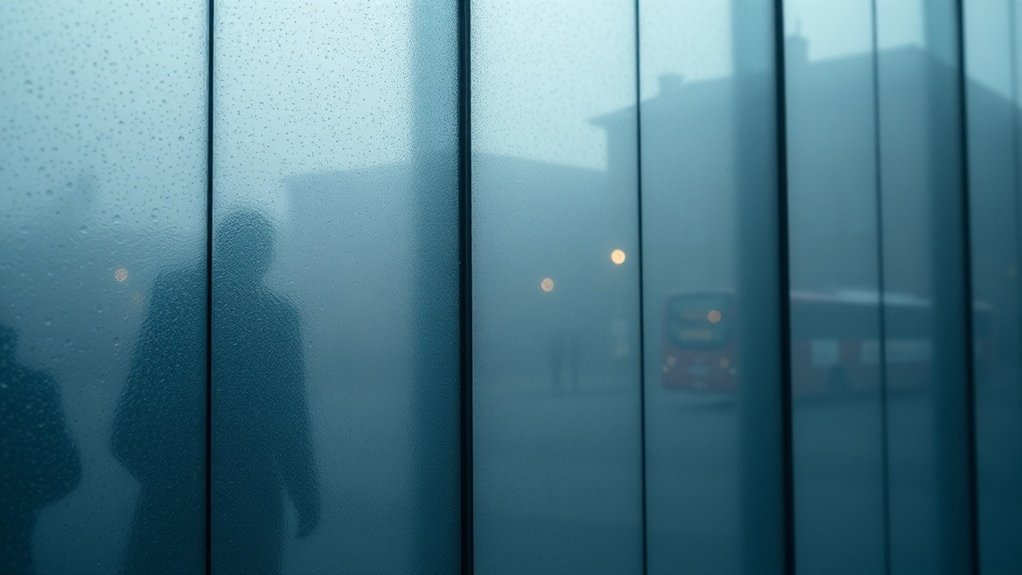
You use frosted and obscure glass in London to secure privacy and glare control while keeping high daylight levels and a clean, modern look. Frosted glass diffuses light with a uniform etched surface, while obscure glass adds patterns or textures that distort views. Applications include bathrooms, front doors, offices and partitions, using acid-etched, sandblasted, laminated or film-applied options. You’ll see how to match glass type, cost, and performance to your specific London property next.
Key insights
- Frosted and obscure glass provide privacy while maintaining natural light, ideal for London’s dense urban homes, bathrooms, shopfronts and offices.
- Available as acid‑etched, sandblasted, patterned, laminated or film-applied options, each offering different levels of translucency, durability and cost.
- Common London applications include front doors, internal partitions, bathroom windows, room dividers and branded office glazing.
- Professional London installers offer site surveys, compliance with building regulations, and rapid installation, from single windows to full-property glazing upgrades.
- Long-lasting, factory-processed frosted glass reduces maintenance, resists scratching and pollution, and supports energy efficiency in double- or triple-glazed units.
What ‘Frosted’ and ‘Obscure’ Glass Actually Mean
Although people often use the terms interchangeably, “frosted” and “obscure” glass describe specific surface treatments and performance characteristics that control light and privacy. When you specify frosted glass, you’re usually referring to a uniformly etched or sandblasted surface that diffuses light evenly, creating a soft, translucent finish. Obscure glass is broader: it includes patterned , textured, laminated, or coated products engineered to distort vision while tuning light transmission.
You can treat frosted glass as a subset of obscure glass, defined more by surface roughness than by pattern. Obscure glass often leverages artistic techniques—rolling, casting, screen-printing—to generate complex optics. Its historical origins lie in cathedral glazing and decorative storefronts, yet modern fabrication lets you target specific glare, view-control, and aesthetic performance criteria.
Why Londoners Choose Frosted Glass for Privacy and Light
In a dense city like London , you choose frosted glass when you need to protect sightlines without sacrificing useful daylight. You’re dealing with tight plots, overlooked windows, and persistent privacy concerns, yet you still need high lux levels for wellbeing and productivity. Frosted glass diffuses incoming light, converting harsh glare into an even luminance that reduces contrast and eye strain.
You also gain a controlled visual boundary : silhouettes blur, but form and function of the space remain legible. From a design standpoint, frosted glass aesthetics integrate well with minimalist, biophilic, or tech-led interiors, avoiding the visual noise of blinds or films. You can zone bathrooms, meeting rooms, and street-facing spaces while maintaining daylight autonomy and a clean, future-ready façade.
Main Types of Frosted and Obscure Glass
Once you’ve decided frosted or obscure glass solves your privacy and daylight brief, you then need to specify the right construction and finish. You’ll typically choose between acid‑etched , sandblasted, patterned (rolled), laminated, and film‑applied systems.
Acid‑etched glass delivers a smooth, durable diffusion layer that’s easy to clean and ideal where you’re upgrading historical architecture without visual noise. Sandblasted glass gives a slightly rougher surface, higher scatter, and strong visual privacy, but needs sealing or lamination for easier maintenance.
Patterned glass embeds texture during manufacture, so you can modulate privacy while referencing period details. Laminated obscure glass adds acoustic control, safety, and UV reduction, supporting energy efficiency. High‑performance films retrofit existing panes, enabling rapid, low‑disruption upgrades across occupied London properties.
Which Frosted Glass Suits Your London Property?
Before you choose a frosted or obscure glass for your London property, you need to match the specification to the exact context: street level vs upper floor, heritage façade vs contemporary rear extension, busy family bathroom vs quiet home office. You’ll start by mapping privacy, light transmission, and thermal performance to each elevation.
For Historical architecture or strict Victorian design, you’ll usually pair slimline double glazing with acid‑etched or sandblasted patterns that mimic traditional rolled glass while meeting Part L and conservation conditions. In contemporary zones, you can specify gradient frosts, switchable privacy glass, or screen‑printed patterns aligned with your façade geometry.
Always check U‑values, solar gain (g‑value), and visible light transmittance to guarantee your chosen glass delivers both performance and aesthetic coherence.
Best Uses for Frosted Glass in London Homes
When you plan the best uses of frosted glass in your London home, you’ll focus on three high-impact zones: bathroom privacy solutions , stylish room dividers, and front door enhancements. In bathrooms, you can specify acid-etched or sandblasted panes with defined opacity levels to protect privacy while maintaining ideal light transmission. For internal partitions and entrances, you can use framed or frameless frosted glass systems that control sightlines, improve thermal performance, and upgrade kerb appeal without compromising security.
Bathroom Privacy Solutions
Bathroom privacy solutions in London rely heavily on frosted and obscure glass to block sightlines while preserving natural light, ventilation, and compliance with local building regulations. You can specify glazing levels to achieve precise translucency, ensuring silhouettes blur while daylight still penetrates deep-plan bathrooms and ensuites.
To optimise performance and innovation, you should consider:
- Acid-etched or sandblasted glass for durable, non-peeling privacy in wet zones.
- Switchable privacy glass linked to smart home integration for on‑demand opacity.
- Low‑emissivity obscure double glazing to enhance energy efficiency in external bathroom windows.
- Patterned obscure glass with graded density to shield key viewpoints (showers, toilets) while keeping upper sections brighter.
You’ll gain robust privacy, safer glazing, and a cleaner, more minimal bathroom envelope.
Stylish Room Dividers
Beyond private bathrooms, frosted and obscure glass becomes a high‑performance material for stylish room dividers in London homes, enabling you to reconfigure space without sacrificing light. You treat each panel as a calibrated filter: specified opacity, texture, and tint control sightlines while preserving daylight penetration deep into your plan.
In historical architecture, you can float slim aluminum or steel-framed frosted partitions just clear of cornices and skirtings, protecting original fabric while creating acoustic and visual zoning. Consider laminated, low‑iron frosted glass with acoustic interlayers for separating living and work zones. For eco friendly materials, pair tempered obscure glass with recycled aluminum frames and low‑VOC sealants. Integrate sliding or pivot systems with soft‑close hardware to maintain clean, quiet operation in compact London layouts.
Front Door Enhancements
Instead of relying on heavy blinds or solid timber, you can use frosted glass at your front door to balance privacy, security, and daylight in one engineered element. By specifying laminated, toughened units with graded translucency , you control sightlines while maintaining a bright, welcoming threshold that suits London’s dense streetscapes.
Frosted glass sustainability also matters: low‑iron, double‑glazed units with thermal coatings cut heat loss and reduce reliance on artificial lighting, especially in north‑facing terraces with deep hallways. You can respect a property’s historical significance while upgrading performance through bespoke patterns that echo original fanlights and stained glass.
- Etched numeric door panels
- Side‑light privacy bands
- Translucent fanlights with acoustic interlayers
- Smart switchable frosted glazing for adaptive privacy
Best Uses for Frosted Glass in London Shops and Offices
When you’re planning glazing for London shops and offices, frosted and obscure glass offer precise control over privacy, light transmission, and branding in high-traffic environments . You can deploy them on street-facing windows to screen workstations while still signalling activity, which is essential in conservation areas where Historical architecture restricts solid façades.
Internally, use frosted glass for meeting rooms, phone booths, and wellness spaces to achieve acoustic separation with visual discretion. In co-working hubs, partial frosting along circulation routes guides movement and reduces visual clutter. For retail, obscure glass in back-of-house areas secures stock while maintaining daylight penetration, improving comfort and lowering artificial lighting loads, which reduces Environmental impact . Throughout, you balance security, user wellbeing, and operational efficiency without sacrificing contemporary aesthetics.
Design Options: Patterns, Etching and Custom Finishes
Although frosted and obscure glass start as functional upgrades, their real value in London projects often comes from how you specify patterns, etching , and custom finishes to solve precise design and performance challenges. You can treat glass as a programmable surface: control light, privacy, and branding with calibrated opacity, line weight, and reflectance.
You’ll typically coordinate:
- Pattern logic – gradients, geometric repeats, or zoned frosting that align with sightlines, wayfinding, and workstation layouts.
- Etching methods – acid-etched, sandblasted, or laser-etched profiles tuned for haze level, cleanability, and tactile feedback.
- Custom finishes – digital print, ceramic frit, and interlayers that integrate Color options without compromising light transmission .
- Sustainability considerations – low-VOC inks, recyclable interlayers, and solar-control strategies that support BREEAM and London energy targets.
Costs, Maintenance and Durability of Frosted Glass in London
Because frosted and obscure glass sit at the intersection of aesthetics and performance, you need to treat costs, maintenance, and durability as an integrated specification decision rather than an afterthought. In London, your cost profile depends on treatment type : acid-etched and ceramic-frit options carry higher upfront prices but deliver longer service life and more stable translucency than basic films.
You should evaluate lifecycle cost, not just m² rates. Consider cleaning frequency, scratch resistance , and how well each finish hides water spots and pollution residue common in urban conditions. Historical trends show a shift from short‑life films to durable, factory‑processed glass, driven by maintenance savings and environmental impact. Longer‑lasting products reduce replacement cycles, waste, and transport emissions while preserving optical performance.
Frosted Glass Installation: What to Expect in London
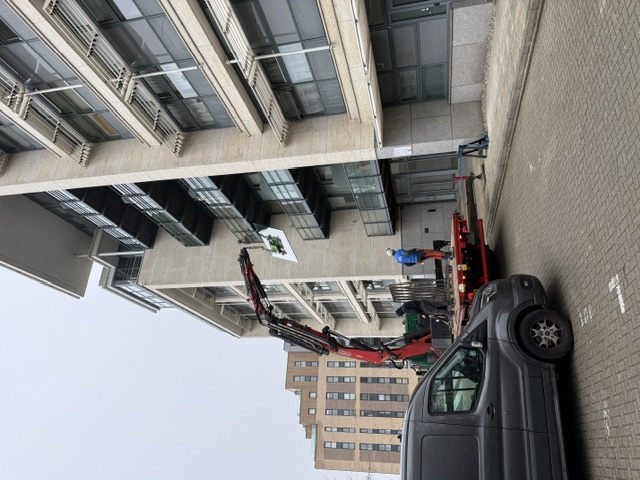
When you’re planning frosted glass in London, you should know exactly what happens from the initial site survey and measurement through to final installation . A professional installer will assess existing frames, access, building regs, and tolerances, then specify glass type, fixing methods, and edge details to prevent issues like binding or thermal stress. You’ll also get a clear installation timeline that covers lead times, on-site fitting stages, curing or sealant setting periods, and any temporary disruption so you can schedule works with minimal impact.
Site Survey And Planning
Before any frosted or obscure glass is ordered, a professional site survey in your London property establishes the exact dimensions, substrate condition, and installation constraints . You’ll map where privacy, light diffusion, and visual continuity matter most, especially when integrating with historical architecture or contemporary façades.
The surveyor evaluates frame tolerances, existing glazing performance, and potential thermal bridging to guarantee the new glass optimises energy efficiency and minimises environmental impact. You’ll also define how patterns, opacities, and coatings align with branding or interior wayfinding.
- Assess structural openings, reveal depths, and fixing points
- Analyse solar gain, glare paths, and privacy sightlines
- Coordinate with conservation or planning requirements
- Specify glass type, film technology, and edge detailing
Installation Process And Timeline
Once your survey and specifications are locked in, the frosted glass installation in your London property follows a tightly sequenced process that minimises disruption while meeting performance and aesthetic targets. Technicians first template and verify openings, checking tolerances, load paths, and any constraints from historical architecture or conservation rules.
They then pre-fabricate units off-site, integrating coatings, laminates, and thermal spacers to optimise energy efficiency and privacy levels. On installation day, they remove existing glazing, prepare frames, install setting blocks, and bed the frosted units with structural or neutral-cure sealants.
You can expect a single window to take 1–2 hours, a full flat 1–2 days, and larger commercial or period properties 3–5 days, including curing, quality checks, and snagging.
How to Choose a Reliable Frosted Glass Glazier in London
How do you separate a truly reliable frosted glass glazier in London from a general glass installer who might compromise privacy, durability, or finish quality? You start by interrogating their technical depth , not just their portfolio. Ask how they balance planning constraints on historical architecture with contemporary performance, security, and glass sustainability targets.
Look for a glazier who can model light transmission, U‑values, and acoustic performance for your specific context. They should specify substrates, interlayers, and etching or lamination methods that won’t degrade under UV or urban pollution.
- Proven experience with listed façades and conservation officers
- Detailed specifications: glass build‑up, fixings, tolerances, testing
- Clear aftercare, warranty, and replacement strategy
- Transparent pricing, lead times, and documented quality-control checkpoints
Frequently Asked Questions
Can Existing Clear Windows in London Be Converted to Frosted Glass On-Site?
Yes, you can convert existing clear windows to frosted glass on-site. You’ll typically use applied window films , acid-etch effect coatings, or sandblasting-style treatments. These solutions upgrade window privacy without replacing the glazing and can integrate precise decorative patterns using plotter-cut films or digitally printed layers. You control translucency, UV performance, and maintenance characteristics, enabling a rapid, non-structural retrofit aligned with innovative façade and interior design strategies.
Does Frosted Glass Affect Indoor Plant Growth Compared to Clear Windows?
Yes, frosted glass can support indoor plant growth, but it changes light quality. By increasing light diffusion, it reduces harsh direct rays and hotspots, which can actually enhance plant health for many shade-tolerant and understory species. However, it lowers overall light intensity, so you’ll need to select plants with lower PPFD requirements or supplement with LED grow lights. Position light-demanding plants closer to the window to compensate for reduced photon flux.
Are There Planning Permission Issues for Frosted Glass in London Conservation Areas?
You might need planning permission if you’re changing window appearance in a London conservation area, even for frosted glass. Councils assess impact on character, not just privacy enhancement. You should check Article 4 Directions and original versus replacement glazing. Propose frosted film or internal solutions first, preserving external sightlines. When applying, supply detailed drawings, material specs, and a heritage statement showing aesthetic appeal is compatible with the building’s historic significance.
How Does Frosted Glass Impact a Property’s Resale Value in London?
Frosted glass can boost resale value when you play your cards right. You’ll enhance perceived Privacy enhancement and Aesthetic appeal , especially in bathrooms, street-facing rooms, and live–work spaces. Buyers seeking premium, innovation‑led design read high-spec frosted glazing as an upgrade, not a compromise. Specify quality laminated or acoustic units, consistent patterns, and clean sightlines; document U-values and compliance, so agents can market both performance gains and contemporary visual impact.
Is Frosted Glass Suitable for Listed Buildings Under London Heritage Rules?
Yes, frosted glass can be suitable for listed buildings, but you must secure listed building consent first. You’ll need to demonstrate that privacy enhancement and aesthetic appeal don’t compromise historic fabric or sightlines. Specify reversible solutions, matching sightlines, and traditional framing systems. Work with a conservation-accredited architect and provide technical datasheets, performance values, and visual mock-ups to heritage officers to validate compatibility with the building’s character and planning policy.
Summary
When you choose frosted or obscure glass in London, you’re not just picking a pane, you’re specifying a performance system. You’ll balance privacy, light transmission, thermal efficiency, and safety compliance, while matching patterns to your interior scheme. By comparing glass types, finishes, and installation methods—and vetting your glazier for accreditation and guarantees—you turn a simple window decision into a precise, long‑term solution that protects your privacy, enhances comfort, and adds measurable value.