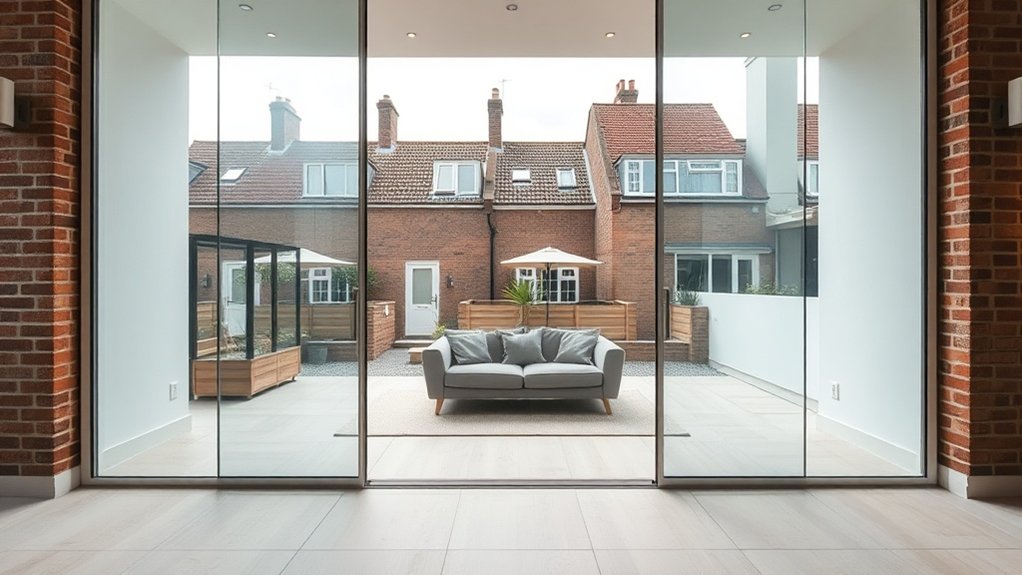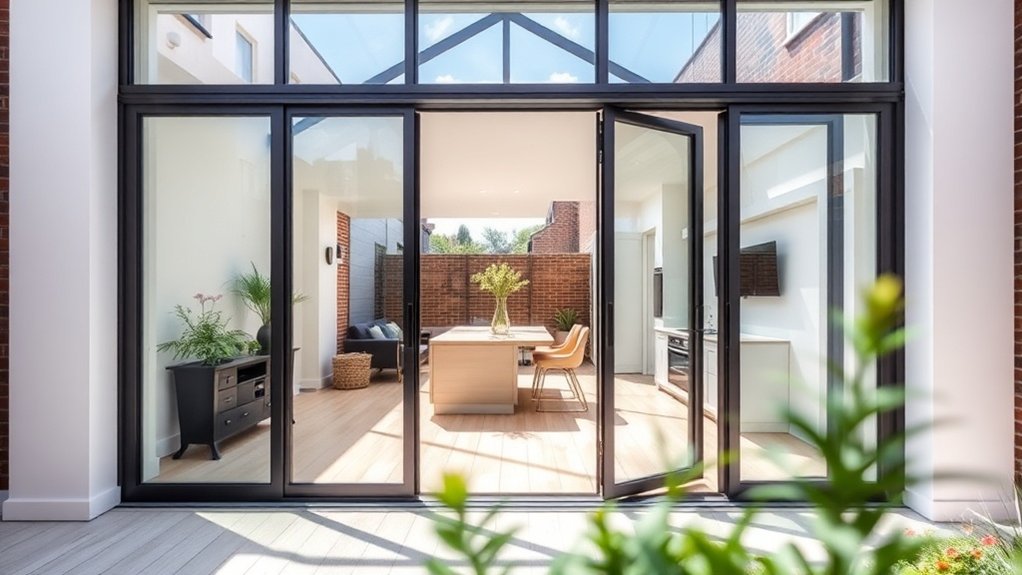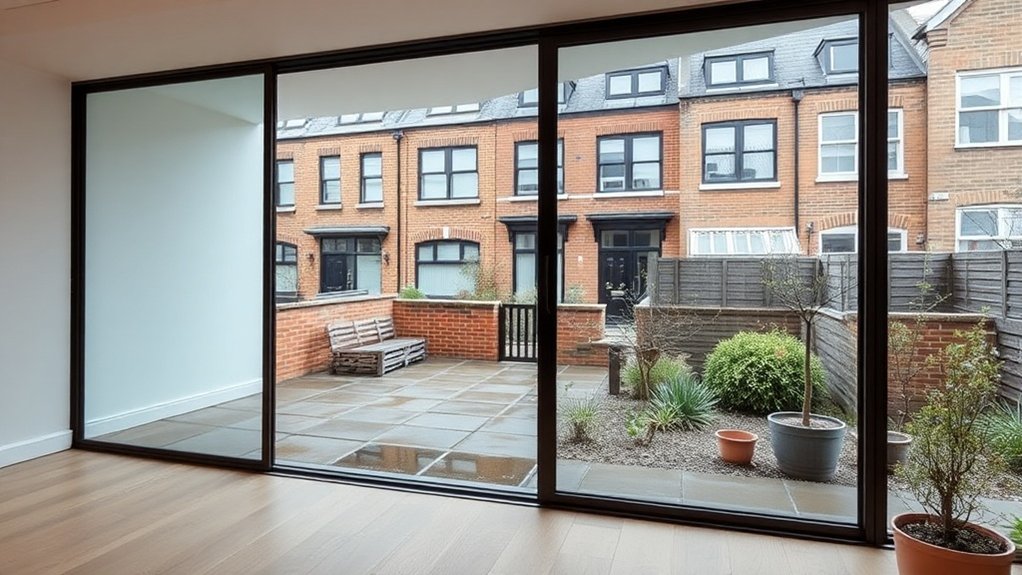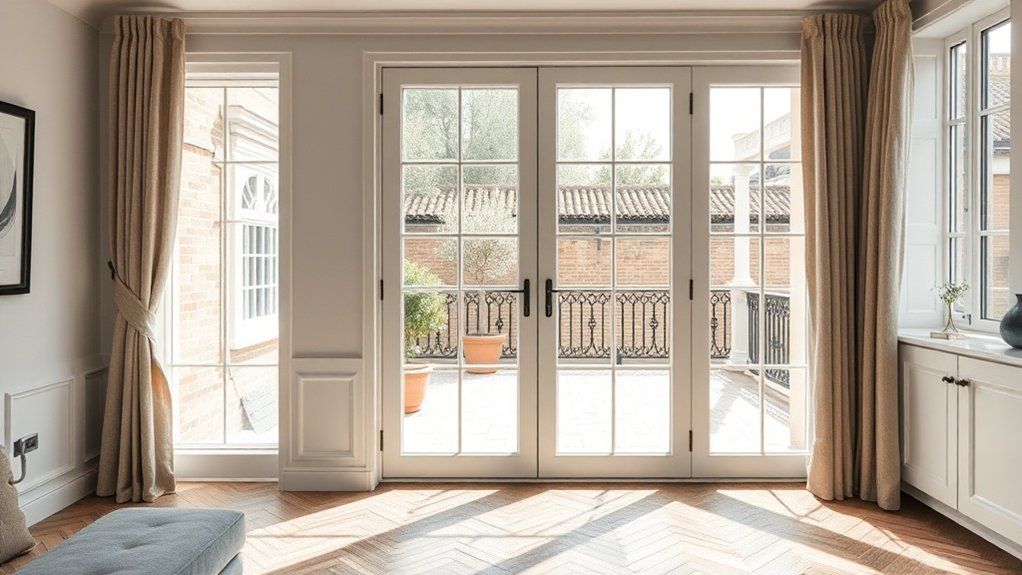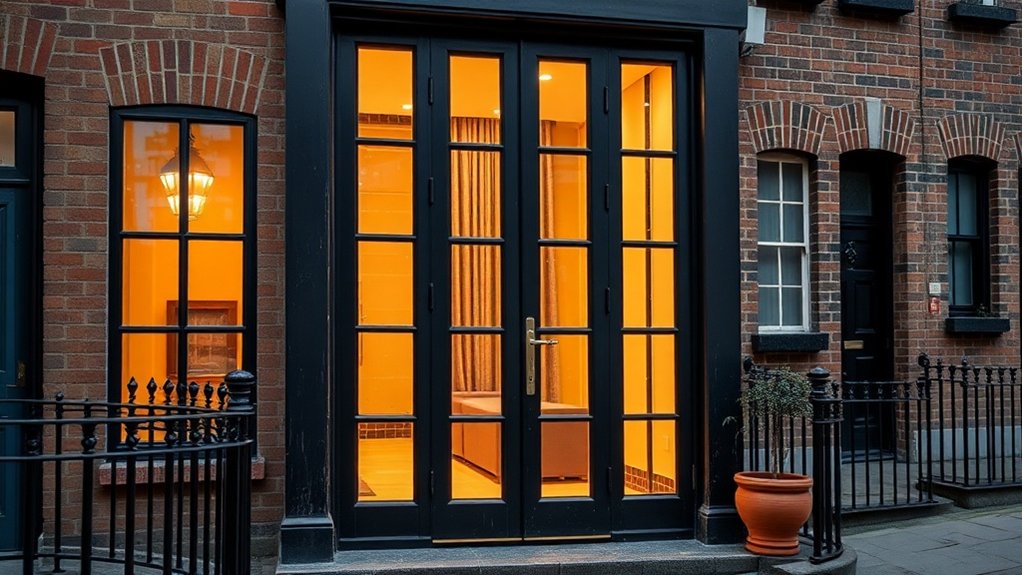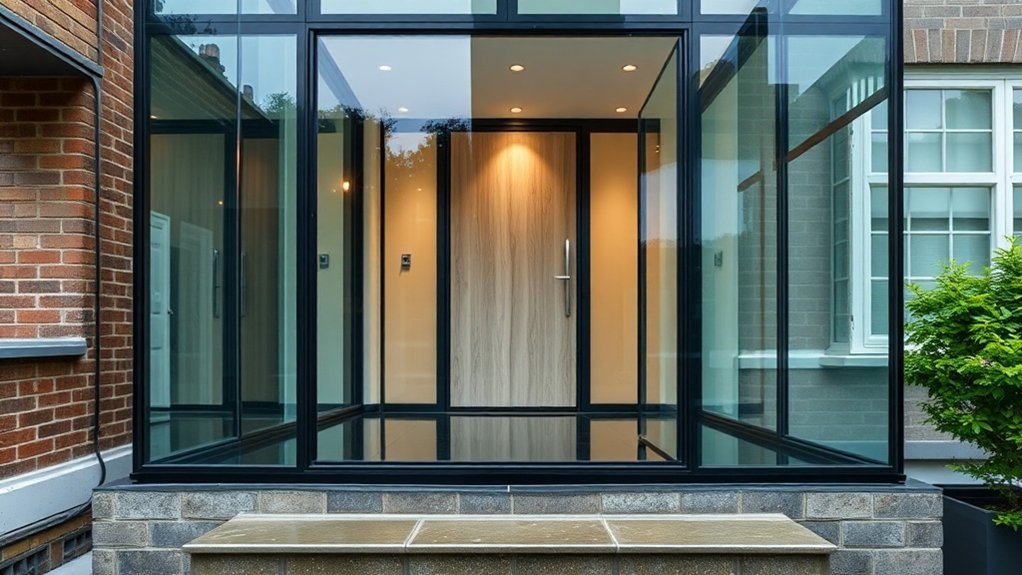
In London, you use glass doors to stretch sightlines, push daylight deep into tight plans, and align interior thresholds with gardens, balconies, or views. You choose thermally broken aluminium or steel frames, low‑E laminated glass, and high‑performance seals to balance security, acoustic control, and energy efficiency. You integrate sliding or pocket systems to reclaim circulation space in small flats while respecting heritage constraints, and you can explore how these systems transform space, comfort, and long‑term performance next.
Key insights
- Glass doors in London maximise natural light, extend sightlines, and make compact homes feel larger while enabling flexible zoning between work, rest, and social areas.
- Choose from sliding, pocket, bi-fold, French, and pivot glass doors to connect interiors with gardens, terraces, and balconies while managing space and circulation.
- Specify thermally broken aluminium, composite, timber, or steel frames with low-U-value glazing to improve energy efficiency in London’s variable, often damp climate.
- Use laminated or toughened safety glass, multi-point locking, secure frames, and quality seals for impact resistance, weather protection, and security against forced entry.
- Consider privacy options such as frosted, reeded, acid-etched, or switchable smart glass, especially for street-facing elevations, bathrooms, and home offices.
How Glass Doors Are Reshaping London Homes
As London’s housing stock densifies and floor plans compress, glass doors are quietly reconfiguring how space, light, and movement operate inside the city’s homes. You’re no longer just specifying a door; you’re calibrating permeability between zones. By replacing solid leaves with glazed planes, you extend sightlines , reduce visual noise from framing, and let daylight penetrate deep into cores.
You treat glass aesthetics as a performative layer: transparency to connect, translucency to blur, and strategic opacity to anchor thresholds. Sliding and pivot systems refine circulation, eliminating dead swing space and enabling flexible micro-zoning for work, rest, and socialising. You still address privacy concerns through layering—setbacks, curtains, or adjacent storage walls—so openness doesn’t compromise acoustic comfort or emotional retreat.
How to Choose the Right Glass Door for Your London Property
When you choose a glass door for your London property, you first map how the opening works with circulation routes, light paths, and existing structural lines. You then match glass type, frame profile, and hardware to your required performance levels for insulation, acoustics, and daily use. Throughout, you balance a clean, contemporary aesthetic with safety standards , including impact resistance, locking systems, and privacy control.
Assessing Property Requirements
How do you translate your property’s layout, usage patterns, and constraints into the right glass door specification for a London setting? You start by mapping circulation routes and measuring clear openings, reveal depths , and ceiling heights. Identify which spaces need maximum interior lighting and which demand integrated privacy solutions, then define transparency levels room by room.
Analyse door frequency-of-use, swing arcs, and adjacent furniture or joinery to decide between sliding, pivot, or hinged systems. Factor in corridor widths, stair proximity, and existing structural openings typical of London conversions. Record wall construction, threshold details, and potential clash points with radiators or sockets. Finally, align all these parameters with your desired visual continuity so the door becomes a calibrated interface, not just an opening.
Balancing Style And Safety
Even in a compact London plan, you can treat a glass door as both a safety‑critical component and a visual anchor that sets the architectural tone. You’re not just choosing glass; you’re calibrating load paths, sightlines, and thresholds.
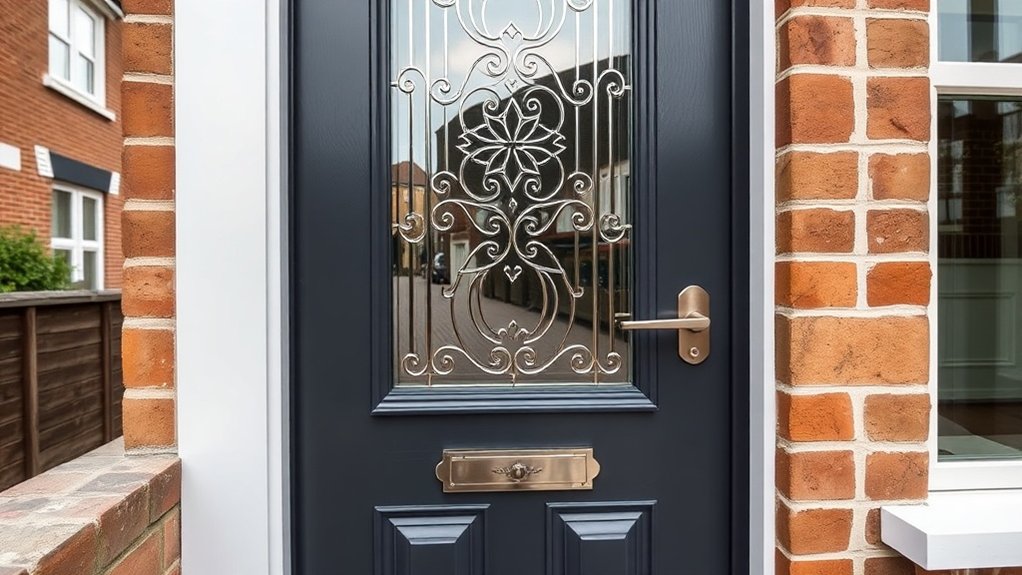
Prioritise laminated or toughened glass with certified impact ratings, then tune the level of stylish transparency to the room’s privacy, orientation, and solar gain. In narrow corridors, use clear or low‑iron glass to expand perceived width; in street‑facing elevations, consider frosted gradients or micro‑patterned interlayers for screening.
Integrate safety considerations into the hardware: self‑closing hinges, anti‑slam dampers, and flush thresholds for accessibility. Finally, align frame profiles and ironmongery with your interior language so performance and aesthetics read as one system.
Benefits of Glass Doors in London’s Climate
When you install glass doors in London, you immediately increase natural daylight penetration, reducing the need for artificial lighting deep into your floor plan. With the right glazing specification and thermal breaks, you also improve energy efficiency by regulating heat gain and loss across the building envelope. Modern weather-resistant systems guarantee your doors perform reliably against London’s wind, rain, and temperature shifts while maintaining clean sightlines between interior and exterior zones.
Maximising Natural Daylight
Why treat glass doors as just an access point when they can function as calibrated light portals, optimised for London’s often overcast skies? You can specify glass types and configurations that harvest high levels of diffuse daylight while controlling contrast and glare. Floor‑to‑ceiling doors aligned with window lines create uninterrupted light corridors, pushing illumination deeper into plan.
Use frosted glass strategically where privacy’s critical but you still want generous luminance; it scatters light, eliminating hard shadows. Integrate decorative panels as layered elements , not afterthoughts: perforated metals, fluted glass, or laser‑etched motifs can modulate brightness, frame views, and guide wayfinding. By treating mullion thickness, frame colour, and threshold detailing as optical tools, you’ll choreograph daylight with architectural accuracy.
Energy Efficiency Advantages
Treating glass doors as calibrated light instruments doesn’t just refine visual comfort; it also strengthens your building’s energy performance in London’s temperate, often overcast climate. By pairing high-performance glass insulation with selective solar control coatings, you exploit diffuse daylight while moderating heat gain and loss.
You reduce dependence on artificial lighting during extended low-lux hours, trimming electrical loads without compromising spatial brightness. Low‑emissivity layers reflect internal radiant heat back into the room, stabilising temperatures and easing boiler demand. In summer, spectrally selective solar control glass limits infrared transmission, so interiors remain cooler with less mechanical cooling.
When you align pane specification, frame thermals, and orientation, glass doors become active energy components, not passive openings, optimising kilowatt consumption across the year.
Weather-Resistant Design Benefits
Although London rarely faces temperature extremes, its mix of driving rain, fluctuating humidity, and polluted urban air demands that glass doors perform as robust weather barriers as well as visual interfaces. You can specify thermally broken aluminium or composite frames, continuous compression gaskets , and low-permeability sealants to prevent wind-driven water ingress and microscopic drafts.
To manage moisture, select laminated units with warm-edge spacers that stabilise internal surface temperatures, minimising condensation at thresholds and mullions. Frosted glass or ceramic-fritted decorative patterns on outer panes don’t just enhance privacy; they also diffuse solar gain, reducing localised thermal stress and surface soiling. By aligning drainage channels, sills, and overhangs, you integrate the door into the façade’s rain-screen strategy , ensuring long-term clarity and structural performance.
Popular Glass Door Styles for London Homes
From slim-framed Crittall-style partitions to full-height sliding panels, glass door styles for London homes balance space efficiency with daylight performance and privacy control. You prioritise Creative design and rigorous material selection, pairing low-iron or tinted glass with thermally broken aluminium, steel, or engineered timber frames to control both aesthetics and performance.
You might specify hinged French doors for period façades, aligning mullion grids with existing sash patterns to preserve rhythm. Internally, pivot doors create generous, uninterrupted openings and emphasise axial views. Sliding pocket systems let you conceal panels within walls, maintaining clean lines and continuous floor finishes. For bathrooms and studies, you can deploy reeded, fritted, or switchable smart glass to modulate transparency while maintaining a coherent spatial language.
Best Glass Door Options for Small London Flats
In compact London flats, the same glass door typologies you’d use in larger homes demand tighter calibration of swing arcs, sightlines , and storage clearances. You’ll gain the most by choosing systems that compress footprint and amplify light.
Prioritise sliding or pocket glass doors to reclaim circulation space and avoid clashes with wardrobes or galley kitchens. Specify full-height panels to elongate walls and enhance perceived ceiling height. For privacy-critical zones, use frosted finishes or acid-etched glass that diffuse light while obscuring clutter.
Consider decorative patterns laminated or screen-printed into the glass to zone functions—workspace, sleeping, living—without erecting opaque partitions. Slim aluminium or steel frames keep profiles minimal, while soft-close tracks and concealed floor guides maintain a clean, highly engineered aesthetic.
Glass Doors for London Terraces, Gardens and Balconies
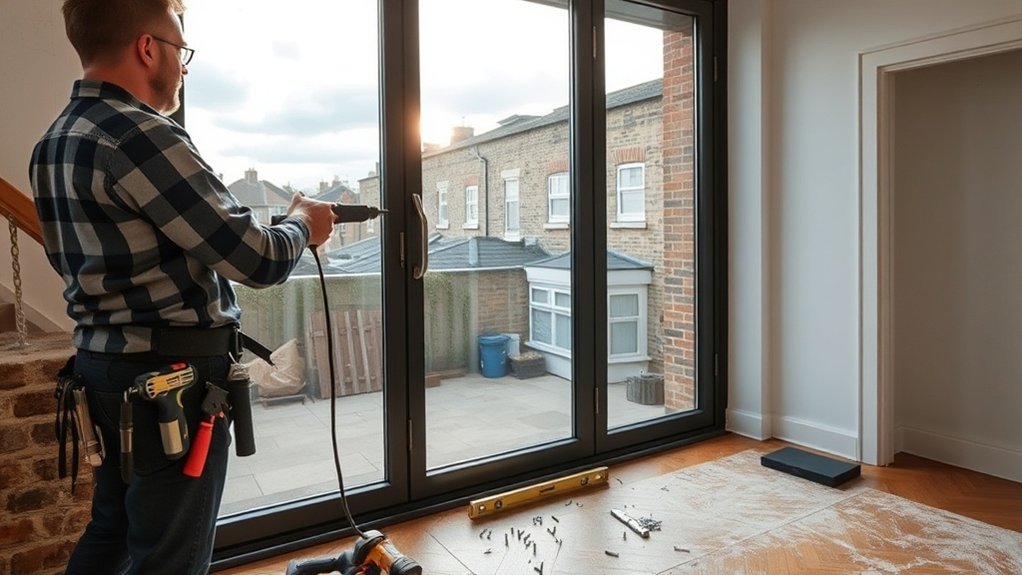
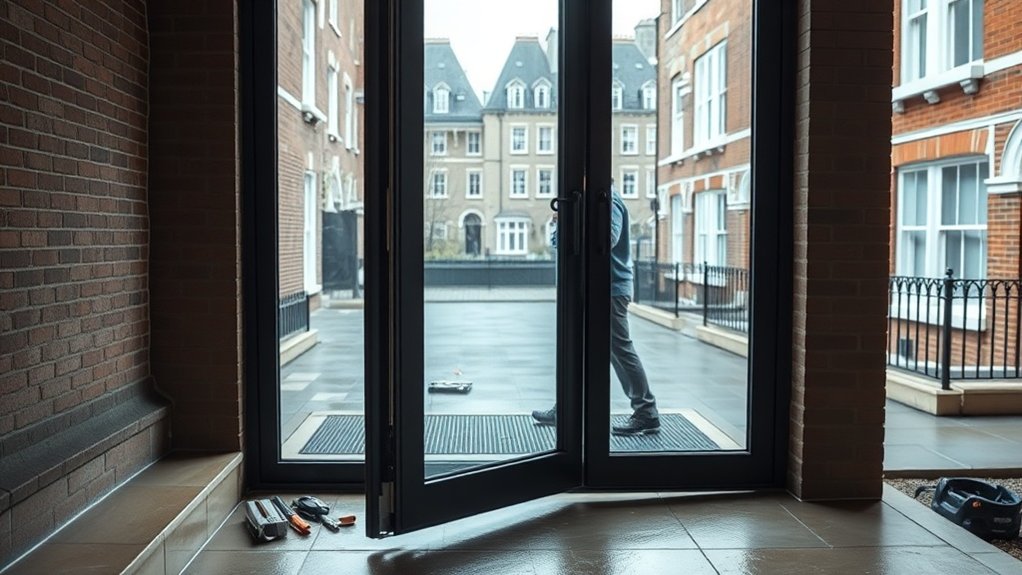
When you connect your terrace, garden or balcony to your interior with glass doors, you’re managing light, sightlines and circulation as a single design system. You’ll need to balance space-saving configurations—such as sliders, bi‑folds or pocket systems—with clear thresholds that resist London’s wind, rain and temperature shifts. At the same time, you must integrate locking hardware, laminated or toughened glass, and secure framing profiles so wide views never compromise safety or security.
Maximising Light And Views
Although London’s architecture often limits natural light, well-specified glass doors can radically open your home to its terrace, garden or balcony by extending sightlines and daylight penetration deep into the floorplan. You treat the glazing as a calibrated light engine: maximise clear aperture, minimise frame thickness, and align head heights to create uninterrupted visual bands to the outside.
Specify low-iron glass for higher clarity and select coatings that enhance daylight while controlling solar gain. Use consistent floor levels to blur thresholds and pull garden textures visually indoors. Integrate slim mullions that frame views like panels in a landscape artwork. Layer in subtle Decorative accents within the glass and intelligent privacy solutions—switchable glass, micro-patterned films—so you can modulate exposure without sacrificing luminance or views.
Space-Saving Door Options
How do you gain generous access to a terrace, garden or balcony without sacrificing precious floor area in a London home? You prioritise door systems that slide, fold, or pivot within a minimal footprint. Slimline sliding glass doors stack neatly along a track, freeing perpendicular space for furniture and circulation. Bi‑fold configurations concertina to one side, creating a clear opening with highly controlled panel geometry.
For micro‑balconies, top‑hung or pocket sliders remove floor track clutter and visually extend internal space. You can integrate decorative accents through bespoke handle profiles, powder‑coated frames, or structured glass interlayers. Laminated or switchable glazing provides privacy solutions without bulky blinds, allowing you to calibrate transparency, light, and spatial flow while keeping every square metre working efficiently.
Weather Resistance And Security
Why should an elegant glass connection to your terrace also perform like a facade-grade envelope? Because in London you’re designing for driving rain, gusting winds, and opportunistic intruders. You need systems with certified glass durability, multi-point locking, and reinforced frames that anchor securely into the surrounding structure.
Specify laminated, toughened glass to resist impact while maintaining clear sightlines and aesthetic appeal. Combine low‑iron panes with warm-edge spacers and high-performance seals so your terrace doors achieve near-curtain-wall weather resistance, limiting drafts and water ingress at threshold junctions.
Integrate slim but robust aluminium or steel profiles, concealed drainage, and anti-lift hardware for secure night ventilation . This way, your garden or balcony interface stays visually light yet performs as a resilient environmental and security barrier.
Energy-Efficient Glass Doors for London Weather
When you specify glass doors for London’s variable climate, you need to balance thermal performance, daylight, and airtightness with the building’s orientation and façade geometry. You treat the door as an active environmental interface, not just a transparent opening.
Prioritise low‑U‑value profiles , thermally broken frames, and warm‑edge spacers to reduce conductive losses at junctions. Use smart glazing to modulate g‑values in response to shifting solar exposure across east, south, and west façades, cutting cooling loads without sacrificing transparency. Pair selective coatings with argon or krypton-filled cavities for best winter performance.
Integrate acoustic insulation within laminated units to counter urban noise while maintaining tight seals. Detail thresholds, gaskets, and closers carefully so the door leaf complements, rather than compromises, the envelope’s energy strategy.
Security Features for London Glass Doors
Security on London glass doors starts with a robust specification of the glazed leaf, framing system, and hardware as an integrated barrier, not an afterthought. You design around laminated or toughened glass, tested to relevant Glass security standards, then lock it into thermally broken aluminium or steel profiles that resist pry points and flex.
You’ll coordinate multi-point locking, reinforced strike plates , and continuous hinges to align with access-control readers and monitored electric strikes. Panic hardware must sit flush to maintain clean sightlines without compromising egress.
To future-proof, you can embed sensors and door analytics into the frame: monitoring forced-entry attempts, hinge stress, open-dwell times, and lock status. Integrate this live data with your BMS to tune thresholds zone-by-zone.
Noise Control and Privacy on Busy London Streets
Although glass doors expose your interior to the street, you can still engineer precise control over noise and privacy by treating the glazed leaf as an acoustic and visual filter, not just a transparent barrier. You start with laminated acoustic glass, specifying interlayers tuned to attenuate mid‑frequency traffic noise and low‑frequency bus engines, using data from Rw and Rw+Ctr ratings.
You then combine these soundproofing techniques with layered surfaces. Deep reveals, soffits, and flanking wall treatments reduce reverberation and edge leakage, so the door functions as part of a complete acoustic envelope , not an isolated plane.
For visual control, you deploy privacy window films—graduated, switchable, or patterned—to choreograph sightlines, masking pedestrians while preserving daylight and street engagement.
Best Frame Materials for London Glass Doors
Across London’s mixed streetscapes, the frame material you choose for a glass door determines its structural stiffness , thermal performance, and visual weight within the façade. You’ll typically compare slim thermally-broken aluminium, engineered timber, and composite or steel systems. Aluminium suits Innovative frame options: ultra-narrow sightlines, high-span openings, and precise junctions with cladding or brick reveals. Engineered timber gives warmer tactility, works well in conservation areas, and pairs effectively with Custom glass designs that demand deeper profiles or integrated blinds.
Composite frames combine a timber interior with an aluminium exterior, giving you durability without sacrificing interior texture. For high-traffic commercial thresholds, steel delivers maximum rigidity and minimal deflection, enabling tall pivot or sliding configurations while keeping mullions visually restrained.
Glass Door Costs in London and Key Price Factors
When you start costing glass doors in London, you’re really pricing a whole façade element: glass specification , frame system, hardware, installation complexity, and compliance with local planning and building regulations.
Your baseline cost hinges on glass type and thickness. Upgrading for Glass durability—laminated, toughened, or triple glazing—adds material price but extends lifecycle and improves acoustic and thermal performance. Oversized panes, minimal sightline frames, and bespoke finishes (ceramic frits, tints, low‑E coatings) further shift the budget.
You’ll also factor thresholds, drainage details, and structural support , especially in large sliders or roof‑terrace interfaces. Advanced installation techniques, such as crane lifting or structural bonding, increase labour and access costs but allow cleaner junctions, slimmer profiles, and more ambitious spatial compositions.
Choosing a London Installer and Checking Your Quote
Before you sign off on any glass door package in London, you need to interrogate both the installer’s credentials and the anatomy of their quote with the same rigour you’d apply to a façade detail. Check they specialise in structural glazing, not generic joinery, and ask for built London references with similar spans, exposure, and thresholds.
Your quote should itemise: glass specification (including Smart glass performance data), hardware, custom fittings, tracks, structural steel, and sealing systems. Insist on drawings showing head, jamb, and sill interfaces, drainage strategy, and tolerances to existing fabric. Clarify who’s responsible for site survey, templating, and final set-out. Finally, compare lead times, warranty terms, and aftercare; a slightly higher fee often buys dramatically better alignment and long‑term stability.
Planning and Heritage Rules for Glass Doors in London Homes
Even in a private London house, a new expanse of glass is never just a design decision; it’s a planning event that interacts with conservation policy, overlooking rules, and the city’s complex heritage fabric. You’ll navigate Historical preservation, daylight strategies , and neighbours’ privacy while still pushing for maximum transparency and minimal frames.
You must map your proposal against:
- Conservation area status and local character appraisals
- Permitted development limits on rear and side elevations
- Overlooking and overshadowing assessments for new glass doors
- Building regulations on structure, fire escape, safety glazing, and U‑values
- Design access statements that justify contemporary detailing in context
Treat the façade as a negotiated interface: planners expect visual coherence from street to garden, and you’ll secure approvals faster when innovation reads as disciplined, not disruptive.
Retrofitting Glass Doors in Period and Listed London Buildings
Although Georgian fanlights and Victorian sashes weren’t designed for sliding panels and minimal frames, you can retrofit glass doors into period and listed London buildings if you treat the envelope as a calibrated intervention rather than a wholesale replacement. You start by mapping original fabric: brick reveals, lintels, and threshold levels dictate feasible opening sizes and pivot points.
You then specify ultra-slim thermally broken frames , recessed tracks, and low-iron glass to maintain sightlines while respecting Historical preservation priorities. Position new openings to align with existing axial views, cornice lines, and floor patterns so Interior aesthetics feel coherent, not grafted on. Use reversible fixings, expressed junctions, and shadow gaps to distinguish new work, ensuring the intervention reads as precise, contemporary infrastructure within a protected shell.
Maintenance and Cleaning Tips for Urban Glass Doors
You treat daily glass-door cleaning as a controlled maintenance routine, not an afterthought, to preserve optical clarity and sharp architectural lines. In London’s polluted air, you also need a strategy to manage particulates, soot, and mineral deposits before they etch the surface or cloud reflections. By aligning products, tools, and cleaning frequency with the door’s orientation and exposure, you guarantee the glass performs as a crisp visual threshold rather than a dull barrier.
Daily Cleaning Best Practices
While London’s pollutants and constant foot traffic quickly dull glass surfaces, a tight daily cleaning routine keeps doors optically clear, safe, and visually aligned with your interior architecture. You’re not just maintaining glass; you’re calibrating the visual thresholds that define your interior design and the performance of each glass installation.
- Use a pH‑neutral glass cleaner and lint‑free microfiber cloths to avoid micro‑scratches.
- Work in vertical then horizontal passes to eliminate streak patterns under directional lighting.
- Prioritize high‑touch zones: pull handles, push plates, and edge bands.
- Inspect pivot points, rails, and floor channels for debris before it abrades glass edges.
- Finish by viewing the door from oblique angles, checking reflections for distortion or residue.
Protecting Glass From Pollution
In London’s dense urban microclimate, exhaust particulates, construction dust, and airborne mineral deposits bond to glass surfaces, degrading clarity and stressing coatings if they’re not controlled. To maximise pollution protection, you need a systematic interface between the façade, the street, and prevailing airflow.
Specify hydrophobic or photocatalytic coatings that break down organic residues and slow adhesion; they extend glass durability and reduce abrasive scrubbing. Position doors away from direct traffic plumes where possible, and integrate overhangs or recesses to shield lower panes from splash and soot.
Use pH-neutral, low-residue detergents and deionised water so particles don’t re-crystallise along edges and hardware. Schedule more frequent, light cleans on street-facing elevations ; you’ll prevent micro-scratches and preserve high-transparency performance.
Future-Proofing Your London Home With Modern Glass Doors
How can a single design decision upgrade both the aesthetics and long-term performance of your London home? By installing modern glass doors that respect historical architecture while optimising light, thermal efficiency, and spatial flow. You align cutting-edge glazing with refined interior decor , creating a flexible envelope that adapts to evolving lifestyles and regulations.
- Specify low‑emissivity, argon-filled units to reduce heat loss and future energy costs.
- Choose acoustic laminated glass to counter traffic and aviation noise.
- Integrate slim aluminium or steel frames to maximise glazed area and views.
- Design wide, level thresholds to support ageing-in-place and step-free access.
- Use modular, reconfigurable door systems so rooms can shift between open-plan and zoned layouts as needs change.
Frequently Asked Questions
Can Glass Doors Increase the Resale Value of My London Home?
Yes, you can increase resale value by installing high-spec glass doors. You introduce immediate aesthetic enhancement, expanding visual depth and blurring interior–exterior boundaries. Buyers read this as premium, contemporary design. If you specify high-performance glazing, you also improve energy efficiency, reducing heat loss and solar gain. This dual benefit—design impact plus technical performance—positions your property as an innovative, future-ready space that commands a measurable price uplift.
Are There Insurance Implications Specific to Installing Glass Doors in London?
Yes, insurers may treat your installation differently, because glass door security directly affects perceived risk and your insurance premium. You’ll need laminated or toughened safety glass , certified multi-point locks, and secure frames aligned with current British Standards. Insurers might specify glazing thickness, hinge positioning, and impact zones relative to access paths. Photograph the installation, submit specs, and confirm that your policy explicitly notes upgraded doors to avoid disputes on future claims.
How Do Glass Doors Affect Indoor Plants in London’s Varying Light Conditions?
They boost plant health by increasing lateral daylight, but you must manage light filtration precisely. You’ll map each door’s solar orientation and glazing spec (clear, low‑iron, low‑E, frosted) to plant placement depths. In south or west exposures, use sheer blinds or films to diffuse high‑angle sun and prevent leaf scorch. In low‑light zones, position shade‑tolerant species near the glazing line, with reflective surfaces amplifying usable lux levels.
Can I Integrate Pet Flaps Into Glass Doors in London Properties?
You can integrate a pet flap into a glass door, but you’ll need a purpose-cut double-glazed panel and professional pet door installation. Coincidentally, the glass’s load paths and stress lines often align perfectly with circular pet flaps, preserving structural integrity. Specify toughened, low‑iron glass and a lockable, multi-point flap to maintain glass door security. Make certain clear swing paths, threshold alignment, and airtight seals so the modification complements your door’s design geometry.
What Warranties or Guarantees Are Typical for Glass Door Installations in London?
You’ll typically get 10–25 years on the sealed units, 5–10 years on hardware, and 1–2 years on installation workmanship . Check that warranty coverage includes frame alignment, seal failure, and hardware tolerance issues, not just breakage. You’ll also want written glass door maintenance requirements, since improper cleaning or impact can void terms. Innovative installers may offer performance guarantees on thermal efficiency and acoustic isolation alongside structural integrity.
Summary
When you choose glass doors for your London home, you don’t just tweak a room—you detonate the boundaries between inside and out. Sightlines stretch absurdly far, daylight floods like a five‑star atrium, and cramped spaces behave like grand galleries. By aligning glazing specs, thermal performance, and planning rules, you sculpt light with surgical precision. Do it well, and your modest flat feels like a rooftop pavilion hovering over the city, permanently tuned to the future.