
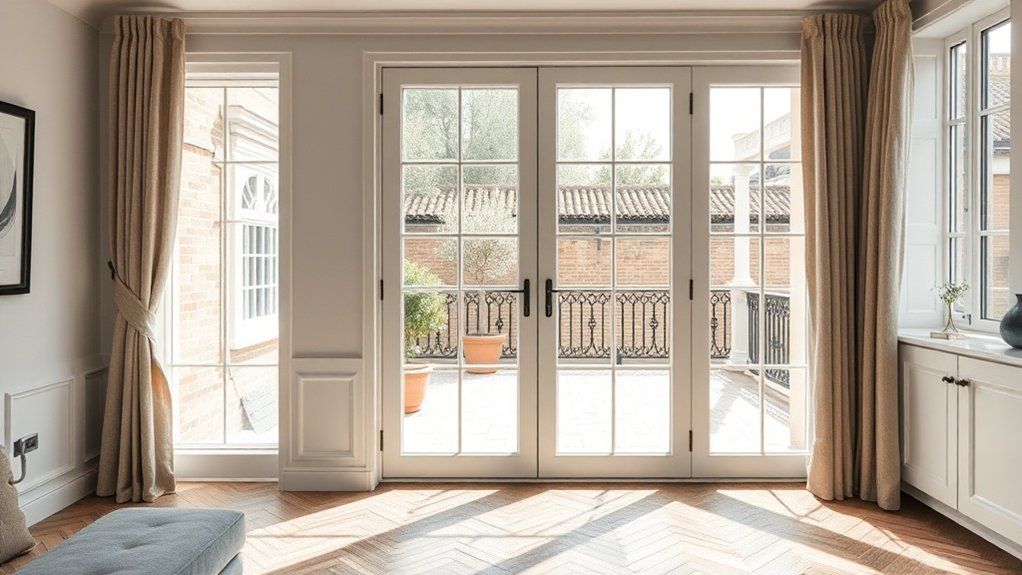
You’ll need French door glazing in London that meets Parts K, L, M and Q, with toughened or laminated safety glass to BS EN 12150/12600, secure beading and PAS 24‑compliant hardware. Specify low‑e double or triple glazing with argon fill and warm‑edge spacers to control U‑values, g‑values and condensation, plus acoustic laminated units for traffic noise. You can also manage overlooking, glare and pollution with specialist interlayers, tints and filtered vents, as the sections below explain further.
Key insights
- Ensure French doors meet UK Building Regulations in London (Parts K, L, M, Q) with certified safety glazing and compliant U-values.
- Choose double or triple glazed low‑E units with gas fill and warm-edge spacers to balance heat loss, solar gain, and condensation control.
- For noisy or polluted London streets, specify acoustic laminated glass, airtight frames, and trickle vents with filters for comfort and air quality.
- In conservation or heritage areas, use slimline insulated units that replicate traditional sightlines while still achieving modern thermal and security performance.
- Factor in installation complexity, balcony exposure, corrosion-resistant hardware, and PAS 24 multi-point locking when comparing quotes and lifecycle costs.
How to Choose French Door Glazing in London
When you choose French door glazing in London , you need to evaluate performance, safety, and regulatory compliance before aesthetics. You start by verifying conformity with Part K and Part Q where applicable, prioritising laminated safety glass with robust interlayers to reduce impact hazards and discourage forced entry.
Next, you assess sightline dimensions and frame-to-glass ratios so you don’t compromise structural integrity, especially in historical architecture subject to conservation constraints. Specify low-iron glass for clarity where your interior decor demands accurate colour rendering.
You then examine acoustic attenuation ratings and solar factor values to align with urban noise and orientation. Finally, require documented test data, certified installers, and traceable warranties to ensure long-term safety, durability, and compatibility with smart-lock and sensor systems.
Best Glazing Options for London’s Climate
When you select glazing for French doors in London, you need to balance low‑U‑value , energy‑efficient glass with robust acoustic insulation that attenuates traffic and rail noise. You’ll compare double or triple glazing with low‑E coatings, warm‑edge spacers, and argon or krypton gas fill to control heat loss while maintaining safe surface temperatures. At the same time, you must assess condensation resistance, gasket and seal performance, and weatherstripping quality to guarantee long‑term airtightness, occupant safety, and reliable operation in London’s damp, variable climate.
Energy-Efficient Glazing Choices
Why does the glazing specification on your French doors matter so much in London’s mixed, often damp climate? You’re balancing thermal performance, condensation control, and Historical charm, while still achieving daylight enhancement. Prioritise low‑emissivity (low‑E) double or triple glazing with warm‑edge spacers and argon or krypton gas fill; these reduce U‑values, limit heat loss, and minimise cold spots that can encourage mould growth around frames.
Specify laminated inner panes for impact resistance and safer breakage behaviour. For period façades, you can use slimline insulated glass units that replicate traditional sightlines yet deliver modern energy metrics. Consider spectrally selective coatings that admit high visible light but restrict solar heat gain, stabilising internal temperatures and reducing reliance on mechanical heating, especially in exposed, wind‑driven rain conditions.
Noise Reduction Glass Types
Noise reduction glazing for French doors in London must address both airborne traffic noise and structure‑borne vibration from trains, buses, and nearby construction, while preserving thermal performance and safety. You’ll typically specify acoustic laminated units, using PVB or ionoplast interlayers with asymmetric glass thicknesses to disrupt sound transmission paths.
For high‑performance façades, you can combine 10.8 mm acoustic laminate with a wider argon‑filled cavity and a 6 mm inner pane, optimised for mid‑ to low‑frequency attenuation. This approach respects Historical preservation when you pair slimline profiles and putty‑line sightlines with concealed acoustic spacers.
You should also coordinate noise‑control glass with certified window security hardware , using laminated inner panes that provide enhanced resistance to forced entry while maintaining acoustic performance.
Condensation and Weather Performance
How do you specify French door glazing that resists London’s persistent damp, driving rain, and rapid temperature swings without inviting condensation or draughts? You start with high‑performance insulated glass units, warm‑edge spacers, and argon or krypton fill to raise internal surface temperatures and improve condensation control. Low‑E coatings on the inner pane reduce radiant heat loss, minimising cold spots that trigger surface water.
For weather resistance, you combine laminated outer panes with precision‑engineered gaskets, drained and ventilated glazing rebates, and multi‑point locking that maintains uniform sash pressure on seals. Specify tested systems to BS EN 12208 (water tightness) and BS EN 1027 (wind‑driven rain). Don’t overlook trickle vents with controllable airflow, so you balance moisture management, security, and thermal efficiency.
Styling French Doors for Period and Modern London Homes
When you specify French door glazing for a London property, you need to balance structural integrity and regulatory compliance while respecting the building’s architectural period. In conservation or listed settings, you’ll typically retain traditional sightlines , glazing bar configurations, and hardware, whereas modern homes can accommodate minimalist, large-format insulated units with low-iron or solar-control glass. You can also adopt hybrid solutions that blend heritage profiles with contemporary high‑performance glazing, ensuring secure locking systems, toughened or laminated safety glass, and appropriate U‑values throughout.
Honouring Traditional Architectural Details
Although French doors suit a wide range of properties, you’ll achieve the best results in London by aligning your glazing choices with the home’s original architectural language and performance requirements. You can preserve vintage charm by replicating traditional sightlines: slim timber profiles, true or applied glazing bars, and proportionally correct mullions.
Specify laminated or toughened safety glass as standard, especially for full‑height doors and high‑traffic terraces. For Victorian, Edwardian, or Georgian façades, you can integrate decorative patterns using acid‑etched motifs, sandblasted borders, or leaded cames that echo historic fanlights while still meeting Part K and Part L regulations. Always coordinate ironmongery finishes, astragal bar layouts, and frame depths so new French doors read as a coherent, structurally compatible evolution of the original envelope.
Contemporary Minimalist Glazing Choices
Traditional detailing doesn’t suit every scheme, and many London homeowners now specify French doors with a contemporary, minimalist glazing aesthetic that prioritises clean lines and high performance. You’ll typically choose large-format, low-iron insulated glass units with slimline thermally broken aluminium or composite frames to maximise visible light and minimise visual clutter.
Prioritise glass security by specifying laminated inner panes , multi-point locking hardware, and PAS 24 or equivalent compliance. For urban plots, consider acoustic interlayers and solar-control coatings to reduce noise and overheating without increasing frame sightlines.
If you want subtle individuality, use understated decorative patterns such as acid-etched bands, fritted dot matrices , or linear screen-printing placed within the cavity, ensuring the outer faces remain smooth for easy cleaning and reduced impact risk.
Blending Heritage With Modern
Even in a conservation area or a sharply contemporary infill, you can specify French doors that respect heritage proportions while delivering modern performance and safety. You align sightlines with original mullions and transoms, then integrate slimline double or triple glazing with low‑iron glass for clarity and high solar control coatings for comfort.
For Heritage restoration, you retain traditional profiles, but use engineered timber or thermally broken aluminium-clad cores to minimise warping and heat loss. Multi-point locking, PAS 24‑compliant ironmongery, and laminated security glass elevate intrusion resistance.
For Modern aesthetics, you can specify flush thresholds with integrated drainage, concealed hinges, and acoustic interlayers to mitigate urban noise, ensuring step-free access and robust weather performance without compromising the façade’s architectural integrity.
Energy‑Efficient French Door Glazing for Urban Homes
When you specify glazing for French doors in a London property, you need to balance thermal performance, solar gain, and acoustic control without compromising safety or compliance with UK Building Regulations (notably Part L and Part K). You’ll typically combine low‑emissivity double or triple glazing with argon or krypton gas fill and warm‑edge spacer bars to achieve low whole‑door U‑values.
To control g‑values and mitigate overheating on south and west elevations, you can integrate spectrally selective coatings, window tinting, or external shading. Internal decorative films can add privacy while preserving visible light transmission, but mustn’t impede safety glazing requirements or hinder critical sightlines. Always verify laminated safety glass, secure beading, and robust locking hardware to maintain both thermal efficiency and impact resistance .
Reducing Noise, Pollution and Overlooking With Glazing
Alongside thermal performance, French door glazing in London must address exposure to traffic noise, airborne pollutants, and close‑range overlooking common in dense streetscapes. You can specify high‑performance glass assemblies that integrate acoustic, filtration, and privacy functions without sacrificing daylight.
Consider:
- Laminated acoustic units using asymmetric panes and damping interlayers as advanced soundproofing techniques to attenuate low‑frequency traffic and rail noise.
- Tight‑seal frames and gaskets that prevent flanking transmission and limit ingress of particulates and gaseous pollutants.
- Integrated pollution barriers, such as trickle vents with activated‑carbon or HEPA‑grade filters, maintaining safe indoor air while windows remain shut.
- Solar‑control and privacy interlayers, including graduated tints or switchable electrochromic glass, to mitigate overlooking, reduce glare, and protect occupants’ visual comfort and security.
Planning Rules and Building Regs for French Doors in London
Although French doors seem straightforward to install, London projects must comply with a tight mix of national Building Regulations and local planning controls that govern safety, energy use, and appearance. You’ll need to demonstrate compliance with Parts K (protection from falling), L (conservation of fuel and power), M (access), and Q (security, where applicable).
Specify safety glass to BS EN 12150/12600 in critical locations, documenting glass durability, impact resistance, and fragmentation characteristics. For thermal performance, calculate whole-door U‑values and ensure glazing ratios don’t compromise Part L targets.
Planning officers may scrutinise frame proportions, transom lines, and glazing aesthetics to preserve street character, especially in conservation areas. You should also assess overlooking distances and privacy intervisibility to avoid refusal on amenity grounds.
Best Frames and Hardware for London French Doors
The right frame and hardware specification for London French doors determines structural performance, security, and lifecycle cost as much as visual impact. You’ll want a system that complements advanced glazing while withstanding urban exposure, high usage, and evolving security standards.
Prioritise:
-
Frame materials Specify thermally broken aluminium or engineered timber with laminated cores. Both support Glass durability, tight tolerances, and low deflection under wind load.
-
Multipoint locking systems Choose PAS 24-compliant, stainless-steel gearboxes and keeps, with anti-jemmy hooks and through-bolted striker plates .
-
Hinges and pivots Use heavy-duty, security-rated hinges with concealed fixings and integrated hinge bolts to resist forced entry.
-
Thresholds and seals Install low-profile, Part M–compliant thresholds with double or triple weather seals, ensuring airtightness, drainage, and slip-resistant cappings.
French Door Design Ideas for Small Rooms, Gardens and Balconies
Carefully planned French door design lets you reclaim light, ventilation, and usable space in small London rooms, gardens, and balconies without compromising safety or performance. You’ll prioritise slim-profile frames, high-performance glazing, and low-threshold tracks to maximise clear opening width and minimise trip hazards.
For compact interiors, specify outward-opening or sliding French configurations to avoid door-leaf conflicts with furniture. On balconies, use laminated safety glass and anti-corrosion hardware to withstand wind load and driving rain. In micro-gardens, align door sightlines with planting zones to create continuity between hardscape and greenery.
Explore contrasting Color options on internal and external faces to define zones, while selecting frames with proven material durability—such as thermally broken aluminium —to maintain structural integrity and secure locking over decades.
Costs, Installation and London French Door Glazing Specialists
When you budget for French door glazing in London, you need to account for more than just the glass and frames; precise surveying, structural checks , Part L and Part F compliance, and secure installation all drive total project cost. You’ll also pay for robust ironmongery, high-security locking, and certified installers who can manage load paths and airtightness.
Specialists typically structure quotations around:
- Glazing material durability (laminated vs. toughened, low‑E coatings, gas fills).
- Frame system (uPVC, thermally broken aluminium, engineered timber).
- Installation complexity (lintel upgrades, threshold detailing, access constraints).
- Long‑term French door maintenance plans and safety inspections.
Choose London installers with FENSA or CERTASS registration, documented U‑value calculations, and written warranties , so innovation never compromises structural integrity or occupant safety.
Frequently Asked Questions
Can French Door Glazing Improve Home Security in High-Crime London Areas?
Yes, you can substantially enhance home security in high-crime London areas with advanced french door glazing. You’ll specify laminated or toughened glass for superior glass durability, preventing easy breach and delaying forced entry. Integrate multi-point locking systems , internally beaded frames, and security upgrades like PAS 24–compliant hardware. Combine low-emissivity glazing with security films and reinforced hinges to create an innovative, resilient barrier that prioritizes intrusion resistance and occupant safety.
How Does French Door Glazing Affect Property Resale Value in London?
It can boost resale value by transforming your doors into a high‑performance building component. You leverage energy efficiency through low‑emissivity coatings, argon‑filled double glazing , and optimized U‑values, cutting thermal losses. You enhance aesthetic appeal with contemporary sightlines and high visible light transmittance, increasing perceived luxury. You also signal safety-conscious innovation via laminated security glass and PAS 24‑compliant ironmongery, reassuring risk‑averse, tech‑minded buyers—value whispers, but performance shouts.
What French Door Glazing Options Suit London Leasehold Flats With Strict Freeholders?
You should specify like-for-like double glazing with low‑E safety glass and neutral Glass tinting to satisfy most strict freeholders. Use internal secondary glazing where external profiles can’t change. Choose laminated panes to enhance security and acoustic performance without altering sightlines. Add removable Decorative patterns (film or internal bars) so you comply with façade uniformity. Always obtain freeholder consent, Part L compliance evidence, and FENSA‑backed installation documentation.
Are There Heritage-Friendly Glazing Solutions for Listed Buildings With French Doors?
Subtle, sympathetic solutions exist: you can specify slimline heritage double glazing that preserves sightlines while boosting Modern insulation. You’ll maintain Historical authenticity by matching original glazing bars, putty profiles, and low-iron glass. Consider vacuum-sealed units, warm-edge spacers, and krypton-filled cavities for superior U-values. Always confirm listed-building consent , fire-escape clearances, toughened safety glass zones, and secure fixing methods to guarantee innovative performance without compromising conservation standards or regulatory compliance.
How Do I Maintain and Clean French Door Glazing in London’s Polluted Air?
You clean glazing in polluted air by using pH‑neutral glass cleaner, de‑ionised water, and lint‑free microfiber cloths, working top‑down to avoid streaking. You inspect seals during cleaning to protect window insulation performance and apply compatible silicone where needed. You integrate weatherproofing techniques —like trickle vents and tight compression gaskets—to minimise grime ingress. Always use stable ladders, cut‑resistant gloves near broken glass, and avoid abrasive pads that weaken surface coatings.
Summary
When you specify the right glazing unit, you cut heat loss, you control solar gain, you minimise acoustic intrusion. When you detail compliant safety glass, you protect occupants, you meet Part K, you reduce liability. When you coordinate frames, seals and hardware, you improve airtightness, you extend service life, you simplify maintenance. By treating French door glazing as a performance system, you enhance comfort, you safeguard residents, you future‑proof your London home.