
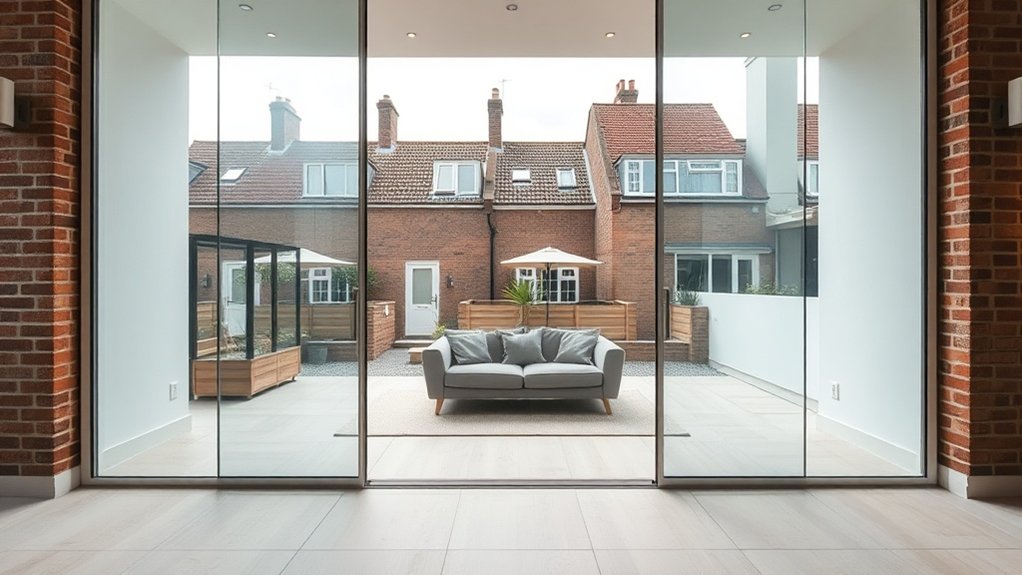
You choose frameless glass doors in London to maximise light, preserve sightlines and meet strict UK performance standards while creating a seamless, contemporary finish across homes, period conversions, offices and retail spaces. You can specify hinged, sliding or bi‑folding systems in toughened or laminated safety glass, with low‑iron, acoustic, or privacy options and flush thresholds . Quality hardware and detailing improve security, energy efficiency and quietness, and you’re about to see how to get the specification exactly right.
Key insights
- Frameless glass doors in London maximise daylight and space, creating bright, open interiors ideal for both modern apartments and period property conversions.
- Systems include hinged, sliding, and bi-folding configurations using 10–12 mm toughened or laminated safety glass to meet UK standards and regulations.
- Options such as low‑iron, acoustic, solar-control, decorative, or switchable privacy glass balance aesthetics, comfort, and performance in urban settings.
- High-quality hardware, flush or weather‑rated thresholds, and precise detailing ensure smooth operation, accessibility, and strong thermal and acoustic performance.
- Specialist suppliers offer design, structural calculations, fabrication, and installation, tailoring solutions to listed buildings, tight spaces, and complex London projects.
Why Frameless Glass Doors Are Booming in London
As London’s architecture evolves toward lighter, cleaner lines, frameless glass doors are surging in popularity because they solve multiple design and performance challenges at once. You gain maximal daylight, visual continuity , and spatial efficiency while retaining structural integrity through toughened or laminated glass and precision-engineered hardware.
You also access a flexible design toolkit. You can specify decorative glass to echo façade rhythms, integrate branding, or introduce subtle texture that diffuses light without feeling heavy. Advanced privacy solutions—switchable glass, strategic fritting, or layered interlayers—let you toggle between transparency and seclusion, ideal for mixed-use schemes and compact urban footprints.
Types of Frameless Glass Doors for London Properties
When you’re choosing frameless glass doors for a London property, you’ll typically compare hinged configurations , sliding assemblies, and bi-folding systems to match both spatial and structural constraints. You’ll need to assess how each option manages clear openings, hardware loading, and threshold detailing so the installation performs as well as it looks. By aligning the door type with your circulation patterns, light requirements, and facade conditions, you can specify a frameless solution that’s both efficient and visually seamless.
Hinged Frameless Door Options
Wondering which hinged frameless glass door suits your London property’s layout and performance needs? You’ll first assess traffic patterns, clear opening widths, and how the hinged installation integrates with adjacent finishes and services. Precision-aligned door hardware is critical: high-spec hinges, minimalist handles, soft-closing pivots, and concealed seals maintain clean sightlines while meeting safety and durability targets.
Consider these core hinged options:
- Wall-hinged single doors for slim openings and discrete meeting rooms.
- Double hinged sets to create wider, flexible thresholds for lobbies and galleries.
- Offset pivot doors delivering wider leafs with reduced floor load and smoother swing.
- Full-height hinged screens integrating side lights and overpanels for acoustic and visual continuity.
Each configuration can be tuned for opening force, hold-open angle, and accessibility.
Sliding Glass Door Styles
Sliding frameless glass doors let you reclaim floor area while delivering uninterrupted sightlines across London apartments, offices, and retail spaces. You can specify single-track sliders for compact openings, or twin- and triple-track systems where you want wider clear spans without visible frames. Ceiling-hung hardware keeps thresholds flush, improving accessibility and continuity between interior and terrace.
For privacy and branding, you might select decorative glass options: gradient frosting, digital print, or subtle interlayers that still read light and contemporary. Soft-close dampers , anti-jump rollers, and precision-aligned guides ensure silent, reliable motion in high-traffic zones.
From a glass maintenance perspective, hydrophobic coatings reduce limescale and pollution build-up, essential for London façades, cutting cleaning cycles while preserving optical clarity over time.
Bi-Folding Frameless Systems
Bi-folding frameless systems maximise clear opening width by stacking multiple glass panels neatly to one or both sides, creating a near-seamless shift between interior and exterior zones in London homes, offices, and hospitality spaces. You gain full-height glazing with minimal aluminium profiles, precision-engineered hinges , and low-friction floor tracks that support smooth, fingertip operation.
You can tune performance and aesthetics with:
- Glass specifications: laminated, solar-control, or acoustic glass to address orientation, noise, and heat gain.
- Privacy films: switchable or patterned films to modulate transparency for boardrooms or terrace doors.
- Decorative patterns: screen-printed or etched designs that align with your brand or interior concept.
- Threshold details: rebated, flush, or weather-rated sills to balance accessibility with air and water tightness.
Frameless Glass Door Design Ideas for London Homes and Period Conversions
Whether you’re opening up a compact mews house or reconfiguring a Victorian terrace, frameless glass doors let you introduce modern transparency without fighting London’s varied architecture. You can align slim head tracks to existing beams, preserving historical architecture while maximising daylight and sightlines.
Use low‑iron glass for true‑colour interiors and specify acoustic interlayers between reception rooms to control sound without solid partitions. In period conversions, pocket sliders conceal within stud walls, keeping ornate skirtings and cornices intact.
For interior decor, treat the glass as a neutral but high‑tech surface: integrate flush floor tracks with continuous herringbone, terrazzo, or poured resin. Consider fritted or switchable privacy zones at eye level, so you maintain openness yet modulate views and brightness dynamically.
Frameless Glass Doors for London Offices and Retail Spaces
In London’s dense commercial fabric , frameless glass doors give offices and retail spaces a way to feel expansive, legible, and secure without adding visual bulk. You use them to choreograph circulation, frame merchandise, and signal brand quality from street to workstation. Precision-engineered patch fittings, floor springs, and concealed tracks let you keep thresholds clean while managing high footfall.
You can specify clear, low-iron, or tinted glazing, then layer visual identity through Glass art and Decorative etching that doubles as subtle wayfinding. Consider how doors perform across your daily cycle:
- Define reception portals without blocking transparency
- Zone hot-desking, meeting, and focus areas
- Create flexible shopfronts with sliding or bi-parting leaves
- Integrate branding, privacy, and light control in one continuous plane
Safety, Security, and Building Regulations for Frameless Glass Doors in London
When you specify frameless glass doors in London , you need to balance a clean, minimal aesthetic with strict compliance to UK building regulations and BS/EN safety standards. You’ll consider safety glass types, impact performance, and vital hardware details to guarantee the doors protect users without compromising transparency. By planning for essential safety features—such as laminated or toughened glass, secure locking, and compliant manifestation—you create a solution that’s both visually refined and fully regulation-ready.
Compliance With UK Regulations
Although frameless glass doors appear minimal and unobtrusive, they must meet stringent UK safety, security, and building regulations to be legally compliant and reliably functional in London properties. You’ll navigate Part K (protection from impact and falling), Part L (energy efficiency), and Part Q (resistance to forced entry), while aligning with BS 6262 and BS EN 12150 for glass performance.
To integrate doors seamlessly with historical architecture and cutting‑edge interiors, you should coordinate aesthetic intent with compliance from the outset, especially when specifying custom finishes and bespoke ironmongery.
Key compliance checks typically include:
- Verified safety glazing classifications and impact tests
- Documented U‑values and thermal performance
- Secure fixing methods compatible with existing substrates
- Evidence of accredited fabrication and installation practices
Essential Safety Features
Regulation compliance only works in practice if the doors you specify embed the right safety features into every component. You start with toughened or laminated safety glass to prevent dangerous shards, while retaining glass transparency and aesthetic appeal. Edge polishing and precision-drilled hardware holes reduce stress points and long‑term fracture risk.
You then design with Grade 304/316 stainless or anodised aluminium fittings, integrating anti‑lift hinges, lockable bottom rails, and multi‑point locking for secure closure. Soft‑close self‑closing mechanisms, compliant with fire and accessibility standards, prevent slamming and finger‑trapping.
Finally, you define manifestation bands and impact protection at regulated heights, ensuring visibility without compromising minimalist lines, so your frameless system meets London’s building regulations and high‑traffic performance demands .
Thermal and Acoustic Performance of Frameless Glass Doors
Even with their minimalist look, frameless glass doors in London can deliver strong thermal and acoustic performance when you specify the right glass build‑up, hardware and detailing. You prioritise energy efficiency by reducing conduction through the glass and limiting air leakage at the perimeter. At the same time, you enhance sound insulation to control urban noise without sacrificing transparency.
You’ll get the best results when you:
- Optimise glass thickness and interlayers to balance U‑values and acoustic damping.
- Detail head, jamb and threshold seals to minimise draughts and flanking sound paths.
- Use thermally broken framing elements at fixing points to limit cold bridging.
- Orient doors to exploit solar gain where useful while preventing overheating with selective coatings.
Glass Options, Hardware, and Finishes for Frameless Glass Doors
When you specify frameless glass doors in London , your choice of glass build‑up, hardware, and finishes determines not just how the door looks, but how it performs, ages, and integrates with the rest of the interior. You’ll typically work with 10–12 mm toughened or laminated glass, selected for impact resistance, edge stability, and code compliance. Low‑iron options sharpen glass aesthetics, while fritted or acid‑etched surfaces deliver privacy without sacrificing light.
Prioritise hardware durability: choose marine‑grade stainless or anodised aluminium hinges, pivots, and patch fittings, especially in high‑traffic or humid environments. Floor springs and soft‑close pivots refine motion control. For finishes, align handle and patch‑fitting tones—brushed stainless, bronze, or black anodised—so the visual language is coherent with your broader interior palette.
Frameless Glass Door Costs, Installation, and Timelines in London
Once you’ve fixed the glass specification and hardware package, you can start testing your scheme against real‑world budgets, installation methods, and programme constraints . In London, frameless glass door costs typically scale with panel size, structural complexity, and performance requirements such as acoustic control and energy efficiency.
You’ll streamline planning if you map costs to programme early:
- Pre‑construction survey and design coordination: 1–2 weeks
- Fabrication and hardware preparation: 2–4 weeks, depending on glass processing
- On‑site installation: usually 1–3 days per opening
- Commissioning, snagging, and sealing: 1–2 days, plus curing time
Factor in access logistics, fire strategy, and integration with lighting and interior decoration. When you phase works around other trades, you protect finishes, compress timelines, and maintain precision alignment.
Choosing a Frameless Glass Door Supplier in London
How do you sort serious frameless glass door specialists from generic glazing firms in a market as dense as London’s? You start by checking whether they engineer around your building, not just the opening. Ask how they’ll accommodate deflection, floor tolerances, and integration with HVAC, lighting, and security systems.
Review their portfolio for complex sites: listed buildings, tight mews houses, mixed-use schemes. A good supplier can align ultra-minimal hardware with both cutting-edge interior decor and sensitive historical architecture without visible compromises.
Interrogate their glass specifications : make-up, load paths, fixing methods, and compliance with BS and EN standards. Finally, confirm in-house design, structural calculations, and aftercare. You’re not just buying doors; you’re buying accountable engineering and long-term operability.
Frequently Asked Questions
Can Frameless Glass Doors Be Retrofitted Into Existing Traditional Wooden Door Frames?
Yes, you can retrofit frameless glass doors into existing traditional wooden frames, but you’ll need to evaluate historic preservation requirements and material compatibility first. You’ll reinforce or modify the timber to carry hinge loads, integrate concealed hardware, and guarantee precise plumb and level alignment. You’ll also specify suitable glass thickness, edge clearances, and seals to manage movement, acoustics, and safety while preserving the original architectural character.
How Do Frameless Glass Doors Perform in London’s Hard-Water Areas for Cleaning and Staining?
You’ll find they perform “brilliantly” in hard‑water areas—until limescale sketches abstract art on your panes. Their smooth, non‑porous surfaces offer good stain resistance, but mineral deposits still cling. Use hydrophobic coatings and specify low‑iron, tempered glass to reduce visual impact. Incorporate precise glass cleaning protocols: squeegee after each shower, pH‑balanced descalers weekly, and soft microfiber cloths. With this regimen, you maintain optical clarity and future‑ready aesthetics.
Are Frameless Glass Doors Suitable for Homes With Pets and Small Children?
Yes, they’re suitable if you specify the right configuration. You’ll want toughened or laminated safety glass, secure floor pivots, and high-spec soft-close hinges to optimise Pet safety and Child proofing. Add minimal-gap seals to prevent paws or fingers getting trapped, plus handles positioned above toddler reach. For advanced child-proofing, integrate magnetic locks or smart access controls, ensuring the doors remain both visually seamless and functionally safe in a high-innovation home.
Can I Integrate Smart Locks or Access Control Systems With Frameless Glass Doors?
Yes, you can—and it’s almost shocking how well it works when done right. You’ll pair Smart lock integration with purpose-designed glass door hardware : surface-mounted strikes, patch fittings, and low-profile electronic locks. Access control systems then manage users, schedules, and logs via Wi‑Fi or PoE controllers. You must coordinate glass thickness, hinge type, and cable routing early in the design to keep the door minimal, secure, and elegantly future-ready.
What Warranty and Maintenance Plans Are Typically Available for Frameless Glass Doors in London?
You’ll typically get Warranty coverage from 5–10 years on glass, hardware, and seals, with shorter terms for moving parts and finishes. Many suppliers offer optional Maintenance schedules : annual or bi-annual inspections, hinge and patch-fitting adjustment, lubrication, seal replacement, and glass integrity checks. You should choose plans that document load calculations, hardware life-cycle expectations, and rapid-response repairs so your minimalist aesthetic stays aligned with high-performance, future-ready operation.
Summary
When you choose frameless glass doors in London, you’re not just adding an opening—you’re engineering a precise, transparent interface between spaces. You gain high-performance glazing , discreet hardware, and compliant installation that respects both design intent and regulations. Like a perfectly cut lens, the right system sharpens light, views, and flow. Partner with a specialist supplier, and you’ll turn structural challenges, planning constraints, and performance demands into a clean, future-proof architectural solution.