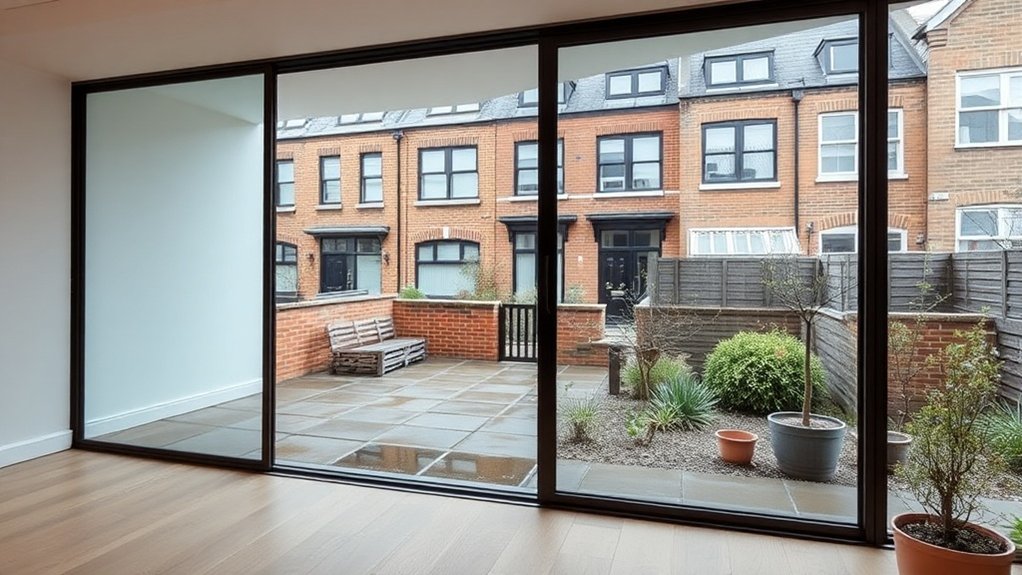
You choose sliding patio doors for your London home to maximise glass area, save floor space, and improve thermal and acoustic performance in tight urban layouts. Specify thermally broken aluminium or multi‑chamber uPVC, low‑E argon‑filled double or triple glazing, and multi‑point locking with laminated glass to satisfy Part L, K and F, plus Secured by Design expectations . Correct installation, threshold detailing and hardware selection guarantee long‑term weather‑tightness, smooth operation, and compliance, and you’re about to see exactly how.
Key insights
- Sliding patio doors suit London homes with tight gardens, balconies, or terraces because they save internal floor space and maximise glass area and daylight.
- Choose thermally broken aluminium, uPVC, timber, or composite frames with low‑E, argon‑filled double glazing to meet London’s energy and noise requirements.
- For period London properties, opt for slimline aluminium or timber sliders that echo traditional sash or French door proportions, colours, and glazing bar patterns.
- Expect installed costs typically from about £1,500–£4,500+ per opening, rising with triple glazing, insulated thresholds, and premium hardware or integrated blinds.
- Prioritise expert installation, multi‑point locking, security sensors, and proper weatherproofing to ensure long‑term performance, security, and draught resistance in London’s climate.
Are Sliding Patio Doors Right for Your London Home?
How do you decide if sliding patio doors are the most suitable choice for your London property’s layout, climate, and performance requirements? You start by mapping opening clearances and traffic flows: sliding panels don’t encroach on internal space, so they suit tight kitchens, balconies, and narrow terraces. Next, you quantify glazing performance—specify low‑U-value, argon‑filled units and thermally broken aluminium or composite frames to mitigate London’s variable temperatures and urban noise.
You then integrate aesthetics and function. Use color coordination to align frame finishes with interior palettes and external cladding, ensuring continuity between zones. Finally, evaluate sightline impact on outdoor landscaping, daylight capture, and ventilation strategy, confirming the system enhances views, solar gain control, and future smart shading or sensor integration.
Sliding vs French vs Bifold Patio Doors
When you compare sliding, French, and bifold patio doors, you need to assess how each configuration manages space, sash movement, and clearance in your specific opening. You’ll also want to measure the glazed area and frame sightlines to understand how much natural light and uninterrupted view each system delivers. Finally, consider threshold design, clear opening width, and traffic flow to optimize everyday access to your garden or balcony.
Space And Opening Style
Two fundamental constraints drive your choice between sliding, French, and bifold patio doors: the floor area you can allocate to door swing and the type of opening you want to create. Sliding doors run on linear tracks , so you don’t sacrifice internal circulation; they’re ideal when you’ve got tight terraces or furniture-dense layouts. French doors, with their historical significance, need clear swing arcs, but you can specify asymmetric leaves to optimise footprint. Bifold systems stack to one or both sides, delivering the widest clear aperture, yet require dedicated parking zones and robust head support. Across all types, you’ll evaluate frame depth, threshold detailing, and hardware projection while aligning profiles and finishes with your material sustainability targets and any future adaptation plans.
Light, Views And Access
While space planning governs what will physically fit, light, views, and access determine which patio door type will perform best in a London context. Sliding doors maximise glass area with minimal framing, giving you strong daylight penetration and wide-angle views, ideal for overcast conditions and compact balconies. You gain continuous visual connection even when the panel’s closed.
French doors prioritise central access and symmetry, suiting traditional interior decoration where you’re framing a view rather than maximising it. However, smaller glass-to-frame ratios reduce daylight.
Bifold doors deliver the most flexible access; you can open entire wall sections for seamless garden integration. They’re best suited for south-facing plots but require careful specification of coatings, drainage, and window cleaning strategies to manage glare, heat gain, and maintenance.
How Sliding Doors Transform Small London Spaces
Even in the tightest London flats and terraces, a well‑specified sliding patio door can release measurable gains in usable floor area, daylight penetration, and visual continuity. By eliminating the swing radius of a hinged door, you reclaim circulation space for storage, seating, or flexible work zones. Slim aluminium profiles and low‑iron glass maximise glass‑to‑frame ratio, extending your perceived room depth into the garden.
You can tune garden privacy and outdoor aesthetics with high‑performance glazing (tinted, frosted, or switchable), external screens, and integrated blinds in the cavity. Multi‑track systems let panels stack neatly, creating a wide opening without increasing footprint. Low‑threshold tracks maintain level access while minimising trip risk, and thermally broken frames keep the envelope efficient despite the expanded glazed area.
Design Ideas for London Period and Modern Homes
When you’re working with a London property, you need sliding patio doors that respect period detailing while upgrading performance, so you’ll focus on proportion, sightline thickness , and heritage-compatible finishes. For period homes, you can specify slimline aluminium or engineered timber systems that align with existing sash or French door rails, match glazing bar patterns, and use muted, historically sympathetic RAL colours. For modern spaces, you’ll prioritise large-span minimalist frames, flush thresholds, and neutral coatings that maximise glass area and create an uninterrupted visual connection between interior and garden.
Blending Period Charm Seamlessly
Because London’s housing stock ranges from stucco-fronted terraces to post-war infill and new-build apartments, specifying sliding patio doors that respect period character while delivering modern performance demands careful control of proportion, detailing, and materiality. You’ll want to align head heights with existing sash windows, replicate traditional sightlines, and use slim interlock profiles to retain vertical emphasis.
To support historical preservation and period authenticity, specify timber or timber-aluminium composites with putty-line glazing effects, ovolo or lamb’s tongue beads, and colour-matched heritage paint systems . Integrate deep bottom rails, astragal bar layouts that echo original fenestration, and hardware with architectural-grade, antiqued finishes. Internally, coordinate architraves and skirting returns so the new opening reads as a coherent, era-appropriate intervention rather than an obvious retrofit.
Contemporary Minimalist Door Styles
While London’s architecture is often ornate, contemporary minimalist sliding patio doors introduce clarity and visual calm by stripping the opening back to pure plane, line, and light. You prioritise ultra-slim sightlines, large-format glazing , and flush thresholds that align interior floor finishes with external terraces for seamless passage and enhanced accessibility.
Specify thermally broken aluminium or steel frames to maximise glass area while meeting London’s energy and Part L requirements. Opt for neutral, architectural colour options—anthracite, silk black, or warm grey—powder-coated for durability in polluted, coastal-influenced air.
Select hardware styles that are linear and low-profile: recessed pull handles , concealed locking strips, and soft-close mechanisms. Integrate minimalist trickle vents, structural glass corners, and pocket-sliding configurations to keep every visible element rigorously disciplined.
Sliding Patio Door Costs in London
Curious what you should actually budget for sliding patio doors in London? You’ll typically allocate from £1,500–£4,500+ per opening, depending on configuration, glass spec, and system performance. Triple glazing , low‑e coatings, and insulated thresholds can raise upfront costs 15–30% but reduce long‑term heating loads.
Factor installation at 25–40% of total cost if you need structural alterations, drainage channels, or low‑profile tracks for flush internal–external floor levels. London’s exposure demands advanced weatherproofing options : multi‑point seals, thermally broken thresholds, and high‑performance gaskets add modest cost but drastically cut draughts and water ingress.
Don’t ignore sliding door accessories in your budget: soft‑close mechanisms, integrated blinds, smart locks, and security sensors can add £300–£1,200 yet deliver better usability, safety, and system longevity.
The Best Frame Materials for London Homes
When you choose a frame material for your sliding patio doors, you’re balancing structural performance, thermal efficiency , and maintenance over the door’s lifespan. You’ll want to compare uPVC and aluminium for rigidity, sightlines, and U-values, while weighing timber frames if you need a traditional aesthetic in conservation areas. By understanding how each material performs on energy efficiency, durability, and weather resistance in London’s climate, you can specify a solution that’s both cost-effective and long lasting.
Comparing uPVC And Aluminium
How do you decide between uPVC and aluminium frames for a London patio door that has to cope with heavy use, variable weather, and strict efficiency targets? You start by matching material properties to performance goals, aesthetics, and maintenance tolerance.
-
Thermal + acoustic performance uPVC offers low U-values and excellent sound reduction with multi‑chamber profiles. Aluminium needs thermal breaks and high-spec glazing to match, but resists frame distortion on large spans.
-
Structural capacity + durability Aluminium’s higher modulus lets you design slimmer sightlines and taller sliders. uPVC works well for standard apertures but can require reinforcement on wide openings.
-
Design flexibility Aluminium delivers bolder Color options, ultra‑slim interlocks, and premium hardware finishes. Foiled uPVC widens your palette but remains bulkier at the mullions.
Timber Frames For Tradition
While uPVC and aluminium dominate modern patio door specifications, timber remains the material you choose if you want a London property to read as period-correct while still meeting current performance standards. You can specify engineered softwood or hardwood laminates that minimise warping, allow slim sightlines, and integrate accurately with existing sash or casement proportions.
For heritage preservation, you’ll match moulding profiles, rail depths, and meeting-stile dimensions so new sliding leaves align with original architectural language. Modern factory-applied coatings reduce on-site maintenance and simplify long-term timber restoration cycles. You can embed concealed drainage channels, low-friction running gear, and multi-point locking within traditional sections, delivering secure, smooth-operating timber sliders that satisfy conservation officers while giving you the precision and reliability you’d expect from contemporary systems.
Energy Efficiency And Durability
Why do some sliding patio doors in London stay draught‑tight and smooth‑running for decades, while others swell, warp, or leak heat within a few winters? You’re really choosing a frame system, not just a “look.” Energy efficiency and durability depend on how well the frame manages thermal insulation, weatherproofing, and structural loads under London’s damp, variable climate.
-
Aluminium with thermal break* – Slim sightlines, rigid, and long‑lasting. Polyamide thermal breaks and *multi‑chamber profiles minimise cold bridging and condensation.
-
uPVC multi‑chamber frames – High inherent insulation, low maintenance, cost‑effective. You’ll want steel reinforcement to resist flexing on large spans.
-
Composite (aluminium‑clad timber or GRP hybrids) – Timber core for strength and insulation, external shell for superior weatherproofing, reduced repainting, and stable operation over time.
Double vs Triple Glazing: What Works Best in London?
Because glazing directly affects energy performance, comfort, and noise levels, choosing between double and triple glazing for sliding patio doors in London demands more than a simple “better vs worse” comparison. You need to weigh U‑values, solar gain, and acoustic attenuation against budget and frame design.
Double glazing with low‑E coatings and argon fill typically delivers sufficient performance for London’s moderate climate, especially when paired with selective window tinting to manage solar gain on south‑ or west‑facing elevations. It’s cost‑effective and lighter, reducing hardware wear.
Triple glazing adds an extra cavity, improving thermal resistance and noise reduction, but increases sash weight and cost. You’ll also face more involved glass cleaning and stricter tolerances for alignment. For most urban homes, optimized double glazing offers the best performance‑to‑cost ratio.
Security Features to Look for in Sliding Patio Doors
Although sliding patio doors are often perceived as a weak point in a property’s envelope, modern systems can integrate robust security features that considerably reduce vulnerability to forced entry. You should prioritise hardware and glazing that resist leverage, prying, and impact while integrating with smart home infrastructure.
-
Advanced lock mechanisms Select multi-point lock mechanisms that engage along the full sash height, with anti-lift pins and reinforced keep plates anchored into the structural frame.
-
Laminated and toughened glazing Specify laminated inner panes so, even if fractured, the glass remains bonded, delaying intrusion and supporting alarm response times.
-
Integrated security sensors Incorporate magnetic contact strips and vibration or break sensors, hard‑wired or wireless, linked to your central alarm or home automation system for real-time alerts and remote monitoring.
London Planning Rules and Building Regs for Sliding Patio Doors
While robust security hardware protects your sliding patio doors from forced entry, you also need to guarantee the installation satisfies London’s planning policies and UK Building Regulations. You’ll first confirm whether your property is listed or in a conservation area, where historic preservation priorities can restrict frame materials, visible mullion widths, and external colour .
You must also meet Part L (thermal efficiency), Part F (ventilation), and Part K (safety glazing, manifestation, guarding). Specify low‑U‑value glazing, continuous trickle vents where required, and toughened or laminated glass in critical zones. For ground-floor doors, ensure adequate threshold drainage and level access to satisfy Part M while aligning with urban landscaping schemes. Always check local borough guidance on rear extensions and garden-facing alterations.
How to Choose a London Sliding Door Installer
Selecting the right London sliding door installer means evaluating more than price and lead time; you’re vetting their technical competence , accreditation, and local compliance knowledge. You need a contractor who understands London’s microclimates, diverse façades, and strict U‑values, while advising on innovative configurations and material options such as slimline aluminium, engineered timber, and hybrid frames.
- Credentials & Compliance – Verify FENSA or CERTASS registration, insurance, manufacturer approvals, and documented Part L and Part K experience.
- Technical Consultation – Expect site-specific load checks, threshold design, drainage strategy, and hardware selection tailored to your opening and usage.
- Detail-Focused Installation Tips – Ask how they’ll manage weatherproofing layers , airtightness tapes, thermal breaks, structural packers, and tolerances for large-format glass.
What to Expect During Installation in a London Property
Once you’ve chosen your installer, a London sliding patio door fit typically follows a tightly sequenced process that minimises disruption while protecting the fabric of your property. First, the team surveys apertures, services, and structure, confirming lintel capacity, threshold levels, and alignment with your garden integration concept. They’ll protect floors, isolate the work zone, and remove existing joinery, carefully managing glazing waste.
Next, they’ll install the frame, laser-check plumb and level , then fix through reinforced zones to avoid thermal bridging. High-performance seals, packers, and membranes go in to optimise noise insulation and airtightness, essential in dense London streets. Finally, they glaze, adjust rollers, test locking points, and verify drainage paths, ensuring smooth operation and weather resilience from day one.
Easy Maintenance Tips for Long‑Lasting Sliding Patio Doors
Even the highest-spec sliding patio doors in London only deliver long-term performance if you adopt a simple, consistent maintenance routine. You’re protecting precision-engineered components from grit, moisture, and thermal movement, so think regarding systematic, low-effort tasks rather than occasional deep cleans.
-
Inspect and clean tracks monthly using targeted cleaning routines: vacuum debris, wipe with a non-abrasive solvent, then apply a dry PTFE lubricant so rollers glide without attracting dust.
-
Check weatherstrips and gaskets each season; replace compressed sections to maintain airtightness and acoustic performance.
-
Plan strategic hardware upgrades over time: swap standard rollers for stainless, low-friction assemblies; upgrade locks and keeps to high-security, corrosion-resistant options; and ensure all fasteners are marine-grade where exposure to London’s urban pollutants and moisture is highest.
Common Mistakes When Buying Sliding Patio Doors
Although London’s market offers a huge range of sliding patio doors, you can still undermine long-term performance by making a few predictable, avoidable mistakes at the specification stage. You might under-specify glass performance, choosing double instead of high-performance triple glazing or omitting low‑E coatings, which weakens thermal efficiency and acoustic control .
You may also ignore frame system engineering, opting for low-cost PVC without multi‑chamber profiles, steel reinforcement, or thermally broken aluminium. Another frequent mistake is treating Color options and hardware finishes as afterthoughts; dark colours without UV‑stable coatings can distort, and cheap rollers or locks quickly fail. Finally, failing to model sightlines, threshold height, and slider direction against your layout can compromise accessibility and daylighting.
Frequently Asked Questions
How Do Sliding Patio Doors Affect Indoor Air Quality in London’s Climate?
They impact indoor air circulation and pollutants infiltration by acting as both a ventilation asset and a leakage risk in London’s humid, traffic‑dense environment. You optimize air quality when you specify high‑performance seals, low‑permeability gaskets, and trickle vents with controllable flow. You should integrate sensors for CO₂ and particulates, then automate opening cycles to purge indoor pollutants while minimizing drafts, condensation, and unfiltered outdoor contaminants.
Can Sliding Doors Integrate With London Smart Home and Security Systems?
You can integrate them seamlessly: you link sensors, you link locks, you link glass-break detectors for full smart home integration and robust security system compatibility. Fit multipoint smart locks with Z-Wave or Zigbee, tie them to your hub, then automate arming, disarming, and presence-based locking. Add contact sensors for status, cameras for verification, and encrypted wireless modules to guarantee low-latency alerts, secure signaling, and future-ready interoperability.
What Acoustic Performance Should I Expect Near Busy London Roads or Railways?
You should target 40–45 dB noise reduction near busy London roads or railways. Specify laminated acoustic glass , deep multi‑chamber frames, and premium seals as core Noise insulation features. Use high‑density soundproofing materials in surrounding wall reveals and head details. Demand tested Rw (Ctr) ratings, not just generic dB claims. Integrate decoupled frames and thermally broken profiles to minimise vibration transfer and maintain performance under real urban conditions.
Are There Eco-Friendly or Recycled-Material Options for London Sliding Patio Doors?
You can specify sliding doors using up to 75% recycled materials in aluminium profiles and still achieve high structural performance . You’ll evaluate eco friendly options like thermally broken aluminium, FSC-certified timber, and uPVC with recycled cores. Prioritize low‑E double or triple glazing, warm‑edge spacers, and argon fill. Ask suppliers for Environmental Product Declarations and cradle‑to‑cradle certifications to quantify embodied carbon and optimize whole‑life performance.
How Do Sliding Patio Doors Impact Property Resale Value in Different London Boroughs?
You’ll see resale gains mainly where buyers prioritise light, views, and modern efficiency. In prime boroughs, high-spec systems with strong Aesthetic appeal can boost value noticeably. In conservation areas, you must balance Historical preservation with slim frames and acoustic glazing to avoid planning pushback. Across outer boroughs, thermally-broken, secure doors that extend kitchen-diners into gardens often deliver the best ROI, especially when paired with low-maintenance, sustainable materials.
Summary
You’re now ready to choose sliding patio doors that fit London’s tight spaces, period details, and planning constraints. Focus on U-values , security ratings, and professional installation to avoid costly callbacks. Energy‑efficient glazing can cut heat loss by up to 30%, so you’ll feel the benefit on bills and comfort. Next step: compare at least three FENSA or CERTASS‑registered installers, ask for full specifications in writing, and challenge any vague performance claims.