For aluminium door installation in London, you’ll want slimline, thermally broken systems that hit Part L and PAS 24/Secured by Design, matched to your property style (Victorian terrace, post‑war estate, or new‑build). Expect laser surveys, precision fixing, toe‑and‑heel glazed sashes, and properly sealed perimeters to control U‑values, g‑values, acoustic performance and weather tightness . Correct planning of access, thresholds, and drainage avoids costly callbacks and helps you understand what a high‑spec install really involves.
Key insights
- Aluminium doors suit London’s Victorian terraces, post-war estates, and new-builds, offering slim, thermally efficient, secure systems that meet Part L and Part Q regulations.
- Installation involves laser surveying, accurate frame fixing, glazing, and airtight sealing; complex access, steelwork, or crane lifts can significantly increase labour and equipment costs.
- Ask for itemised quotations covering frames, glazing, hardware, finishes, access equipment, and waste removal instead of a single headline price.
- Check installers’ FENSA/Certass accreditation, security and fire certifications, and past London projects to verify quality, compliance, and reliability.
- Plan access, parking, delivery windows, and noisy works in advance, and confirm maintenance, warranties, and aftercare for hardware, seals, and powder-coated finishes.
Why Aluminium Doors Suit London Homes
Because London’s housing stock spans Victorian terraces, post-war estates, and new-build apartments, aluminium doors provide a versatile, high‑performance solution that integrates cleanly with diverse façade systems. You get a slimline profile with high structural integrity, so large glazed areas don’t compromise wind load resistance or security performance.
You can tune thermal breaks, low‑E units, and gasket systems to meet or exceed Part L and local SAP targets. Powder-coated finishes let you respect Historical architecture externally while executing contemporary interior design schemes internally with dual-colour frames.
Hardware options integrate multi-point locking, PAS 24 compliance, and automated access control for smart-home ecosystems. Corrosion resistance suits London’s pollution and microclimates, cutting lifecycle maintenance and delivering predictable whole‑life cost performance.
Key Aluminium Door Styles for London Properties
From heritage refurbishments in conservation areas to high‑rise infill schemes, you’ll typically specify aluminium doors in a small number of core formats: rebated front entrance doors, thermally broken French doors, multi‑panel sliding systems , and top‑hung or bottom‑rolling bifolds. Each relies on precision aluminium design, tight tolerance fabrication, and project‑specific ironmongery sets.
For London streetscapes, rebated entrance doors let you integrate PAS 24 security hardware, concealed closers, access‑control readers, and bespoke decorative finishes without compromising sightline discipline. French doors suit tighter apertures, using slim thermally broken profiles and low‑threshold or ramped access details. Sliding and bifold assemblies maximise glazed area, with ultra‑slender interlocks, high‑performance rollers, and drainage‑managed thresholds engineered for driving rain , wind‑load, and acoustic constraints.
Bifold vs Sliding vs French Aluminium Doors
With the core aluminium door formats set out, you now need to decide whether bifold, sliding, or French configurations best suit each London opening regarding use, performance, and planning context. You’ll assess clear opening width, threshold detailing, and sightline hierarchy first.
Bifolds maximise aperture, delivering near-full-span clear openings and strong indoor–outdoor flow, ideal for contemporary Interior design schemes. However, they require stacked leaf parking zones and precise floor build‑up coordination.
Sliding systems prioritise minimal frame sections, large glass ratios, and effortless operation on high-spec running gear, suiting panoramic views and compact terraces.
French aluminium doors, especially in Historical architecture and conservation streetscapes, give you a traditional leaf aesthetic with modern thermal breaks, controlled ventilation, and sympathetic mullion proportions.
Aluminium Door Costs in London: What to Expect
Aluminium door costs in London fluctuate across a wide band, so you need to break pricing down into frame system, glazing spec, hardware, and installation complexity to budget accurately. You’re typically looking at entry-level residential systems at the lower end, moving up to premium, slim-sightline commercial-grade profiles with higher price tags but sharper aluminium door aesthetics and superior material durability.
Expect to pay more for bespoke powder-coat colours, oversize leafs, and low-profile thresholds that require subfloor modification. High-spec multipoint locks, concealed hinges, and integrated access control also uplift cost. Site conditions matter: steelwork, structural openings, and crane lifts on tight London plots all add to labour. Always request itemised quotations by line item , not just a single headline figure.
Energy Efficiency and Thermal Breaks in Aluminium Doors
Understanding how aluminium doors perform thermally in London’s climate starts with the profile’s thermal break and the glass specification, not just the U‑value on the brochure. You’re effectively designing a controlled barrier against conductive, convective, and radiant heat transfer.
Specify a polyamide or advanced resin thermal break with generous section depth, not a token strip. Multi‑chambered profiles , foamed inserts, and warm‑edge spacers further reduce linear thermal bridges and surface condensation risk.
Pair the frame with low‑E, argon‑filled double or triple glazing tailored to your façade orientation. Pay attention to whole‑door performance: frame‑to‑glass ratio, gasket compression, and threshold detailing all impact Energy conservation.
When you integrate high‑performance Thermal insulation with airtight installation practice, you stabilise internal temperatures and cut operational heating loads.
Security Standards and London Building Regulations
You now need to guarantee your aluminium door specification satisfies key security compliance benchmarks such as PAS 24, Secured by Design, and Part Q of the Building Regulations. You’ll assess hardware selection, locking points, glazing type, and frame reinforcement against tested intrusion-resistance criteria. At the same time, you must coordinate these measures with fire safety requirements under Part B , including fire-resistance ratings, approved ironmongery, and compliant escape route configurations.
Key Security Compliance
Why does compliant door security matter so much in London? You’re working in a city where Historical architecture, cutting‑edge Interior design, and dense urban living collide. To stay compliant, you need aluminium door sets that align with PAS 24 , Secured by Design, and London Plan security policies, while integrating with existing fabric and smart‑building systems.
Focus on:
- Multi-point locking gear with tested attack resistance and anti-lift hinge arrangements
- Glazing spec that meets security laminates and beading from the secure side only
- Cylinder and hardware suites rated to TS 007 or equivalent, with anti-snap, anti-pick features
- Documented conformity: installation certificates, test reports, O&M manuals for sign‑off
Fire Safety Requirements
How does fire performance intersect with security when you’re specifying aluminium doors in London? You’ve got to align door sets with Approved Document B, BS 476 or EN 1634 fire tests, and London Fire Brigade expectations. Specify certified fire safety ratings (FD30, FD60) with evidence of test reports and third‑party accreditation.
You must integrate fail‑safe hardware that maintains compartmentation yet enables compliant emergency exits. Use CE/UKCA‑marked panic bars, electrically released locks with fire‑rated keeps, and intumescent seals around aluminium frames and glazing beads. Coordinate door closers with controlled closing forces and delayed‑action where needed for accessibility.
Always check interface details: cable routing for access control, hinge selection, and threshold design so security upgrades don’t compromise fire integrity or evacuation flow.
Choosing Glazing and Hardware for Aluminium Doors
Selecting glazing and hardware for aluminium doors directly impacts thermal performance, security ratings, acoustic control, and overall service life of the installation. You should interrogate glazing options first: specify low‑E, argon‑filled double or triple units with warm‑edge spacers to hit London-specific U‑value targets and mitigate condensation risk. For street-facing elevations, consider laminated acoustic glass to attenuate traffic noise without compromising daylight.
Next, align hardware styles with performance criteria. Opt for multipoint locking gear, security escutcheons, and PAS 24‑tested cylinders to achieve robust attack resistance. Pair these with heavy‑duty, adjustable hinges and threshold systems that maintain weather tightness under frequent cycling.
- Thermal transmittance (U‑value)
- Solar gain (g‑value) and light transmittance
- Acoustic attenuation (Rw, Ctr)
- Security compliance (PAS 24, Secured by Design)
How to Choose a Reliable Aluminium Door Installer
When you choose an aluminium door installer in London, you should first verify their industry accreditations , such as FENSA, Certass, or equivalent competence schemes, and confirm they work to current Building Regulations. You’ll also want to scrutinise their portfolio of completed installations, checking alignment tolerances, gasket seating, drainage slots, and finish quality in real-world conditions. Ask for case studies or site references so you can assess consistency of workmanship across different systems, configurations, and exposure levels.
Checking Industry Certifications
Before you sign a contract with any aluminium door installer, you should verify that their qualifications align with recognised UK and industry standards, not just marketing claims. You’re not just buying a product; you’re buying compliance, performance, and lifecycle reliability. Ask for registration numbers and independently confirm them.
Check that certifications explicitly reference thermal performance, weather-tightness, security ratings, material durability, and aesthetic appeal within façade systems. Prioritise installers whose credentials demonstrate competence with contemporary profiles, slim sightlines, and smart-integrated hardware .
Key certifications and memberships you should validate:
- FENSA or CERTASS (competent person schemes for glazing)
- UKAS-accredited test reports for installed systems
- Manufacturer-approved installer status for your chosen profile system
- Membership of GGF or similar trade body for documented best practice
Evaluating Previous Installation Work
Although certificates and memberships prove baseline competence, you still need to interrogate an installer’s built work to verify real‑world performance and finish quality. Ask to visit recent projects , not just view curated gallery shots. On site, check sightline alignment, gasket compression, and uniform reveal lines against surrounding Interior design elements.
Run your hand along profiles to feel for burrs, sharp arrises, or misaligned mitres. Inspect powder‑coat or anodised paint finishes for colour consistency, edge coverage, and resistance to chalking or micro‑blistering. Open and close each leaf: you want smooth operation, true tracking, and zero sash drop.
Finally, ask for performance data : air‑tightness, U‑values, acoustic ratings, and hardware specifications on the exact systems they’ll install for you.
How Aluminium Door Installation Works Step by Step
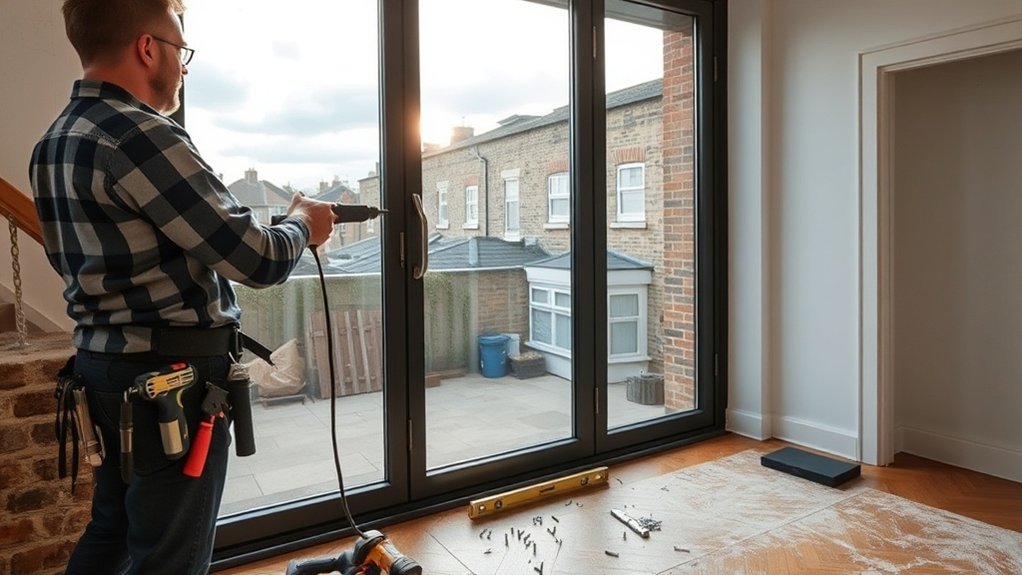
Even with a made-to-measure aluminium set, a correct door installation follows a strict sequence: survey, preparation, frame fixing, sash hanging, glazing (if required), sealing, and final adjustment . You start by laser-checking openings for plumb, level, and twist, so the system’s Aluminium durability isn’t compromised by racking.
You then dry-fit the thermally broken frame, pack it off the substrate, and fix with appropriate anchors, maintaining constant sightlines. Next, you hang the sash, set hinge tension, and calibrate multipoint locking engagement.
For units with glazing, you choose high-performance glass options, insert setting blocks, then toe-and-heel to prevent drop. Finally, you apply perimeter sealants and fine‑tune compression gaskets.
- Verify tolerances
- Secure fixing points
- Optimise hardware alignment
- Test airtightness and operation
Planning Access, Disruption, and Waste for Installation
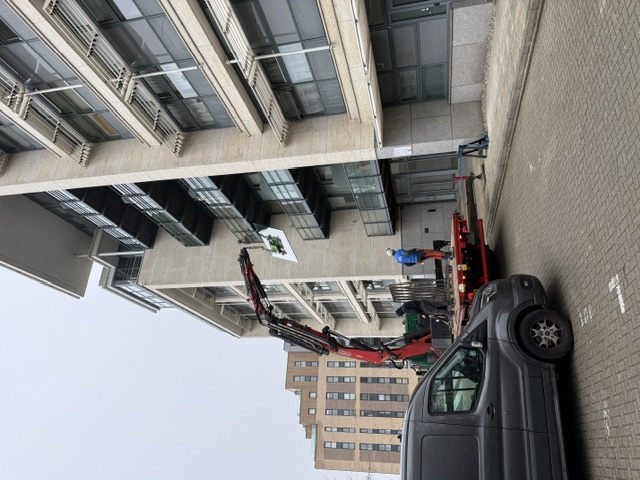
You’ll need to plan site access so your installer can get frames, glass units, and tools to the aperture safely, factoring in parking bays, loading restrictions, and stair or lift constraints common across London postcodes. At the same time, you should agree a disruption management plan covering noisy works, dust control, and temporary security to keep the property operational during the change‑out. Finally, specify waste streams and disposal routes in advance—old frames, glass, packaging—so everything’s handled in line with WRAP guidance and your contractor’s waste carrier license.
Site Access Logistics
Before a single frame is lifted into place, site access logistics determine whether your aluminium door installation runs smoothly or stalls on day one. You map vehicle routes , loading zones, and lift paths so your installers can move large-format profiles without damaging finishes or compromising material durability and aesthetic appeal.
You’ll coordinate with building management, neighbours, and local authorities to align delivery windows with parking and crane restrictions common across London boroughs. A precise access plan typically covers:
- Clear dimensions for corridors, stairwells, and lift cars
- Temporary protection to floors, reveals, and façade interfaces
- Staging areas for frames, glass units, and ironmongery
- Segregated walkways to keep residents and operatives safely separated
This upfront detail compresses install time and reduces on-site risk.
Managing Disruption And Waste
While access planning sets the route in, managing disruption and waste determines how cleanly your aluminium door installation integrates with day‑to‑day life in a London building. You sequence noisy operations into tight work windows, isolate the workface with dust barriers, and protect high‑traffic routes with Correx, hardboard, or Ram Board.
You pre‑specify skip size, waste segregation (metal, glazing, timber, masonry), and lifting methods so old frames, packers, and defective plaster go straight into designated streams. For garden integration, you coordinate temporary lifting platforms, turf protection, and reinstatement of landscaping. Internally, you align protection layouts with Interior design schemes, safeguarding finishes and fixtures. A clear method statement and resident communication plan keep nuisance, downtime, and environmental impact to a minimum.
Common Aluminium Door Problems in London Homes
London’s housing stock and variable microclimates create a distinct set of aluminium door issues, typically centred on frame movement, hardware fatigue, and glazing performance. You often see differential settlement between old masonry and new frames, causing sash misalignment, compromised seals, and draught paths that undermine both thermal performance and aluminium aesthetics within high-spec interior design schemes.
You’ll typically contend with:
- Bi‑fold and slider rollers binding on contaminated or racked tracks
- Lock keeps and multipoint gearboxes de‑centering, leading to handle “bounce”
- Cold-bridge risks at poorly specified thresholds near uninsulated floor zones
- Condensation at perimeter gaskets where vapour control and ventilation are mismatched
In London’s dense urban fabric, acoustic lamination can also underperform if glazing units de-couple from the frame under cyclical movement and traffic vibration.
Maintaining Aluminium Doors and Keeping Them Looking New
Once you understand how aluminium doors in London can rack, lose gasket compression, or suffer from fatigued hardware, you can put a maintenance regime in place that keeps them operating smoothly and looking factory‑fresh. You start by implementing scheduled maintenance routines : quarterly checks of hinge fixings, lock keeps, and adjustment points on the friction stays or pivot gear.
Clean the profiles with a pH‑neutral detergent, not abrasive agents that can score anodised or powder‑coated decorative finishes. Inspect the EPDM gaskets for hardening, shrinkage, or loss of bite against the sash and frame; replace sections that no longer provide uniform contact.
Lightly lubricate multipoint lock gearboxes and rollers with a non‑silicone, corrosion‑inhibiting spray, wiping off excess to avoid attracting particulates.
Warranties, Guarantees, and Aftercare in London
Although aluminium systems are inherently durable, you should still interrogate the warranties, guarantees, and aftercare packages offered by London installers with the same rigour you apply to U‑values or wind‑load calculations . You’re looking for warranty coverage that differentiates between frame, hardware, powder‑coat finish, glass units, and installation workmanship, with clear defect definitions and exclusions.
Specify response times and call‑out protocols within formal aftercare services. A serious installer will log your doors on a digital asset register and schedule proactive inspections.
Key points to lock down:
- Duration and scope of structural and finish warranties
- Transferability of guarantees on sale or lease of the property
- Availability of smart diagnostics and remote support for automated doors
- Costed, itemised aftercare services for seals, rollers, and adjustments
Frequently Asked Questions
Can Aluminium Doors Be Installed in Listed Buildings or Conservation Areas in London?
You can install aluminium doors in listed buildings or conservation areas, but you’ll need planning consent and possibly listed building consent . You must prove Historical preservation isn’t compromised and demonstrate Architectural compatibility through detailed elevations, section details, and material samples. Specify slimline thermally broken profiles, sympathetic sightlines, heritage glazing bars, and muted powder‑coat finishes. Engage a conservation officer early and submit a full specification package to de‑risk refusals.
How Do Aluminium Doors Perform in London’s Polluted, High-Traffic Environments?
They perform exceptionally well, provided you specify the right system. Powder‑coated profiles offer superior weather resistance against acidic rain, soot and particulates, while EPDM gaskets and thermal breaks prevent ingress and condensation. You’ll minimise maintenance requirements with anodised or marine‑grade finishes, periodic hardware lubrication and scheduled seal inspections. High‑traffic sites benefit from robust hinge gear, multi‑point locking and offset pivot options that maintain alignment under constant use and urban pollution.
Are There Eco-Friendly or Recycled Aluminium Door Options Available in London?
Yes, you’ll find eco friendly options and recycled aluminium systems readily available. Picture a skyline forged from re-melted curtain-wall offcuts and reclaimed billet, then scaled down into your threshold. You can specify thermally broken profiles, low-embodied-carbon alloys, and powder coats compliant with Qualicoat and ISO 14001. Ask for Environmental Product Declarations , high post-consumer scrap content (≥75%), and compatibility with PAS 24 and Part L to future‑proof your spec.
Can Existing Wooden or uPVC Frames Be Reused for New Aluminium Doors?
You can sometimes reuse existing timber casings, but wood frame reuse for aluminium slabs is rarely plug‑and‑play. You’ll need a survey to verify plumb, twist, structural integrity and anchorage points. UPVC frame adaptation is even less viable; profiles lack the compression strength and fixing options for aluminium door weights and hardware loads. Most innovators specify new thermally broken aluminium outer frames, precision‑shimmed and mechanically fixed into the existing aperture.
How Long Does Planning Permission for New Exterior Aluminium Doors Usually Take?
You’ll typically see planning permission decided within 8–12 weeks, assuming clean drawings, specs, and no conservation constraints. You’ll fast‑track approval by supplying section details, U‑values, glazing data, and hardware schedules demonstrating enhanced door security and weather resistance (gaskets, thresholds, drainage). Factor extra time if you’re altering apertures or elevations. Engage building control early so planning, structural sign‑off, and Part L/Part Q compliance run in parallel.
Summary
When you specify aluminium doors for your London property, you’re not just upgrading; you’re weaponising your envelope. You lock in U-values, slam shut thermal bridging, and turbo‑charge usable glazing area. With correct setting-out, plumb and level frames, and fully bedded perimeter sealant, you’ll dodge the horror-show of drafts, racking, and water ingress. Maintain hardware, re-lubricate, and inspect gaskets, and your install will outlast fashion, fads, and probably the building itself.