
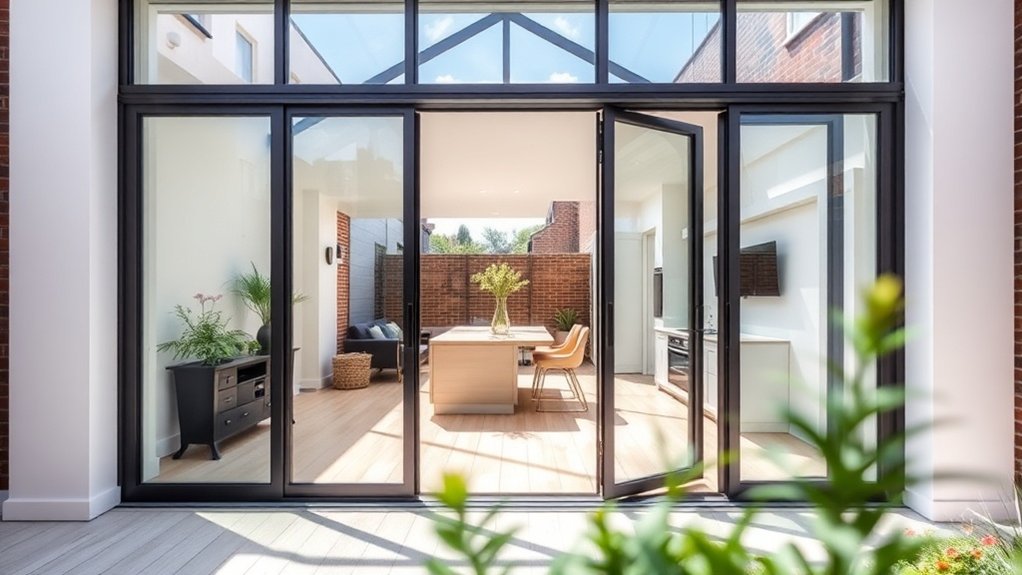
When you specify bifold door glazing in London, you balance slim aluminium or timber frames, low‑E double or triple glazed IGUs, and warm‑edge spacers to hit Part L U‑value targets around 1.0–1.2 W/m²K while controlling solar gain and noise. You’ll consider PAS 24‑rated laminated security glass, trickle vents, drainage paths, and heritage sightline constraints in conservation areas. Get these details right and you can gain access to wide openings, strong performance, and compliant installations.
Key insights
- Choose thermally broken aluminium or timber-look frames with slim sightlines to balance modern aesthetics, heritage sensitivity, and maximum glass area in London homes.
- Specify double glazing with low‑E coatings and argon fill for most London properties; consider triple glazing only where noise and thermal performance demands justify added weight.
- Ensure compliance with Part L U‑values, PAS 24 security, and any conservation or Article 4 planning restrictions before committing to a bifold glazing system.
- Use laminated or toughened safety glass, multi‑point locking, and continuous gaskets for burglary resistance, impact safety, and reliable long‑term weather sealing.
- Select reputable FENSA/Certass installers, demand itemised quotes and written warranties, and confirm drainage, trickle vents, and maintenance access are properly detailed.
How Bifold Glazing Works in London Homes
Ever wondered what actually happens between those slim aluminium sightlines and the edge of your opening when a bifold runs across its track? You’re driving a series of top- or bottom-hung panels along precision rollers, compressing gaskets against the frame to maintain a continuous thermal and weather seal. Each sash hinges on multi-leaf carriers that distribute load into the head and threshold.
In London homes, especially within Historical architecture, you’re often interfacing new thermally broken aluminium or composite profiles with irregular masonry reveals. That demands packers, shims, and silicone bedding to keep the glazing line true. Drainage slots, trickle vents, and warm-edge spacer bars handle condensation risk. If you ignore these details, you’ll see premature hardware wear, blown units, and ongoing maintenance challenges.
Key Factors When Choosing Bifold Glazing in London
When you choose bifold glazing for a London property, you’re really balancing structural performance, thermal efficiency, daylighting, and planning constraints against budget and site conditions. You’ll need glass specs that satisfy London micro‑climate loads, Part L/U‑value targets, and acoustic attenuation for urban noise. Low‑iron, solar‑control, or triple glazing may be justified on south‑facing elevations.
In conservation areas or streets dominated by historical architecture, sightlines, mullion pattern, and reflective index must respect heritage character while still optimising glass‑to‑frame ratio. Factor in interior decoration: specify coatings and tints that preserve colour fidelity and control glare for open‑plan spaces. Finally, scrutinise hardware integration, drainage thresholds, and airtightness details to ensure the glazing package performs as a coherent façade system.
Frame Materials and Styles for London Bifold Doors
Having defined the glazing specification , you now need a frame system that supports those loads, meets Part L targets, and suits London’s architectural context. You’ll typically shortlist thermally broken aluminium, alu-clad timber, or engineered timber with laminated cores for dimensional stability on wide-span bifolds.
Go for slimline aluminium profiles if you want maximum glass-to-frame ratio and precise sightline control; specify polyamide thermal breaks, warm-edge spacers, and low-conductivity gaskets to keep Uw values compliant. For heritage streetscapes, you can deploy slender, putty-line timber sections or steel-look aluminium with applied glazing bars and decorative patterns aligned to existing fenestration.
Integrate custom tints, frits, or ceramic-printed designs by coordinating bead depths, rebate dimensions, and drainage paths with your preferred glazing system.
Double vs Triple Glazing for London Bifold Doors
Although both can meet Part L in London, choosing between double and triple glazing on bifold doors hinges on balancing U‑values, unit weight, and real‑world performance in an urban climate. Double glazing typically delivers compliant U‑values with slimmer IGUs, lighter sash weights, and reduced hardware stress, which matters on wide‑span bifolds.
Triple glazing pushes thermal performance further, but you’ll load hinges, rollers, and head tracks, increasing risk of deflection and service calls if the frame system isn’t engineered for the extra mass. In historical architecture retrofits, double glazing often interfaces better with existing lintels and thresholds. For contemporary interior design schemes demanding quieter, more thermally stable garden rooms, a structurally‑rated triple‑glazed bifold can justify its higher capex.
Glass Types: Low‑E, Solar Control and More
When you specify bifold glazing for a London property, you’ll usually choose between Low‑E coatings for enhanced U‑values and solar control glass for better g‑value management. You’re not just picking “energy‑efficient glass”; you’re selecting precise coating types, tint options, and performance ratings that affect heat loss , solar gain, and visible light transmission. Understanding how Low‑E glass improves thermal performance and how different solar control configurations limit overheating helps you match the glazing spec to London’s mixed heating‑and‑cooling demands.
Low‑E Glass Benefits
Why specify Low‑E or solar control glass in your bifold doors instead of standard double glazing? You’re chasing higher performance. Low‑E coatings reflect long‑wave heat back into the room, cutting U‑values and improving whole-frame thermal transmittance . In London refurbishments, that’s vital when you’re opening up rear elevations or integrating bifolds into historical architecture without over-insulating the fabric.
You can specify different Low‑E soft‑coat formulations to fine‑tune g‑values, daylight transmittance, and interior surface temperature, improving comfort at the glass line and reducing cold‑spot downdrafts . Low‑E also helps mitigate internal condensation risk on large-span bifolds. For custom designs, you’ll combine Low‑E with laminated units, slimline sightlines, and warm‑edge spacers, delivering contemporary energy performance while preserving original proportions and detailing.
Solar Control Glass Options
So once you’ve committed to performance glazing for your London bifolds, the next step is choosing the right solar control specification from the growing range of coated glass types . You’re balancing g‑value, visible light transmittance (VLT), and U‑value to keep solar gain in check without deadening natural daylight.
-
Low‑E solar control: Dual‑purpose coatings that cut heat loss while selectively reflecting near‑infrared radiation.
-
Neutral solar control: Spectrally selective coatings delivering high clarity with reduced internal glare.
-
Tinted solar control: Body‑tinted substrates with low‑E or solar coatings layered on, giving advanced tinting options.
-
Decorative patterns with control: Fritted or patterned glass combined with solar control coatings, optimising shading, privacy, and façade aesthetics while still hitting London compliance on overheating and energy targets.
Acoustic Bifold Glazing for Noisy London Streets
Acoustic bifold glazing lets you enjoy large openings to your garden while sharply reducing the intrusion of traffic, rail, and aircraft noise common across London streets. You prioritize Historical preservation and Aesthetic design, so you can’t tolerate bulky secondary glazing or compromised sightlines.
You specify laminated acoustic glass with asymmetric panes, using different thicknesses to disrupt sound frequencies typical of buses, sirens, and Tube lines. A widened air cavity, optimized for 35–45 dB Rw performance , combines with warm‑edge spacers and argon fill to maintain thermal efficiency.
You also select high‑compression gaskets, multi‑point locking, and precision‑engineered thresholds to eliminate flanking paths and resonance. By working with manufacturers who provide lab-tested acoustic data , you guarantee the installation meets your project’s noise criteria and planning constraints.
Light, Privacy and Views With Bifold Glass
Once you’ve controlled noise, bifold glazing becomes a tool for managing daylight, privacy, and sightlines rather than a compromise. You’re effectively specifying a transparent façade system, so you need to tune glass build-up and coatings to your urban context and Interior aesthetics.
- Daylight control – Use low-iron glass and variable tint interlayers or switchable (PDLC) glass to modulate lux levels without heavy blinds.
- Privacy tuning – Combine obscure panes on lower sections with clear vision panels at eye level to block overlooking while preserving long views.
- View framing – Minimise mullion widths and align panel breaks with key external focal points to create intentional view corridors.
- Glazing maintenance – Specify hydrophobic coatings and accessible hardware sightlines so routine cleaning and inspection remain practical in dense London plots.
Energy Efficiency and U‑Values in London Homes
When you specify bifold door glazing for a London property, you need to understand U‑values so you can quantify heat loss through the glass and frames. A lower whole‑unit U‑value (not just centre‑pane) means better thermal performance, reduced space‑heating demand, and easier Part L compliance. By choosing appropriate double or triple glazing, low‑E coatings, warm‑edge spacers, and argon or krypton fills, you’ll optimise energy savings without compromising the bifold’s sightlines or operation.
Understanding U‑Values
Although they’re often buried in the small print of product specs, U‑values are one of the most critical performance figures to understand when choosing glazed bifold doors for a London home. A U‑value quantifies heat transfer (W/m²K) through the complete door system: glass, frames, spacers, and seals. Lower numbers mean tighter thermal performance and less energy loss.
When you compare options, you should interrogate:
- Whole‑door U‑value vs centre‑pane U‑value (many brochures only quote the latter).
- Glass build‑up: double vs triple, gas fill, low‑E coatings, and any window tinting.
- Frame material and thermal breaks; sightline depth vs conductivity.
- Impact of decorative patterns, spacer bars, and gaskets on edge‑of‑glass performance.
Glazing For Energy Savings
In a city where energy costs and Part L compliance keep tightening, glazing choices for your bifold doors directly influence both heat loss and solar gains in a London home. You’re balancing low U‑values with g‑value control, daylighting, and frame-to-glass ratios.
For superior energy savings, you’ll typically specify argon- or krypton-filled double or triple glazing, warm-edge spacers, and soft‑coat low‑E to push whole-door U‑values toward 1.0–1.2 W/m²K. In conservation zones, you can still meet Historical preservation constraints by using slimline units , putty‑line sightlines, and sash‑like mullion layouts.
Solar-control coatings on south and west elevations limit summer gains without killing winter passive heat. Lamination, acoustic interlayers, and thermally broken aluminium systems let you integrate high performance with sharp aesthetic design.
Security and Safety Features in Bifold Door Glazing
Even before you consider aesthetics or thermal performance, bifold door glazing in London has to meet demanding security and safety criteria driven by dense urban living and stringent UK standards. You’re not just choosing glass; you’re specifying an integrated security envelope .
- Laminated security glass: Multi-layer PVB or ionoplast interlayers resist manual attack, keep shards bonded, and support PAS 24 compliance.
- Toughened safety glass : Heat-treated, impact-rated panes fracture into small granules, minimising injury risk on busy terraces and high-traffic zones.
- Obscuration with control: Frosted finishes and decorative patterns deliver privacy without compromising sightlines for CCTV and natural surveillance.
- Hardware–glass interface : Internally beaded systems, high-spec hinge fixings, and continuous glazing gaskets prevent panel deglazing, improving anti-jemmy performance.
Planning and Conservation Rules for Bifold Doors in London
Before you sketch an opening or specify glass, you have to map your bifold door glazing proposal against London’s layered planning and conservation controls, which can be more restrictive than general UK guidance. You’ll navigate Article 4 Directions, conservation area appraisals , and listed building consent, all of which dictate sightlines, frame‑to‑glass ratios, and threshold geometry.
Planners will test how your bifolds read within the host elevation, especially where historical architecture drives the streetscape character. You’ll often need heritage‑impact statements, 1:20 joinery details, and section drawings proving minimal intervention to original fabric . Align your glazing specification with Part L, noise attenuation targets, and solar‑gain limits, while collaborating early with conservation officers so your contemporary interior design concept and high‑performance bifold system remain policy‑compliant.
Costs, Warranties and Choosing a Bifold Glazing Specialist
Although bifold door glazing can transform a London property, you need to interrogate costs, warranties, and installer credentials with the same rigour you’d apply to structural or M&E packages. Treat the bifold package as a long‑term performance asset, not a cosmetic add‑on.
- Costs: Request itemised quotations separating frame, glass spec, hardware, Color options, access control, structural steels, and making-good. Compare like-for-like U‑values and acoustic ratings.
- Warranties: Check system house vs. installer warranties, paint finish guarantees, IGU seal failure cover, and workmanship terms. Insist on insurance‑backed protection.
- Specialist credentials: Verify FENSA/Certass, manufacturer approval, and references for complex openings or heritage interfaces.
- Installation timelines: Align lead-times with your critical path, allowing for survey, fabrication, off-site testing, and snagging before practical completion.
Frequently Asked Questions
How Do Bifold Glazed Doors Affect Home Resale Value in Different London Boroughs?
You’ll typically see higher resale uplift in premium boroughs where buyers pay a premium for Energy efficiency and aesthetic appeal. In Kensington & Chelsea or Westminster, thermally broken , low‑U‑value systems can add strong ROI, especially opening onto landscaped terraces. In outer boroughs like Bromley or Enfield, value hinges on cost-effective specs: secure, PAS 24‑rated hardware, argon-filled units, and decent sightlines, rather than ultra-slim, top-tier architectural systems.
Can Existing Bifold Doors Be Retrofitted With Upgraded Glazing Later?
Yes, you can usually retrofit existing bifold doors with upgraded glazing, provided the profiles are rated for heavier units. A competent installer will check sash sightlines, hinge load capacity, and gasket compatibility before swapping in higher-spec units. You’ll typically upgrade to low‑E, argon‑filled, laminated panes , boosting energy efficiency and glass durability. Specify warm‑edge spacers, toughened outer skins, and correct unit thickness to avoid sash drop, binding, or seal failure.
What Seasonal Maintenance Do London Bifold Glazed Doors Typically Require?
You’ll inspect gaskets, seals, and drainage channels each season, then adapt Cleaning schedules to local pollution and pollen loads. In spring and autumn, lubricate hinges, rollers, and locking cams with silicone spray, not oil. Winter Weatherproofing tips : check rebate compression, adjust hinge alignment, and verify threshold packers. Summer: monitor glass expansion, tweak locking keeps, and confirm trickle vent operation to maintain airtightness without compromising thermal performance.
How Do Bifold Glazed Doors Perform in London’s Hard Water and Pollution Conditions?
You’ll see solid performance: Glass durability generally resists mineral-laden hard water and airborne particulates, while modern seals deliver strong water resistance under driving rain. However, limescale spotting contrasts with the sleek glazing, so you’ll specify low-iron, hydrophobic or photocatalytic coatings to minimise etching and staining. Use marine‑grade hardware, EPDM gaskets, and thermally broken aluminium profiles to combat corrosion, guarantee smooth stacking, and maintain long-term air‑tightness and clarity.
Are There Smart-Home Integrations Available Specifically for Bifold Door Glazing Systems?
You can integrate glazing systems with smart-home ecosystems using smart sensors and voice control. You’ll specify contact sensors in the frame, motorised locks, and sometimes electrochromic or integral blinds tied into Zigbee, Z‑Wave, or Matter hubs. You’ll trigger scenes via Alexa, Google, or HomeKit and set automation for security, thermal management, and occupancy. Make certain the door hardware supports low-voltage wiring, secure APIs, and over‑the‑air firmware updates.
Summary
When you choose bifold door glazing in London, you’re not just picking glass; you’re specifying U‑values , selecting profiles, and optimising performance. You align thermal efficiency, acoustic control, and solar gain. You balance sightlines, panel weight, and hardware loading. You factor in Part L, Secured by Design, and conservation constraints. By working with a specialist, you’re reducing callbacks, improving airtightness, and future‑proofing your property’s envelope and long‑term lifecycle cost.