
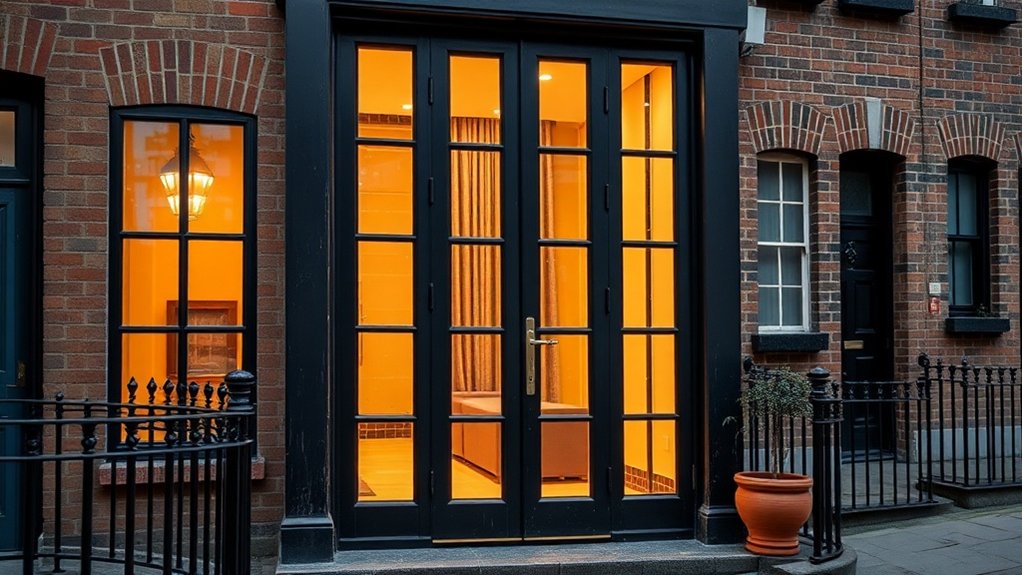
Glass panel doors in London let you maximise daylight , improve U-values, and upgrade security while respecting period character and local planning controls. You can specify engineered timber, aluminium, or uPVC frames with argon-filled low‑E double or triple glazing, laminated security glass, and PAS 24‑rated multi-point locking. Internal glass doors prioritise light transfer and zoning with frosted or reeded privacy options. Next, you’ll see which door types, materials, and costs best suit your property.
Key insights
- Glass panel doors in London homes maximise natural light and space, especially in Victorian terraces and modern apartments with long, narrow layouts.
- Homeowners can choose internal doors for light flow and zoning, or secure external doors prioritising PAS 24 security, U‑values, and weather resistance.
- Popular frame materials include engineered timber, aluminium, uPVC, and alu‑clad hybrids, balancing aesthetics, maintenance needs, and thermal performance.
- Frosted, reeded, etched, or switchable glass provides privacy while maintaining daylight, ideal for street‑facing entrances and overlooked urban sites.
- Made‑to‑measure doors allow bespoke sizes, glazing specs, and hardware, while off‑the‑shelf options suit standard openings with faster, predictable lead times.
Why Glass Panel Doors Suit London Homes
Although London’s housing stock spans everything from Victorian terraces to contemporary apartments, glass panel doors consistently solve the same core challenges: light, space, and flow. You leverage glazed doors to maximise daylight penetration, achieve visual continuity , and reduce the perceived depth of narrow corridors and compact rooms.
By aligning sightlines, you create a seamless spatial narrative that standard solid doors can’t deliver. You can integrate glass art within the door leaf to act as a focal point, merging function with bespoke aesthetics.
Optimised window design principles apply: you calibrate glazing ratio, U‑values, and solar gain to maintain thermal performance while enhancing luminosity. With acoustic laminates, privacy interlayers, and slimline profiles, you get a future‑proof, design‑led solution tailored to London’s dense urban fabric.
Internal vs External Glass Panel Doors in London
When you specify glass panel doors in London, you need to differentiate clearly between internal systems and external units, as each demands distinct glazing configurations and hardware performance. External doors must prioritise PAS 24-compliant security , U-value optimisation, and privacy control, while internal doors focus more on light transmission, acoustic performance, and spatial zoning. By matching design, security, privacy, and insulation requirements to location, you’ll select door assemblies that perform correctly for both interior layouts and exposed elevations.
Design Differences And Uses
In specifying glass panel doors for London properties, you need to distinguish early between internal and external applications, as each demands a different construction, glazing spec, and performance profile.
For internal doors, you’ll typically prioritise daylight transfer , spatial flow, and visual hierarchy. Slimmer stiles and rails, larger vision panels, and bespoke decorative glass or stained glass let you define zones while keeping a continuous aesthetic across open‑plan schemes and circulation routes.
External doors demand a different design intent: robust framing sections, weather‑resistant thresholds, and glazing layouts that manage exposure and user traffic. You’ll often deploy narrower glass apertures or sidelights and fanlights instead of full‑height glazing, enabling strong frontage design while still aligning with contemporary London façades and conservation constraints.
Security, Privacy And Insulation
Balancing security, privacy, and insulation correctly hinges on whether you’re specifying glass panel doors for internal partitions or external openings onto London streetscapes. For external doors, you’ll prioritise laminated security glass, multi-point locking , and low‑emissivity double or triple glazing to meet Part L and Secured by Design benchmarks while maintaining thermal performance against London’s variable climate.
Internally, you can relax impact resistance and U‑values, focusing instead on privacy control using etched, reeded, or switchable smart glass. These solutions let you retain borrowed light while preventing overlooking between zones. Where façades possess historical significance, you can integrate slimline heritage IGUs and discreet security films behind existing decorative accents, achieving enhanced security and insulation without compromising period character or conservation requirements.
Main Types of Glass Panel Doors in London
When you’re selecting glass panel doors in London, you’ll typically assess two core categories: internal glazed door styles and external glass door options. Internally, you’ll weigh up configurations like fully glazed , part-glazed, and glazed pocket or sliding systems to optimise light transfer, privacy, and acoustic performance. Externally, you’ll specify between options such as composite doors with glazed inserts, aluminium or uPVC glazed units, and sliding or bifold systems to achieve the right balance of thermal efficiency, security, and aesthetics.
Internal Glazed Door Styles
Whether you’re retrofitting a Victorian terrace or specifying doors for a new-build flat, the main internal glazed door styles in London fall into a few clear categories: fully glazed, half glazed , and panelled with vision lights, plus space-saving systems like pocket, sliding, and bi-fold configurations.
You’ll typically pair fully glazed doors with slimline timber or aluminium stiles and rails, using bespoke glass tints and decorative patterns to tune privacy, daylight transmission, and acoustic performance. Half glazed doors suit traditional joinery, maintaining solid lower panels for impact resistance.
For tight floorplates, specify top-hung sliding or pocket systems with soft-close gear, or bi-fold leaves on low-profile tracks to minimise threshold disruption while maximising clear opening width and circulation efficiency.
External Glass Door Options
From high-spec rear extensions to secure street-facing entrances, external glass panel doors in London typically resolve into a few core systems: thermally broken aluminium sliders and bifolds, composite or timber front doors with insulated glazed inserts, and steel-framed or aluminium-framed minimal-profile sliders for premium schemes.
You’ll typically specify low‑E, argon-filled double or triple glazing with warm-edge spacers to hit London’s tight U‑value targets while maximising solar gain control. For front doors, combine laminated security glass with multipoint locking and PAS 24 compliance .
If you want Decorative glass, consider acid-etch, reeded, or digital ceramic frits that maintain privacy without sacrificing daylight. Factor in Glass cleaning from the outset: self-clean coatings, accessible track design, and integrated drainage reduce maintenance on urban façades.
Frame Materials for London Glass Panel Doors: Wood, Aluminium, uPVC
Although glass is the visual focus, the frame material ultimately dictates performance, security, and lifecycle costs for London glass panel doors. You’ll balance frame durability, thermal efficiency, and glass transparency with architectural intent and planning constraints.
With engineered timber, you gain excellent structural integrity, natural insulation, and refined detailing, but you must commit to cyclical coating maintenance, especially on exposed elevations. Aluminium systems deliver slim sightlines, high torsional rigidity, and large-span capabilities; specify thermal breaks and marine‑grade powder coating to combat London’s polluted, moisture‑rich air. uPVC offers strong U‑values and low upkeep at a lower price point, but you’ll accept thicker profiles and limited colour stability. For premium performance, many London projects now specify alu‑clad timber hybrids.
Light and Privacy Options for Glass Panel Doors
As you configure glass panel doors for a London property, you’ll treat light control and privacy as a single performance brief rather than an afterthought. You’re balancing daylighting , sightlines, and occupier comfort while keeping the design language refined.
- Specify frosted, reeded, or satin decorative glass to diffuse daylight, soften external views, and maintain a clean, contemporary aesthetic along busy London streets.
- Use glass etching or acid-etched patterns to establish graded privacy zones —clear at eye level internally, obscured toward the public sphere—without sacrificing perceived openness.
- Integrate switchable (privacy) interlayers and integrated blind systems for meeting rooms, live–work units, or street-facing entrances, giving you on‑demand opacity while retaining slender door profiles and minimal hardware clutter.
Energy-Efficient Glass for London’s Climate
When you specify energy-efficient glass for London’s climate, you’re typically looking at double glazing units that optimise U-values and minimise thermal bridging. By combining argon-filled cavities with low-E coatings, you improve surface temperatures, reduce radiant heat loss, and maintain interior comfort in winter. This approach helps you cut heat loss through your glass panel doors, stabilise indoor temperatures, and lower ongoing heating demand.
Double Glazing For Efficiency
Even in London’s relatively mild climate, double-glazed glass panels dramatically improve thermal performance, acoustic insulation, and overall door efficiency. You’re creating a high‑performance envelope , not just a stylish entrance.
Double glazing traps air or inert gas between panes, reducing U‑values and minimizing convective heat loss through your glass panel doors. You’ll stabilise internal temperatures, cut drafts, and reduce reliance on mechanical heating.
- Specify slimline double-glazed units that integrate seamlessly with modern frames while maintaining a minimal sightline profile.
- Combine bespoke color options with etched or laminated decorative patterns to deliver both branding potential and visual privacy.
- Opt for warm‑edge spacer bars and precision gaskets to minimise thermal bridging, eliminate cold spots at the perimeter, and enhance long‑term airtightness.
Low-E Coatings And Comfort
Double glazing gives your glass panel doors a strong baseline for performance, but low‑emissivity (Low‑E) coatings fine‑tune how those doors manage solar gain, radiant heat and occupant comfort in London’s variable climate. You’re effectively specifying a selective filter: high visible light transmission with controlled solar heat gain coefficients, so spaces feel bright without overheating on south‑facing elevations.
With soft‑coat Low‑E on the inner pane, you stabilise mean radiant temperature, reducing cold‑edge downdrafts and thermal discomfort, vital in tall door sets and curtain‑wall interfaces. In historical architecture, you can pair slimline profiles with bespoke Low‑E spectrums to preserve period sightlines while leveraging modern glazing innovations. You align façade aesthetics, occupant wellbeing and long‑term energy performance in a single specification decision.
Reducing Heat Loss Indoors
Although London’s winters are relatively mild, sustained heat loss through poorly specified glass panel doors drives up energy demand and undermines comfort. You combat this by specifying thermally optimised glazing that treats the door as an insulated façade element, not a weak point.
- You select double or triple glazing with argon fill and warm-edge spacers, cutting U-values while preserving large glazed areas for glass art and decorative panels.
- You integrate insulated thermally broken aluminium or composite frames, eliminating cold bridges around the perimeter.
- You deploy advanced weather seals, low-conductivity thresholds, and tight tolerances, maintaining airtightness under wind pressure .
Safety and Security Features for Glass Panel Doors
How do you balance aesthetics with robust protection when you specify glass panel doors for a London property? You start with laminated or toughened safety glass, using multi-layer interlayers that resist impact and inhibit forced entry. Combine this with PAS 24-compliant door sets, multi-point espagnolette locking , and anti-bump, anti-snap cylinders to harden the envelope.
You can integrate decorative accents without compromising security by applying surface-applied or encapsulated designs to laminated units. For historical restoration, specify slimline security glazing that replicates sightlines while incorporating concealed steel reinforcement in the door leaf and frame. Add security-rated hinges with dog bolts, reinforced keep plates, and sensors pre-wired for your smart alarm system, so you achieve a fully integrated, future-ready security specification.
Best Glass Doors for Period London Homes
Carefully specified glass doors can upgrade a period London home without eroding its architectural integrity or breaching planning constraints. You’ll balance conservation requirements with high‑performance glazing , ensuring U‑values, acoustic ratings, and sightlines all respect the property’s historical significance while delivering contemporary comfort.
-
Choose slimline timber or steel glazing systems that replicate original mullion ratios, allowing larger glazed areas without visually diluting the façade.
-
Integrate bespoke leaded lights, sandblasted motifs, or acid‑etched decorative patterns that echo existing fanlights, cornices, or stained glass in adjacent rooms.
-
Specify laminated, low‑iron glass with warm‑edge spacers and discreet heritage ironmongery, so you achieve PAS 24‑ready security and thermal efficiency while maintaining a period‑correct aesthetic aligned with local conservation guidelines .
Modern Glass Door Styles for London Homes
For contemporary London interiors, you’ll typically evaluate minimalist frameless glass doors, industrial-style Crittall partitions, and frosted glass systems as your core specification options. You can use frameless assemblies to create seamless sightlines, Crittall-style screens to zone open-plan layouts, and frosted glazing to introduce privacy without sacrificing natural light. By aligning these systems with your aperture sizes, acoustic targets, and Part K safety requirements, you’ll achieve a modern, performance-led door solution.
Minimalist Frameless Glass Doors
When you specify minimalist frameless glass doors for a London property, you’re selecting a system that delivers maximum daylight transmission , clean sightlines, and a highly contemporary aesthetic with almost no visible hardware. You control glass thickness to meet structural loading, acoustic performance, and Part K compliance, typically ranging from 10–15 mm toughened or laminated glass. You can integrate subtle decorative patterns via acid‑etching, screen‑printing, or interlayer graphics without compromising transparency.
- Specify ceiling‑concealed tracks and rebated floor details so door leaves appear to float, eliminating visual clutter.
- Combine soft‑close sliders with minimal patch fittings for seamless, low‑friction operation in tight London footprints.
- Pair clear, low‑iron glass with continuous floor finishes to merge zones, maximising perceived volume in compact spaces.
Industrial-Style Crittall Partitions
Although often associated with early 20th‑century warehouses, industrial‑style Crittall‑inspired partitions now deliver rigorously detailed, high‑performance glazing for London homes, combining slender steel or aluminium profiles with narrow sightlines and multi‑pane grids. You leverage thermally broken frames and low‑iron, toughened glass to maximise clarity, structural integrity, and acoustic attenuation between zones.
You can specify fixed screens, pivot or sliding sets to create flexible spatial layouts without sacrificing glass aesthetics. Black powder‑coated finishes remain classic, but you might push into custom RAL colours or anodised aluminium for a more experimental, tech‑driven look. Integrating these partitions as artistic installations, you align muntin patterns with lighting tracks, exposed services, and floor joints, delivering a coherent, industrial‑lux envelope that still feels refined and future‑ready.
Frosted Glass for Privacy
As London plots tighten and sightlines between homes increase, frosted and satin‑etched glass doors let you preserve privacy without sacrificing daylight or a clean, contemporary aesthetic. You can specify the opacity level, diffusion pattern, and coating, so Frosted privacy becomes a calibrated performance feature rather than a compromise.
You’ll treat the door leaf as an architectural light filter, using:
- Full‑height, acid‑etched frosted glass sliders to zone kitchens and living spaces while maintaining luminous, open‑plan flow.
- Decorative glass with gradient frosting for ensuites, delivering obscuration at eye level and clarity above for maximum daylight penetration.
- Laminated frosted privacy units with soft‑close pocket systems in hallways, optimising circulation, acoustic control, and visual screening without adding bulk.
Made-to-Measure vs Off-the-Shelf Glass Panel Doors
Choosing between made-to-measure and off-the-shelf glass panel doors in London comes down to how precisely you need to control dimensions, performance, and aesthetics. With made-to-measure, you specify exact aperture sizes, hinge locations, and hardware interfaces, optimising clearances, swing paths, and threshold details. You can upgrade glass durability with thicker toughened or laminated units, low-iron glass, and bespoke coatings, while tuning aesthetic appeal through custom mullion layouts, frit patterns, and edge finishes.
Off-the-shelf doors suit standard openings and fast-track programmes. You leverage pre-engineered frame systems, tested hardware sets, and predictable lead times, but accept constraints on glass thickness, panel width, and configuration. For high-spec residential or commercial schemes, you’ll often hybridise: standardised cores with custom leafs, ironmongery, and glazing specifications.
Planning and Building Rules for London Glass Doors
Before you finalise any glass panel door specification in London, you need to map it against planning controls, Building Regulations, and (where relevant) conservation or leasehold restrictions . You’ll need to evidence compliance on thermal performance, safety glazing, fire integrity, and means‑of‑escape, especially in multi‑residential schemes.
-
Façade and streetscape – Check if your elevation change triggers planning; frameless doors, Glass art, and oversized decorative panels often need design‑led justification within local design codes.
-
Safety and fire compliance – Specify BS 6262 and BS EN 14449 safety glass, appropriate impact zones , and, where required, FD30/FD60 rated systems with certified ironmongery.
-
Leasehold and common parts – For flats, align with landlord specifications, acoustic requirements, and escape route widths; obtain freeholder consent before commissioning any structural opening or threshold reconfiguration.
Costs and Budgeting for Glass Panel Doors in London
Cost planning for glass panel doors in London starts with understanding how specification, access constraints, and compliance requirements drive the final price per opening. You’ll model costs around glass type (laminated, acoustic, fire‑rated), hardware set, and frame system, then overlay London‑specific logistics such as manual handling, hoists, and out‑of‑hours installation.
Structured cost analysis should break down supply, prelims, fixings, access equipment, waste removal, and certification. You’ll also factor in design coordination with M&E and façade interfaces to avoid expensive rework. For robust budget planning, create ranges: baseline (standard toughened), mid‑spec (enhanced U‑values, soft‑close), and premium (smart glass, integrated access control). Include a contingency for variations triggered by Building Control comments or late-stage design changes.
How to Choose Glass Door Installers in London
Once you’ve ring‑fenced a realistic budget , you need installers who can execute your glass door specification without value‑engineering away performance or compliance. You’re not buying generic glazing; you’re procuring precision‑engineered assemblies where Glass durability, structural loading, and detailing are non‑negotiable.
-
Technical credentials – Prioritise firms with FENSA/GGF membership, demonstrable Part L and Part K literacy, and a portfolio of complex London refurbishments, not just new‑build volume.
-
Specification discipline – Guarantee they commit in writing to glass type, hardware systems, tolerances, and sealing methodology, not just “equivalent” products.
-
Programme and logistics – Test their installation timing strategy : lead times, survey accuracy, crane/hoist access, out‑of‑hours working, and risk mitigation for occupied properties, so your project runs lean, fast, and disruption‑light.
Care and Maintenance to Extend Glass Door Lifespan
Although high‑spec glass door systems in London are engineered for long service lives, their durability still depends on disciplined, routine maintenance. You should implement a scheduled regime that integrates glass cleaning , frame maintenance, and hardware calibration into your FM workflow.
Use pH‑neutral, non‑abrasive solutions for glass cleaning to protect advanced surface treatments, low‑iron panes, and UV coatings. Specify microfiber applicators and squeegees to eliminate micro‑scratching that can propagate into edge defects.
For frame maintenance, inspect aluminium or steel profiles for electrolytic corrosion, sealant failure, and gasket compression set. Re‑torque fixings to manufacturer tolerances and lubricate hinges, pivots, and sliding gear with silicone‑compatible lubricants.
Finally, document all interventions in a digital maintenance log to analyse performance trends and pre‑empt structural or operational failures.
Frequently Asked Questions
Can Glass Panel Doors Help Reduce Noise From London Street Traffic?
Yes, if you specify the right system. You’ll need double- or triple-glazed glass panel doors with laminated acoustic glass, tight perimeter seals, and decoupled frames to leverage advanced soundproofing techniques. Integrate high-density acoustic insulation in surrounding wall cavities and threshold drops at the sill. You’ll achieve meaningful reductions in street traffic noise by treating the door as part of a holistic acoustic envelope upgrade , not a standalone element.
Are Glass Panel Doors Suitable for Households With Pets and Young Children?
Yes, they’re suitable if you specify the right configuration. You’ll prioritize laminated safety glass for impact resistance, robust frames, and secure multi-point locking for Pet safety and Childproof features. Integrate soft-close hinges , low-threshold sills, and anti-finger-trap gaskets. Specify toughened or laminated units that meet BS EN safety standards and consider integral blinds to eliminate cord hazards. You’ll get transparency, durability, and a secure interface between high-traffic zones and living areas.
How Do Glass Panel Doors Perform in London’s Hard-Water Areas and Damp Conditions?
They perform reliably if you specify the right spec. With limescale affecting over 60% of UK homes, you’ll want toughened glass for maximum glass durability and low porosity. Hard water leaves mineral deposits, but you can mitigate this with hydrophobic nano-coatings and periodic squeegee cleaning. In damp conditions, prioritize thermally broken frames, drained-and-vented glazing systems, and marine-grade hardware to keep maintenance requirements predictable and lifecycle costs optimised.
Can I Integrate Smart Locks or Sensors With My Glass Panel Doors?
You can integrate smart locks and sensors , provided you specify hardware engineered for glazed-door applications. Prioritize Smart lock integration with through-glass or clamp-on mounting and low-profile interior escutcheons to avoid glass stress. Confirm Sensor compatibility with multi-point locking gear, magnetic contacts, and concealed wiring in the frame. Always coordinate with your fabricator for hinge-load calculations, glass cut-out tolerances, and EN/BS-certified access control components.
What Design Options Work for Very Narrow London Hallways or Entrances?
You maximise narrow hallways by specifying full-height, Modern minimalist glazed leaves with slim aluminium stiles and top-hung sliders to eliminate swing radius. Use clear low‑iron glass with Decorative frosted banding for privacy while retaining light transmission. Integrate pocket or wall‑track systems, recessed floor guides, and concealed overhead closers. Opt for flush pull‑handles, colour‑matched hardware, and soft‑close mechanisms to keep circulation clear and the visual profile ultra‑streamlined.
Summary
When you specify glass panel doors for your London property, you’re not just chasing aesthetics – you’re optimising performance. Studies show upgrading glazing can cut heat loss by up to 30%, directly impacting your EPC rating and running costs. By selecting appropriate U-values, acoustic ratings and secure hardware, you resolve light, privacy and security constraints in one package. Partner with a FENSA-registered installer and implement a proactive maintenance schedule to maximise lifecycle and ROI.