You can use patterned decorative glass in London to fine-tune privacy, daylight, and acoustics while respecting both period and contemporary architecture. Fritted, acid-etched, reeded, and fluted options work for shopfronts, stairwells, offices, and bathrooms, with patterns tuned for sightlines and light spread. Correct BS EN safety specs , edge detailing, shadow gaps, and minimal channels keep panels durable and easy to clean. You’ll also want to understand costs, lead times, and planning rules to make the best decisions.
Key insights
- Patterned decorative glass in London is widely used for retail frontages, offices, transport hubs, and residential interiors to balance transparency, privacy, and branding.
- Typical applications include fritted or etched shopfronts, fluted balustrades, shower screens, office partitions, and feature doors with tailored light and privacy control.
- London projects often integrate patterned glass with heritage detailing, referencing Victorian, Edwardian, or Art Deco motifs while upgrading performance and energy efficiency.
- Specialist London fabricators offer custom patterns, digital printing, acid-etching, embossing, and switchable films, allowing precise control of opacity, color, and pattern scale.
- Successful installations depend on precise detailing: specialist fixings, shadow gaps, minimal channels, and carefully aligned joints to maintain pattern continuity and durability.
Where You’ll See Patterned Glass Around London
Although it’s easy to overlook, you’ll encounter patterned glass across London in a wide range of architectural and interior applications, each chosen for specific aesthetic and performance reasons. You’ll see it in retail frontages along Regent Street, where fritted and etched patterns modulate transparency to frame merchandise without visual clutter. In transport hubs, large-format panels integrate wayfinding graphics while maintaining impact resistance and easy cleanability.
In offices, you’ll specify patterned partitions to balance openness with acoustic control, often coordinating textures with brand-driven color options in interlayers or surface back-painting. Residential schemes use reeded or fluted glass for balustrades, shower screens, and doors, where slip resistance, privacy gradients, and edge detailing introduce specific installation challenges that demand precise tolerance planning and specialist fixings .
Why Patterned Decorative Glass Works So Well in London
In London’s dense streetscape, patterned glass lets you control light transmission and sightlines with precise levels of obscuration, so you maximise daylight while protecting privacy. You can specify motifs that align with period detailing—Victorian fanlights, Edwardian door panels, or Art Deco stairwells—so the glazing reinforces original proportions, mouldings, and ironwork. At the same time, you use pattern scale, texture, and etching techniques to express a clear personal design language, from minimal geometric grids to richly layered, decorative surfaces.
Balancing Light And Privacy
Because London homes and commercial spaces sit so close to the street and to each other, patterned decorative glass becomes a precise tool for modulating sightlines without sacrificing daylight levels. You control privacy by tuning opacity, pattern density, and refractive index, rather than defaulting to blinds or solid partitions.
Specify fritted, etched, or textured patterns with graded translucency , so you block direct views at eye level while admitting diffuse sky light above. Integrate Color psychology by using cool hues in workspaces to promote focus, and warmer tones in living areas to enhance comfort, all embedded within the glass interlayer.
Prioritise low‑iron substrates, recycled content, and durable ceramic inks to align with sustainability practices, while high-performance coatings manage solar gain and glare.
Enhancing Period Architecture
How do you introduce contemporary glazing into a Georgian terrace or a Victorian shopfront without breaking the original composition? You start by treating patterned decorative glass as a calibrated intervention, not a statement piece. You work with existing module sizes, sightlines, and pane proportions, then specify patterns that echo historic joinery rhythms.
You can reference fanlights or original leadwork with linear, Art Deco–inspired motifs sandblasted onto low-iron glass, maintaining crisp transparency while adding surface depth. In stairwells, you might combine subtle reeded glass with selective stained finishes that pick up heritage paint colours without mimicking traditional stained glass. By tuning opacity, colour density, and pattern scale, you preserve the facade’s legibility while discreetly upgrading performance, daylight modulation, and visual intrigue.
Expressing Personal Style
Handled with that kind of sensitivity to context, patterned decorative glass stops being just a conservation tool and becomes a precise way to express how you live in London now. You’re effectively specifying a visual interface between you and the city.
You control color palettes at a granular level: low-iron glass for clean whites in north light, laminated interlayers for saturated chroma in south-facing façades, subtle tints to manage glare from adjacent glass towers. You then tune material textures —acid-etched gradients, prismatic embossing, kiln-formed relief—to choreograph privacy, shadow, and reflectivity.
Popular Patterned Glass Styles in London, From Victorian to Minimalist
You’ll find that London’s patterned glass vocabulary spans from highly ornamental Victorian motifs —think prismatic florals, reeded borders, and acid-etched scrollwork—to ultra-clean, contemporary minimalist textures like linear flutes, soft-matte satin, and fine micro-patterns. As you specify glass for doors, partitions, or street-facing windows, you’re really choosing between dense historic patterning that scatters light and obscures views, and restrained surface treatments that control glare while preserving visual continuity. Understanding how these classic and minimalist styles manipulate translucency, reflection, and shadow helps you align the glass pattern precisely with your project’s architectural language.
Classic Victorian Glass Patterns
Although London now embraces a spectrum of contemporary glazing styles , classic Victorian glass patterns still define much of the city’s architectural character and set a strong design precedent for modern refurbishments. When you specify these patterns, you’re leveraging Artistic craftsmanship and Historical significance as active design tools, not nostalgic gestures.
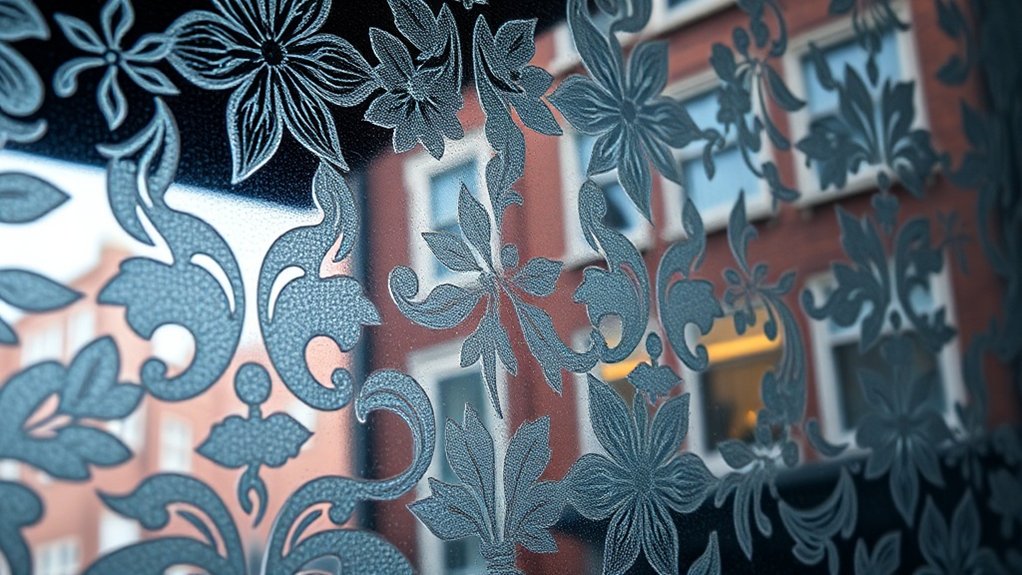
You’ll typically work with acid‑etched florals, deeply rolled reeded glass, geometric prisms, and jewel‑like bull’s‑eye rounds. Each profile manipulates light differently, controlling privacy, luminance, and glare while preserving slender sightlines in sash windows and fanlights.
Contemporary Minimalist Textures
Once you move beyond Victorian ornamentation, contemporary minimalist glass textures in London hinge on controlled surface modulation rather than overt pattern. You prioritise micro‑textures that manage light, privacy, and reflection with calibrated precision. Frosted textures, produced via acid‑etching or controlled sandblasting, diffuse daylight to eliminate glare while preserving luminous interiors, ideal for slim-framed partitions and shower screens.
You might specify linear or radial gradients, where translucency shifts across the pane to choreograph views and daylight penetration. Subtle embossed finishes—very shallow ribs, pixel grids, or soft prismatic fields—refract light without reading as decorative motifs. By aligning texture direction with façade orientation and internal circulation, you turn glass into a performative surface , optimised for energy, visual comfort, and a distinctly contemporary London aesthetic.
How to Choose Patterned Glass for Privacy and Light
When selecting patterned glass for privacy without sacrificing daylight, treat the pane as both a light filter and a visual screen. Start by mapping your privacy concerns to specific pattern densities : tighter, smaller-scale motifs obscure silhouettes more effectively, while medium-density patterns balance legibility and openness. Evaluate light diffusion by checking how the pattern breaks up direct beams into softer, scattered illumination, reducing glare yet preserving brightness.
Analyse pattern orientation and repeat: linear textures can guide light deeper into a room, while radial or organic patterns create more uniform luminance. Specify glass with tested light-transmission values and, where possible, view full-size samples in situ. Finally, consider layering —patterned outer pane with clear inner pane—to fine-tune performance without visually overloading the space.
Patterned Glass for Period vs Contemporary London Properties
When you’re working with London’s eclectic streetscapes, you need patterned glass that can either honour heritage detailing or reinforce a pared‑back, contemporary language. In period homes, you’ll look for patterns that reference original leadlight grids, floral or geometric motifs, and slightly irregular textures that echo hand‑cast glass. For minimalist schemes , you’ll specify sleek, low‑relief patterns—linear ribs, micro‑dot, or soft satin finishes—that read as clean surfaces while still controlling light, glare, and sightlines.
Honouring Heritage Detailing
Although London’s streets read like an architectural timeline, your patterned glass choices can’t be one-style-fits-all; they must calibrate to the era of the façade and the detailing that frames it. You’re not copying the past; you’re decoding it. Read cornices, mullion widths, and joinery profiles, then translate those cues into glass geometry, line weight, and texture.
You’ll align Artistic techniques with historical influences by mapping:
- Georgian rhythm: fine-lined, low-relief reeds or diamonds that echo slender sash proportions.
- Victorian exuberance: deeper embossing, botanical or gothic tracery scaled to match door panels and fanlights.
- Edwardian clarity: bolder, simplified motifs with controlled negative space that respects leaded light grids.
Always prototype patterns at full scale to verify sightlines and shadow behaviour.
Sleek Patterns For Minimalism
Even in a city dense with ornament, the most disciplined London schemes rely on patterned glass that’s almost invisible in its restraint: think ultra-fine linear flutes, soft satin etching , or micro-dot gradients that read as a controlled veil rather than decoration. You use these to tune privacy, glare, and reflections without visual noise, especially in open-plan apartments and glass-heavy extensions.
Specify Frosted textures with different diffusion indices to modulate light transmission between circulation zones and living areas. Combine low-iron substrates with subtle Color variations—cool neutrals for north-facing elevations, warmer tints for south-facing façades—to correct daylight tone. In period-to-contemporary interfaces, run continuous vertical ribs or dot matrices across old and new openings, aligning transoms and mullions so minimalist pattern becomes the linking datum.
Custom Patterned Glass and Bespoke Commissions in London
While off‑the‑shelf options can solve straightforward glazing needs, custom patterned glass and bespoke commissions in London let you control every variable of the design—pattern geometry, scale, depth, opacity, colour, and light transmission—to achieve a precise architectural effect. You collaborate directly with fabricators who specialise in glass embossing, digital etching, and kiln‑formed reliefs , so every facet of pattern customization aligns with your concept, branding, and spatial constraints.
- Translate brand identities into repeatable, metrically precise surface motifs
- Synchronise patterns with façade modules, mullion grids, and lighting schemes
- Prototype quickly using sample plaques before committing to full‑scale production
You’re not just choosing a pattern; you’re engineering a performative surface that modulates views, choreographs light, and reinforces the narrative of your space.
Safety, Maintenance and Durability of Patterned Decorative Glass
Once you start engineering patterned glass as a performative surface rather than a decorative overlay, you have to treat safety, maintenance, and durability as core design parameters, not afterthoughts. You’ll align every specification with relevant Safety regulations: impact resistance (BS EN standards), balustrade loadings, fire performance, and safe breakage characteristics through tempering or lamination.
You then prioritise pattern technologies that embed or fuse artwork within the glass—acid-etching, ceramic frit, digital ceramic printing—so the surface remains cleanable without degrading detail. Micro-relief textures must balance slip-resistance and ease of Glass cleaning, avoiding deep crevices that trap contaminants. For longevity, you coordinate edge protection, drainage, UV-stable interlayers, and compatible sealants, ensuring patterned units resist delamination, abrasion, and London’s pollution-heavy microclimate.
What Patterned Glass Costs in London and How Long It Takes
Cost and lead time for patterned decorative glass in London hinge on five variables: glass type (annealed, toughened, laminated), patterning method (rolled, acid-etched, sandblasted, ceramic frit, digital print), panel size and thickness , fixing system, and project logistics. You balance aesthetics, performance, and budget by making a precise cost comparison between standard rolled patterns and bespoke digital or fritted treatments, which typically sit at the top of the pricing spectrum.
- Optimise cost by standardising thicknesses, repeating panel modules, and simplifying fixing details.
- Expect an installation timeline of 2–4 weeks for stock rolled patterns, 4–8 weeks for custom-etched or fritted façades.
- Factor coordination time for laser surveys, shop drawings, and mock‑ups into your programme to avoid site delays.
Planning and Conservation Rules for Patterned Glass in London
Because patterned glass changes both a building’s appearance and its light performance, London planners treat it as part of the external design rather than a minor finish, and you often need consent before installing it. In conservation areas and listed buildings, you must demonstrate that new glass respects historical significance in pattern scale, translucency, and reflectivity. Planners scrutinise whether your design preserves established façade rhythms, sightlines, and daylight factors to adjacent properties.
You’ll strengthen applications by evidencing sustainable sourcing , such as recycled content, low‑iron substrates, and certified production. Expect conditions on colour rendering, internal luminance at night, and privacy gradients to prevent visual clutter. Always cross‑check borough-specific design guides; many now explicitly reference patterned or textured glazing in façade innovation policies.
Working With London Glass Suppliers and Installers
With planning parameters defined, you can focus on selecting London glass specialists who can engineer patterned units to meet both aesthetic intent and regulatory constraints. You should interrogate their glass manufacturing capabilities: ask for furnace sizes, lamination options , and tolerance data for patterned interlayers, screen-printed surfaces, and embossed textures.
- Validate test evidence for impact resistance, acoustic performance, and solar control on patterned constructions.
- Request mock‑ups that combine your specified Artistic techniques with actual framing, sealants, and fixings.
- Confirm installation sequencing , site protection, and cleaning protocols to avoid damaging complex surface reliefs.
Engage installers early so they coordinate setting blocks, edge cover, and structural silicone with pattern orientation, ensuring joints, frit bands, and hardware align precisely across façades, balustrades, and internal partitions.
Design Tips for Using Patterned Glass in Your London Project
Although patterned glass can seem purely decorative, you’ll get the best results in a London project by treating it as a performative material that shapes light, privacy, and spatial legibility. Start by mapping solar orientation and street overlooks, then specify pattern density accordingly: tighter motifs for bathrooms and street façades, more open geometries for internal partitions.
Align Color schemes with glass interlayers, back-painting, or frit tones, ensuring spectral consistency between natural and artificial lighting. Treat Material selection as a system decision: pair patterned glass with thermally broken framing, acoustic interlayers, or switchable films where performance is critical.
At junctions, detail crisp transitions—use shadow gaps, minimal channels, and carefully positioned silicone joints to keep the pattern visually continuous.
Frequently Asked Questions
Can Patterned Decorative Glass Improve Energy Efficiency in London Homes or Offices?
Yes, you can improve energy efficiency with patterned decorative glass. You specify high-performance coatings and insulated glazing units to reduce heat loss while maintaining daylight. The patterned surface diffuses light, minimizing glare and hotspots, cutting reliance on artificial lighting. You gain aesthetic enhancement and design versatility without sacrificing U-values or solar control. For London’s climate, you combine low‑E coatings, argon-filled cavities, and thermally broken frames to optimize performance.
How Does Patterned Glass Affect Acoustic Insulation in Busy London Streets?
It improves acoustic insulation when you specify the right build-up. You’re leveraging irregular surfaces and varying glass thicknesses to scatter sound, increasing sound absorption and perceived noise reduction. Deep, asymmetrical patterns disrupt airborne sound transmission more effectively than shallow, repetitive motifs. For busy London streets, you’d pair patterned glass with laminated interlayers or insulated glass units, tuning cavity depth and pattern orientation to optimize decibel drop without sacrificing daylight or visual dynamism.
Is Patterned Glass Compatible With Smart Glass or Switchable Privacy Technologies?
Yes, it’s compatible if you manage layer sequencing and optical performance. Imagine you specify a switchable PDLC laminate where the patterned lite sits as the external ply, bonded over the smart interlayer; you maintain pattern compatibility while preserving switching uniformity. You’ll need low-iron substrates, precise haze control, and busbar concealment strategies to guarantee aesthetic integration, clean wiring routes, and consistent opacity levels across both patterned and active zones.
Can Existing Plain Glazing Be Retrofitted With Patterned Film Instead of Replacement?
Yes, you can retrofit existing plain glazing with patterned film . You apply a high‑performance vinyl or PET film directly to the glass, achieving decorative privacy and aesthetic enhancement without structural alteration. Specify thickness, light transmission, and surface finish to align with glazing type and building regulations. You’ll need meticulous surface preparation, bubble‑free wet application, and precise trimming at seals to maintain optical clarity, durability, and a clean, innovation‑driven design outcome.
Are There Eco-Friendly or Recycled Patterned Glass Options Available in London?
You’ll find several eco-friendly, patterned options in London, including glass with 20–30% recycled materials and low-iron substrates produced via sustainable manufacturing. Think of it like adaptive reuse for facades—one studio I worked with cut their embodied carbon by 25% switching to recycled patterned laminates. You can specify acid‑etched, screen‑printed, or digital ceramic frit patterns, plus low‑VOC interlayers, all compatible with high‑performance double or triple glazing systems.
Summary
You might worry patterned glass will look fussy or dated, but in London’s layered streetscape it actually sharpens your architecture. The right motif—crisp reed, geometric fluted, or heritage acid‑etched—controls sightlines, glare and solar gain while preserving generous daylight. When you tune pattern scale, opacity, and iron content to your façade, you’re not just adding decoration—you’re engineering privacy, atmosphere, and character into the envelope of your London home or workspace.