
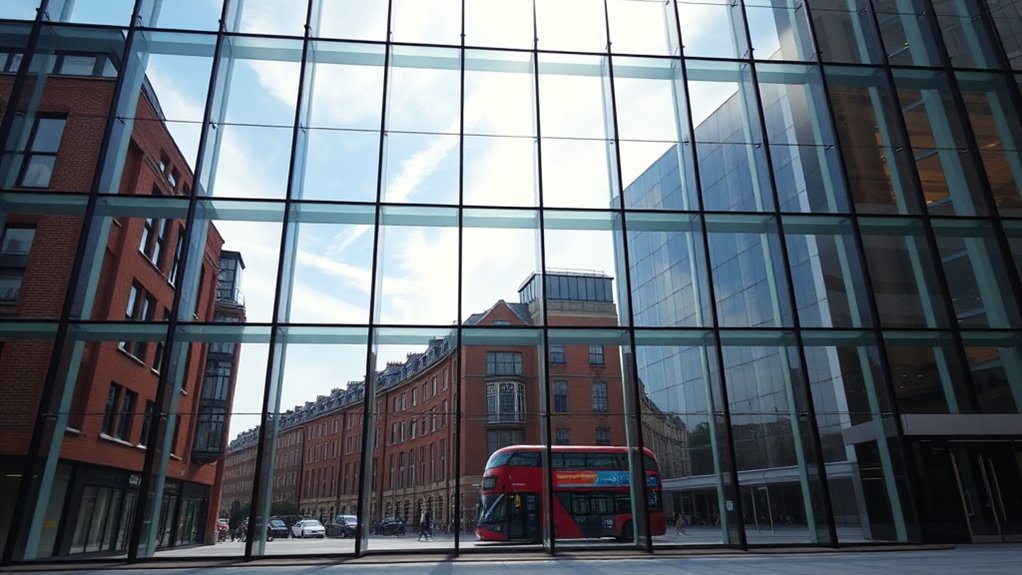
When you design curtain wall glazing in London, you’re coordinating a non-loadbearing, high‑performance façade that must meet marine-grade durability, strict thermal and acoustic criteria, and demanding fire regulations above 18m. You’ll choose between stick, unitised, or hybrid systems based on programme, access, and heritage context, tuning low‑E glass, g‑values, and mullion density for daylight, comfort, and conservation constraints. Understanding cost drivers, planning rules, and emerging technologies will clarify your next technical decisions.
Key insights
- Curtain wall glazing in London must balance high thermal, acoustic, and fire performance with strict planning, heritage, and Part L/BREEAM/WELL requirements.
- Marine‑grade aluminium, durable coatings, compatible sealants, and high-spec gaskets are essential to withstand London’s polluted, maritime climate over a 40–60 year lifespan.
- Choice between stick, unitised, or hybrid systems depends on site access, programme pressure, logistics, and desired façade performance and tolerances.
- Design must respect conservation areas with controlled reflectivity, proportion, depth, and jointing that echo historic rhythms without pastiche.
- Daylighting and solar control are optimised using simulations, low‑E and spectrally selective glass, fritting, and discreet shading to manage glare and comfort.
Curtain Wall Glazing in London: What You Need to Know
Whether you’re planning a new build or a façade upgrade, understanding curtain wall glazing in London starts with its role as a non-loadbearing, high-performance building envelope system. You’re decoupling structure from skin, allowing large glazed areas to optimise daylight, views, and thermal performance while the primary frame carries loads.
You must balance Historical preservation requirements with contemporary performance metrics. In conservation areas, you’ll negotiate sightline depth, mullion profiles, and reflectivity to respect context while integrating low‑E coatings , warm-edge spacers, and high-spec gaskets.
Material durability’s critical in London’s polluted, maritime climate. You’ll specify marine-grade aluminium, robust anodising or powder coating, and compatible sealants to mitigate corrosion, staining, and joint fatigue, ensuring long-term airtightness, watertightness, and minimal lifecycle maintenance.
Main Curtain Wall Systems Used in London
Three primary curtain wall systems dominate London projects: stick, unitised, and hybrid configurations , each with distinct implications for programme, tolerances, and façade performance. When you select stick systems, you prioritise on-site flexibility, detailed interface coordination, and granular control over grid alignment, but you accept higher labour intensity and weather‑risk during installation.
Unitised systems suit London’s compressed programmes and tight sites. You pre-assemble large panels off-site, achieving superior quality control, consistent material durability, and predictable air‑water‑thermal performance, while reducing site disruption and working at height.
Hybrid systems let you combine unitised fields with stick-built inserts or bespoke zones, optimising cost, logistics, and aesthetic integration. You can deploy advanced materials, complex geometries, and high‑performance envelope strategies without sacrificing buildability.
Aesthetic Trends in London’s Curtain Wall Façades
As London’s skyline densifies and planning scrutiny intensifies, curtain wall aesthetics now balance civic context, brand expression, and envelope performance in a much tighter design space. You’re no longer composing flat glass planes; you’re curating façades as urban interfaces.
You’re seeing artistic expression delivered through three key levers: micro-articulation of mullions and transoms, controlled chromaticity of coatings , and calibrated reflectivity to satisfy viewing corridor constraints. You pair material innovation with parametric rationalisation: hybrid aluminium–GFRP caps, textured fritted glass, expanded metal interlayers, and unitised stone-veneer panels that preserve panel tolerances.
You’re also leveraging 3D-formed glass , anodic gradients, and CNC-milled caps to generate depth without compromising buildability, enabling façades that remain manufacturable, maintainable, and compliant while still reading as distinctly “London” in silhouette and streetscape.
Daylighting, Views and Comfort With Curtain Wall Glazing
When you specify curtain wall glazing in London, you’re balancing stringent daylight factor targets with glare control, thermal comfort , and visual connection to the cityscape. You need to optimise glass selection, mullion density, and floor-to-ceiling ratios to maximise natural daylight while maintaining compliant U-values, g-values, and internal surface temperatures. By carefully managing sightlines, spandrel placement, and shading integration, you guarantee occupants gain high-quality views and stable comfort conditions across changing sky conditions.
Maximising Natural Daylight
How do you harness curtain wall glazing to drive daylight deep into a floorplate while maintaining visual comfort and energy performance? You start with rigorous daylight simulation, mapping London’s variable sky conditions across orientations and obstructions, including historical architecture and emerging urban greenery that can shadow façades.
You then optimise vision-to-spandrel ratios, mullion depths, and floor-to-floor heights to maximise daylight penetration while controlling contrast. Specify high-transmission, spectrally selective coatings to boost visible light while limiting solar gains and glare risk. Integrate light-shelves at transom level to redirect daylight onto the ceiling plane, extending daylight factors towards the core. Calibrate frit patterns and interlayer tints by orientation, ensuring each curtain wall zone delivers target illuminance levels and aligns with Part L and WELL daylight criteria.
Enhancing Views And Comfort
Ultimately, curtain wall glazing must do more than admit light; it must curate what occupants see and how they feel. You optimise façade performance by balancing daylight , views, glare control, and thermal comfort through carefully specified glass build-ups and framing systems.
Prioritise view quality as much as daylight factors. In London, you’re mediating between Historical architecture, dense streetscapes, and emerging Urban greenery. High‑performance low‑iron glass preserves colour rendition, while selective coatings manage solar gain without degrading external views.
Use vision zones with higher visible light transmittance and spandrel or fritted bands for glare mitigation at desk height. Integrate dynamic shading, ventilated cavities, and thermally broken mullions to stabilise internal temperatures, ensuring occupants experience visual connection, acoustic buffering, and year‑round comfort.
Cost Drivers and Budgeting for Curtain Wall Glazing
Cost planning for curtain wall glazing in London hinges on a clear understanding of the key cost drivers: system type (stick, unitised, or hybrid), glass specification (performance coatings, acoustic ratings, security class), frame material and finish, interface complexity with the primary structure, access and installation logistics , and compliance with local planning and Part L/Part B requirements.
You’ll see early decisions on Curtain wall materials and glazing aesthetics cascade through the budget. Higher-performance units (triple glazing, warm-edge spacers, bespoke frit patterns) increase capital cost but can reduce plant size and operational energy. Allow for bespoke bracketry where tolerances in the primary frame are loose. Factor in London-specific prelims: restricted delivery windows, cranage, and scaffold or mast climbers. Build in contingency for design iteration driven by planners or fire consultants.
How to Choose Curtain Wall Glazing by Building Type
When you select curtain wall glazing in London, you must tune the specification to the building typology—commercial high-rise, residential, or institutional—rather than rely on a generic system. For commercial towers, you’ll prioritise wind load resistance, unitised systems, solar control, and façade access strategy, while residential schemes demand acoustic attenuation, thermal comfort, and occupant privacy. Institutional buildings, such as hospitals and universities, require robust impact resistance, stringent fire-stopping at floor edges, and glazing that supports wayfinding, daylighting targets, and long-term maintenance regimes.
Commercial High-Rise Requirements
Although all curtain walls provide enclosure and daylight, commercial high-rise towers in London demand glazing systems engineered for greater wind loads, stricter fire strategy , higher occupant density, and more complex façade access than low- and mid-rise buildings. You need unitised systems with tested performance under dynamic wind, stack effect, and movement joints aligned with primary structure creep and sway.
Your specification should prioritise:
- High-performance IGUs with selective coatings, tuned visible light transmittance, and g-values that support deep floorplates and animated urban art integrated into illuminated façades.
- Enhanced acoustic and thermal performance to create calm, efficient community spaces within dense urban microclimates, without compromising slender mullion profiles.
- Robust fire-stopping at slab edges, rated spandrel zones, and compartmentation-compatible brackets, coordinated with BMU tracks and maintenance access.
Residential Performance Priorities
In residential projects, you calibrate curtain wall glazing less around peak office occupancy and more around long-duration comfort, privacy, and energy stability for full-time occupants. You prioritise low U‑values, optimised g‑values , and high CR ratings to mitigate surface condensation at bedroom and living‑room perimeters.
You fine-tune visible light transmittance to support circadian comfort while controlling night-time glare and overlooking, especially in dense urban landscaping contexts. Acoustic-laminated units with asymmetric build-ups address traffic and rail noise.
In London’s conservation areas, you align glazing reflectance, colour rendering, and profile depth with surrounding historical architecture, often combining high-performance low‑iron glass with slender thermally broken mullions. You also integrate trickle ventilation, motorised shading, and balcony interfaces without compromising airtightness or thermal continuity.
Institutional Design Considerations
Residential schemes set the comfort benchmark, but institutional buildings in London force you to re-weight glazing criteria around occupancy patterns, governance standards, and risk management. You’re not just optimising U-values; you’re aligning façade performance with safety, continuity of operations, and long-term capital planning, all within London’s dense urban fabric and demanding Historical context.
You’ll typically interrogate:
- Blast resistance, forced-entry performance, and fire-stopping interfaces at every mullion/transom node.
- Glare control, colour rendering, and acoustic attenuation for healthcare, education, and civic environments with extended occupation.
- Material durability , cleanability, and component interchangeability to keep lifecycle costs predictable over 40–60 years.
Lean on parametric modelling and dynamic glazing where you need adaptable envelopes that satisfy institutional governance while still signalling innovation and civic identity.
Meeting Part L: Thermal Performance of Curtain Walls
Precisely how you address thermal performance in curtain wall glazing now determines whether your London project complies with Part L and passes compliance modelling at design stage. You must treat the façade as a quantified thermal insulation system, not just an aesthetic wrapper. Start with rigorous U value optimization at system level: combine low‑conductivity framing, high‑performance IGUs, warm‑edge spacers, and aerogel or mineral wool insulated spandrels.
Model whole-wall performance, not just centre-of-glass values, using BS EN ISO 12631 and validated ψ‑values for mullion–transom junctions and perimeter interfaces. Pay close attention to bracketry and slab edge details, where thermal bridging can quietly undermine compliance. Finally, align your specification with the building’s notional model, ensuring airtightness targets and thermal line continuity support your Part L strategy.
Solar Control, Shading and Overheating Risk
You’ll need to treat solar control, shading and overheating as a single façade engineering problem , not a series of add‑ons. That means selecting solar control glass types with carefully specified g‑values, LT (light transmittance) and external reflectance, then pairing them with fixed or dynamic shading systems tuned to London’s latitude, urban context and orientation. By coordinating glass coatings with brise‑soleil, fins, light shelves or internal blinds, you can reduce peak cooling loads and address TM59/TM52 overheating criteria without compromising daylight or façade aesthetics.
Solar Control Glass Options
How do you balance generous daylight with the need to limit solar heat gain through curtain wall glazing in London’s increasingly warmer climate? You start by specifying solar control glass that delivers a tight g‑value , neutral colour rendering, and stable performance under variable sky conditions, while remaining compatible with automated window treatments and low‑maintenance glass cleaning regimes.
You’ll typically evaluate:
- Solar control coatings: Double/tri‑silver low‑E with spectrally selective performance to reduce cooling loads while preserving visible light transmittance .
- Body‑tinted substrates: Bronze, grey, or green tints to trim solar gain cost‑effectively, often combined with selective coatings.
- Insulating glass units (IGUs): Optimised cavity width, argon or krypton fill, and warm‑edge spacers to fine‑tune U‑values, limit perimeter condensation, and protect coatings over the facade lifecycle.
Shading Strategies For London
Although advanced solar control glass is doing more of the heavy lifting in London facades, robust shading strategies remain essential to keep curtain wall glazing within comfort and energy targets as summer design temperatures rise. You need to integrate external shading—fins, light-shelves, perforated screens—optimised by orientation-specific solar studies and dynamic simulation.
In a dense urban landscape, you’ll model overshadowing from adjacent masses , reflected gains from neighbouring glazing, and canyon effects that trap heat. Dynamic façades with motorised louvers or electrochromic layers let you track variable cloud cover and shoulder-season sun.
Where you’re interfacing with historical architecture, you must recess shading within existing rhythms, minimise visual clutter, and exploit internal blinds or micro‑baffles, ensuring they’re thermally decoupled to prevent re‑radiation into the occupied zone.
Acoustic Performance in London’s Noisy Urban Context
In London’s dense urban fabric, where rail corridors, arterial roads, and flight paths converge, curtain wall glazing must deliver robust acoustic performance as a core design criterion rather than an afterthought. You need to treat Acoustic insulation as an integrated façade system, not just thicker glass.
You’ll typically combine laminated panes with acoustic interlayers, asymmetric build-ups, and carefully dimensioned air spaces to target specific frequency bands. For effective Noise mitigation, you must also address flanking paths at slab edges and interface details.
- Specify laboratory-tested Rw + Ctr values aligned to your site’s noise spectrum.
- Use pressure-equalised, thermally broken framing to reduce structural-borne transmission.
- Coordinate ventilation strategy (e.g., acoustic trickle vents, sealed façades with MVHR) to maintain performance under real operating conditions.
Fire Safety Regulations for Curtain Wall Glazing
Seldom is curtain wall design in London as unforgiving as when you address fire safety compliance , where Part B of the Building Regulations, the Building (Amendment) Regulations 2018, and associated guidance (notably Approved Document B and BS 9999) set strict performance thresholds for external walls. You must demonstrate that glazing, framing, insulation, and cavity barriers collectively satisfy reaction‑to‑fire and fire‑resistance criteria, with particular scrutiny on materials above 18m.
You’ll treat the façade as a system, much like Automotive safety or Marine navigation: every component, junction, and interface requires tested performance and traceable certification. You prioritise A1/A2-s1,d0 materials, rigorously detail compartment lines, and design spandrels, brackets, and interfaces with slab edges to prevent vertical fire spread and external flaming.
Wind Loads and Structural Design of Curtain Walls
Whether you’re designing a mid‑rise retrofit or a super‑slender tower in the City cluster, you have to treat wind loading as the primary driver of curtain wall structural design in London. You’re dealing with complex flow patterns , corner accelerations, and significant vortex shedding, so you can’t rely on generic code pressures alone.
You’ll typically combine computational wind engineering with targeted wind‑tunnel testing to optimise:
- Mullion sizing, anchorage design, and bracket stiffness for Wind resilience and long‑term Structural integrity
- Glass thickness, interlayer selection, and edge restraint to control deflection, breakage risk, and occupant comfort
- System movement joints, stack joints, and slab‑edge tolerances to accommodate drift and creep without compromising air‑water performance
Curtain Walls in Conservation and Heritage Areas
When you introduce curtain wall glazing into a London conservation or heritage setting, you must balance contemporary performance criteria with strict requirements to preserve established townscape, materials, and proportions. You’ll need to evidence this balance through detailed heritage impact assessments, material samples, and carefully modelled sightline studies that demonstrate visual compatibility. Planning and conservation approvals will hinge on early engagement with local authorities, adherence to relevant SPDs and design codes, and a robust justification for any alteration to the existing façade character.
Balancing Modernity And Heritage
Although London’s conservation areas impose strict controls on external alterations , you can still deploy curtain wall glazing if you calibrate design, detailing, and performance to the heritage context. You’re not mimicking the past; you’re translating its cultural symbolism into a contemporary envelope system that respects protected fabric while delivering transparency and daylight.
You should treat the façade as engineered artistic expression , using proportion, depth, and jointing to echo historic rhythms. That means interrogating:
- Module size and mullion hierarchy to align with established street elevations
- Glass specification (reflectance, colour, coatings) to avoid discordant visual noise
- Interface details at cornices, string courses, and party walls to preserve legibility of the original structure
Done well, the curtain wall reads as a precise, modern layer framing heritage rather than competing with it.
Planning And Conservation Approvals
Treating the façade as engineered artistic expression isn’t enough in London’s conservation areas ; you also need a planning and heritage strategy that’s as rigorous as your technical design. You’re not just submitting elevations; you’re evidencing how your curtain wall responds to historical context, protected sightlines, and established façade rhythms.
You’ll need pre-application engagement with conservation officers, heritage statements, verified views, and detailed section studies showing set-backs, transom alignment, and junctions with retained fabric. Demonstrate material durability with lab data, weathering projections, and maintenance regimes so planners trust long-term performance.
You should frame innovation as reversible, low-impact intervention: structurally glazed systems behind retained masonry, slim mullion profiles, and high-performance coatings that replicate traditional reflectance while delivering contemporary thermal and solar control.
Planning Rules and London Design Guidance
Because curtain wall glazing considerably alters a building’s external envelope , you must navigate a dense framework of London-specific planning rules and design guidance before progressing beyond concept stage. You’ll align your proposals with borough Local Plans, the London Plan, and area-based SPDs that scrutinise Historical context, townscape impact, and façade articulation.
You should map out requirements for:
- View management, massing, and reflectivity set by the London View Management Framework and local tall building policies
- Daylight, sunlight, and overlooking standards that shape glazing ratios, fritting strategies, and mullion depths
- Fire safety, access, and material durability performance, ensuring your façade specification satisfies Approved Documents and borough-specific façade design codes
Sustainability and Embodied Carbon in Curtain Wall Glazing
Once you’ve aligned curtain wall proposals with London’s planning and façade design codes, you need to interrogate their carbon and resource profile with the same level of rigour. You start by quantifying embodied carbon across the full cradle‑to‑cradle cycle: primary aluminium production, recycled content, glass manufacturing, spacers, gaskets, sealants, and site logistics.
You then benchmark options using EN 15978-compliant LCAs and London’s Whole Life Carbon guidance , prioritising Eco friendly materials with verified EPDs. Specify high-recycled aluminium billets, low-iron glass only where daylight or solar-control modelling justifies it, and thermally broken framing that reduces mullion depth and metal weight. Finally, you design for disassembly: mechanical fixings, mono-material interfaces, and documented materials passports that future-proof reuse and closed-loop recycling.
Innovations: Smart Glass, BIPV and Double-Skin Façades
As curtain wall glazing in London shifts from passive envelope to active building system, you now have a mature toolkit of innovations—electrochromic and thermochromic smart glass, building‑integrated photovoltaics (BIPV), and double‑skin façades—that can materially change energy balances, comfort strategies and services design. You’re no longer just selecting glass; you’re configuring an integrated building technology platform.
- Smart glass with dynamic tints and smart coatings lets you modulate SHGC and glare in real time, coordinated with BMS logic.
- BIPV integration converts the façade into a distributed generator, demanding careful routing, string design, and fire‑safe cable zones.
- Double‑skin façades create a controllable thermal buffer, enabling stack‑driven ventilation, acoustic attenuation, and seasonal façade re‑tuning for London’s variable climate.
Best Practices for Installing, Maintaining and Retrofitting Curtain Walls
Well‑designed curtain wall glazing in London only performs to its specification if it’s installed, maintained and, when needed, retrofitted with the same rigor used in its design. You start by controlling tolerances: verify substrate plumb, anchor edge distances, thermal breaks, and gasket compression against project-specific performance criteria.
You protect curtain wall aesthetics and glazing durability by specifying tested sealant systems, drained and ventilated cavities, and compatible interfaces with adjacent envelopes. Establish a maintenance regime : biennial sealant inspections, drainage path clearing, hardware torque checks, and recalibration of operable vents and integrated sensors.
When retrofitting, you phase works to maintain weather‑tightness, upgrade to higher‑performance IGUs, integrate BIPV or smart glass where viable, and validate outcomes through post‑installation air‑tightness and infrared thermography testing.
Frequently Asked Questions
How Do Curtain Walls Affect Indoor Air Quality and Ventilation Strategies?
You treat curtain walls as active components in Indoor air quality and Ventilation strategies. Their airtightness reduces uncontrolled infiltration, so you must design precise mechanical ventilation and pressure regimes. You integrate operable vents, trickle ventilators, or double-skin façades to enable controlled fresh-air intake. You coordinate glazing ratios, solar gains, and stack effect to prevent condensation, guarantee pollutant dilution, and maintain stable thermal and airflow performance.
Can Curtain Wall Glazing Improve Wireless Signal Strength or Cause Interference?
You treat glass like a transparent spectrum filter: it can enable signal enhancement or trigger wireless interference. You’ll see low‑E coatings , metallic frits, and laminated interlayers attenuate RF, especially 5G bands. Clear, non‑metalized glazing generally supports stronger indoor coverage. When you specify curtain wall systems, you must model RF propagation, coordinate with IT for antenna placement, and consider selective RF‑friendly zones to future‑proof connectivity within high‑performance façades.
What Insurance Considerations Apply Specifically to Curtain Wall Façades in London?
You must treat curtain wall façades as specialist building elements in your policy, focusing on Insurance claims complexity and upfront risk assessment. You’ll need to address wind‑load failure, water ingress, thermal break defects, fire‑stopping continuity, and glass breakage, including post‑tensioned or unitized systems. Confirm design‑professional indemnity, contractor all‑risks, latent defects cover, and clear allocation of façade maintenance duties, access strategies, and product warranties to safeguard future innovation-driven refurbishments.
How Do Curtain Walls Impact Bird Collisions and What Mitigation Is Possible?
You substantially influence bird collision risk through glazing choices and detailing. Highly reflective, large glass areas confuse flight paths; you counter this using evidence‑based mitigation strategies . Specify fritted or UV‑patterned glass with ≤5 cm spacing, external screens, or secondary meshes. Break up reflections via projecting fins, external shading, and varied façade planes. Integrate dimmable lighting controls and night‑time curfews, then validate performance using collision‑risk modelling and post‑occupancy monitoring.
What Are Typical Tenant Lease Obligations for Maintaining Curtain Wall Glazing?
You typically assume limited obligations: you must prevent damage, report defects promptly , allow access, and comply with prescribed Maintenance protocols. Tenant responsibilities usually cover interior cleaning, protection from impact loads, and avoiding film applications or fixings that compromise seals, coatings, or warranties. Landlords retain structural upkeep, reglazing, and system upgrades. Innovative leases may add performance monitoring, sensor integration, and coordinated façade-access scheduling to optimize lifecycle performance and minimize operational disruptions.
Summary
When you approach curtain wall glazing in London with clear performance targets, you turn a complex façade package into a controllable system—like tuning a high‑precision instrument. By aligning system selection, U‑values, g‑values, airtightness, and interfaces with planning policy, you’ll balance aesthetics, cost, and embodied carbon. Build in access, maintainability, and upgrade pathways from day one, and your façade will remain compliant, resilient, and high‑performing over its full design life.