
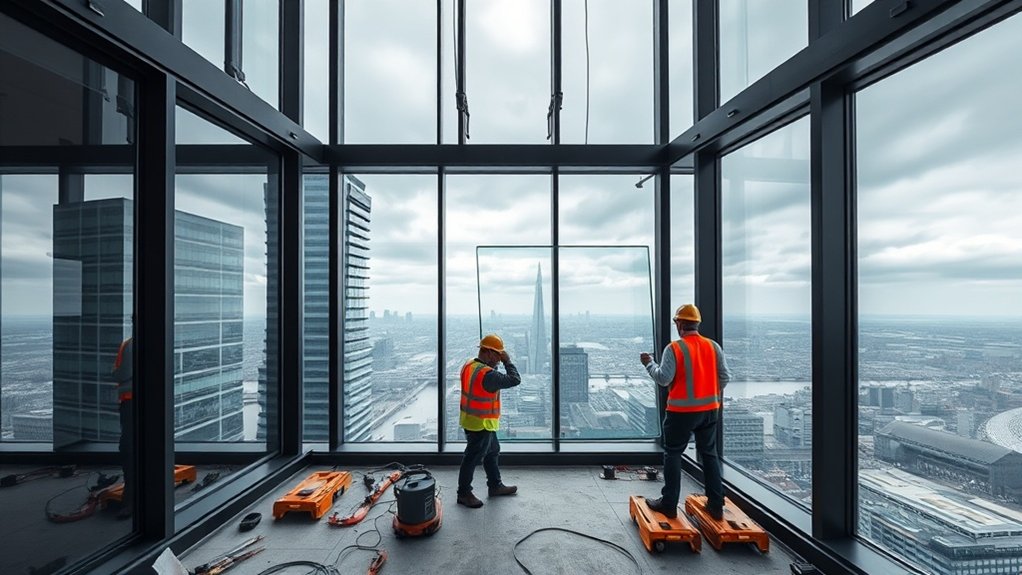
When you install office windows in London, you must treat it as a regulated upgrade, not a cosmetic swap. You’ll start with a detailed site survey , then specify compliant glazing, frames, safety hardware, and acoustic/thermal performance to satisfy Parts B, K, L and Q. Installers must manage lifting, exclusion zones, and airtight sealing, then test for water, air and drainage performance. From planning constraints to PAS 24 security, there’s more you should understand next.
Key insights
- Full survey-led office window replacement across London, including access planning, lifting routes, IT protection, and phased works to minimise disruption to staff and operations.
- Supply and installation of high‑performance glazing (double/triple, low‑E, acoustic, security) meeting UK Building Regulations Parts B, K, L and Q.
- Heritage‑sensitive window upgrades for listed or conservation area offices, matching original sightlines while improving thermal, acoustic and security performance.
- Comprehensive compliance support, including planning advice, detailed drawings, U‑value calculations, fire egress and safety glazing to London and national standards.
- Ongoing maintenance, airtightness checks, and performance upgrades, including tinting, films, and smart controls to enhance comfort, energy efficiency and glare control.
Office Window Installation in London: What to Expect
When you book office window installation in London, you can expect a tightly controlled process that starts with a detailed site survey and ends with a final safety inspection and handover. First, specialists assess existing openings, structural supports , and façade interfaces, then specify glazing types, thermal performance, acoustic ratings, and security hardware.
Next, installers sequence works to minimise disruption, protect IT equipment, and maintain safe circulation routes. They use calibrated lifting gear, dust control, and edge protection to safeguard staff and assets.
You’ll see fixings anchored to manufacturer data, joints sealed for air‑tightness, and drainage paths tested. Throughout, they’ll align window aesthetics with wider office aesthetics, integrating frame profiles, coatings, and sightlines to enhance light, comfort, and future‑ready workspace performance.
London Building Rules for New Office Windows
Before you sign off on any office window specification in London, you need to account for a tight framework of building rules that govern safety, energy performance, and fire strategy. You’ll reference the Building Regulations Approved Documents, especially Parts B, K, L, and Q, and verify your Office window design aligns with them from concept stage.
You must demonstrate compliant U-values , solar gain control, and robust ventilation performance. Specify safety glazing in critical locations, restrictor devices on upper floors, and compliant opening sizes for escape routes. Prioritise window security with PAS 24-tested ironmongery, anti-jemmy profiles, and reinforced frames, particularly at ground and accessible levels.
Integrate sensors, automated actuators, and smart glass only where they don’t compromise these core compliance requirements.
Planning Permission for London Office Window Projects
Although office window replacement can seem relatively minor, planning permission in London often hinges on nuanced factors such as the building’s designation, its façade treatment, and its relationship to neighbouring properties. You must confirm whether the property sits in a conservation area , is listed, or forms part of protected historical architecture, because each status triggers stricter controls on frame profiles, sightlines, and external finishes.
Planners increasingly expect you to integrate safety and performance innovations discreetly. Demonstrate how upgraded window security—laminated glass, anti-jemmy hardware, certified locking systems—won’t visually compromise the streetscape. Provide scaled elevations, section details, and material samples that evidence compatibility with surrounding buildings. Engage with the local planning authority early, and document compliance with fire egress , fall protection, and acoustic objectives.
Choosing Between Single, Double and Triple Glazing
Planning consent sets the parameters of what you’re allowed to install; the next decision is which glazing specification will achieve the performance you need without breaching those constraints. You’ll balance thermal performance, acoustic control , security, and visual comfort.
Single glazing typically won’t meet Part L or modern comfort expectations, but it may be the only compliant option for strictly protected façades; you can partially mitigate losses with advanced window tinting films.
Double glazing remains London’s baseline: low‑E coatings, argon fill, and warm‑edge spacers give robust U‑values and reasonable solar control. It integrates well with security enhancements such as laminated inner panes.
Triple glazing offers superior insulation and noise reduction but adds weight, cost, and potential planning scrutiny on heritage frontages.
Best Frame Materials for London Office Windows
When you select frame materials for London office windows, you need to balance structural performance, lifecycle cost, and occupant safety . Aluminium frames offer high durability and strength for larger apertures, uPVC gives you cost efficiency and low maintenance, while engineered timber provides superior aesthetics and good thermal performance. You should assess each option against fire safety compliance, wind load resistance, security standards, and long-term maintenance requirements before specifying a system.
Aluminium Frames For Durability
Because London offices face constant weather fluctuations, pollution, and heavy daily use, aluminium window frames offer a robust, low-maintenance solution that resists warping, corrosion , and impact damage over the long term. You gain measurable Aluminium durability through alloy compositions engineered to withstand UV exposure, acid rain, and particulate deposits common in dense urban zones.
To maximise frame longevity, you should specify thermally broken aluminium profiles with anodised or powder-coated finishes. These enhance surface hardness, colour stability, and resistance to micro-abrasion from wind-borne debris. Precision-engineered corner joints, multi-point locking , and reinforced fixings maintain structural integrity under wind loads and repeated operation, reducing safety risks. When correctly detailed with compatible sealants and gaskets, aluminium frames also minimise air leakage, improving thermal performance and interior comfort without compromising security.
uPVC For Cost Efficiency
Although aluminium often dominates specifications for performance, uPVC frames offer a highly cost-efficient route to compliant, durable office glazing in London, particularly on tightly controlled fit‑out budgets. You gain significant cost benefits at procurement stage, with reduced fabrication complexity and lower hardware costs, while still meeting Part L thermal requirements .
Modern multi‑chamber profiles enhance insulation, cutting operational energy use and helping you hit ESG and lifecycle‑cost targets. uPVC durability is strong in urban conditions: it resists pollution, moisture ingress, and UV exposure with minimal maintenance, supporting predictable FM planning.
Specify reinforced profiles and tested hardware to maintain structural integrity on higher‑rise elevations and larger spans. When paired with high‑performance sealed units, uPVC systems deliver a robust, safe, and economically optimised office window solution.
Timber Frames For Aesthetics
Even in a market dominated by aluminium and uPVC, timber frames remain the preferred option where design intent prioritises character, warmth, and alignment with heritage townscape in London office schemes. You gain aesthetic appeal with tactile surfaces, fine sightlines, and profiles that integrate seamlessly with listed façades and conservation areas, while still enabling high-performance glazing.
Properly specified timber frames use engineered softwood or hardwood with factory-applied coatings, ensuring dimensional stability, security, and long service life . You’ll need a maintenance strategy and compliance with fire, acoustic, and Part L energy regulations.
- Specify FSC-certified, laminated timber for structural integrity and sustainability.
- Use multi-layer coatings and trickle vents to manage moisture safely.
- Integrate concealed ironmongery to preserve aesthetic appeal without compromising safety.
Balancing Office Window Thermal Performance and Energy Bills
When you specify new office windows in London, you need to treat thermal performance and energy bills as linked design constraints rather than separate goals. You start by defining target U‑values , g‑values, and air permeability that align with your mechanical services strategy and Part L compliance.
You then select glazing systems that maximise thermal insulation while controlling solar gains to prevent overheating and equipment stress. Low‑emissivity coatings , warm‑edge spacers, and inert gas fills deliver energy savings without compromising occupant safety or comfort.
You also assess frame conductivity, installation detailing, and airtightness around interfaces to eliminate thermal bridges and condensation risks. Finally, you model lifecycle costs, so higher‑spec units, sensors, and smart controls justify their capital cost through predictable, auditable reductions in operational energy use.
Reducing Noise in London Offices With the Right Windows
In London, you’re managing constant noise from traffic, rail lines, aircraft, and street activity that can undermine concentration and health in your office. To control this, you need to match specific acoustic glazing solutions —such as laminated panes, varied glass thicknesses, and optimized air gaps—to the dominant noise frequencies around your building. You’ll also have to guarantee the installation team applies airtight seals, correct frame fixings, and tested acoustic sealants so your upgraded windows actually deliver the sound reduction their specifications promise.
Common Office Noise Sources
How does noise actually infiltrate your office in London, despite closed doors and modern equipment? You’re exposed to a complex spectrum of office noise that undermines focus, speech privacy, and safety-critical decision‑making, even when you deploy advanced soundproofing solutions.
- Traffic and transport: Buses, sirens, rail lines, and delivery vehicles generate low‑frequency rumbles and impulse noise that penetrate poorly sealed window frames and junctions.
- Urban activity: Street conversations, loading bays, and nearby construction transmit mid‑ to high‑frequency sound that easily bypasses outdated gaskets and perimeter seals .
- Internal building systems: HVAC plant, lift shafts, and neighbouring offices introduce structure‑borne vibration that re‑radiates through window reveals and mullions.
Acoustic Window Glazing Options
Those noise sources don’t just “get in”; they exploit specific weaknesses in the glass composition, air gaps, and frame detailing of your existing windows. To counter them, you need glazing that treats the window as an engineered acoustic system, not just a pane of glass.
Start by specifying laminated acoustic glass with a viscoelastic interlayer ; it converts sound energy into heat, boosting acoustic insulation without compromising daylight. Combine unequal glass thicknesses to disrupt resonance and target low‑frequency traffic noise.
Use double or triple glazed units with asymmetric cavities, filled with argon or krypton, to enhance soundproof barriers while maintaining thermal performance. Ensure the glazing specification aligns with measured dB reduction targets for your London location, occupancy type, and internal safety requirements.
Installation Tips For Quietness
Although high‑performance acoustic glazing is essential, you’ll only achieve real quiet if the installation eliminates every potential sound path around the frame and through the surrounding structure. You’ll need rigorously tested Soundproofing techniques and precise window sealing methods to prevent flanking transmission from London traffic and rail lines.
Specify rigid, decoupled frames, installed plumb and square, with perimeter gaps calculated, not guessed. Fill cavities with non-combustible acoustic mineral wool, then apply airtight, flexible sealants compatible with the frame material.
- Use multi-stage seals : compression gaskets, acoustic sealant, and internal tapes to maintain airtightness under movement.
- Design junctions to the façade as continuous acoustic breaks, not fragmented patches.
- Commission on-site acoustic testing to verify performance before handover.
Maximising Natural Light in London Offices
When you plan office window installations in London, you should prioritise strategies that maximise natural light while maintaining thermal performance, glare control, and occupant safety. You start by optimising window‑to‑wall ratios and specifying high‑performance low‑iron glass to enhance visible light transmission without raising solar gain excessively.
You integrate external shading, internal blinds , and spectrally selective coatings to keep luminance levels within CIBSE guidelines and prevent monitor reflections. To support well‑being, you align desk layouts with garden views while maintaining robust window security through laminated glazing, reinforced frames, and PAS 24‑compliant locking systems. You coordinate sill heights, mullion spacing, and transom placement with daylight modelling outputs, ensuring uniform illuminance across deep floorplates and allowing dimmable LED systems to operate primarily in daylight‑harvesting mode.
Window Styles for Different London Office Buildings
When you choose window styles for London offices, you must balance structural performance , occupant safety, and compliance with local planning and Building Regulations. You’ll assess modern glazed office fronts, heritage-sensitive window options, and energy-efficient glazing choices regarding their fire performance, impact resistance, acoustic control, thermal transmittance (U-values), and solar gain (g-values). By matching these specifications to your building type—whether a contemporary curtain wall façade or a listed property—you reduce risk, optimise comfort, and maintain regulatory compliance.
Modern Glazed Office Fronts
Why do modern glazed office fronts dominate London’s commercial streetscape? You’re leveraging high-performance glass systems that optimise Office window aesthetics while respecting neighbouring historical architecture. Curtain walling or structural glazing delivers clean sightlines, robust wind-load resistance, and compliant impact performance to BS EN safety standards. You integrate laminated and toughened panes , fire-rated zones, and anti-fall barriers to protect occupants and pedestrians.
You also engineer façades to improve energy performance and daylight penetration:
- Specify low‑e coatings, warm‑edge spacers, and thermally broken frames to cut heat loss and solar gain.
- Integrate external fins or double-skin façades to manage glare and reduce cooling loads.
- Design secure access points with PAS 24‑aligned locking, controlled ventilation, and discreet wiring channels for sensors and smart façade monitoring.
Heritage-Sensitive Window Options
Although London’s skyline keeps evolving, many office projects sit inside conservation areas or listed buildings, so your window strategy has to respect heritage character while meeting modern performance and safety standards. You’ll need a window design that replicates original sightlines, frame depths, and opening patterns while integrating secure hardware, compliant restrictors, and robust fire-escape routes .
For Georgian and Victorian façades, you’ll typically specify slim-profile timber sash or steel-look systems with putty-line glazing bars, matched horn details, and traditionally proportioned mullions. You can use concealed trickle ventilation, laminated safety glass, and reinforced meeting rails to satisfy both Heritage preservation and current risk assessments. In post-war modernist blocks, you’ll often opt for modular aluminium curtain-wall inserts that echo original grids yet upgrade structural stability and impact resistance.
Energy-Efficient Glazing Choices
Because office space in London carries high heating and cooling loads, your glazing specification has to prioritise thermal performance, solar control, and occupant comfort without compromising structural safety or compliance. You’ll balance U-values, g-values, and visible light transmittance to cut operational carbon while protecting occupants from glare and overheating.
You should evaluate:
- High-performance double or triple glazing with low‑e coatings and warm-edge spacers to meet Part L and reduce perimeter cold spots.
- Selective solar control coatings that limit infrared gain while preserving daylight and colour neutrality, particularly on south and west façades.
- Engineered window tinting and laminated glass that integrate UV filtration, shatter resistance, and acoustic interlayers, ensuring resilience against impact, traffic noise, and façade maintenance risks.
Choosing a Reliable Office Window Installer in London
When you choose an office window installer in London, you’re making a decision that affects structural integrity, energy performance, security, and compliance with UK building regulations. You need a contractor with FENSA or CERTASS registration , robust public liability insurance, and a documented health-and-safety policy aligned with CDM Regulations.
Check that they understand how glazing performance interacts with office decor, daylighting strategies, and ergonomic furniture layouts, ensuring low glare, stable temperatures, and acoustic control. Review CAD details, fixing methods, and vapour-control strategies, not just product brochures.
Ask for references from similar multi-storey or mixed-use offices, plus evidence of pressure testing and air‑tightness results. Finally, confirm they issue operation and maintenance manuals, including hardware inspection intervals and re-sealing schedules, to safeguard long‑term performance.
Office Window Installation Costs in London
Office window installation costs in London vary widely, but you should budget with line-item precision rather than a single “per window” allowance. You’ll typically break costs into glazing units, structural modifications, safety compliance, and finishing. High-performance glazing, acoustic control, and solar gain management directly influence energy use, Office design flexibility, and employee productivity.
You should request detailed quotations that separate labour, access equipment, and safety measures (edge protection, internal barriers, waste handling). For innovative schemes, factor in sensors, automated vents, or smart glass.
Key cost drivers include:
- Glazing specification: U-values, g-values, acoustic ratings, and frame material
- Building constraints: access, heritage status, structural openings, fire strategy
- Compliance and assurance: CDM obligations, risk assessments, warranties, and post-install inspections
Office Window Fitting Timeline and On-Site Process
Once you’ve secured detailed costs and specifications, the next step is to map out how the window fitting will run on site. You’ll begin with a pre-start survey , confirming access, lifting routes, power sources, and emergency egress. Installers then set up exclusion zones, signage, and edge protection, complying with CDM and London building management protocols.
Old units are removed in phases, with temporary weather protection installed immediately. New frames are fixed, packed, and sealed, then pressure-tested for air and water tightness. Glazing follows with mechanical aids where possible to reduce manual handling risks.
You’ll schedule window tinting and decorative films after structural installation, coordinating with IT to align solar control and privacy with screen locations and sensor-based lighting.
Office Window Installation Mistakes to Avoid
Although a well-planned programme reduces risk, several recurring mistakes can still undermine an office window installation in London’s constrained, high-compliance environment. You can’t afford to neglect buildability during window design; interfaces with cladding, MEP routes, and fire-stopping must be modelled early, ideally in BIM, or you’ll face costly rework and compliance issues.
Avoid these critical errors :
- Misclassifying wind load, acoustic, and thermal performance, leading to frames and fixings that underperform in London’s dense, high-rise context.
- Treating installation safety as a checklist, not a system—overlooking edge protection, crane lift plans, and manual handling limits.
- Ignoring tolerances and movement joints, causing glazing stress, water ingress, and premature seal failure under differential building movement.
Office Window Maintenance Tips for London Workplaces
You should treat window maintenance as a planned, systematic task, setting cleaning schedules with appropriate non-abrasive products that protect glass, coatings, and hardware. At the same time, you’ll need to inspect seals, frames, and fixings regularly to catch early signs of air or water ingress that could compromise safety and thermal performance. By actively managing condensation and drafts, you reduce mould risk, protect finishes, and keep your London office compliant with comfort and health standards.
Cleaning Schedules And Products
When you establish a structured cleaning schedule and select appropriate products, office windows in London stay clearer for longer and are less prone to damage. You should align Cleaning schedules with local pollution levels: weekly for main roads, bi‑weekly for quieter streets, and daily spot-cleaning for reception glazing.
Use Product recommendations that prioritise pH‑neutral , non‑abrasive formulations to protect low‑E coatings and tinted films. Always integrate safety-compliant access systems and secure edge protection before any exterior work.
- Specify deionised water systems to minimise mineral spotting on high-performance glazing.
- Deploy microfiber heads and squeegees with replaceable rubber blades to reduce scratching risk.
- Standardise labelled, COSHH-assessed chemicals and train facilities staff in dilution ratios and contact times.
Inspecting Seals And Frames
Even with a robust cleaning regime in place, neglected seals and frames quickly undermine the performance of office windows in London’s variable climate. You should schedule systematic seal inspection at least twice a year, focusing on perimeter gaskets, corner joints, and any interfaces between dissimilar materials. Look for compression set, micro-cracking, loss of elasticity, and gaps around fixings that can propagate under wind loading.
Check frame alignment using a laser level or digital inclinometer, confirming that mullions and transoms haven’t racked due to building movement. Misalignment stresses locking mechanisms and glazing units, increasing safety risks. Verify fixings, packers, and setting blocks remain secure and corrosion‑free. Document all measurements and defects, then integrate findings into a planned maintenance program and warranty discussions.
Managing Condensation And Drafts
Although condensation and drafts may seem like comfort issues, they’re key performance indicators for office windows in London’s mixed, often humid climate. You should treat Condensation control as both a building physics problem and a health priority, since persistent moisture supports mould and degrades frames, gaskets, and adjacent finishes.
Use targeted Draft prevention to stabilise internal temperatures, protect sensitive equipment, and maintain indoor air quality without overloading HVAC systems.
- Specify low‑emissivity double or triple glazing with warm‑edge spacers to reduce surface temperature differentials and minimise interstitial condensation.
- Integrate trickle vents and controllable mechanical ventilation to manage humidity without creating cold air streams.
- Conduct smoke‑pen or infrared thermography tests around frames and interfaces to locate micro‑leaks, then seal with compatible, fire‑rated membranes and sealants.
Frequently Asked Questions
How Do New Office Windows Impact Employee Wellbeing and Productivity in London Workplaces?
New office windows boost wellbeing and productivity by optimizing daylight penetration and thermal performance. You leverage Natural light to regulate circadian rhythms, reduce eye strain, and cut reliance on artificial lighting. With high-performance glazing, you control solar gain, glare, and noise, improving Employee comfort and focus. You also enhance indoor air quality through safe, controllable ventilation. In London’s dense urban fabric, you’ll achieve quieter, brighter, energy-efficient workspaces that support innovative, high-performance teams.
Can Office Window Designs Support Branding and Client-Facing Aesthetics in London Offices?
Yes, you can align window designs with branding and client-facing aesthetics by specifying window materials and design customization from the outset. You’ll match frame colours to brand palettes, integrate etched logos in glazing, and control visible fixings for a clean, premium look. Use high-performance glass to manage glare on display areas, guarantee compliant safety laminates, and coordinate mullion layouts with interior sightlines to create a coherent, innovation-focused client experience.
What Security Features Are Recommended for Ground-Floor London Office Windows?
You’ll want laminated glazing, PAS 24-rated frames, and multi-point locking hardware as your baseline. Then prove the “deter‑and‑detect” theory by integrating Security alarms directly with perimeter Window sensors on every opening light. Add anti‑jemmy hinge bolts, reinforced beading, and internal glazing to resist forced entry. For innovation, connect sensors to an intelligent access-control platform with audit trails, remote monitoring, and automated lockdown protocols.
How Can New Windows Improve Ventilation and Indoor Air Quality in London Offices?
You boost ventilation improvement by specifying larger openable areas, trickle vents, and controllable tilt‑and‑turn sashes that promote cross‑flow without drafts. You enhance Air quality enhancement by integrating low‑leakage seals, filtered background vents, and smart actuators linked to CO₂, VOC, and humidity sensors. You can also specify low‑VOC frames , warm‑edge spacers, and airtight interfaces, ensuring fresh air exchange while maintaining thermal performance and occupant safety.
Are There Insurance Implications When Replacing Office Windows in London Commercial Properties?
Yes, window replacement can affect your commercial property insurance. You must verify policy requirements before specifying systems, especially regarding glazing standards, fire performance, security rating , and professional installation. If you upgrade to enhanced security or impact-resistant glass, you may reduce future insurance claims risk. Always notify your insurer, document warranties, and guarantee contractors carry appropriate liability cover, so you maintain compliance and avoid cover disputes after a façade or envelope-related incident.
Summary
You’ve seen the rules, costs, glazing options, and safety steps—but the most critical choice still waits. When you sign off on that office window installation, you’re not just meeting London regulations or shaving energy bills. You’re locking in light levels, thermal comfort, acoustic control, and occupant safety for years. So pause. Recheck specifications, installation method, and maintenance plan. Because once those frames are sealed, the building’s performance story is written—by you.