
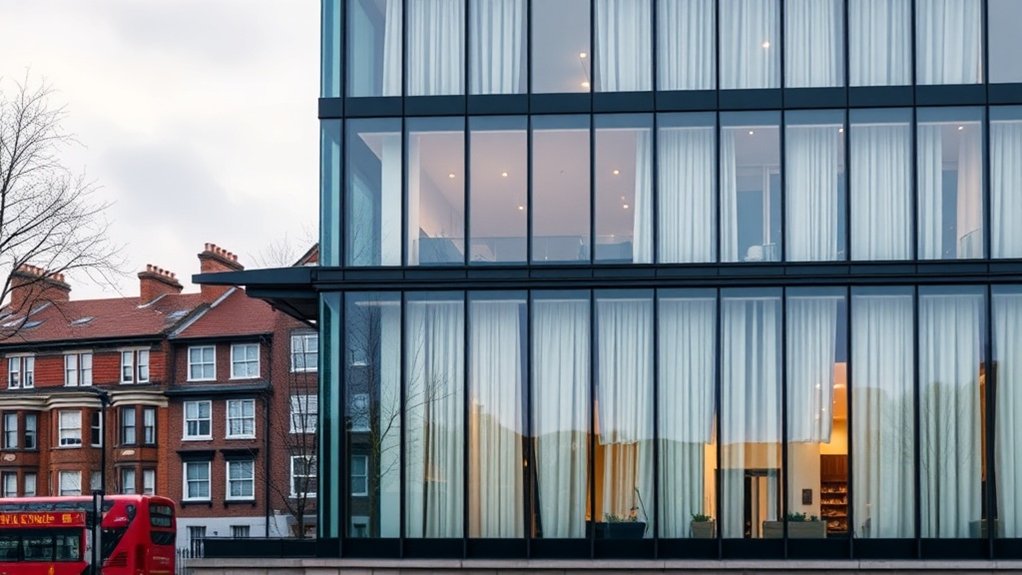
You’re designing hotel glazing in London within tight planning controls, heritage streetscapes, and high urban noise. You’ll need slim, conservation‑friendly facades that still achieve low whole‑window U‑values, controlled g‑values, and high Rw+Ctr ratings, while complying with Approved Documents L, O, B, K, BS 8233, ProPG, and CWCT guidance. Success means coordinating glass types, frames, shading, and access/maintenance to satisfy planners, guests, and BREEAM targets , which is exactly what the following sections unpack in detail.
Key insights
- London hotel glazing must balance high acoustic insulation, low U‑values, and solar control within dense, often heritage-sensitive urban streetscapes.
- Schemes must comply with UK Building Regulations (Part L, B, K, O) and borough planning policies, including strict aesthetic and conservation requirements.
- Acoustic strategies use laminated, often asymmetric IGUs with acoustic interlayers, optimised cavities, and airtight frames to meet BS 8233 and ProPG noise criteria.
- Heritage and listed hotels typically combine secondary or vacuum glazing with slim steel/bronze profiles to preserve original sightlines while improving performance.
- Successful planning approvals rely on detailed façade drawings, performance specifications, daylight/overheating/noise analyses, and visualisations that justify the glazing design.
How London’s Hotel Glazing Challenges Are Different
Because London combines dense urban fabric with strict planning controls, hotel glazing there faces a distinct set of challenges driven by conservation constraints, acoustic extremes, and demanding performance standards. You’re often inserting an innovative facade into heritage streetscapes that can’t tolerate visual disruption, yet must still deliver high acoustic insulation against traffic, rail, and nightlife.
You need glazing assemblies that reconcile slim sightlines with low U‑values, tight air permeability, and exacting solar control. Sustainable materials and high-spec coatings must work within constrained cavity depths and complex junctions to avoid thermal bridging . You also have to coordinate with rooftop plant, light spill limits, and neighbour daylight sensitivities, so your facade strategy can’t rely on generic curtain wall systems or off‑the‑shelf acoustic units.
Building Regs and Planning Rules for London Hotel Glazing
Managing London’s building regs and planning rules for hotel glazing means aligning national performance standards with hyper-local planning controls and conservation policies. You must reconcile Approved Document L (thermal performance), Part B (fire safety), Part K (protection from falling), and Part O (overheating) with borough-specific policies and Article 4 Directions.
You can’t treat window aesthetics as cosmetic; planners often require proportion, mullion depth, and reveal details that visually match heritage fabric while still achieving low U‑values and g‑values. Acoustic criteria near transport corridors further tighten glass specification.
You’ll also need to evidence safe access for glass maintenance under CDM Regulations, including cleaning strategies for high façades. Finally, factor bird-strike mitigation, solar gain control, and circular-economy glazing choices into your compliance narrative.
Getting Hotel Glazing Designs Through London Planning
Once you understand how building regs and borough policies shape performance targets, the next step is packaging your hotel glazing proposal so planners can approve it. You’ll need a coordinated pack: detailed elevation drawings, section details at typical junctions, and a glazing schedule that specifies U‑values, g‑values, light transmittance, and acoustic ratings.
Demonstrate how your Innovative materials meet London Plan energy, overheating, and noise criteria, referencing BS EN standards and approved calculation methods. Explicitly address overlooking, daylight/sunlight impacts , and facade reflectivity with quantified analyses.
For conservation or sensitive contexts, justify aesthetic enhancements using verified precedents, material samples, and photorealistic visualisations. Tie every design move to policy clauses, so officers see performance, safety, and townscape benefits as an integrated, testable package.
Planning a Glazing Strategy for London Hotels
You’ll need to structure your glazing strategy around quantifiable performance targets that balance acoustic attenuation with daylight factors for London’s variable urban contexts. At the same time, you must optimise U‑values, g‑values, and air‑tightness to meet Part L, London Plan energy policies, and your own comfort criteria for overheating and winter warmth. This requires selecting glazing build‑ups, coatings, and frame systems that explicitly trade off sound reduction indices (Rw + Ctr), solar control, and thermal performance within a coherent, building-wide specification.
Balancing Acoustics And Light
How do you admit generous daylight into guest rooms while still meeting stringent acoustic targets along London’s busy streets? You start by defining performance criteria: target Rw+Ctr values, daylight factor , and glare indices for each façade orientation. You then specify laminated units with asymmetric pane thicknesses and acoustic interlayers, tuned to attenuate traffic-dominant low frequencies.
To preserve transparency, you calibrate visible light transmittance while controlling reflections via low-iron glass, selective coatings, and fritted bands. You deploy Innovative textures and custom finishes on inner panes or spandrels to diffuse light without degrading sound insulation. You also detail airtight frames and decoupled fixing systems, ensuring tested system-level acoustic ratings (per BS EN ISO 10140) align with your modelled façade performance.
Energy Efficiency And Comfort
Why does an effective glazing strategy in London hotels start with quantified energy and comfort targets rather than product selection? You first define kWh/m², overheating hours, and operative temperature bands, then let these KPIs drive glazing choices . You model solar gains, U‑values, and visible light transmittance against London’s weather files and Part L / Part O requirements, while aligning with your brand’s innovative aesthetics and sustainable materials agenda.
- You specify low‑g‑value, low‑U, high‑LT glass on south and west façades, integrated with dynamic shading and high‑performance frames.
- You deploy triple glazing with warm‑edge spacers in noise‑exposed, comfort‑critical suites.
- You integrate sensor‑controlled electrochromic glazing in premium zones, linking BMS logic to occupancy, daylight, and façade orientation for ideal comfort.
Choosing the Right Glass Types for London Hotels
When specifying glass for a London hotel, the choice of glass type must align with defined performance criteria for safety, acoustics, energy efficiency, and guest comfort rather than aesthetics alone. You’ll typically combine laminated safety glass to meet BS EN 12600 and BS 6262 with low‑e coated IGUs to optimise U‑values and solar control, supporting both comfort and energy targets.
To protect Luxury amenities and interior aesthetics, you should select glass with high colour neutrality, low internal reflectance, and proven UV filtration . In dense urban contexts, specify acoustic laminated units with tailored interlayers, validated by laboratory Rw and spectrum‑adapted indices. For bathrooms and suites, deploy switchable privacy glass or patterned laminated products, ensuring compliance with critical location safety requirements near wet areas and circulation routes.
Glazing Strategies for New-Build London Hotel Towers
When you plan glazing for a new-build London hotel tower, you need to treat curtain wall performance as a primary façade engineering problem, not just an architectural expression. You’ll optimise U-values, g-values, thermal bridging, and airtightness to meet Part L , London Plan energy intensity targets, and typical BREEAM HEA/ENE credits, while coordinating with structural and fire strategies. At the same time, you must integrate purpose-designed acoustic glazing systems—using laminated interlayers, asymmetric build-ups, and properly detailed frames—to achieve façade-weighted sound reduction indices (Rw+Ctr) that satisfy BS 8233 and local planning noise criteria.
Optimising Curtain Wall Performance
Although the architectural expression of a London hotel tower often centres on its glazed curtain wall , you need to treat that façade first and foremost as a high‑performance environmental system governed by Part L, Part O, fire safety requirements, and local planning guidance on daylight, overheating, and townscape. You optimise performance by linking Innovative window designs and Sustainable glass solutions with a rigorously modelled envelope strategy.
-
Specify selective coatings, low‑iron glass, and tuned VLT/g‑values to balance solar gain, winter heat capture, and genuine daylight autonomy, validated via Climate‑Based Daylight Modelling and dynamic thermal simulation.
-
Deploy unitised curtain wall systems with thermally broken frames, warm‑edge spacers, and optimised cavity depths to minimise ψ‑values and air leakage.
-
Integrate operable elements, shading devices, and BMS controls to achieve adaptive comfort while reducing plant sizing.
Integrating Acoustic Glazing Systems
Even with a perfectly tuned thermal façade , your London hotel will fail its brief if external noise intrudes into guest rooms, so you need to treat acoustic glazing as a primary performance driver rather than an afterthought. Start by mapping façade exposure to transport and nightlife sources, then specify glazing configurations that deliver target Rw+Ctr values per BS 8233 and ProPG guidance.
Use laminated panes with asymmetric build-ups and wide cavities to maximise Acoustic insulation and Noise mitigation without excessive glass thickness. Combine this with thermally broken frames, continuous perimeter seals, and tested trickle vents achieving verified Dn,e,w ratings. For tower typologies, integrate acoustic twin-skin zones and sealed spandrels, validating performance through façade mock-up testing to EN ISO 10140 before committing to full façade procurement.
Glazing for Listed and Heritage London Hotels
While London’s listed and heritage hotels must preserve historically significant façades and window details, they’re still required to meet demanding performance, safety, and energy standards, making glazing specification highly constrained and technical. You must balance heritage preservation and historical authenticity with Part L, Part K, and security requirements, often under Listed Building Consent.
You’ll typically combine ultra-slender glazing with concealed technologies:
- Primary elevation – Single glazing retained; add bespoke secondary glazing with low‑iron , low‑e panes, warm‑edge spacers, and micro-ventilation, all hidden within existing linings.
- Courtyards and infills – Use thermally broken steel or bronze systems replicating original sightlines while delivering modern U‑values.
- Feature spaces – Deploy vacuum glazing units to mimic thin historic glass yet achieve high thermal performance without visible double-glazed bulk.
Acoustic Glazing Strategies for Noisy London Sites
At noisy London sites, you’ll need to specify acoustic glass types by measured Rw, C, and Ctr values, matching or exceeding the façade performance targets in BS 8233 and local planning conditions. You should evaluate laminated, asymmetric, and secondary glazing configurations based on frequency-specific attenuation, façade orientation, and proximity to major transport corridors. To realise the glass’s full acoustic rating, you must also optimise frames, gaskets, and perimeter seals, paying close attention to airtightness, installation tolerances, and tested system performance.
Selecting Acoustic Glass Types
How do you specify acoustic glass that genuinely attenuates London’s traffic, rail, and nightlife noise rather than just improving lab results on paper? You start by mapping octave-band façcade noise to required internal NR levels, then back-calculate composite Rw+Ctr targets for each glazing zone, ensuring robust acoustic insulation.
-
Laminated asymmetry – Combine dissimilar glass thicknesses with acoustic PVB interlayers, tuned to dominant low frequencies from buses and Underground lines, validated against BS EN ISO 10140 data.
-
Hybrid IGUs – Use laminated inner panes plus tailored cavities (often 12–20 mm), optimizing mass–air–mass resonance while respecting U-value and g-value constraints.
-
Performance and aesthetics – Integrate spectrally selective glass tinting or low-iron laminates so daylight, colour rendering, and brand aesthetics don’t compromise verified acoustic performance.
Frame And Seal Optimization
Too often, you’ll see hotel projects in London specify high‑performance acoustic glass, then lose 5–10 dB of real‑world benefit through poorly designed frames and seals. You need to treat the frame as a continuous acoustic barrier : specify thermally broken aluminium or composite sections with multi‑chamber profiles, tested to BS EN 14351‑1 and BS EN ISO 10140.
Prioritise dual or triple compression gaskets, not just brush or bubble seals, and verify long‑term resilience through cyclic‑aging test data. Use innovative materials—such as viscoelastic interlayers in frame interfaces and acoustically damped packers —to suppress flanking transmission. Integrate concealed trickle vents with tested Dn,e,w ratings. Finally, coordinate frame sightlines and aesthetic enhancements so mullion depths, cover caps, and junctions don’t compromise acoustic continuity.
Thermal Performance in London Hotel Glazing
Why does thermal performance in hotel glazing matter so much in London’s climate? You’re dealing with frequent temperature swings, high humidity, and tight energy‑efficiency targets under UK Building Regulations Part L and local planning policies. High‑performance assemblies must minimise U‑values, suppress edge losses, and stabilise interior temperatures to protect guest comfort and operational budgets.
You’ll typically combine insulated glass units with inert gas fills, warm‑edge spacers, and Innovative coatings that tune emissivity without sacrificing clarity. To push further, specify Sustainable materials and verify performance via whole‑building simulations, not catalogue values.
- Guests experience stable room temperatures without draughts.
- Plant loads reduce, enabling smaller, smarter HVAC systems.
- You demonstrate measurable progress toward decarbonisation and ESG commitments.
Solar Control and Overheating Solutions for Hotel Glazing
You now need to address solar control and overheating risk by specifying high‑performance glazing that limits solar heat gain while maintaining strict visual comfort criteria. You’ll evaluate coated glass with optimised g-values and visible light transmittance, configuring the façade to reduce glare and peak cooling loads in line with CIBSE TM52, TM59, and Part O guidance. To refine performance further, you should integrate dynamic shading technologies—such as automated external blinds or electrochromic glazing—coordinated with BMS controls to respond to real-time solar irradiance and occupancy patterns.
High-Performance Solar Control
How can London hotels maintain generous glazing while still meeting stringent overheating and energy performance criteria? You start by specifying high-performance solar control glazing that selectively transmits daylight while sharply limiting solar heat gains (low g‑values), aligned with Part L, TM59, and local planning guidance. This lets you protect luxury amenities and interior design from thermal stress, while preserving expansive views.
- Specify spectrally selective coatings tuned to London’s solar profile, balancing low-emissivity layers with neutral colour rendering for premium interiors.
- Combine laminated solar-control interlayers with argon-filled double or triple units to reduce SHGC while maintaining low U‑values.
- Integrate glazing into a façade system with verified thermal bridging details, ensuring modeled performance translates to in‑use comfort across diverse room orientations.
Reducing Glare And Heat
Building on the specification of high‑performance solar control glazing, effective glare and heat management in London hotels depends on pairing the glass selection with coordinated solar control strategies that perform under TM52, TM59, and CIBSE guidance. You prioritise low g‑values and selective coatings that attenuate solar gains while preserving colour neutrality, ensuring guest comfort without compromising views.
You calibrate visible light transmittance to maintain compliant daylight factors in guestrooms and lounges, reducing disability and discomfort glare at working and resting positions. Laminated constructions with interlayers tuned for particular wavelengths let you modulate brightness gradients, support circadian‑friendly daylight, and protect finishes. You can also specify fritted or patterned panes that echo Historical motifs while controlling luminance, using Artistic reflections to enrich façades without breaching overheating criteria.
Dynamic Shading Technologies
While high‑performance solar control glazing establishes the baseline, dynamic shading technologies let you fine‑tune solar gains in real time to meet TM52 , TM59, and CIBSE overheating criteria across variable London weather conditions. You integrate façade systems that modulate g‑values, visible transmittance, and U‑values in response to solar altitude, irradiance, and occupancy.
- Electrochromic glass with smart tinting dynamically reduces solar gains on west and south façades, limiting peak operative temperatures without sacrificing skyline views.
- External automated blinds, linked to BMS and weather data, maintain compliance‑ready internal temperatures while optimising daylight factors.
- Double‑skin façades using innovative coatings and controllable vents create a buffer zone, enabling night purging and reducing chiller loads.
You verify performance using hourly simulations aligned with London TRY/DSY weather files.
Glazing for Guest Comfort, Privacy and Wellbeing
Although hotel glazing is often specified for energy performance and façade aesthetics, its most critical function is to control comfort, privacy, and wellbeing in guest rooms with precise optical, acoustic, and thermal performance. You should define Guest privacy requirements through visible light transmittance, external reflectance, and daylight glare probability , using EN 17037 and CIBSE LG10 as design references.
For wellbeing enhancement, you can specify spectrally selective low‑E coatings that maximise circadian-effective illuminance while limiting g‑values to prevent overheating under London’s evolving climate profiles. High STC/Rw laminated units with asymmetric build-ups reduce urban noise, stabilising sleep quality. Combine warm-edge spacers , inert gas fills, and ψ‑value optimisation to minimise edge losses and downdraughts, ensuring uniform operative temperatures across the occupied zone.
Security, Safety and Fire Performance in Hotel Glazing
How do you reconcile expansive glazing with the stringent security, safety, and fire performance obligations that apply to London hotels? You start by treating the façade as a critical life‑safety system, not just an envelope for glass aesthetics.
You’ll specify laminated security glass with P1A–P5A or higher classifications, robust framing , and tested ironmongery to resist forced entry and ballistic threats while still enabling clean sightlines. Fire performance then drives you toward compartmentation, integrity/insulation ratings, and certified systems tested to BS EN 1364/1634, coordinated with your escape strategy.
To visualise the outcome:
- Ground floor glazing that’s elegant yet attack‑resistant.
- Fire‑rated corridor screens that preserve transparency.
- Accessible façade design that anticipates maintenance challenges while maintaining compliance over the building’s life.
How Glazing Supports Part L and BREEAM in London Hotels
Done well, hotel glazing in London becomes a primary tool for driving Part L compliance and BREEAM credits rather than a liability you have to mitigate. You start by optimising whole-window U‑values, g‑values, and air leakage, then validating them through SAP/SBEM modelling . High‑performance low‑e units, warm‑edge spacers, and insulated frames cut regulated carbon, supporting Part L TER/DER targets.
For BREEAM, you use glazing to enhance fabric energy efficiency, reduce cooling loads through solar control, and improve daylight factors while limiting glare. Careful façade design lets you balance hotel aesthetics with performance, proving compliance via BRUKL reports, daylight simulations, and thermal bridge assessments . Precision glazing installation is critical: poor tolerances, inadequate air seals, or thermal discontinuities can erode both Part L performance and BREEAM scores.
Cost, ROI and Lifecycle Planning for London Hotel Glazing
When you plan hotel glazing in London, you need to treat cost as a lifecycle investment decision driven by performance metrics, not just a capital line item. You quantify total cost of ownership by modelling energy, maintenance, replacement, and downtime across a 30–40 year horizon, aligned with London’s tightening carbon trajectory.
You prioritise Innovative materials that deliver cost effective solutions without compromising acoustic, thermal, or fire performance. Use parametric studies to test U‑values, g‑values, VLT, and airtightness against predicted occupancy patterns.
- Capex vs Opex: Compare higher-spec IGUs with reduced plant size and energy spend.
- Revenue Uplift: Model ADR and occupancy gains from façade comfort and views.
- Refurbishment Cycles: Plan seal, coating, and hardware renewal to maintain compliance and ROI.
Working With Glazing Contractors in London
Selecting and managing glazing contractors in London demands the same rigour you apply to façade design and performance modelling. You should pre-qualify firms on their command of Part L, Part B, and BS 6262, plus experience with CWCT-tested systems. Demand project-specific method statements , interface details, and verified wind-load and impact calculations.
Interrogate how they balance innovative aesthetics with tested material durability, including edge-seal robustness, coating stability, and spacer performance. Require evidence of mock-up testing, water-tightness and air-permeability results, and documented acoustic performance.
You should also align BIM coordination, tolerance strategies , and sequencing with your main contractor’s programme. Insist on clear O&M documentation, glass replacement protocols, and warranties tied to both product and installation quality, not just headline performance values.
Emerging Glazing Trends in London Hotels
Rigorous contractor selection gives you the platform to exploit the next wave of glazing innovation now reshaping London hotels. You’re no longer just buying glass; you’re specifying integrated façade systems that drive brand, performance, and revenue.
-
Smart façades You deploy dynamic glazing with solar-control coatings and automated blinds tied to building management systems, cutting cooling loads while preserving skyline views and guest comfort.
-
Innovative materials You adopt high‑performance laminated units, vacuum IGUs, and structural interlayers that slim profiles, enhance acoustics, and meet Part L, Part O, and BS 6262 thermal and safety thresholds.
-
Aesthetic finishes with function You combine fritted patterns, ceramic printing, and low‑iron glass to deliver signature aesthetics while controlling glare, preserving privacy, and maintaining daylight factors.
Frequently Asked Questions
How Can Glazing Help Differentiate a London Hotel’s Brand and Guest Experience?
You use glazing to encode your brand in the envelope itself. Specify high‑performance façades using sustainable materials and low‑e coatings to cut thermal loads while improving acoustic isolation and visual comfort. Integrate artistic patterns via fritted glass, interlayers, or digital printing to create a recognizable signature. Align U‑values, g‑values, and daylight factors with WELL and BREEAM benchmarks so guests perceive innovation, clarity, and intentional design in every view.
What Glazing Choices Most Influence Online Reviews and Guest Satisfaction Scores?
You influence reviews most through acoustic performance and thermal comfort. When noise drops by 10 dB, perceived loudness halves, often lifting satisfaction scores by 15–20%. Prioritize high-spec window insulation (low‑U‑value, thermally broken frames, airtight gaskets) while preserving controlled daylight penetration via spectrally selective low‑E coatings and optimized visible light transmittance. Validate choices using EN 14351-1, ISO 10140, and in-situ post-occupancy measurements to correlate glazing performance with rating trends.
How Does Glazing Impact Housekeeping Routines and Long-Term Maintenance Staffing?
Glazing directly reshapes housekeeping workflows and long‑term maintenance staffing. With high‑performance glass insulation and superior window durability, you reduce condensation, staining, frame corrosion, and seal failures, so you schedule fewer deep‑clean cycles and disruptive repairs. You can recalibrate FTE allocations toward predictive inspections rather than reactive fixes, standardize cleaning chemicals and tools, and align maintenance intervals with manufacturer standards, BREEAM objectives, and lifecycle‑cost models to support scalable, innovation‑driven asset management.
Can Glazing Designs Support Future Conversion to Aparthotel or Co-Living Formats?
Yes, you can future‑proof for aparthotel or co‑living by specifying adaptable glazing now. You prioritise high window insulation values (e.g., ≤1.1 W/m²K) to meet stricter residential energy and comfort criteria. You select glass durability solutions—laminated, low‑iron, and abrasion‑resistant coatings—to withstand intensive use and cleaning cycles. You standardise opening types, ventilation slots, and shading interfaces so façades reconfigure with minimal structural or compliance redesign.
How Early Should Glazing Strategy Involve Marketing, Operations, and Revenue Management Teams?
You should engage marketing, operations, and revenue management at RIBA Stage 1–2 , before locking the glazing brief. Collaboratively define room mix, Window insulation performance, Sunlight control strategy, acoustic targets, and façade articulation to align with brand segmentation and RevPAR goals. Early inputs let you model dynamic pricing, length-of-stay patterns, and amenity usage, ensuring the glazing specification remains adaptable for future aparthotel or co-living reconfiguration without costly retrofits.
Summary
When you treat London hotel glazing as a strategic system, you cut carbon, control comfort, and critically manage compliance. By pairing precise U‑values, proven acoustic performance, and properly detailed interfaces, you protect Part L targets, bolster BREEAM scores, and future‑proof façades. Prioritise robust specifications, rigorous testing, and reliable contractors to deliver durable, defect‑free, and design‑led glazing that safeguards guests, satisfies planners, and secures long‑term lifecycle value in London’s demanding urban context.