
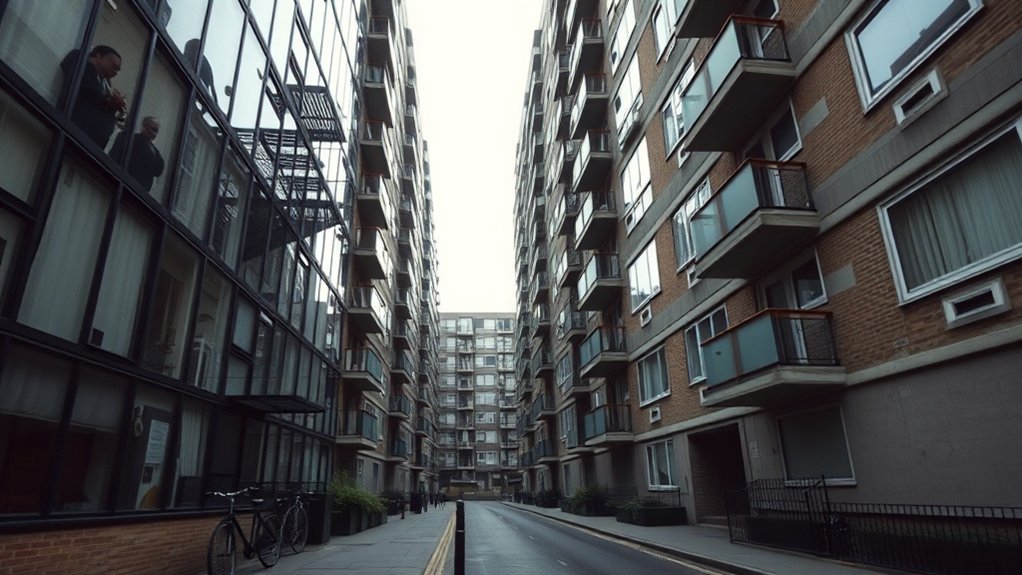
In London social housing, glazing acts as critical infrastructure that controls heat loss, noise, condensation and overheating in ways old estate windows never could. You’re balancing U‑values, g‑values, airtightness and ventilation to hit energy, comfort and health targets while managing cost and heritage constraints. Better glazing cuts fuel bills, mould and noise, but needs smart ventilation to avoid summer overheating. If you want to understand what actually works on London estates, the next sections explain it.
Key insights
- Upgrading social housing glazing in London improves thermal efficiency, reduces fuel poverty, and enhances resident health by cutting heat loss and condensation.
- Modern high-performance double or triple glazing balances energy savings, noise reduction, safety, and comfort within London’s dense urban environment.
- Refurbishment projects must meet strict London and UK regulations on fire safety, structural performance, ventilation, and conservation or heritage requirements.
- Robust procurement and specification frameworks are crucial to avoid low-spec legacy glazing and ensure long-term durability, maintainability, and lifecycle value.
- Dynamic design of glazing, shading, and ventilation is needed to control overheating, support net-zero goals, and future-proof London social housing estates.
Why Glazing Matters In London Social Housing
Although glazing can seem like a simple specification detail, it’s one of the most critical components in London’s social housing performance and compliance. You rely on it to balance thermal efficiency , acoustic control, daylight access, and resident safety within strict regulatory frameworks and tight budgets.
You have to evaluate glass durability against urban stresses: wind loading, pollution, thermal shock, and high-use openings. Robust glazing assemblies reduce lifecycle costs and unplanned maintenance, while improving fire performance and secure‑by‑design outcomes .
At the same time, you can’t ignore glazing aesthetics. Façade transparency, frame proportions, and visible junctions influence resident wellbeing, passive surveillance, and estate identity. By treating glazing as a strategic system, you optimise energy, comfort, and long‑term asset value across your housing portfolio.
The Legacy Of Poor Estate Glazing
You now have to assess how historical glazing shortfalls on London estates continue to shape performance, cost, and habitability. Earlier specifications—often single glazing, poor frame detailing, and weak junctions—haven’t just reduced thermal efficiency; they’ve locked estates into higher maintenance, retrofit complexity, and uneven asset value. By tracing these long-term estate impacts, you can quantify how outdated glazing still constrains building safety, energy strategy, and resident comfort.
Historical Glazing Shortfalls
How did London’s post‑war social housing estates end up with glazing that performs so poorly by today’s standards? You inherited systems driven by cost, speed, and standardisation, where artistic craftsmanship and glazing aesthetics ranked far below structural output. Architects often specified large single‑glazed panels in thin steel or aluminium frames, prioritising daylight and modernist expression over thermal resistance.
You see the result in high U‑values , poor airtightness, and minimal solar‑control strategies. Procurement frameworks locked in low‑spec glass, limited frame breaks, and rudimentary seals. Limited understanding of condensation risk, acoustic control, and lifecycle performance reinforced under‑engineered solutions. Regulatory baselines focused on safety and basic durability, not energy performance. Consequently, you face a legacy of glazing that underdelivers on comfort, efficiency, and adaptability.
Long-Term Estate Impacts
Over decades, underperforming glazing has reshaped estate conditions far beyond simple heat loss, locking in systemic deficits in comfort, health, and operating cost. You inherit not just cold flats, but degraded fabric, stressed services, and constrained capital. Poor glazing aesthetics also depress resident pride and reduce acceptance of new technologies.
You see long‑term impacts accumulate across four critical vectors:
- Thermal instability: Persistent cold spots, drafts, and overheating undermine retrofit gains elsewhere.
- Moisture and health: Condensation drives mold, respiratory risk, and premature finishes failure.
- Asset performance: Elevated maintenance, shortened lifecycle of frames, and reduced resilience to climate extremes.
- Urban perception: Weak aesthetic integration and outdated glazing aesthetics lock estates into stigma, limiting regeneration leverage and external investment.
Balancing Performance, Comfort And Condensation
When you upgrade glazing in London’s social housing, you need to optimise thermal performance without creating new risks around condensation. You must balance U‑values, solar gains, and airtightness with ventilation strategies that maintain stable internal temperatures and humidity. This section evaluates how you can enhance resident comfort while preventing window condensation that damages fabric and undermines perceived quality.
Optimising Thermal Performance
Although high-performance glazing can considerably reduce heat loss in London’s social housing, you have to balance thermal efficiency against occupant comfort and condensation risk. You optimise thermal performance by treating glazing as a system where Energy efficiency, material durability, and moisture behaviour interact.
You can structure your approach around four levers:
- Quantify U-values, g-values, and airtightness to match façade performance with SAP targets and local microclimate.
- Specify frame and spacer materials with low thermal conductivity yet high material durability, limiting thermal bridging at junctions.
- Use selective coatings and gas fills to fine‑tune solar gains while constraining night‑time heat losses in exposed elevations.
- Model interstitial and surface condensation using dynamic simulations , then adjust glazing build‑ups or ventilation strategy to keep internal surface temperatures above critical dew points.
Enhancing Resident Comfort
Even as you push glazing performance towards lower U‑values and tighter façades, you still have to prioritise how residents actually experience their homes: temperature stability, visual comfort , acoustic protection, and air quality. You need to balance energy efficiency with perceived comfort, ensuring glazing systems don’t create cold downdraughts, glare, or acoustic leakage from streets and rail lines.
You can specify selective coatings and interlayers that optimise solar gain, colour rendering, and sound attenuation while maintaining daylight factors. Smart technology lets you integrate automated blinds, actuated vents, and adaptive shading linked to sensors, so internal conditions respond dynamically to occupancy and weather. In social housing, you also have to design controls that remain intuitive, robust, and low‑maintenance for diverse user profiles.
Preventing Window Condensation
Why does a façade that performs well thermally still suffer from condensation at the window edge? You’re dealing with localised thermal bridges, surface temperature gradients , and occupant-driven humidity loads. To prevent this, you need solutions that stabilise glass-edge temperatures while preserving daylight and aesthetics.
You can prioritise four coordinated strategies:
- Optimise edge details : use warm-edge spacers, insulated frames, and continuous airtightness to raise internal surface temperatures.
- Control interior moisture: integrate demand-controlled ventilation and humidity sensors using smart technology.
- Manage surface temperatures: deploy low‑power edge heaters or phase‑change materials only where modelling shows risk.
- Ensure aesthetic integration: conceal sensors, wiring, and ventilation grilles within frames, sills, or cladding reveals so performance upgrades don’t compromise visual coherence or resident acceptance.
Ventilation And Overheating In Better-Glazed London Flats
While higher‑performance glazing improves thermal comfort and cuts heat loss, it also changes how London flats gain, store, and release heat, making ventilation strategy critical to avoiding overheating. You must treat the façade, ventilation, and internal gains as an integrated thermal system, not separate elements.
You can’t rely on casual window opening alone. Natural ventilation needs predictable air paths, controllable inlets, and stack or cross‑flow drivers, otherwise you’ll compromise indoor air quality or fail to purge excess heat at night. You should model summertime risk using dynamic simulations that include occupancy, solar gains, and urban heat‑island effects. Prioritise shading, purge‑vent strategies, and low‑energy fans with demand‑controlled operation. Specify user‑friendly controls, so residents can intuitively balance noise, security, and cooling.
Double Vs Triple Glazing In London Blocks
Because London’s climate, construction quality , and budgets all constrain specification, the choice between double and triple glazing in social housing blocks comes down to quantified performance trade‑offs rather than a blanket “more is better” rule. You’re balancing U‑values, airtightness, weight, and capital cost against operational savings, embodied carbon, and glass sustainability.
You should benchmark options against:
- Thermal performance vs. cost: triple glazing cuts heat loss but may deliver diminishing returns in London’s relatively mild climate.
- Acoustic attenuation: both systems can meet WHO internal noise targets with the right glass build‑ups.
- Smart technology integration: frames and cavities must accommodate sensors, actuators, and automated vents.
- Structural and maintenance impacts: triple units increase loads, replacement complexity, and whole‑life cost.
Glazing For London High-Rise Refurbishments
Glazing for London high‑rise refurbishments must reconcile stringent fire and safety regulations, complex existing structures , and occupied‑building constraints with ambitious energy and comfort targets. You need systems that integrate with existing façades while upgrading thermal performance and airtightness without overloading the structure.
You should prioritise high‑performance units that balance window aesthetics with glass durability, specifying laminated and toughened panes that meet post‑Grenfell fire and containment requirements. Optimised coatings, warm‑edge spacers, and thermally broken frames reduce heat loss and mitigate summer overheating, vital in dense urban microclimates.
On occupied towers, you’ll favour off‑site prefabricated glazing cassettes to minimise disruption, improve quality control, and accelerate installation. Rigorous wind‑load, impact, and acoustic modelling should inform your specification, ensuring long‑term resilience and low lifecycle costs.
Glazing In Heritage And Conservation Estates
When you upgrade glazing in heritage and conservation estates, you must navigate strict planning and regulatory constraints that can limit frame profiles, sightlines, and visible coatings. You need to preserve historic aesthetics while accommodating requirements from conservation officers and local design guides. At the same time, you must balance thermal, acoustic, and safety performance with heritage significance, often by specifying sympathetic frame materials, glazing build-ups, and installation methods.
Planning And Regulatory Constraints
Although glazing upgrades in London’s social housing often appear straightforward, estates within conservation areas or involving listed buildings sit under a dense layer of planning and heritage controls that considerably shape what you can specify. You must navigate the Planning (Listed Buildings and Conservation Areas) Act, local plan policies, and GLA energy guidance while aligning with emerging sustainability standards.
Decision-makers typically interrogate:
- How your U-values, g-values, and frame sections balance thermal performance with policy-compliant visual impact.
- Whether acoustic and safety laminates alter external appearance or reflectivity thresholds.
- Your justification within Design & Access and Heritage Statements, supported by robust technical options appraisal.
- How Community engagement evidence shows residents accept trade-offs between performance, maintenance, and regulatory limits.
Preserving Historic Aesthetics
In heritage and conservation estates , you have to treat glazing as part of a wider townscape composition rather than a stand‑alone performance upgrade. You’re intervening in a calibrated visual system: façade rhythm, frame depth, and reflection patterns all contribute to architectural aesthetics and streetscape legibility.
You need to map historic sightlines, proportions, and mullion hierarchies , then specify glazing that replicates these cues while exploiting contemporary fabrication. Thin-profile double glazing, vacuum units, and precision-engineered spacers let you maintain slender sections and authentic shadow lines. You also have to test coatings and interlayers for colour neutrality to avoid disruptive tint shifts across elevations.
Material durability becomes a design variable: you must select frame and sealant systems that weather predictably, aligning patination with historic fabric.
Balancing Performance And Heritage
Balancing performance and heritage in social housing estates means treating thermal and acoustic upgrades as constraints‑driven optimisation problems rather than generic retrofit tasks. You’re steering planning controls, historic fabric, and resident comfort simultaneously, so glazing design has to be parametric, evidence‑led, and fully modelled.
You typically need to:
- Quantify U‑values, g‑values, and air‑tightness targets, then test options with dynamic simulation .
- Specify glass durability and hardware life‑cycle so replacement intervals align with estate‑wide asset strategies.
- Engineer aesthetic integration: profile depths, sightlines, and surface reflectance must visually reconcile with original fenestration.
- Prototype and monitor: use pilot blocks to validate acoustics, condensation resistance, and occupant satisfaction before scaling.
This approach lets you deliver measurable performance gains without eroding heritage significance.
London Rules On Social Housing Glazing
How does London’s regulatory framework shape the glazing you can specify for social housing? You must align London Plan policies , Building Regulations, and local SPD documents to deliver compliant, future‑ready façades. Part L drives thermal performance, while Part O and the London Plan’s overheating guidance constrain solar gain and mandate dynamic modelling, especially on dense, high‑rise estates.
You also need to integrate acoustic requirements from BS 8233 and local noise SPDs, which often push you toward higher‑performance sealed units. Design codes increasingly link glazing ratios to daylight, Urban greenery, and façade articulation, requiring coordinated planting and shading strategies. Community engagement influences acceptable window types, ventilation strategies, and privacy controls, ensuring residents endorse visible innovations such as smart coatings or adaptive shading.
Retrofitting Glazing In Occupied Homes
Retrofitting glazing in occupied London social housing takes the same regulatory drivers you apply to new façades and compresses them into a live, constrained environment. You must phase works around residents, maintain fire integrity at every stage, and minimise disruption while upgrading thermal and acoustic performance.
To structure decisions, you can focus on:
- Assessment – quantify existing U-values, air leakage, and acoustic insulation against London and national benchmarks.
- Specification – select units using smart materials (e.g., low‑e coatings, switchable glazing) compatible with existing frames.
- Installation sequencing – design stack‑by‑stack programmes that preserve means of escape and weather‑tightness daily.
- Performance verification – commission on-site testing for air permeability, noise reduction, and condensation risk to validate real‑world gains in occupied conditions.
Cost, Funding And Payback For New Glazing
Although design intent often focuses on performance , decisions on new glazing in London social housing ultimately turn on capital cost, available subsidy, and verifiable payback. You need a granular cost analysis that separates frame replacement, glass specification, access, and compliance overheads, then normalises these per dwelling and per square metre of façade.
You should model lifecycle cost , not just upfront spend, incorporating maintenance intervals, expected service life, and end‑of‑life disposal. To close the gap between viable schemes and budget constraints, you’ll typically blend funding sources: central and mayoral retrofit programmes, planning‑gain contributions, green bonds, and asset‑backed borrowing.
You then validate payback using metered pre‑ and post‑installation data, scenario testing energy prices and discount rates to demonstrate robust whole‑stock returns.
How Glazing Affects Fuel Poverty And Health
When you upgrade glazing in London social housing, you directly influence residents’ exposure to fuel poverty and to health risks linked with cold, damp homes. High‑performance units cut conductive heat loss , so households need less energy to maintain thermal comfort, reducing under‑heating, arrears, and stress.
You can frame the impacts under four interlinked outcomes:
- Reduced transmission losses lower space‑heating demand, directly mitigating fuel poverty.
- Higher internal surface temperatures minimise condensation, mould growth, and associated respiratory illness.
- Improved airtightness, combined with designed ventilation, stabilises indoor air quality instead of relying on leaky, inefficient frames.
- Better acoustic insulation reduces noise stress, indirectly supporting cardiovascular and mental health.
How London Landlords Are Getting Glazing Right
Across London’s social housing stock, the landlords making the most progress on glazing treat it as a targeted performance intervention, not a cosmetic upgrade. You start with data: fabric performance surveys, thermal imaging , and occupant feedback to identify blocks where glazing delivers maximum impact.
You then specify glazing materials by performance metrics—U‑value, solar heat gain coefficient, visible light transmittance—rather than brand. You integrate these into wider urban design constraints such as conservation frontage, daylighting to narrow courtyards, and noise from major transport corridors.
You phase works block‑by‑block, aligning window replacements with façade repairs to minimise disruption and scaffold costs. You validate outcomes through monitored space temperatures, condensation incidence, and energy consumption, then iterate specifications based on measured results.
Policy And Innovation For Future-Proof Glazing In London Social Housing
Even as individual landlords refine their glazing strategies block by block, it’s policy , regulation, and procurement frameworks that will determine whether London’s social housing stock is genuinely future‑proofed. You need clear performance-based standards that integrate overheating risk, embodied carbon, and whole-life cost, not just basic U‑values.
To operationalise this, you can align your strategies with four policy‑driven levers:
- Define minimum performance specs that encourage innovative coatings and smart glass where they’re demonstrably cost‑optimal.
- Use aggregated, pan‑borough procurement to de‑risk emerging glazing technologies.
- Embed post‑occupancy evaluation clauses so real thermal and daylight performance informs future tenders.
- Link funding to verifiable reductions in peak cooling load and winter heat loss, incentivising continuous innovation in glazing systems.
Frequently Asked Questions
Can Residents Choose Window Styles or Are Designs Standard Across the Estate?
You’ll usually see standard designs across the estate to maintain design consistency, structural performance, and streamlined maintenance. However, limited window customization may be possible within predefined specifications—such as frame colour, handle type, or glazing options—if they don’t compromise thermal performance, safety, or façade integrity. You should check project guidelines and planning constraints; any deviation typically requires technical approval to guarantee compliance with performance, cost, and aesthetic targets.
How Are Vulnerable Residents Supported During Disruptive Window Replacement Works?
You support vulnerable residents by planning disruption mitigation as carefully as surgeons schedule complex operations. You start with proactive resident communication: pre-works briefings, written schedules, and named contacts. You then phase works to minimise time without windows, offer quiet rooms or decant options, and coordinate with carers or support workers. You provide temporary heating, dust and noise controls, accessibility adjustments, and daily welfare checks, all tracked through a clear, data-driven risk register.
What Glazing Maintenance Responsibilities Fall on Tenants Versus the Landlord?
You handle routine cleaning, safe operation, and prompt reporting of defects as core tenant responsibilities. You mustn’t modify glazing or hardware without consent. The landlord obligations cover structural integrity, frame and seal replacement, resolving condensation from system failure, and ensuring regulatory compliance (thermal, acoustic, safety). You should document issues with photos , log them digitally, and escalate persistent faults to trigger formal inspection, planned maintenance, or system upgrade pathways.
How Can Residents Report and Track Glazing Defects or Draught Issues Digitally?
You enter a digital control room where each pane’s a data node. You report glazing defects or draughts through an online portal or app, uploading photos, videos, and descriptions for Virtual inspections . You tag location, window ID, and severity, then submit. The system generates a case ID, timestamps it, and logs status updates. Through dashboards and automated alerts, you track resolution while providing continuous Digital feedback to optimise asset performance.
Are There Community Engagement or Consultation Processes Before Major Glazing Upgrades?
You’ll usually see structured community feedback and formal consultation procedures before major glazing upgrades. You might receive digital surveys, attend design workshops, or join tenant forums that evaluate thermal performance, acoustic targets, and visual impact. You can challenge specifications, propose innovations (e.g., smart glazing, advanced coatings), and review lifecycle data. Landlords then integrate responses into option appraisals, publish consultation reports, and iterate designs before procurement and installation.
Summary
You’ve seen how glazing choices directly shape comfort, bills, and health in London’s social housing. Upgrading single glazing to high‑performance double can cut heat loss by up to 50%, yet many estates still rely on outdated units that lock in fuel poverty and damp. If you treat glazing as critical infrastructure—integrated with ventilation, shading, and smart controls—you’ll future‑proof blocks against stricter carbon targets, rising energy prices, and hotter summers.