You use a glass canopy in London to create a slim, structurally engineered shield against rain and wind that still delivers high daylight and a refined façade line. You’ll combine laminated or toughened safety glass, stainless-steel fixings, calculated slopes and concealed drainage to meet UK standards and London’s heavy rainfall. You can tune coatings, frits and support ribs for heritage or contemporary contexts. Explore how types, costs, detailing and maintenance influence the right solution for your building.
Key insights
- London glass canopies must meet UK Building Regulations for structural stability, impact safety, drainage, and fire/escape routes, especially over pavements and entrances.
- Designers typically use laminated, heat-strengthened or fully toughened safety glass with low-iron options for clarity and optional frits for glare and solar control.
- Structural systems often combine slender steel or aluminium ribs, stainless tie-rods, and point-fixed spider fittings, sized via structural analysis for wind, snow, and self-weight.
- Detailing in London’s rainy, polluted climate prioritises 3–5° falls, concealed gutters, drip edges, and durable hydrophobic coatings to minimise staining and maintenance.
- In conservation areas, glass canopy aesthetics, fixings, and lighting must respect historic façades, requiring careful planning submissions and early consultation with local authorities.
Why Glass Canopies Work So Well in London
Although London’s climate is notoriously changeable, glass canopies perform exceptionally well here because they deliver controlled weather protection without blocking natural light or compromising architectural lines. You benefit from high-spec laminated or toughened glass that resists wind uplift, impact, and thermal stress while maintaining a minimal visual footprint.
You can calibrate visible light transmittance, solar gain, and acoustic performance through interlayers, coatings, and frit patterns, aligning the canopy with London’s dense urban fabric. Structural fixings—tension rods, cantilevered steel, or concealed brackets—let you retain façades of historical significance while adding a contemporary intervention with measurable cultural impact. By specifying self-cleaning and low-iron glass, you reduce maintenance and preserve optical clarity, ensuring your canopy reads as a precise, future-ready architectural element.
Glass Canopies for Entrances, Patios and Gardens
Building on these performance advantages , glass canopies become highly effective architectural tools when you apply them to entrances, patios, and gardens. You define a controlled microclimate using laminated or toughened glass panels, precision-fixed with stainless-steel point supports or slimline aluminium framing, ensuring structural rigidity and minimal visual intrusion.
At entrances, you can cantilever the canopy from the façade, aligning joints with door reveals to create a clean datum line. On patios, modular panel grids let you tune shading coefficients and integrate concealed drainage channels. In gardens, you transform canopies into exterior glass art, sandblasting or fritting patterns that modulate glare. Integrate layered lighting design—linear LEDs in rafters, uplights to connections—to dramatise structure and extend evening usability.
Commercial Glass Canopies for Shops and Offices
When you specify commercial glass canopies for shops and offices, you’re enhancing weather protection , daylight transmission, and the perceived quality of the entrance zone. You can treat the canopy as a branded architectural element, using tailored glazing types, steel or aluminium support systems, and integrated lighting to align with your façade design and corporate identity. It’s also essential that you understand installation methods, load paths, fixings, safety glass standards, drainage details, and maintenance access so the system remains compliant, durable, and easy to service over time.
Benefits For Commercial Entrances
In commercial entrances for shops and offices, a well‑designed glass canopy functions as both a weather barrier and a key architectural element that defines the façade. You gain controlled Light transmission, shielding thresholds from rain while maintaining high daylight levels in lobbies and display zones. This enhances Urban aesthetics , giving the frontage a clean, lightweight profile.
Design Options And Branding
Beyond performance at the entrance threshold, a commercial glass canopy gives you a highly controlled canvas for design expression and brand identity . You can choreograph first impressions using glass specification, support hardware, and integrated technologies.
You’ll define brand-led color schemes through fritted patterns, interlayers, or back-painted panels, aligning RAL tones with your storefront. Edge profiles, visible fixings, and stainless-steel tension rod or bracket systems become deliberate design features, not just structure.
You can embed logos via ceramic printing or laminated inserts, maintaining durability under UV exposure. Dynamic lighting options —LED strip detail in mullions, spot luminaires in steel beams, or RGB nodes within glass fins—let you tune colour temperature and scenes, synchronising the canopy’s night-time presence with your wider visual identity.
Installation, Safety And Maintenance
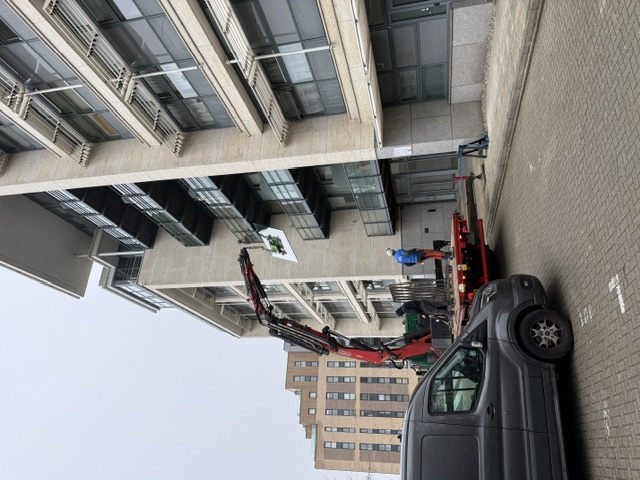
How do you turn a concept canopy into a built, safe, and low‑maintenance asset over a busy shopfront or office entrance? You start with a structural survey, checking load paths through historical architecture, façade fixity, and existing services. Specify laminated, toughened glass with point‑supported or bolted fin systems, validated by finite element analysis and wind/snow load calculations.
During installation, you coordinate access, temporary propping, and traffic management, then torque‑test all stainless‑steel fixings and verify fall‑arrest anchors. Integrate drainage channels to protect thresholds and any urban greenery beneath.
For maintenance, you schedule periodic inspections of interlayer edges, sealants, and brackets, plus annual cleaning using non‑abrasive agents. A digital logbook tracks inspections, impact events, and component replacements for long‑term safety compliance.
Popular Types of Glass Canopies in London
You’ll typically assess three core canopy configurations in London: frameless glass systems, steel-supported assemblies, and dedicated porch or entrance canopies . Frameless glass canopy styles rely on structural glass, point-fixings, and tension rod or cantilever brackets to achieve a minimal, visually light roof plane. In contrast, steel-supported designs and porch canopies use engineered steel members, connection details, and drainage integration to handle higher loads and traffic at key access points.
Frameless Glass Canopy Styles
Ever wondered why frameless glass canopies look so clean and minimal yet still handle London’s weather and loading requirements? You’re relying on high Glass durability, precision-engineered fixings, and careful load-path design to keep panels rigid under wind, snow, and impact. Frameless systems maximise Canopy aesthetics by eliminating visible primary frames and using point-supported or edge-clamped glass.
-
Point-fixed canopies – Use stainless steel spider fittings through countersunk holes; ideal when you want a floating, ultra-minimal soffit.
-
Edge-clamped canopies – Secure the glass in linear brackets at the perimeter, optimising load transfer into the façade while keeping lines sharp.
-
Cantilevered fins – Use vertical glass fins as structural elements, creating a transparent support strategy that enhances daylight and architectural legibility.
Steel-Supported Canopy Designs
While frameless systems chase pure minimalism, steel-supported glass canopies dominate London’s streetscapes because they offer higher spanning capacity, predictable stiffness , and straightforward load paths back into the primary structure. You treat the steelwork as an exposed chassis, resolving moment, shear, and uplift through welded frames, tapered box sections, or Vierendeel trusses that sit neatly within the façade grid.
You can fine-tune member sizes to balance glass aesthetics with performance: slender CHS rafters with knife plates at glass fixings, or laser-cut plate ribs that double as lighting carriers. By aligning support nodes with mullions and slab edges, you achieve clean urban integration, clear drainage strategies, and coordinated movement joints, all while keeping the glazing plane visually dominant and the structural hierarchy legible.
Glass Porch and Entrance Canopies
From that exposed steel chassis at upper levels, focus shifts down to the threshold, where glass porch and entrance canopies compress the same structural logic into tighter, more people-focused geometries. Here you’re calibrating cantilever lengths, fixing points, and drainage routes so the entry zone reads as both shelter and precision-engineered interface.
-
Cantilevered canopies – You use laminated low‑iron glass, point-fixed to a steel or aluminium spine, calculating deflection limits and snow loads while keeping fixings visually recessive.
-
Tie‑rod systems – Stainless tension rods anchor into masonry or concrete slabs, allowing ultra-thin glass planes with controlled pre-tension.
-
Framed heritage hybrids – You reinterpret historical examples by combining slender mullions, ceramic frits, and etched decorative patterns to deliver contemporary weather protection that satisfies conservation officers.
Glass Canopy Design Styles to Match London Architecture
Because London’s streets combine Georgian terraces, Victorian townhouses , modernist blocks and glass-clad towers, selecting a glass canopy design demands careful alignment with architectural language, proportion, and materiality. You’ll calibrate structural rhythm, fixing points, and soffit depth so the canopy reads as an extension of the façade, not an add‑on.
For period streetscapes and Historical landmarks, you might specify slim steel tension rods, curved brackets, and patterned frit to echo original cornices and railings, integrating subtle artistic glasswork within a restrained framework. In contemporary contexts, you can push toward cantilevered, minimally framed systems using structural glass fins, concealed fixings, and knife‑edge margins that align with curtain wall gridlines, datum bands, and existing mullions to preserve a coherent urban elevation.
Choosing Glass Types and Finishes for Your Canopy
As you specify a glass canopy for a London streetscape, you’ll choose glass types and surface finishes with the same rigour you apply to structure and detailing, balancing impact resistance, optical clarity, thermal performance, and maintenance. You’ll typically combine heat-strengthened or fully toughened glass with laminated interlayers to secure canopy durability while controlling post-breakage behaviour and deflection.
Consider how Glass aesthetics, user comfort, and urban microclimate interact:
- Glass type – Low-iron for crisp colour rendition, solar-control coatings to limit g‑values, and laminated make-ups tuned to acoustic attenuation.
- Surface finish – Screen-printed frits, ceramic dots, or acid-etch for glare control, slip-resistant edges, and shadow modulation.
- Detail performance – Hydrophobic nano-coatings to reduce soiling, condensate streaking, and cleaning cycles in London’s polluted, rainfall-intensive context.
Structural Supports and Fixings for Glass Canopies in London
When you move from canopy glazing specification to the supporting structure , your priority shifts to how loads flow cleanly into the building while keeping the glass in favourable stress states. You’ll coordinate primary steel or aluminium ribs, tension rods, and brackets so dead, live, and impact loads resolve into existing frames without overstressing Historical architecture.
Use point-fix spider fittings, countersunk bolts, or continuous clamped rails sized by finite element analysis, ensuring edge distances and bearing pressures respect glass design codes. Specify articulated fixings and slotted connections to accommodate thermal movement and construction tolerances.
To align with sustainability practices, you’ll favour demountable bolted assemblies, low-embodied-carbon metals, and rationalised node geometries that minimise material while maintaining stiffness, redundancy, and clear load paths.
Weather Performance of Glass Canopies in a Rainy City
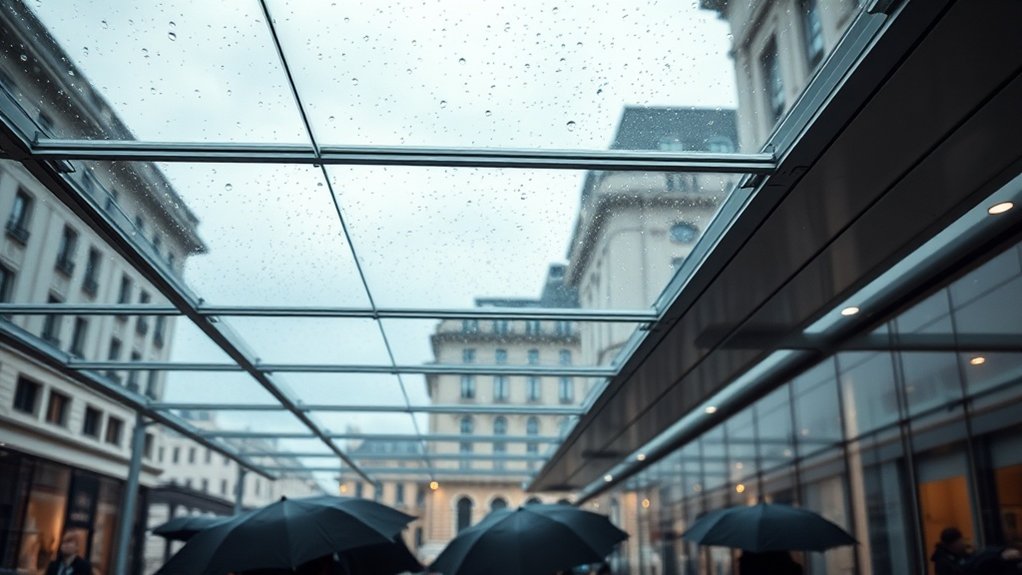
When you design a glass canopy for London’s climate, you must treat rain protection and drainage as an integrated system of slopes, gutters, downpipes, and sealed joints that control runoff and prevent ponding at supports. You also need to specify glass thickness, fixing patterns, and edge restraint to achieve adequate wind resistance and occupant safety under high uplift and lateral loads. At the same time, you should consider thermal performance year-round, optimising glass coatings, lamination build-ups, and overhang geometry to manage solar gain, reduce heat loss, and maintain comfort beneath the canopy.
Rain Protection And Drainage
How effectively a glass canopy manages London’s frequent rain depends on its geometry, drainage design , and detailing at every junction. You need to choreograph water flow so runoff clears the glazing quickly while preserving historical architecture and sharpening contemporary urban aesthetics.
-
Geometry and Fall Specify minimum slopes (typically 3–5°) toward controlled edges. Break large spans into bays with defined fall lines so water never stagnates at fixings.
-
Integrated Drainage Paths Conceal gutters within edge beams, feeding downpipes inside columns or adjacent walls. Dimension outlets for peak storm intensity, not average rainfall.
-
Junction and Edge Detailing Use continuous drip edges, baffles, and properly compressed gaskets. At abutments, integrate step flashings and upstands, ensuring water’s always directed away from façade interfaces and entrances.
Wind Resistance And Safety
Although London’s prevailing winds are moderate, you have to design glass canopies as primary wind‑loaded structures , not just rain shelters. You quantify local wind pressures, apply dynamic gust factors, and verify fixation details for uplift, suction, and edge vortices. Laminated, heat‑treated glass with mechanically fixed point‑supports or clamped edge beams prevents brittle failure and progressive collapse.
You’ll coordinate stainless or aluminium primary frames with stiff diaphragms, bracing, and moment connections to control deflection and vibration, especially on corner sites and tall podiums. For material sustainability, you can specify high‑recycled steel, demountable fixings, and modular glazing panels that simplify future replacement. Aesthetic integration comes from expressing structural logic—slender tension rods, transparent fins, and concealed drainage—while still meeting conservative safety factors.
Thermal Performance Year-Round
Even under London’s relatively mild climate , you have to treat a glass canopy as a year‑round thermal modifier of the microclimate beneath it, not just as a rain screen. You’re calibrating solar gains, convective heat loss, and comfort for users who occupy the threshold space in all seasons.
Design the build‑up as a high‑performance envelope element, not decorative glazing:
-
Glazing specification – Combine low‑e coatings with selective interlayers to optimise Thermal insulation while still admitting useful daylight and winter sun.
-
Sun shading strategy – Integrate frit patterns, external fins, or electrochromic layers to control peak summer irradiance and reduce overheating.
-
Geometry and ventilation – Use canopy tilt, perimeter gaps, and stack‑effect openings to exhaust warm air while limiting downdrafts and cold‑edge discomfort.
Planning Permission for Glass Canopies in London
When you plan a glass canopy in London, you must treat planning permission as a core design parameter, not an afterthought. You’ll negotiate aesthetics, massing, and load paths alongside local planning policy , conservation area status, and sightline protection. In districts defined by historical architecture, you must evidence that your canopy’s structural rhythm, fixing details, and reflectivity won’t visually dominate heritage façades.
You’ll prepare scaled elevations , section drawings, and a materials schedule showing steel profiles, connection plates, and glass specifications. For bolder, canopy-integrated artistic installations, you’ll justify how lighting, colour treatments, or fritted patterns enhance the streetscape without creating glare or visual clutter. Pre-application discussions help you refine overhang depth, column spacing, drainage routes, and edge conditions to secure swift consent.
Building Regulations and Safety Rules for Glass Canopies
When you specify a glass canopy in London, you must align the design with UK Building Regulations, particularly structural stability, impact safety, and fire performance requirements. You’ll need to choose compliant safety glass (typically toughened or laminated to BS EN standards) with appropriate thickness, edge treatment, and fixing compatibility. You also have to calculate load-bearing capacities for wind, snow, and self-weight, and coordinate anchorages, brackets, and bolt fixings to guarantee secure transfer of forces into the primary structure.
UK Building Code Compliance
A structurally sound glass canopy in London must satisfy specific UK Building Regulations and associated British Standards that govern load-bearing capacity, impact safety, fire performance, and safe access/egress. You’ll coordinate structural design with local planning policy, especially in conservation areas where Historical architecture and urban aesthetics drive façade control.
-
Structural loading and fixings You must verify compliance with BS EN 1991 and BS EN 1993/1999 for dead, imposed, snow, and wind actions, detailing brackets, tension rods, and anchors to resist uplift and progressive collapse.
-
Means of escape and headroom Part B and Part M require unobstructed egress routes, clear headroom, and controlled projection over pavements.
-
Thermal and drainage performance Part L and Part C demand condensation control, thermal bridging mitigation at brackets, and positive drainage to prevent slip hazards beneath the canopy.
Safety Glass Specifications
Precisely specified safety glass underpins a compliant canopy in London, because you must satisfy both UK Building Regulations and key British Standards governing impact resistance, breakage behaviour, and restraint. You’ll typically combine heat-strengthened or fully toughened glass with laminated interlayers so fractured panes remain captive, protecting pedestrians below.
You should reference BS 6262 and BS EN 12150/14449 when selecting thickness, edge treatment, and pane configuration. For overhead glazing , you’ll prioritise laminated make-ups that prevent dangerous fall‑through and allow controlled post‑breakage performance. Low‑iron compositions preserve glass aesthetics and maximise daylight; fritted or printed interlayers can integrate canopy lighting, wayfinding, or branding. Specify visible quality, tolerances, and surface treatments early so structural performance and visual ambition align without compromising safety.
Load-Bearing And Fixings
Although glass performance often dominates early design discussions, London‑compliant canopies fundamentally depend on how you resolve load‑bearing structure and fixings to transmit self‑weight, wind, snow, and impact loads safely back to the primary frame in line with UK Building Regulations and Eurocodes. You must coordinate Glass durability, structural redundancy, and connection detailing from concept stage.
-
Primary structure – Design steel or aluminium arms, fins, or tension rods to satisfy uplift, vibration, and serviceability limits; verify to EN 1990, 1991, 1993, 1999.
-
Fixing techniques – Use countersunk fittings, point‑supported spiders, or continuous clamped rails with tested slip resistance and controlled edge stresses.
-
Anchorage and redundancy – Detail bracketry, through‑bolts, and chemical anchors with verified edge distances and robust ties so that, under localized glass failure, the canopy retains residual load‑bearing capacity.
Glass Canopy Costs in London and What Affects Them
When you budget for a glass canopy in London, you’re not just paying for the glass sheet but for a coordinated system of structural components , engineering, and installation complexity. Costs pivot on glass specification: laminated vs. toughened, pane thickness, low‑iron clarity, and coatings. Larger spans, cantilevers, and minimal-framing concepts demand higher glass performance and more robust fixings.
Your interface with historical architecture often requires bespoke brackets, discreet tension rods, and conservation-approved anchoring, which increases engineering hours and structural steelwork. Wind and snow load calculations , especially in exposed corners or elevated terraces, drive up the size and number of fixings. Finally, detailing for drainage, integrated lighting, and alignment with surrounding urban aesthetics adds fabrication time, specialist hardware, and on-site coordination.
Choosing a Reliable Glass Canopy Installer in London
Costs and specifications only translate into a successful canopy if the installer can execute complex structural and architectural detailing on site. You need a contractor who understands London loading codes , point-fixed glazing, and tolerance control around existing façades, including Historical landmarks and contemporary Art installations.
Look for teams that model in BIM, coordinate with structural engineers, and can proof load fixings into brick, stone, and steel substrates without compromising heritage fabric or planning consents.
- Technical credentials – Verify chartered structural input, glass specification expertise (laminated, heat-soaked, SentryGlas), and tested fixing systems.
- Urban track record – Demand built examples spanning conservation areas, transport hubs, and mixed-use schemes.
- On-site methodology – Assess lifting strategies, weatherproofing detailing, and quality-control procedures for seals, brackets, and drainage.
Maintaining and Cleaning Glass Canopies Over Time
Even with robust detailing and high-spec glass, a London canopy only performs as designed if you maintain its surface, seals, and fixings to a defined regime. You should implement a scheduled inspection cycle , checking structural brackets, tension rods, and laminated edges for delamination, corrosion, or displacement, especially where canopies interface with historical architecture.
Clean the glass using pH-neutral, non-abrasive agents and microfiber systems that won’t scratch coatings or compromise sealants. Specify eco friendly materials for detergents and water-efficient equipment to reduce environmental load. Clear gutters, drip edges, and silicone or EPDM joints so water sheds cleanly, preventing staining and freeze–thaw damage. Document interventions in a maintenance log, aligning future upgrades, re-sealing, or glass replacement with the canopy’s original structural design intent.
Common Mistakes to Avoid With Glass Canopies in London
Although contemporary glass canopy systems are highly engineered, many London projects still fail because designers, contractors, or owners repeat a small set of avoidable errors. You can prevent performance issues by interrogating the interface between structure, glazing, and services from day one.
-
Under‑specifying structural support* You might rely on minimal steelwork or undersized bolts. In London wind zones, verify *glass thickness, fixing edge distances, and deflection limits through structural calculations and dynamic load modelling.
-
Ignoring drainage and pollution* Don’t overlook falls, *drip edges, and concealed gutters. Poor detailing lets grime streak, degrading glass aesthetics and accelerating seal failure.
-
Treating canopy lighting as an afterthought Retrofit fixtures create glare, visible cabling, and thermal stress. Integrate LED channels, drivers, and maintenance access into the primary canopy geometry.
Frequently Asked Questions
How Long Does Installation of a Typical Residential Glass Canopy in London Take?
You’ll typically see installation completed in 1–2 days, assuming foundations and wall structure are prepared. Installers set out fixing points, drill anchor positions, and mount the support brackets or tension rods, then glaze and seal the canopy. Design trends like minimal steel framing and oversized panels don’t usually extend the timeline, but higher-spec hardware and laminated glass for material durability can require more precise alignment and quality checks.
Can Glass Canopies Be Integrated With Outdoor Lighting or Heating Systems?
Yes, you can seamlessly integrate glass canopies with outdoor lighting and heating systems. You’ll embed conduits within steel supports, specify IP-rated LED linear strips or spotlights, and route cabling through structural members for clean, Aesthetic designs. For heating, you can suspend infrared heaters from the canopy frame or integrate them into overhead beams. Smart technology lets you control brightness, zoning, and heater output via sensors, timers, and app-based automation.
Are There Eco‑Friendly or Recycled Glass Options for London Canopies?
You can specify eco‑friendly or recycled glass options through local Recycling programs and specialized suppliers. You’ll typically use laminated safety glass with a percentage of post‑consumer cullet, low‑iron or low‑E coatings, and thermally efficient interlayers. Since “waste not, want not,” you’ll also design minimal, demountable steel or aluminum support systems to enable future reuse, optimize structural spans, and reduce embodied carbon while maintaining optical clarity and performance.
How Do Glass Canopies Affect Natural Light Inside Adjacent Rooms?
They modulate natural illumination, typically increasing daylight enhancement while filtering glare. You control transmission via glass specification—low‑iron laminates, fritted patterns, or selective coatings. Clear projections admit high lux levels deep into adjacent rooms; tinted or coated units reduce solar gain but still diffuse light. Overhang geometry, projection depth, and support spacing shape light distribution, shadow patterns, and sky‑view factor, letting you fine‑tune luminous ambience and visual comfort.
Can Existing Canopies Be Upgraded to Self‑Cleaning or Tinted Glass Later?
Yes, you can upgrade existing canopies to self‑cleaning or tinted glass, assuming the support structure isn’t held together by nostalgia and rust. You’ll specify replacement glazing units with compatible thickness, load ratings, and fixing details. Self‑cleaning coatings reduce maintenance challenges; spectrally selective tints deliver aesthetic enhancements while managing solar gain and glare. You’ll likely need re‑calculated wind/snow loads, new gasket systems, and precise on‑site survey data before fabrication.
Summary
When you invest in a glass canopy in London, you’re not just adding cover, you’re adding structure, clarity, and precision. You define entrances, you protect circulation routes, you extend usable outdoor zones. By aligning load paths , matching fixings to façade types, and selecting the right glass specification, you get performance, not guesswork. Choose the right installer, plan the detailing, maintain the system—and your canopy will stay sharp, stable, and visually lightweight for years.