
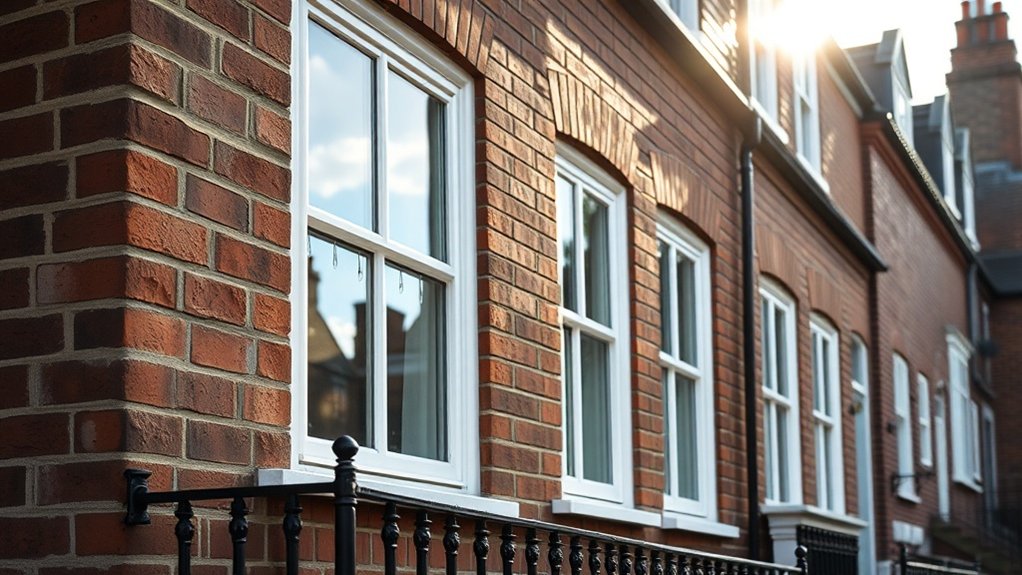
A-rated windows in London use low‑emissivity double or triple glazing, warm‑edge spacers and thermally broken frames to achieve whole-window U-values around 1.4 W/m²K or better, cutting heat loss and saving roughly £250–£450 a year on energy. They’re tested under BFRC schemes, support Part L compliance, help protect your EPC against MEES pressures, and typically pay back in 10–18 years. You’ll also see how to verify genuine A-ratings, compare installers and access grants.
Key insights
- A-rated windows in London improve energy efficiency, cutting heat loss and bills, and meet tightening UK Part L, EPC, and MEES compliance requirements.
- They use low‑E coatings, inert gas fills, warm‑edge spacers, and thermally broken frames to achieve whole-window U-values typically ≤1.4 W/m²K.
- Typical installed costs are £550–£850 per window, with London projects around £6,000–£12,000 and payback in roughly 10–18 years via energy savings.
- High-performance glazing provides better comfort and security, reducing noise by 30–45 dB and supporting enhanced locks and laminated glass to UK security standards.
- Properly specified and certified installation, with airtightness and performance verification, ensures A-rated windows deliver the promised efficiency and long-term compliance.
Are A-Rated Windows Worth It in London?
Although A-rated windows typically cost 10–25% more upfront than lower-rated units, they’re usually worth it in London because they align with current and emerging UK building regulations while cutting heat loss and energy bills in a high-cost market. You operate in a city where Part L tightening, EPC targets, and MEES pressures are converging, so sub‑optimal glazing quickly becomes a liability.
You gain lower U-values, better air tightness, and optimised solar gain, which stabilise internal temperatures and reduce HVAC runtime. Over a 20–25 year lifecycle, that performance typically offsets the premium, especially as energy prices track upward.
You also future‑proof refurbishment cycles: advanced glazing techniques and good window maintenance extend service life, preserve compliance, and protect asset value in a regulation-driven marketplace.
What “A-Rated Windows” Actually Means
When a UK window carries an “A” energy rating, it means the whole unit—frame, glass, spacers, seals, and coatings—meets a defined performance band under the BFRC or an equivalent certified scheme, not just that it uses “efficient glass.” The rating is based on a calculated energy balance (kWh/m²·year) that combines U‑value (heat loss), solar heat gain (g‑value), and airtightness, then benchmarks the result against bands from G (worst) to A++ (best).
To qualify, you’re relying on tightly controlled window manufacturing processes: low‑emissivity coatings, warm‑edge spacers, inert gas fills, and thermally broken frames validated through simulation and physical testing. You then need installation standards that preserve the lab performance on site—airtight perimeter sealing, correct packer placement, and verified compliance with Part L .
How A-Rated Windows Cut Heating Bills
So how do A‑rated windows actually reduce your gas or electricity spend in a London home? They stabilise internal temperatures by cutting conductive, convective, and radiative heat loss through advanced glazing technology and tightly specified frames. In practice, you need less boiler or heat‑pump runtime to maintain 20–21°C, particularly in exposed Victorian or mid‑terrace properties.
Low‑emissivity coatings, warm‑edge spacers, and argon‑filled cavities typically deliver 20–30% lower heat loss than legacy double glazing, aligning with Part L conservation‑of‑fuel‑and‑power requirements. High‑performance gaskets and precision installation minimise uncontrolled air infiltration, so you don’t pay to heat draughts.
Ongoing window maintenance—lubricating hinges, checking seals, and cleaning coatings correctly—helps preserve these performance levels, ensuring your actual savings track the predicted SAP or EPC modelling.
A-Rated Window Energy Ratings vs U-Values and G-Values
While A‑rated windows sound like a simple label, the rating actually summarises a balance between three technical metrics: whole‑window energy rating (the A–G band you see on labels), U‑value (heat loss, W/m²K), and g‑value or solar factor (solar heat gain). You’re not just buying a low U‑value; you’re optimising the net energy balance defined in standards such as BS EN 14351‑1 and the BFRC scheme.
A lower U‑value reduces conductive losses, essential for London’s Part L compliance. However, an excessively low g‑value can cut useful winter gains, increasing heating demand. Intelligent Solar shading and advanced Window tinting let you fine‑tune g‑values without compromising visible light, enabling dynamic façades that respond to orientation, climate data, and overheating criteria in Approved Document O.
Double vs Triple Glazed A-Rated Windows in London
Optimising U‑values and g‑values on paper naturally leads to the practical choice you face in London: A‑rated double glazing or A‑rated triple glazing . With double glazing, you’ll typically see centre‑pane U‑values around 1.0–1.2 W/m²K; triple glazing can push this down to about 0.6–0.8, useful for meeting tighter Part L targets or London Plan ambitions.
However, triple glazing’s extra weight demands more advanced installation techniques: deeper rebates, reinforced hinges, and meticulous air‑tightness detailing to preserve the declared A‑rating in situ. It also affects window aesthetics—thicker sightlines and potentially reduced visible light transmittance, which matters for daylight‑factor calculations.
You’ll balance marginal energy gains against cost, structural loading, and acoustic or comfort objectives on a project‑by‑project basis.
Best Frame Materials for A-Rated Windows in London
Although glass performance attracts most attention, the frame material often determines whether a London window actually achieves an A‑rating once you account for whole‑window U‑values , Psi‑values at the edge seal, and airtightness. You’ll typically evaluate three advanced framing options: engineered timber, multi‑chamber uPVC, and thermally broken aluminium or alu‑clad timber.
High‑density engineered timber can deliver frame U-values around 1.0–1.2 W/m²K with excellent airtightness, ideal where you prioritise low‑carbon materials and warm internal surfaces. Modern uPVC with six‑plus chambers and foamed cores can reach comparable figures at lower cost, but with different window aesthetics.
For maximum design flexibility, specify aluminium systems with polyamide thermal breaks and insulated infills; you’ll offset aluminium’s conductivity while retaining ultra‑slim sightlines.
How A-Rated Windows Help You Meet London’s Building Rules
When you specify A-rated windows in London, you’re directly supporting compliance with Part L of the Building Regulations by achieving lower whole-window U-values and improved energy performance. These units reduce heat loss, which cuts space-heating demand and contributes to the carbon targets set out in both Part L and local planning policies. By quantifying gains in kWh saved and kgCO₂e avoided, you can demonstrate that your window specification helps meet regulated carbon and energy-efficiency benchmarks.
Meeting Part L Requirements
As London tightens its energy-efficiency standards, A-rated windows provide a direct, practical route to meeting Part L of the Building Regulations by delivering low whole-window U-values, improved airtightness, and verified performance data. You’re targeting 1.4 W/m²K or better for replacements, so specifying independently certified A-rated units de-risks compliance.
You can integrate window tinting to optimise g‑values and limit solar gains, supporting SAP calculations without compromising visible light transmission. In conservation settings, you’ll align sash restoration with Part L by using slimline A-rated double glazing, warm-edge spacers, and advanced draught-proofing systems.
Always demand BFRC or equivalent labels , test reports, and installation detailing; then feed those into your energy model, O&M manuals, and Building Control submissions to demonstrate robust, auditable compliance.
Reducing Carbon Emissions
By cutting heat loss and moderating solar gains , A-rated windows make a measurable contribution to reducing regulated carbon emissions under London’s planning and building control framework. You’re improving whole-building performance metrics such as TER vs DER and SAP scores, not just ticking an upgrade box. Low-U-value glazing, warm-edge spacers, and inert gas fills reduce space-heating demand, allowing smaller, more efficient heating systems.
When you combine A-rated windows with solar panels, you lower both operational demand and grid imports, helping you satisfy London Plan carbon targets and local authority energy statements. In a smart home, integrated sensors and automated blinds optimise solar gains and internal temperatures in real time, cutting peak loads, improving Part L compliance margins, and future‑proofing against tightening standards.
Noise and Comfort Benefits of A-Rated Windows in the City
When you specify A-rated windows in London, you’re not just improving U-values; you’re also tightening acoustic performance , often cutting external noise by 30–45 dB depending on glazing configuration and frame type. This level of attenuation directly supports compliance with BS 8233 and WHO interior noise guidelines for bedrooms and living spaces in dense urban areas. At the same time, high thermal efficiency and reduced air leakage help you maintain stable indoor temperatures year-round, lowering heating and cooling demand while improving perceived comfort.
Urban Noise Reduction
How do A-rated windows help you control urban noise levels as precisely as you manage heat loss or solar gain? You start by specifying acoustic performance alongside energy ratings. Look for windows tested to BS EN ISO 10140/717 with weighted sound reduction (Rw) values of 35–45 dB, and enhanced glazing configurations or acoustic laminated glass . You don’t have to sacrifice window aesthetics: slimline thermally broken frames, warm-edge spacers, and low-iron glass maintain a clean, contemporary look while delivering noise attenuation.
To keep performance stable, follow basic maintenance tips: routinely check perimeter seals, gaskets, and trickle vents; re-align sashes to maintain compression; and clean drainage channels. Verified installation to Approved Document O and local planning requirements ensures predictable, model-based noise reductions.
Year-Round Indoor Comfort
Few upgrades influence year-round comfort in a London property as measurably as A‑rated windows engineered for both thermal and acoustic performance. With whole-window U-values typically ≤1.4 W/m²K and verified under BFRC or CERTASS schemes, you stabilise internal temperatures, cut draughts, and reduce boiler runtimes in line with Part L targets.
High-spec laminated units and insulated frames can deliver 40–45 dB Rw, lowering exposure to night‑time traffic and rail vibration, which supports WELL and Fitwel comfort criteria. You maintain window aesthetics with slimmer warm-edge spacers, colour‑stable foils, and concealed trickle vents, avoiding the “bulky frame” problem.
Plan for installation challenges: integrating airtight tapes, resolving cold bridges at reveals, and coordinating with MVHR to prevent over‑sealing and condensation risk.
Security Upgrades to Pair With A-Rated Windows
Beyond energy performance , A-rated windows in London should integrate specific security upgrades that align with UK regulatory standards and insurance requirements. You need solutions that enhance window aesthetics without compromising compliance with PAS 24, Part Q of the Building Regulations, and Secured by Design guidelines. Precision installation techniques are critical; even certified hardware underperforms if fixings or frame anchoring are incorrect.
Consider specifying:
- Laminated or toughened glazing that meets BS EN 356 to resist forced entry and opportunistic attacks.
- Multi-point locking systems with key-operated shoot bolts that satisfy common insurer requirements.
- Internal glazing beads and reinforced frames to prevent deglazing and frame distortion.
- Smart sensors and integrated contact switches, compatible with Grade 2 EN 50131 intruder alarm systems.
Typical Costs and Payback for A-Rated Windows
When you budget for A-rated windows in London, you’re typically looking at £550–£850 per replacement casement window installed, or £700–£1,100 for larger tilt-and-turn or triple-glazed units, with costs varying by frame material, glazing specification, and compliance features such as PAS 24 and Part L U‑value targets.
You’ll usually see installed project costs of £6,000–£12,000 for a typical London terrace, depending on window aesthetics, access complexity, and installation timelines. With current London gas and electricity tariffs, you can often trim 10–18% from space-heating demand, delivering annual savings of £250–£450 on a well-insulated property, more on leaky stock.
That translates to a pure energy payback of roughly 10–18 years, improved by reduced maintenance, better airtightness, and higher EPC ratings.
Grants and Finance for A-Rated Windows in London
Although A-rated windows remain a largely “self‑funded” upgrade in London, you can offset upfront costs through a mix of national schemes, local authority funding , and low‑interest finance tied to energy performance. You’ll need to track eligibility thresholds, EPC targets, and technology specifications, especially if you integrate window tinting or decorative glass without undermining Uw or g‑value requirements.
- ECO‑4 and Great British Insulation Scheme – target low‑income or vulnerable households; window upgrades can be bundled with fabric measures.
- London borough grants/loans – some councils ring‑fence funds for SAP score uplift projects.
- Green mortgages – lenders offer rate discounts where post‑works EPC reaches band B or above.
- On‑bill and supplier finance – spreads capex while aligning repayments with predicted kWh savings.
How to Choose and Compare A-Rated Window Installers
Securing grants or green finance only pays off if your installer actually delivers A‑rated performance on site, so you need to assess companies against clear technical and regulatory benchmarks. Start by checking FENSA, Certass, or BM Trada registration and asking for evidence of Part L compliance and documented whole‑window U‑values , not just glass specs.
Interrogate their design process: how they optimise window frame styles for thermal breaks, airtightness, and structural loads in London’s wind zones. Request data sheets for spacer bars, gas fill, and glass tinting options, confirming they’re independently tested to BS EN standards.
Compare written proposals line‑by‑line: Uw, g‑values, installation method, and warranty terms. Prioritise installers who provide commissioning reports and post‑installation performance verification.
Common Mistakes When Buying A-Rated Windows (And How to Avoid Them)
Despite clear regulatory standards and published performance data, buyers still make recurring mistakes that undermine the real‑world efficiency of A‑rated windows in London. You often focus on the label, not the system performance of frame, glazing, installation, and ongoing calibration.
- Ignoring whole-property modelling*: You don’t assess how *A‑rated units interact with existing fabric, missing higher‑impact energy efficient upgrades like insulation or MVHR.
- Overlooking solar gain control: You choose high g‑value glass without shading analysis, causing summer overheating.
- Undervaluing airtightness detailing: You accept generic foam-only sealing instead of tested tapes and membranes, increasing infiltration losses.
- Skipping planned maintenance: You neglect data-led window maintenance tips—hinge adjustment, gasket checks, drainage clearance—degrading performance years before the nominal product life.
How to Check Your Windows Are Genuinely A-Rated
How can you be certain a window is genuinely A‑rated and not just marketed as “high performance”? First, verify the official energy label: look for a certified A‑rating from BFRC, FENSA, or CERTASS, including the unique license number and manufacturer details. Cross‑check this ID on the scheme’s online database.
Next, interrogate performance metrics: demand documented whole‑window U‑values (≤1.4 W/m²K for London retrofits is common), solar factor (g‑value), and air leakage figures , not just glass specs. Compare these against current Part L and Future Homes Standard trajectories.
Assess window frame materials and spacer technologies; insist on evidence for thermal breaks and glazing unit composition. Finally, follow rigorous window installation tips: require photographic evidence, airtightness measures, and post‑installation certification to ensure design performance translates on site.
Frequently Asked Questions
Do A-Rated Windows Increase My London Property’s Resale Value?
Yes, you’re likely to see a resale uplift. Buyers increasingly value Energy efficiency due to rising bills and EPC regulations. A-rated glazing improves your EPC band, lowers U‑values, and demonstrates compliance with Part L, signalling lower operational carbon. You’ll gain Cost savings for occupants through reduced heating demand and enhanced thermal comfort, differentiating your asset in a data-driven market where high-performance envelopes command a measurable pricing premium.
Can I Get A-Rated Windows in Conservation Areas or Listed Buildings?
You can, but you must work within strict conservation area regulations. With windows responsible for up to 18% of heat loss, upgrading to high window energy ratings is attractive, yet planners often insist on matching sightlines, glazing bars, and materials. In conservation areas, you’ll usually get slimline double glazing approved; in listed buildings, secondary glazing is more realistic. Always obtain written consent and supply U‑values, section details, and heritage impact statements.
How Long Does Installation of A-Rated Windows Typically Take per Property?
You’ll typically see 1–3 days per standard residential property, depending on window count and access. A straightforward 8–10 window installation process often completes in a single day; complex façades, structural repairs, or bespoke glazing extend timelines. Installers must comply with Building Regulations Part L on energy efficiency, FENSA/Certass self-certification protocols, and onsite air‑tightness checks. Pre‑survey accuracy and offsite fabrication quality are critical to keeping installation time predictable and innovation‑led.
Are There Aesthetic Limitations With A-Rated Windows in Period London Homes?
You do face some aesthetic limits , but they’re narrower than you’d think. Subtle symmetry, slender sightlines, and selective sash profiles preserve historical authenticity while meeting Part L thermal targets. You’ll balance glazing bar width, frame depth, and coating colour against U‑value and g‑value performance. Modern systems offer strong design flexibility: you can specify bespoke profiles, heritage putty lines, and concealed trickle vents, provided you document compliance for Building Control.
What Maintenance Do A-Rated Windows Require to Keep Their Performance Over Time?
You’ll maintain performance by cleaning frames and glass quarterly, inspecting seals and gaskets annually, and lubricating hinges and locks with silicone-based products. Check trickle vents and drainage channels to preserve energy efficiency and prevent moisture issues. Replace failed double- or triple-glazed units showing condensation. Verify hardware fixings against manufacturer specifications. Document maintenance tips and cycles to align with warranty conditions and relevant building regulations on ventilation and thermal performance.
Summary
When you choose A-rated windows in London, you’re making a smart, standards-led switch that slashes heat loss, stabilises bills, and supports stricter sustainability targets. You cut carbon, comply with current Building Regulations , and capitalise on credible performance metrics like U-values and BFRC ratings. By checking certifications, comparing installers, and confirming specs, you secure safer, sounder, scientifically verified glazing that delivers durable, demonstrable, data-backed benefits for your home and the wider London environment.