
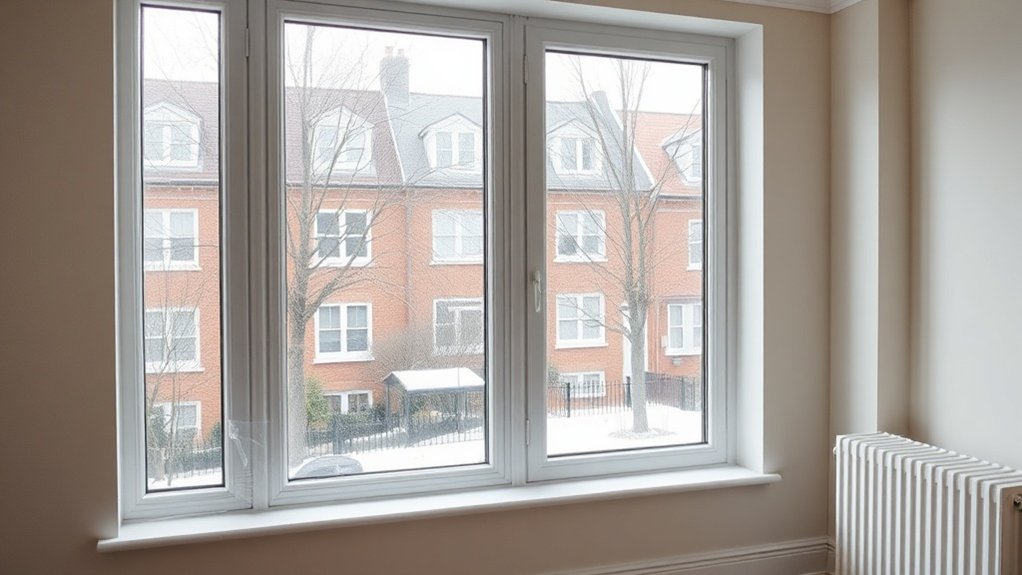
You use window insulation film in London to upgrade cold, draughty single or sash‑glazed windows without replacing them. A clear, low‑E layer adds a thermal barrier that cuts heat loss, surface condensation, UV fading and perceived draughts while keeping daylight and period details. It’s ideal for listed or rented flats where you can’t change frames, reduces gas or electric demand, and supports London’s net‑zero goals—next you can see how to choose the right film and estimate savings.
Key insights
- Window insulation film is a low-cost way to cut heat loss and drafts in London’s older sash and single-glazed windows without replacing them.
- Modern low‑E and solar-control films improve winter warmth, limit summer overheating, reduce UV fading, and can trim energy bills by roughly 10–25%.
- Films are usually applied internally, causing minimal disruption, and many products are near-invisible, making them suitable for conservation areas and listed buildings.
- Tenants and leaseholders often need written consent; choose reversible, non-damaging films to comply with planning and heritage regulations.
- Professional installation in London ensures bubble-free application, long-term adhesion in damp, polluted conditions, and correct specification for historic or complex glazing.
Why London Homes Need Window Insulation Film
Although London’s climate is relatively mild, its combination of damp winters, rising energy prices, and a high proportion of older, poorly insulated housing makes window insulation film a practical upgrade rather than a luxury. You’re dealing with sash frames, single glazing, and thermal bridges that leak heat straight into the street. Film adds a low‑cost thermal barrier, improving energy efficiency by reducing convective drafts and radiant losses through cold glass.
In dense boroughs, you also want privacy enhancement without sacrificing daylight. Advanced films let visible light in while limiting sightlines and cutting glare, ideal for street‑facing flats or basement windows. By retrofitting film, you stabilise indoor temperatures, reduce reliance on gas or electric heating, and future‑proof your home against volatile UK energy markets.
How Window Insulation Film Works on Your Windows
When you apply window insulation film to your London windows, you’re effectively adding a transparent, engineered barrier that alters how heat, light, and air interact with the glass. The film’s low‑emissivity and reflective layers reduce radiant heat loss on cold days and limit solar heat gain during summer spikes, stabilising internal temperatures across London’s variable climate.
You gain UV protection through embedded filters that block most ultraviolet radiation while maintaining visible light transmission, protecting furnishings without darkening rooms. Advanced adhesives create a tight seal, cutting drafts around older sash frames common in London housing stock. Window film durability comes from scratch‑resistant coatings and multi‑layer construction, ensuring long‑term performance against condensation cycles, pollution, and everyday cleaning.
Is Window Insulation Film Right for Your Home?
Because every London property performs differently thermally, deciding if window insulation film suits your home starts with evaluating your glazing , orientation, and comfort issues. South‑ and west‑facing rooms in Zone 1–3 often overheat, while north‑facing bays in older terraces leak heat in winter; both scenarios benefit from a high‑performance film.
You’ll get most value if you’re targeting:
- Rapid thermal upgrades without replacing original sash or Crittall windows
- Lower peak‑time gas and electric demand while retaining clear daylight
- UV protection to slow fading of timber floors, fabrics, and artwork
- Window safety enhancements, as film can help glass stay bonded on impact
- Reduced draught perception and cold‑radiation from large panes overlooking noisy streets
Types of Window Film for London Properties
In London’s mixed building stock—from single‑glazed Victorian sashes to modern curtain walling—the “right” window insulation film usually means choosing from four main families: low‑emissivity (low‑E) thermal films to cut heat loss and improve winter comfort; solar control films that limit summer overheating and glare in south‑ and west‑facing rooms; clear UV‑blocking films that protect interiors without changing the façade; and safety or security films that upgrade glass to meet impact or containment requirements .
You’ll typically combine performance aims: low‑E with strong UV protection for galleries or riverside flats, or solar control with privacy for overlooked terraces. In conservation areas, you can specify virtually invisible films, while commercial frontages might use ceramic or spectrally selective coatings that add subtle decorative accents without violating branding or planning constraints.
Window Film vs Double and Secondary Glazing
How do you decide between fitting window film and investing in double or secondary glazing for a London property? You start by mapping performance to constraints: façade character, budget, and disruption tolerance. High‑spec window film upgrades existing panes, while double or secondary glazing alters the window system itself.
Key comparisons you should evaluate:
- Upfront cost versus lifecycle value , including Window film durability on older sash frames
- Installation disruption in occupied flats or conservation-area terraces
- U‑value and solar control performance under London’s mixed heating‑and‑cooling demands
- Acoustic gains from secondary glazing versus marginal sound change from film
- Double glazing aesthetics compared with near‑invisible, retrofit film on heritage glass
Benefits of Window Film in a London Climate
Why does window film suit London’s climate so well? You’re dealing with frequent overcast skies, sharp solar peaks on clear days, and increasingly hot summers in dense urban streets. High‑performance films add a low‑emissivity layer that reduces conductive heat loss through glazing in winter while controlling solar heat gain in summer, boosting energy efficiency without intrusive construction.
In London’s mixed‑use buildings, you balance daylight with screen visibility and occupant comfort. Spectrally selective films filter infrared wavelengths to limit overheating yet maintain high visible light transmission, cutting reliance on artificial lighting and cooling. Integrated UV protection blocks up to 99% of harmful rays, stabilising indoor temperatures and preventing fading of flooring, furnishings, and merchandise—critical for premium retail, galleries, and design‑led workspaces.
Window Film for Period and Listed Buildings
When you’re working with sash windows in a Kensington terrace or Georgian facades in Bloomsbury, you need thermal upgrades that don’t alter original glass, putty lines, or sightlines. High‑performance, low‑emissivity window film lets you increase U‑value performance and reduce draught‑related heat loss while remaining virtually invisible from street level and compliant with most conservation requirements. You can target specific elevations, orientations, or problem rooms to cut heat loss and solar gain without triggering costly secondary glazing or frame replacement that planners often resist.
Discreet Thermal Upgrades
Although many London homeowners accept draughts and cold spots as the “price” of living with original sash or casement windows, discreet thermal window film offers a way to upgrade performance without altering the building’s character or falling foul of conservation rules. You’re effectively adding an invisible secondary glazing layer , optimised for the capital’s damp winters and increasingly hot summers.
- Reduce conductive heat loss through single glazing with low‑emissivity coatings
- Minimise solar gain while maintaining clarity, avoiding overheating in south‑facing rooms
- Integrate subtle decorative patterns where privacy or zoning’s required
- Achieve high levels of UV protection to slow fabric, artwork, and timber fade
- Install from the interior, typically in a single visit, minimising disruption and scaffolding costs
These films let you meet modern comfort expectations while respecting planning constraints.
Preserving Historic Aesthetics
How do you upgrade comfort in a Georgian terrace or Victorian villa without compromising its original glazing lines, crown glass, or putty details? You use ultra-clear window insulation films engineered for historical preservation. These films bond directly to existing panes, so you retain original sashes, cylinder or crown glass distortions, and slender glazing bars.
In London, conservation officers typically resist visible alterations. You can specify low-iron, spectrally selective films that are virtually undetectable from street level, protecting architectural integrity while improving U‑value and reducing radiant cold. Edge sealing respects traditional putty lines, and reversibility supports listed‑building consent . You’ll also cut UV transmission, stabilising historic joinery, pigments, and textiles, while avoiding double‑glazing units that visually thicken frames and alter sightlines.
Style, Privacy, and Light With Window Film
Even as you focus on cutting heat loss in a London property, the right window film lets you tune style , privacy, and daylight rather than sacrificing one for another. You can specify color options that complement brick, stone, or contemporary curtain walling while fine‑tuning visible light transmission for overcast winters and bright summer highs.
Modern films use multi-layer polyester stacks , ceramic particles, or nano-metal coatings to achieve high material durability plus precise solar performance. That means stable tint, minimal haze, and resistance to London’s pollution and moisture.
You can engineer the façade experience:
- Frosted films for diffused privacy in street-facing rooms
- Dual-reflective films for daytime one-way views
- Neutral tints that avoid mirrored glass aesthetics
- Patterned films that echo period glazing bars
- Spectrally selective films that keep daylight, cut glare
DIY Window Insulation Film: Can You Do It?
When you’re weighing up DIY window insulation film for a London property, the key question isn’t just “can you do it?” but whether you can achieve an airtight, wrinkle‑free install that genuinely improves U‑values and cuts draughts. You’ll need surgically clean glass, accurate measuring to the millimetre, and careful trimming around sashes, trickle vents, and Georgian bars common in London housing stock.
With a good heat‑shrink or low‑e kit, DIY installation can lift surface temperatures, reduce condensation, and preserve window film aesthetics if you squeegee out micro‑bubbles and align edges precisely. Pay attention to compatibility with existing double glazing, listed‑building constraints , and south‑facing solar gain. If you’re meticulous and method‑driven, you can absolutely deliver performance gains yourself.
Professional Window Film Installation in London
When you use a professional window film installer in London, you get precision cutting , bubble‑free application, and adhesives cured correctly for the city’s variable humidity and temperature swings. A qualified installer will also specify film performance (U‑value, g‑value, visible light transmission) to match your glazing type, orientation, and local building or conservation requirements. To choose the right London specialist, you’ll need to check certifications (e.g., manufacturer‑approved, FENSA/MCS links), warranty terms, and evidence of work on similar properties across the capital’s diverse housing stock.
Benefits Of Professional Installation
Because London’s building stock ranges from listed Georgian terraces to modern glass-fronted offices, professional window film installation delivers benefits you can’t reliably achieve with DIY kits. A specialist team calibrates the installation process to your glazing type, frame condition, and orientation, then applies films in controlled conditions that minimise dust, creasing, and optical distortion. You also gain expert advice on U‑value improvement, g‑value targeting, and compatibility with existing low‑E or laminated units.
- Precision cutting for irregular sash, bay, and crittall windows
- Correct film specification for conservation areas and Part L compliance
- Optimised thermal and solar performance, validated by technical data
- Long-term adhesion and edge sealing suited to London’s polluted air
- Manufacturer-backed warranties that protect your capital investment
Choosing Qualified London Installers
Although window film may look simple to apply, choosing a qualified London installer is critical if you want predictable performance, warranty protection, and compliance with local regulations. You should prioritise firms accredited by recognised film manufacturers, with demonstrable experience on London housing stock—Victorian sash, steel-framed crittall, and modern low‑E glazing.
Ask for U‑value and g‑value projections for your specific elevation and orientation, not generic brochures. A good installer will coordinate with your decorating ideas, recommending tints and reflectivity that complement interior schemes while meeting Part L requirements and local conservation constraints.
Verify they provide maintenance guidance: compatible window cleaning tips, safe squeegee methods, and non‑abrasive detergents to protect coatings. Finally, insist on written guarantees covering adhesion, optical clarity, and thermal performance.
Window Film Costs and Real-World Savings in London
Despite London’s reputation for mild weather , the economics of window insulation film are driven by real numbers: upfront material and installation costs versus measurable savings on heating, cooling, and even glazing replacement. You weigh Energy efficiency gains against capital outlay through a clear Cost comparison: film typically ranges from modest DIY kits to premium, spectrally selective laminates installed by London specialists.
You benchmark cost per square metre against alternatives like secondary glazing or full window replacement, factoring in frame condition, orientation, and local planning constraints.
Key cost drivers you should model:
- Film type (low‑E, solar control, security hybrid)
- Glass area and access complexity
- Professional vs DIY installation
- Integration with smart building controls
- Maintenance, warranty length, and lifecycle performance
How Much Can Window Film Cut Your Bills?
A well‑specified window insulation film can trim a typical London home’s heating and cooling bills by roughly 10–25%, with higher gains in properties that currently have single glazing or leaky sash windows. You achieve this by reducing conductive heat loss through the glass and cutting radiant heat transfer , particularly relevant with London’s damp, wind‑driven winters and increasingly hot summers.
On gas‑heated homes, that can translate to annual cost savings of £120–£350, depending on your tariff, glazing area, and orientation. South‑ and west‑facing elevations usually deliver the fastest payback. Because film upgrades existing glass, you avoid the embedded carbon and disruption of full window replacement, improving energy efficiency at a fraction of the capital outlay, and often hitting sub‑5‑year payback periods.
How Window Film Helps With Draughts and Noise
Ever wondered why some rooms feel draughty and noisy even after you’ve sealed the window frames? In London’s mixed-age housing stock, single glazing and tired seals still let cold air and traffic noise leak through the glass itself. High‑performance insulation film adds a micro‑thin extra layer that increases surface temperature and damps vibration across the pane.
- Reduces convective draughts by limiting cold-glass downdraught.
- Improves acoustic comfort by lowering high-frequency street noise.
- Enhances Window film durability with multi-layer polyester and UV-stable coatings.
- Keeps Maintenance requirements minimal: periodic non-abrasive cleaning only.
- Integrates with existing frames, ideal for Victorian sashes and steel casements.
Installed correctly, you get a tighter thermal envelope and quieter interiors without replacing windows—perfect for upgrading London homes efficiently.
London Rules on Window Film for Renters and Leaseholds
Before you stick any insulation film on your windows in London, you need to check how tenancy agreements , lease terms, and building rules treat “alterations” to glazing. Most private rentals and leaseholds classify adhesive film as a semi-permanent change, so you’ll often need written consent from the landlord, managing agent, or freeholder.
Prioritise removable, non-residue films and keep a specification sheet showing they’re reversible and don’t damage existing coatings or seals. In conservation areas or listed buildings, verify that visible external changes comply with planning constraints.
Document installation and window film maintenance: cleaning methods, removal process, and lifecycle data. Emphasise reduced heating demand and lower carbon intensity to frame the upgrade’s environmental impact as aligned with London’s net‑zero objectives.
Frequently Asked Questions
Can Window Insulation Film Be Recycled or Is It General Waste in London?
You’ll usually treat window insulation film as general waste in London because mixed plastics and adhesives fall outside standard recycling regulations. However, you can innovate your disposal methods: first, check your borough’s waste guide for any specialist plastic streams; second, contact commercial recyclers handling LDPE or PVC films; third, separate clean off‑cuts from adhesive backing. If no compliant route exists, dispose via residual waste, not mixed dry recycling.
How Does Window Film Affect Indoor Plants Near the Windows?
Window film can help or harm indoor plants, depending on light transmission . You know the saying, “too much of a good thing…”—strong sun can scorch leaves, while overly dark film starves plants. In London’s lower winter light, you’ll want high visible transmission (≥60%) and UV‑blocking film to support plant health. Monitor leaf color and growth; if plants stretch or yellow, shift them closer, use grow lights, or choose shade‑tolerant species.
Will Window Insulation Film Interfere With Mobile, Wi‑Fi, or Radio Signals?
It usually doesn’t. Standard insulating films are dielectric plastics , so they don’t cause signal interference with mobile, Wi‑Fi, or radio. Signal disruption only becomes likely if you choose metallised or low‑E films with conductive layers that can attenuate 2.4/5 GHz and cellular bands. In the UK’s dense urban environments, you’d mitigate this by selecting non‑metal films, leaving small uncoated areas, or deploying mesh Wi‑Fi or repeaters strategically.
Are There Hypoallergenic or Low-Voc Window Films for Sensitive Occupants?
Yes, you can specify hypoallergenic coatings and low VOC materials when selecting window films for sensitive occupants. You’ll look for polyester-based films with water‑borne adhesives, tested to ISO 16000 or equivalent VOC standards, and certified by EU or UK allergy/indoor‑air schemes. You should request full MSDS data, independent emission reports, and on-site off‑gassing guidance to guarantee clean installation, rapid curing, and minimal chemical exposure in modern, airtight London buildings.
How Do I Safely Remove Old Window Film Without Damaging Heritage Glass?
You start at a corner, lifting the film with a plastic scraper, never metal, to avoid scratching. Warm the surface with a low‑heat gun to soften adhesive. For Removing adhesive residue, use a pH‑neutral, non‑ammonia citrus gel and microfiber, testing on an edge first. When Protecting historical glass, avoid razor blades, steam, and aggressive solvents; instead, work slowly in passes, ventilate well, and document glass condition before and after.
Summary
When you add window insulation film to your London home, you’re effectively putting a tailored technical jacket on your glass. One client in Walthamstow cut heat loss through single‑glazed sashes by around 30%, matching the feel of basic double glazing without touching the frames or breaching their lease. If you treat each window as a weak link in your building envelope, film is the quickest, least disruptive way to reinforce it.