
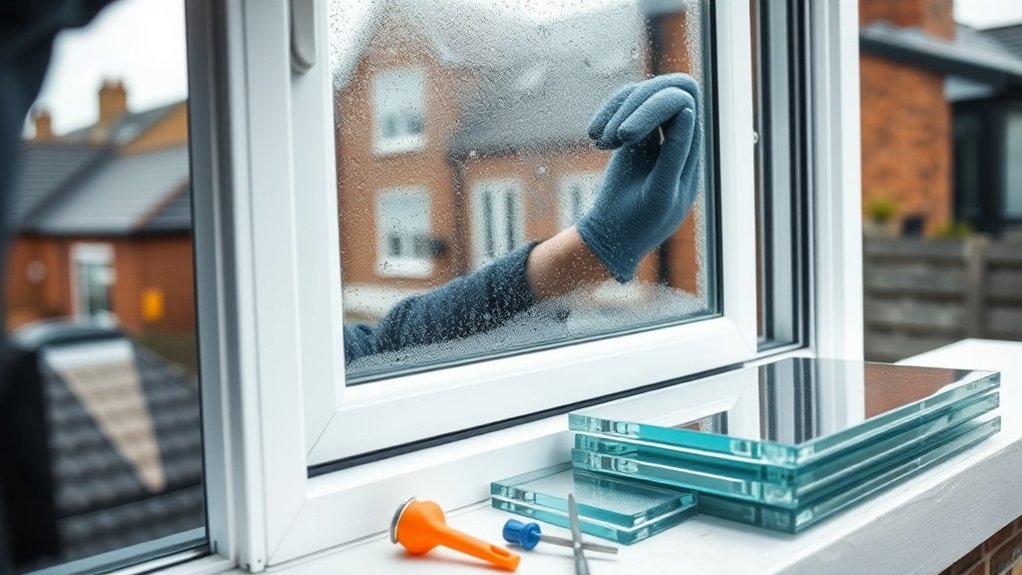
If your double-glazed windows in London are misted between the panes , the sealed unit’s failed and you’re losing insulation, comfort, and money. You don’t usually need new frames – a specialist can replace just the glass with modern low‑E, argon‑filled units that drop into your existing sashes, cut U‑values, and reduce condensation and heating demand. A proper survey, specification, and installation sequence guarantees long-term performance you can fully comprehend and optimise next.
Key insights
- Misted double-glazed units in London usually need full sealed-unit replacement, not repair, to restore insulation, clarity, and reduce condensation.
- Replacement can often keep existing frames if sound, upgrading to low‑E, argon‑filled units for better energy efficiency and comfort.
- Same-day replacement is possible when standard sizes, glass specs, and frame details are confirmed in advance with the installer.
- Professional installers assess frame condition, measure accurately, remove beads carefully, clean rebates, then fit and seal new units for durability.
- Upgraded units can improve thermal performance, noise reduction, safety, and security while preserving the appearance of existing or heritage windows.
How to Tell If Your Double-Glazed Unit Needs Replacing
When a double-glazed unit starts to fail, you’ll usually see clear physical and performance symptoms that indicate it needs replacing rather than repairing. You’ll notice persistent condensation or fogging between panes, confirming the perimeter seal has broken and moisture has infiltrated the cavity. This degrades thermal insulation and can create cold downdrafts near the glass surface.
Inspect the glass for milky staining, mineral deposits, or internal streaks that resist cleaning; these permanently compromise window aesthetics. Touch-test the inner pane on a cold day: if it feels almost as cold as the exterior pane, the argon (or krypton) fill’s likely depleted. You may also detect higher heating demand, localized mould around beads, or warped spacer bars—strong indicators the unit’s performance envelope has failed.
Can Misted Double-Glazed Windows Be Repaired?
Although some companies advertise “misted unit repair” services, it’s important to understand that you’re not truly restoring the original insulating glass unit (IGU); you’re only managing its symptoms. Once the edge seal fails and moisture penetrates, the IGU’s thermal performance and argon/krypton fill are compromised.
Most “repair” methods drill into the glass, vent moisture, and install plugs. This can:
- Reduce structural integrity, especially with large spans or complex window framing.
- Leave you with an unsealed cavity that’s more vulnerable to future condensation and dirt ingress.
- Limit design flexibility if you want upgraded coatings, acoustic laminates, or decorative glass patterns.
If you’re aiming for long-term performance, you should treat misting as a sign the IGU needs engineered replacement, not cosmetic repair.
Misted Unit Replacement vs New Windows: What’s Best?
Faced with misted double-glazing , you’re fundamentally choosing between replacing just the failed glass units or commissioning completely new windows, including frames and hardware. Unit replacement retains your existing frame materials, so it’s ideal when frames are structurally sound, correctly aligned, and still meet thermal and security standards. You restore clarity and insulation with minimal disruption and lower cost.
New windows suit you if you want a full performance and design upgrade. You can re‑specify frame materials (aluminium, composite, advanced uPVC, engineered timber) to optimise U-values, rigidity, and lifespan. You also unlock modern color options, slimmer sightlines, integrated trickle vents, and enhanced locking systems. The best route depends on frame condition, energy targets, aesthetic ambitions, and long‑term refurbishment plans.
What Causes Double-Glazed Units in London to Mist Up
Choosing between unit replacement and brand-new windows only makes sense if you understand why double-glazed units mist up in the first place. Moisture appears between panes when the sealed unit fails and humid London air infiltrates the cavity, then condenses on the colder inner surfaces.
Key technical drivers you should watch for:
- Seal degradation – UV exposure, movement in historical architecture, and poor edge-sealing allow vapour ingress and argon loss.
- Frame and spacer performance – Distorted frames, low‑grade spacers, and incompatible sustainable materials create micro‑gaps and thermal bridges that accelerate condensation.
- Moisture loading and temperature swings – High internal humidity, inadequate ventilation, and rapid external temperature shifts stress the unit, overwhelming desiccants and triggering persistent misting.
Misted Unit Replacement Costs in London
When you plan misted unit replacement in London, you need clear price bands for different glass types, sizes, and frame systems so you can budget accurately. You’ll find that unit dimensions, glazing specification (e.g. low‑E, laminated, acoustic), access constraints, and installer overheads all push costs up or down. By understanding these typical London price ranges and the key cost drivers, you can compare quotes on a like‑for‑like basis and choose the most cost‑effective solution.
Typical London Price Ranges
London misted unit replacement typically starts from around £80–£120 for a small double-glazed pane and can exceed £250–£300 for large, specialised, or toughened units, depending on glass type, thickness, and access. In practice, you’ll see tighter bands once you factor in frame material, opening style, and integration with historical architecture, particularly Victorian sash windows that demand slimline or heritage-spec units.
You can benchmark typical London price ranges like this:
- Standard uPVC casement double-glazed unit: £80–£150
- Slimline or heritage-spec unit for Victorian sash or similar: £140–£220
- Large, toughened, acoustic, or solar-control unit: £200–£320
These ranges help you quickly scope budgets and prioritise which failed units you’ll replace first.
Factors Influencing Replacement Cost
Although headline figures are useful for budgeting, misted unit replacement costs in London ultimately hinge on a tight set of technical variables: glass specification (standard, low‑E, toughened, laminated, acoustic, or solar-control), unit size and thickness, frame material (uPVC, aluminium, timber, composite), and sash or casement design.
You’ll also see pricing flex with spacer bar technology, gas fill (argon, krypton), and warm-edge systems that enhance U-values. In Historical architecture , you may need slimline heritage units, putty glazing, or bespoke Georgian bars, all of which increase fabrication time and cost. If you prioritise Eco friendly materials, specify low‑iron glass, recycled aluminium, or FSC timber, plus high-performance coatings that cut operational carbon—higher upfront, but offset by long-term energy savings and reduced maintenance cycles.
How Long Misted Unit Replacement Takes in London
When you plan misted unit replacement in London, you need clear expectations on typical timeframes, from initial survey to final installation . You should also account for factors that extend or reduce duration, such as glass type, access constraints, frame condition, and supplier lead times. If downtime is critical, you can assess same-day or rapid-response service options that minimise disruption while still meeting technical and safety requirements.
Typical Replacement Timeframes
Most misted unit replacements across London glazing firms typically take between 30 minutes and 2 hours per window, assuming straightforward access and standard sizes. Within that window, a technician can deglaze, remove the failed unit, install the new sealed unit, and re-seal for airtight, moisture‑free performance. Lead times for manufacturing usually range from 3–10 working days, especially when you specify advanced color options or non-standard frame materials.
You can expect the on-site workflow to follow a predictable sequence:
- Survey confirmation and final measurement check (5–15 minutes).
- Removal of beads, failed glass, cleaning of rebates, and preparation (10–30 minutes).
- Installation, squaring, packing, sealing, and quality verification —plus clean‑down (15–60 minutes).
Factors Affecting Duration
Those 30–120 minute estimates only hold if the survey, glass specification, and access conditions are straightforward; in practice, several variables can extend or compress the time on site. You’ll see the biggest impact from aperture size , height above ground, and how easily technicians can deglaze and re‑bed the unit.
Complex frame materials—such as thermally broken aluminium or hybrid timber‑aluminium—often require slower, more controlled bead removal to avoid damage, adding minutes per opening. Bespoke color options on trims or gaskets can also influence duration if components need careful alignment to maintain sightlines and uniform reveals.
Existing frame condition, presence of integrated blinds or sensors, and need for temporary weatherproofing further affect how long the replacement actually takes in London settings.
Same-Day Service Options
Ever wondered whether misted unit replacement can genuinely be done the same day in London? It can, if you align your expectations with how specialist glaziers schedule, source glass, and manage on‑site logistics. Same-day service typically applies when units match standard sizes and specifications already in stock.
To secure fast turnaround, you should clarify:
- Unit specification – Confirm dimensions, glazing type, coatings, and gas fill; non-standard design trends or special tints usually extend lead times.
- Frame compatibility – Provide details on frame depth, bead type, and ventilation gaps; this ensures correct packers and sealants are available immediately.
- Performance priorities – Discuss thermal performance, acoustic control, and material durability so the installer can pre-select units that balance speed with long-term reliability.
Step-by-Step: How Misted Unit Replacement Works
Once you’ve decided to replace a misted unit rather than the whole window, the process follows a precise sequence that guarantees a clean fit and long-term performance. First, the technician surveys the frame , especially in historical architecture, checking tolerances, sightlines, and any movement that could stress the new sealed unit. Next, they measure the rebate and spacer depths with digital gauges, then specify a unit compatible with current glazing innovations and your existing frame system.
On site, they remove beads or gasket , release the failed unit, and clean the rebate, eliminating debris that could cause point loading. They then insert setting blocks, position the new unit, check squareness with a laser level, re-install beads, compress gaskets uniformly, and finally verify airtightness and drainage.
Choosing the Right Glass for Your New Double-Glazed Unit
When you choose glass for your replacement double-glazed unit, you need to balance energy performance (U-values and coatings), acoustic attenuation , and privacy requirements. You’ll also assess safety and security standards, such as toughened or laminated panes, along with optional tints that control glare and solar gain. By matching these specifications to your property’s orientation, noise exposure, and usage, you get a unit that performs efficiently and complies with UK regulations.
Energy Efficiency And U-Values
Choosing the right glass for your replacement double-glazed unit starts with understanding energy efficiency ratings and U-values , because these directly determine how much heat your windows lose and how much you’ll pay to heat your home. A lower U-value means better thermal insulation and reduced energy demand, essential in London’s variable climate.
Focus on the glass specification, gas fill, and spacer technology, not just the frame. You should also balance performance with effective window ventilation to manage moisture and indoor air quality without sacrificing efficiency.
- Target U-values: Aim for ≤1.2 W/m²K for high-performance domestic upgrades.
- Low-E coatings: Choose soft-coat low-E glass to reflect internal heat back into the room.
- Gas fills and spacers : Specify argon or krypton gas and warm-edge spacers to minimise thermal bridging.
Noise Reduction And Privacy
Although energy performance often gets most of the attention, you should treat noise reduction and privacy as core design criteria when specifying new double‑glazed units for a misted replacement in London. Start by defining your target decibel reduction, then select glass and cavity configurations that align with it.
Use asymmetric glazing (e.g. 4mm/6mm) and wider cavities to disrupt sound waves; combine this with advanced Soundproofing techniques such as laminated acoustic glass with interlayers tuned to traffic and rail frequencies. Optimise perimeter sealing to eliminate flanking noise.
For privacy, pair low‑iron or standard clear glass with external or internal window privacy films that deliver one‑way or diffuse visibility without sacrificing daylight. Choose films with stable UV resistance and neutral colour rendering to preserve interior aesthetics.
Safety, Security And Tints
A robust misted unit replacement in London doesn’t just insulate and quieten your home; it also upgrades impact resistance , security performance, and solar control through carefully specified glass types and tints. You can treat the new unit as a platform for enhanced window security and visual comfort rather than a like‑for‑like swap.
-
Safety glass specification Use laminated inner panes in critical locations. The interlayer holds shards in place, improving containment and resisting forced entry.
-
Security hardware synergy Pair laminated glass with multi-point locking and internally beaded frames so the glazing can’t be removed from outside.
-
Advanced tinting options Consider low‑E solar control tints that cut glare and UV while maintaining daylight levels. Reflective or bronze/grey tints reduce sightlines into your home, stabilise internal temperatures, and protect interior finishes.
Energy and Comfort Gains After Replacing Failed Units
Ever wonder why your home still feels draughty and your bills stay high even after you turn up the heating? Failed double-glazed units lose their insulating gas, allow moisture ingress, and create cold bridges, so your building envelope performs closer to single glazing.
When you replace misted units with low‑emissivity, argon-filled panes , you cut U‑values dramatically, stabilise internal surface temperatures, and reduce convective downdrafts. You feel fewer cold spots, and your heating system cycles less frequently, improving efficiency and component lifespan.
In London’s dense housing stock, upgrading failed units also has Historical significance: you can retain original frames while radically improving thermal performance. The Environmental impact is immediate—lower carbon emissions , reduced peak demand, and a more resilient, future‑ready urban dwelling.
Preventing Future Misting in Double-Glazed Windows
Why do some new double-glazed units stay crystal clear for decades while others mist up in just a few winters? It comes down to system design , material quality, and installation precision. To prevent future misting, you need to control moisture pathways, thermal stress, and frame interaction with the sealed unit, especially in London’s variable climate and dense urban pollution.
- Specify advanced units with warm-edge spacers, low-permeability seals, and argon or krypton fill; demand certified test data for seal longevity.
- Optimise frames and drainage so water can’t sit against the edge seal; guarantee correct packer placement and avoid frame distortion.
- Manage internal humidity with efficient extraction and ventilation, essential in properties blending historical architecture or Victorian design with modern insulation.
Misted Unit Replacement in London’s Listed and Period Homes
When you’re dealing with misted double-glazed units in London’s listed or period homes, you must balance thermal performance and moisture control with strict conservation rules and original aesthetics. You can’t simply swap in standard units; you need slimline insulated glass that replicates historic sightlines, rebate depths, and glazing bar profiles.
Start by documenting existing frames, putty lines, and decorative finishes, then specify argon-filled or warm-edge units sized to the original rebates to avoid structural alteration. Use low-iron outer panes to maintain clarity while preserving historical accuracy in reflection and colour tone.
You should also detail vented glazing tapes, heritage-compatible spacers, and reversible fixing methods , so the upgrade enhances U-values and condensation resistance without compromising the building’s listed status.
Finding a Trusted London Misted Unit Specialist
Although many London firms advertise misted unit repairs, you need a specialist with verifiable glazing credentials, conservation awareness , and the right tooling to diagnose and replace failed units without damaging existing frames. You’re not just clearing fog; you’re protecting thermal performance, sightlines, and the visual link between Garden design and interior decor.
Look for a provider who integrates digital surveying, low‑tolerance measuring, and factory‑sealed replacement units engineered for London’s variable climate. Prioritise firms that document their process and materials so you can benchmark long‑term performance .
- Check membership in recognised glazing and conservation bodies.
- Review case studies on complex frames, large spans, and heritage profiles.
- Confirm they can coordinate with architects, Garden design teams, and interior decor specialists.
Questions to Ask a London Glazing Company Before You Book
Before you book, you need to test how familiar the company is with diagnosing and replacing misted units specifically, not just general glazing. You should ask for exact replacement glass specifications—pane thicknesses, spacer bar type, gas fill, coatings, and U-values—so you know the new unit will match or improve your current performance. Clarify their warranty terms , response times for remedial work, and what aftercare support they provide if the new unit fails or mists again.
Experience With Misted Units
Even if a glazing company claims it replaces “all types of double glazing,” you still need to drill into its specific experience with misted units in London’s housing stock. Ask how they diagnose failure points in seals, spacers, and drainage channels across different frame materials and color options, especially in period conversions and high-rise blocks.
Verify they’ve solved issues similar to yours:
- How many misted units have you replaced in London in the last 12 months, and in what property types (Victorian, ex-local authority, new-build)?
- What’s your process for surveying, measuring, and matching existing sightlines, frame materials, and finishes?
- How do you minimise disruption: lead times, on-site installation sequence, waste handling, and post-install performance checks for air‑tightness and moisture ingress?
Replacement Glass Specifications
What exactly will go inside the new sealed unit matters just as much as who installs it, so you need to pin your glazing company down on glass specifications, not vague promises. Ask them to define the glass types they’ll use: low‑E, solar control, acoustic, laminated, or toughened, and why each suits your orientation, noise level, and security needs.
Drill into performance data : Ug-value, g-value, light transmission, and expected dB reduction. Confirm cavity depth, gas fill (argon, krypton), and spacer bar material (warm-edge vs aluminium).
Then challenge their installation techniques. Will they use setting blocks sized to the glass, drained and ventilated rebates, neutral cure silicone, glazing tapes, and correct packer positions to prevent frame distortion and premature unit failure?
Warranty And Aftercare
Specifying the right glass and installation method is only half the job; you now need to lock in how the glazing company will stand behind that work. You’re not just buying a unit; you’re buying its performance over time, so interrogate their warranty coverage and aftercare services with precision.
-
Warranty architecture Ask for written terms: duration on units vs. hardware, what “misted” or “seal failure” explicitly includes, response times , and any voiding conditions (abrasive cleaners, unapproved films, etc.).
-
Aftercare services Clarify cleaning protocols, scheduled inspections, and moisture-diagnostics for marginal seals, plus whether site data is logged for future callouts.
-
Failure-resolution workflow Confirm how they triage issues, lead times for replacement, temporary weatherproofing, and whether they use like-for-like high-performance units, not generic downgrades.
Installation Day and Aftercare: What to Expect
Once you’ve confirmed your appointment, installation day for your misted unit replacement in London follows a clear, structured process: the technician arrives, assesses access and safety, removes the failed double-glazed unit, installs the new sealed unit , and then completes sealing, alignment, and final checks to guarantee thermal and acoustic performance meet specification. They’ll inspect the window frame for distortion, decay, or contamination that could compromise seal integrity, then apply high-performance spacers and perimeter sealants engineered for low thermal transmittance.
You’ll receive guidance on curing times, ventilation, and safe cleaning protocols to protect coatings and gaskets. Expect advice on monitoring for early warning signs—condensation in the cavity, draughts, or movement. Technicians may also propose smart ventilation or glazing upgrades to future‑proof performance.
Frequently Asked Questions
Will Replacing Misted Units Increase My Property’s Resale Value in London?
Yes, it usually will. When you replace misted units, you restore thermal performance , improving energy efficiency and lowering heat loss metrics that savvy buyers track. You also enhance noise reduction, which boosts perceived comfort and modernity. Clear, high-spec glazing signals proactive maintenance and reduced future risk. Together, these factors can strengthen EPC ratings, buyer confidence, and negotiation power, translating into a measurable uplift in your London property’s resale value.
Are There Finance or Payment Plans for Misted Unit Replacement in London?
Yes, you’ll usually find finance or payment plans through specialist glaziers and partner lenders . Picture turning fogged glass into clear, high‑performance units while spreading costs via staged payments. Providers may offer loan options with fixed APRs, 0% short‑term credit, or buy‑now‑pay‑later structures. You gain payment flexibility with monthly instalments, tailored terms by project size, and sometimes no‑fee early settlement, letting you upgrade efficiently without heavy upfront capital.
Can I Claim Tax Relief or Grants for Upgrading Failed Double Glazing?
You can sometimes claim tax relief or secure grants if the upgrade demonstrably improves Energy efficiency and Noise reduction. Check current UK schemes like ECO, Boiler Upgrade Scheme adjunct measures, or local authority retrofit grants. Guarantee installers provide U‑value data , acoustic ratings, and invoices itemizing “energy‑saving materials.” Coordinate with an accountant to classify costs correctly (capital vs repair) and validate eligibility under evolving HMRC guidance and any regional innovation or green‑homes programs.
How Does Misted Unit Replacement Affect My Home Insurance or Warranties?
It can impact both your Warranty coverage and Insurance claims. If you replace misted units with like‑for‑like glass , your home insurance usually stays unchanged, but you must document the work and installer credentials. Insurers may reject future glazing claims if you use non‑compliant units. Existing window warranties can be voided once you swap panes, yet quality installers often provide a new unit‑specific warranty, restoring structured protection.
Is It Worth Upgrading to Acoustic Glass When Replacing Misted Units in London?
Yes, upgrading to acoustic glass is usually worth it if you’re targeting performance. You gain measurable acoustic enhancement through laminated interlayers that disrupt sound waves, delivering significant noise reduction versus standard double glazing. You’ll also improve thermal efficiency and perceived interior comfort. When replacing misted units, you’re already paying for labour, so you minimize marginal upgrade costs while future‑proofing your envelope against urban noise and boosting the property’s technological spec.
Summary
When your double‑glazed units mist, you can’t fix the failed seal, but you can solve the problem. By evaluating condensation patterns, frame condition , and energy loss, you’ll know whether to replace just the units or the entire windows. In London’s varied housing stock, including listed properties, a specialist matters. Get itemised quotes, certifications, and guarantees. Act early—“a stitch in time saves nine”—and you’ll protect thermal performance, reduce bills, and preserve your home’s fabric.