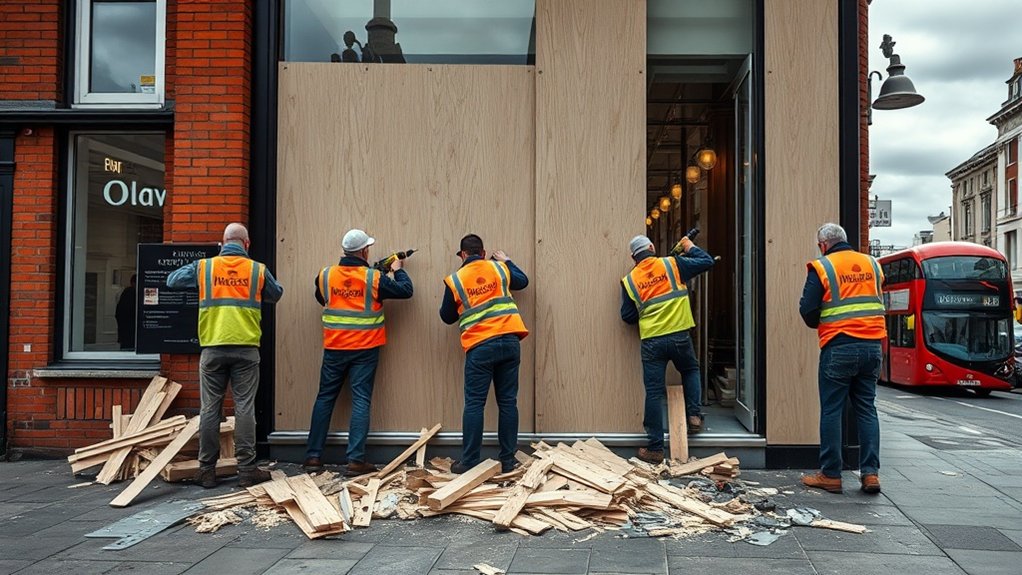
You use boarding up security in London as a rapid, engineered control to lock down breached doors and windows, contain risk, and stabilise your perimeter after break-ins, vandalism, or structural damage. You start with a risk assessment, isolate hazards, then install impact-rated boards using anti-tamper fixings, verified load paths, and temporary sensors where needed. You treat boarding as a short-term, auditable barrier within a wider defence-in-depth plan, and there’s more that can optimise how you do it.
Key insights
- Emergency boarding in London secures properties after break-ins, damage, or storms, restoring a safe perimeter and buying time for permanent repairs.
- Effective boarding is a temporary, engineered barrier using impact-rated panels, tamper-resistant fixings, and verified load paths, not just basic plywood over windows.
- Vacant and void properties require layered protection: secure boarding, anti-climb features, monitored alarms, and IoT sensors tailored to local crime patterns.
- Material choice depends on risk and duration: OSB or plywood for rapid cover, steel or mesh systems for higher forced-entry resistance and better sightlines.
- Choose providers offering 24/7 rapid response, clear SLAs, compliance with London planning and insurance requirements, and full documentation with photos and risk assessments.
Why Boarding Up Security Matters In London
Why does boarding up security matter so much in London’s constantly changing risk landscape ? You operate in a city where threat vectors shift fast: targeted vandalism, organised burglary, protest spillover, and climate‑driven storm damage. Traditional boarding up myths—like “it’s only for derelict sites” or “glass alone is enough”—ignore data from historical incidents involving rapid forced entry and opportunistic crime.
You need a procedural, engineered approach: map facade vulnerabilities, specify impact‑resistant boarding substrates , define fixing patterns, and integrate sensors where possible. Treat boarding as a temporary but performance‑rated barrier in your overall security architecture, with load, dwell‑time, and attack‑route assumptions documented. By standardising methods and materials, you convert a reactive, ad‑hoc practice into a predictable, auditable control within your wider risk management system.
When To Use Emergency Boarding Services
You should treat emergency boarding as a critical control measure immediately after break-ins, vandalism, or any event that compromises external glazing or doors. In these scenarios, you’re not just protecting against further intrusions, you’re also mitigating risks related to structural weakness, falling glass, and weather ingress. You must also use emergency boarding after storm and impact damage to stabilise openings, prevent unauthorised entry, and maintain insurance and safety compliance until permanent repairs are completed.
After Break-Ins Or Vandalism
When a break-in or act of vandalism leaves doors, windows, or glazing compromised, emergency boarding becomes a priority risk-control measure , not an optional extra. You’re not just patching damage; you’re restoring your security perimeter and evidential integrity.
Act in a strict sequence to contain risk and data:
- Isolate the area, preserve footprints, tool marks, and CCTV sightlines.
- Notify police, insurers, and—where relevant—Neighborhood watch or community patrols.
- Deploy a 24/7 boarding team using tamper-resistant fixings and measured sheet coverage.
- Specify materials based on threat profile : anti-lift plywood, polycarbonate, or steel panels.
- Integrate temporary sensors—door contacts, vibration detectors, portable cameras—into your existing system.
You’re buying time: preventing re-entry, deterring opportunists, and stabilizing the site for forensic and insurance processes.
Storm And Impact Damage
Suddenly losing a window, rooflight, or shopfront to wind, flying debris, or vehicle impact isn’t just a repair issue; it’s an immediate breach of your building envelope and security posture. You should trigger emergency boarding when glazing is compromised, frames are distorted, or structural movement is suspected.
First, isolate the zone: cut power if there’s water ingress, restrict access, and document damage . Next, call a 24/7 boarding team specifying substrate, span sizes, and any critical assets exposed.
Technicians will install mechanically fixed boards, verify load paths, and ensure temporary weatherproofing until permanent works proceed. Post‑incident, integrate findings into your risk model: upgrade impact‑resistant glazing, revise roof maintenance regimes, enhance tree trimming schedules, and adjust collision barriers to reduce repeat exposure.
Emergency Boarding After Break-Ins And Vandalism
After a break-in or vandalism, you need to secure the property immediately to limit further loss, prevent unauthorised access, and stabilise any structural vulnerabilities. You must also protect the crime scene by controlling entry points so police and insurers can preserve and assess evidence correctly. Emergency boarding then provides temporary safety and privacy, creating a controlled environment until permanent repairs or security upgrades are in place.
Immediate Property Securing
Although every minute counts following a break‑in or vandalism incident, you can stabilise the risk quickly by securing all compromised entry points with emergency boarding. You treat the site as a live risk environment and lock down the perimeter in a structured sequence.
- Isolate the area, switch off vulnerable circuits, and verify no ongoing hazards.
- Conduct rapid roof inspections to identify uplifted tiles, skylight damage, or loft access points.
- Board windows, doors, and ad‑hoc breaches with tamper‑resistant fixings and impact‑rated panels.
- Seal sub‑floor and service penetrations to block opportunistic access and support integrated pest control measures.
- Implement temporary smart locks and monitored sensors on critical points until permanent glazing and doors are installed.
Protecting Evidence And Entry
Because every intrusion scene is both a crime scene and a live security failure, emergency boarding must protect the property without corrupting evidence or masking the intruder’s entry path. You start by establishing an exclusion zone, documenting all impact points , and recording high‑resolution images before touching debris or frames.
You then coordinate with investigators to identify surfaces needing forensic preservation. Fix boards to existing structural points, never to damaged locking hardware or obvious tool-mark areas. Use pre-drilled patterns and tamper-evident fasteners to minimize additional imprinting.
Integrate temporary outdoor surveillance to cover the compromised façade and route video to your central access control platform. This lets you log post-incident movements, monitor for offender return, and validate that your boarding layout doesn’t create new blind spots.
Temporary Safety And Privacy
How do you turn a breached frontage into a controlled, habitable envelope within the first hour of response? You start by imposing structure on chaos. You’re not just covering a gap; you’re restoring personal safety, privacy, and predictable movement.
- Deploy rapid-assessment: map breach points , glazing type, frame integrity, and lock failures.
- Specify board grade, fixing pattern, and anchor depth to resist lever, kick, and weather loads.
- Use internal framing or anti-tamper fixings so boards can’t be lifted from outside.
- Integrate temporary vision control: peepholes or smart cameras aligned with neighborhood watch protocols.
- Seal perimeters for acoustic dampening, thermal retention, and line-of-sight denial, preventing hostile reconnaissance while you plan permanent remediation.
Securing Vacant And Void Properties In London
Vacant and void properties in London quickly attract trespassers, metal thieves, squatters, and vandals, so you must secure them as if they’re active crime targets. Begin with a structured risk assessment: map all access points, visibility lines, and escape routes, then overlay local neighborhood crime rates and incident patterns. For listed or historical architecture, integrate non-invasive, reversible measures that won’t compromise fabric or planning compliance.
Next, implement a layered defence model : physical barriers, intrusion detection, and remote monitoring. Deploy tamper‑resistant locking systems, anti‑climb features, and lighting calibrated to avoid light pollution complaints. Add IoT sensors at high‑risk entry nodes and connect them to a monitored platform with audit logs and real‑time alerts. Review configurations quarterly and after any security event.
Types Of Boarding For Doors And Windows
When you choose boarding for doors and windows in London, you’re effectively selecting a security control set , so you need to match the material and fixing method to the risk profile and time horizon. You prioritise impact resistance, material durability, and speed of deployment, then layer in decorative options only where they don’t dilute protection.
- Structural plywood: rapid-fit, high deterrence, but visually intrusive and moisture-sensitive.
- OSB/engineered panels: cost-efficient, predictable performance, good for short-to-medium terms.
- Steel sheeting: highest forced-entry resistance, excellent material durability, slower to install.
- Perforated or mesh steel: maintains light and sightlines while resisting prying and levering.
- Hybrid boarding systems: steel or composite panels in modular frames, enabling quick removal, reuse, and integration with smart sensors or temporary access controls.
Staying Secure, Safe And Within The Law
Before you start screwing boards into frames and brickwork, you need to treat boarding-up as a compliance exercise as much as a security upgrade , aligning your measures with UK law, London council requirements, and your insurance conditions. You’re not just blocking access; you’re managing liability, fire egress, and public-safety risk.
Map the legal considerations first: planning constraints, conservation-area rules, highways sightlines, and requirements for emergency access and lighting. Document every intervention: materials, fixings, dates, photos, risk assessments.
Design boards so they deter entry but don’t create secondary hazards —no protruding screws at street level, no sharp edges, no blocked vents where gas may accumulate. Use transparent or perforated panels where passive surveillance and community outreach matter, reducing complaints and potential enforcement action.
How To Choose A Boarding Up Service In London
When you choose a boarding up service in London, you must treat emergency response time as a critical risk-control factor, not a convenience. You’ll need to verify how fast they can attend site, what resources they deploy , and how they prioritise incidents under high-demand conditions. At the same time, you should evaluate the technical specifications of their materials and methods, gauging impact resistance, fixing systems, and installation standards against the likely threats to your property.
Assessing Emergency Response Times
How quickly a boarding up team reaches your property directly affects how much additional damage, theft, or liability you face after a break-in or window failure. You should treat emergency response as a measurable performance metric, not a promise.
When assessing providers, verify how they operationalize speed, not just quote “24/7.”
- Confirm guaranteed response-time SLAs by postcode, with financial penalties for breaches.
- Ask how they use security technology (GPS tracking, digital dispatch, live ETAs) to compress deployment time.
- Check call-handling redundancy: multiple lines, cloud telephony, automatic rollover.
- Review historic incident logs and references to validate average on-site times and peak-load performance.
- Evaluate their integration with police, insurers, and local community awareness networks to reduce access delays.
Evaluating Materials And Methods
Although speed determines the immediate containment of a breach, the materials and methods a boarding up service uses determine your residual risk exposure over the following days or weeks. You should specify graded timber or impact‑resistant composite panels , corrosion‑resistant fixings, and anti‑tamper screws anchored into the structural frame, not just window beading.
Insist on a documented method statement: fixing pattern, load paths, and wind‑load assumptions. Ask how they integrate temporary reinforcement with your existing security technology—CCTV sightlines, alarms, and access control—so boards don’t create blind spots.
Verify they use pre‑drilled templates, dust‑minimising cutting tools, and rapid‑deploy systems to shorten on‑site exposure. Finally, evaluate how their methods support community awareness: visible deterrent signage, contact details, and clear delineation of secure versus unsafe zones.
Boarding Up Costs In London And Pricing Factors
Because boarding up is usually a reactive measure after a break‑in, accident, or structural failure, you need to understand the cost drivers before you authorise any work. You’re not just buying sheets of timber; you’re buying response time, risk reduction, and evidence‑friendly documentation for future insurance claims and ongoing property maintenance.
Key pricing factors in London typically include:
- Extent of damage and number of apertures to secure
- Material specification (OSB vs ply vs composite, fire‑rated or not)
- Access complexity: upper floors, restricted streets, or hazardous structures
- Response profile: standard, out‑of‑hours, or rapid 60‑minute deployment
- Add‑ons: digital photo reports, incident logs, and temporary alarms or sensors
Request itemised quotes, with rates separated for labour, materials, and emergency call‑out, so you can benchmark suppliers.
How Boarding Up Fits Into Your Overall Security Plan
Viewed correctly, boarding up functions as a short‑term risk‑control measure that plugs immediate vulnerabilities while you stabilise and redesign your wider security posture. You should treat it as a controllable layer in a defence‑in‑depth model , not a standalone solution.
Map boarding‑up use cases to specific threat scenarios: post‑incident containment, asset isolation, and access governance during refurbishments. Define trigger thresholds, authorisation levels, and maximum deployment durations.
Integrate boarding aesthetics and historical preservation into your risk register so temporary screens don’t breach planning constraints or damage heritage fabric. Standardise material specifications, fixing patterns, and inspection intervals. Align boarding layouts with camera sightlines, alarm fields, and lighting grids. Finally, feed incident data from each deployment back into your security risk assessments and capital‑upgrade roadmap.
How To Prepare For An Emergency Boarding Call-Out
When a window fails at 2 a.m. or a storefront is breached, the value of your boarding contractor depends on what you’ve already put in place. You treat an emergency boarding call-out like any other critical intervention: pre-plan, standardise, document.
- Define escalation criteria, response times, and authority to approve call‑outs in your incident runbook .
- Pre‑register multiple sites, access routes, and security contacts with your contractor.
- Specify board materials, fixings, and interim window insulation requirements for different risk profiles.
- Embed aesthetic considerations in the specification so temporary boards still align with brand and planning constraints.
- Test the process with drills, logging timestamps, photos, and follow‑up actions.
You’re not improvising at impact; you’re executing a rehearsed, measurable protocol.
Frequently Asked Questions
Can Boarding up Improve My Property’s Energy Efficiency or Insulation?
Yes, boarding up can enhance your property’s energy efficiency by boosting thermal insulation and supporting energy conservation. You’ll reduce air leakage , stabilize internal temperatures, and cut heat loss through damaged or exposed glazing. To optimize performance, you should specify rigid, tightly fitted panels, seal all junctions with appropriate tapes or foams, and assess condensation risk. Integrate this as a temporary, data-driven measure within a broader building fabric upgrade strategy.
Are There Eco-Friendly or Recyclable Boarding Materials Available in London?
Yes, you can source eco friendly options and recyclable materials locally. You start by specifying FSC-certified plywood, OSB with low-VOC resins, or recycled plastic sheets. You then verify suppliers’ environmental certifications and chain-of-custody data . Next, you assess fire ratings, impact resistance, and moisture performance. Finally, you implement a documented removal and recycling plan, so boards re-enter material streams instead of going to landfill—waste becomes a closed-loop resource.
How Does Boarding up Affect My Home Insurance Premiums or Coverage Terms?
Boarding up can lower risk, but insurers treat it variably. You might access insurance discounts if you document professional installation and compliant materials. However, providers can impose coverage adjustments, such as higher deductibles, exclusions for neglect, or mandatory inspection schedules. You should notify your insurer before boarding, request written confirmation of any premium changes, and log photos, invoices, and timestamps to prove proactive risk mitigation and maintain best policy terms.
Can I Brand or Advertise on Boarding Panels for My Business Premises?
You can brand or advertise on boarding panels, but you must treat it as a controlled security measure. First, confirm local planning and signage regulations . Then specify boarding customization: material grade, anti-tamper fixings, fire rating, and anti-graffiti coatings. Make certain graphics don’t obscure CCTV sightlines or emergency exits. Document specifications, installation method, and maintenance schedule so insurers, landlords, and regulators see security performance isn’t compromised by the advertising layer.
Are There Noise-Reducing Boarding Options for Properties on Busy London Streets?
Yes, you’ve got several soundproofing options that reduce noise on busy London streets, like a well-tuned filter cutting harsh frequencies. You’d specify acoustic boarding with dense cores, decoupled framing, and airtight seals for maximum noise pollution reduction. You then integrate secondary glazing, perimeter seals, and acoustic sealants. Finally, you’d verify performance using dB-rated products, on-site sound tests, and ongoing monitoring to validate the installation’s technical effectiveness.
Summary
When London’s security storm clouds gather, you can’t afford cracks in your defenses. Boarding up is your rapid-response shield, locking down doors, windows, and void properties before threats seep in. Treat it like a drilled procedure: assess, call, secure, review . Document vulnerabilities, keep a vetted boarding contractor on standby, and integrate each call-out into your overall security plan. When impact hits, you won’t improvise—you’ll execute a tested, technical response that keeps your premises protected.