
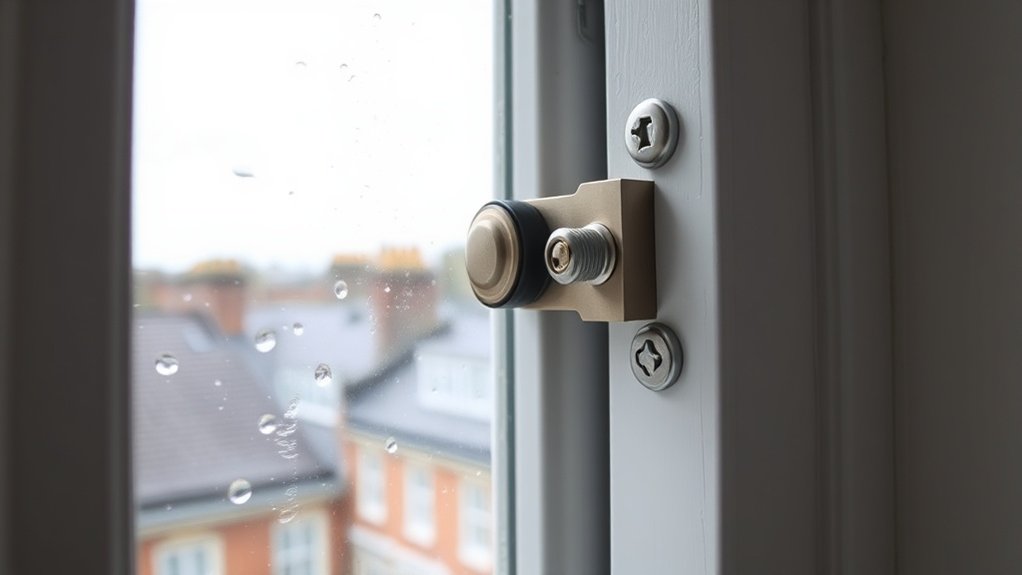
You need window restrictors in London to limit how far upper-floor windows open, reducing fall risks while preserving ventilation and emergency escape. They must align with Building Regulations (Parts B, K, M), the Housing Act 2004, HHSRS guidance, and meet BS EN 14351-1 and BS EN 13126 performance standards. Landlords, HMO owners, and dutyholders face enforcement action for non-compliance. Continue to discover when they’re required, how to choose them, and how to check they’re safe.
Key insights
- Window restrictors in London limit window openings to reduce fall risks while still allowing adequate ventilation in homes, HMOs, schools, and healthcare buildings.
- They must comply with Building Regulations and British Standards (BS EN 14351-1, BS EN 13126) and are often legally required where children or vulnerable people are present.
- Landlords and building owners can face enforcement notices, fines, or legal claims if required window restrictors are missing, defective, or non-compliant.
- Various types exist for different window styles, including cable, friction stay, sash, and concealed restrictors, suitable for both modern and heritage properties.
- Professional selection, installation, and documentation ensure safety, preserve emergency escape routes, and satisfy London’s regulatory and conservation requirements.
Why Window Restrictors Matter in London Homes
Although London’s housing stock varies from Victorian terraces to high‑rise new builds, window restrictors serve the same primary function across them all: they limit the opening of a window to reduce the risk of falls while still allowing ventilation. You face particular obligations where children, vulnerable adults, or higher floor levels are present, as reflected in BS EN standards and Building Regulations guidance .
In London, you must reconcile life‑safety, security, and energy‑efficiency demands with Historical architecture and modern aesthetic considerations. Poorly specified restrictors can breach duty‑of‑care requirements or invalidate insurance. Robust solutions support retrofit across mixed portfolios, enabling consistent compliance documentation, inspection regimes, and digital asset records. By treating window restrictors as a core safety system, you future‑proof homes against evolving regulation and risk profiles.
What Window Restrictors Are and How They Work
To specify and manage these systems correctly, you need a clear understanding of what a window restrictor is and how it operates in practice. A window restrictor is a mechanical safety device that limits the opening distance of a sash, casement, or tilt-and-turn window to a pre‑defined gap. It typically consists of a cable, bar, or friction stay, plus a locking or releasable mechanism .
You integrate the restrictor with the window’s existing ironmongery so the leaf opens for ventilation but can’t exceed the safe threshold without deliberate override. Modern solutions let you calibrate force resistance, opening angle, and release method, while remaining compatible with historical architecture and contemporary aesthetic design. You thereby maintain safety, usability, and façade integrity in one coordinated system.
London Laws on Window Restrictors
When you install or manage window restrictors in London, you must understand how key legal requirements apply under building, housing, and health and safety regulations. You’re also responsible for ensuring that all devices comply with relevant British and European safety standards, from design performance to ongoing maintenance. If you ignore these duties, you can face formal enforcement action, including improvement notices, prohibition notices, and financial penalties.
Key Legal Requirements
While the term “window restrictor” sounds straightforward, London’s legal framework around it is precise and fragmented across several regulations you must treat together. You have to align safety, Historical architecture, and aesthetic considerations without breaching statutory duties .
-
Building Regulations – You must interpret Parts B, K, and M together, ensuring restrictors limit openings in risk areas yet preserve compliant means of escape.
-
Housing and Landlord Law – As a landlord, you’re obliged under the Housing Act 2004 and related guidance to prevent falls from windows, especially where children may be present.
-
Health and Safety at Work – If premises are workplaces, you must manage window-opening risks under general risk assessment duties.
-
Conservation and Planning – In listed or conservation properties, you must obtain approvals for visible restrictor installations.
Safety Standards Compliance
Effectively complying with London’s safety standards on window restrictors means aligning product choice and installation with specific technical benchmarks set by British Standards and reflected in UK guidance. You must verify that restrictors meet BS EN 14351-1 performance parameters and, where applicable, BS EN 13126 for hardware durability, opening limitation, and child-safety functionality.
You should also evidence conformity with the Building Regulations (especially Parts B and K) and the Housing Health and Safety Rating System, documenting escape window requirements, maximum opening gaps, and load resistance. When you specify solutions, integrate Aesthetic design and Cost considerations only after confirming full technical compliance. Prioritise tested, third‑party‑certified products , maintain installation records, and embed these standards into your digital asset registers and ongoing compliance audits.
Enforcement And Penalties
Ultimately, enforcement of London’s window‑restrictor duties operates through multiple regulatory channels that can expose you to both civil and criminal liability. You must align safety engineering with historical architecture and aesthetic considerations while still satisfying statutory thresholds.
-
Local authority enforcement – Inspectors can issue improvement or prohibition notices where restrictors are absent, defective, or improperly maintained, particularly in HMOs and higher‑risk residential stock.
-
Criminal sanctions – Persistent or serious breaches can trigger prosecution, fines, and, in extreme cases, custodial sentences under housing or health‑and‑safety legislation.
-
Civil liability – Occupant falls can generate negligence and occupiers’ liability claims, with damages linked to documented compliance failures .
-
Regulatory scrutiny in refurbishments – Innovative retrofit schemes must evidence compliant restrictor specification across conservation areas and modern developments.
When Are Window Restrictors Legally Required in London Homes?
When you assess when window restrictors are legally required in London homes, you must distinguish between statutory duties on landlords and best-practice safety measures for families. As a landlord, you’re obliged to comply with housing, fire safety, and building regulations that can require restrictors in higher-risk settings, particularly where there’s a risk of falls from height . As a parent or carer, you should align your window safety provisions with these standards even when the law doesn’t expressly mandate devices in every room.
Legal Requirements For Landlords
Although window safety often feels like common sense, landlords in London must navigate specific legal duties that dictate when window restrictors are required. You’ve got to balance compliance with innovation, especially where Historical architecture and Window aesthetics are integral to your asset’s value.
-
Housing Health and Safety Rating System (HHSRS) – You must assess falls from windows as a Category 1–2 hazard and install restrictors where risk is non‑trivial.
-
Building Regulations (Part K) – For new builds and major refurbishments, you must limit opening sizes on upper floors or rely on compliant restrictors.
-
HMO Licensing Conditions – Many boroughs explicitly mandate restrictors on upper‑storey windows in licensed HMOs.
-
Landlord’s Common Law Duty of Care – You must take reasonably practicable measures—often including restrictors—where foreseeable fall risks exist.
Safety Rules For Families
Because London’s housing laws don’t spell out a simple “family home window restrictor” rule, you have to read several regulations together to understand when they’re effectively required. If you occupy a flat above ground level, especially with young children, Building Regulations and Housing Health and Safety Rating System guidance expect robust fall‑prevention, making window restrictors a de‑facto requirement as part of your childproofing measures.
You must still preserve Emergency escape functionality . On designated escape windows, restrictors should be releasable without a key yet resistant to child operation, aligning with BS EN standards. You should prioritise restrictors where cill heights are low, beds or furniture sit beneath windows, or balcony guarding is inadequate. Proactively specifying certified, tamper‑resistant devices keeps you within best‑practice safety expectations.
Window Restrictor Safety Standards and Testing
While window restrictors may look like simple devices, their design and installation in London are governed by specific safety standards and test requirements that you must understand and comply with. You’ll primarily reference BS EN 14351-1, BS EN 13126 , and relevant Building Regulations, ensuring restrictors withstand defined load, cyclic use, and misuse tests without compromising emergency egress.
- Performance testing – Verify resistance to applied force, durability under repeated operations, and reliability of override mechanisms.
- Compliance documentation – Demand test certificates, CE/UKCA marking, and traceable batch data.
- Aesthetic impact – Specify compact, colour-matched hardware that aligns with façade design and conservation constraints.
- Cost considerations – Evaluate lifecycle cost: product price, installation complexity, maintenance intervals, and potential liability reduction through robust compliance.
Types of Window Restrictors Used in London Properties
As you move from standards to specification , you’ll encounter several distinct types of window restrictors commonly used in London, each suited to particular window forms, risk profiles, and regulatory duties. You’ll typically work with cable restrictors, friction stays with integrated limiting devices, locking ventilators, and concealed restrictors embedded within the frame.
For casement and tilt‑and‑turn systems, friction stays and cable restrictors dominate, providing defined opening angles and child‑safety compliance. For sliding sashes in historical architecture, you’ll often specify retrofittable sash restrictors that preserve sightlines while meeting fall‑prevention requirements. In high‑rise or high‑occupancy buildings, robust locked restrictors support stricter duty‑of‑care obligations. Throughout, you must balance mechanical performance, tamper resistance, cleaning access, and aesthetic considerations aligned with London’s conservation expectations .
How to Choose the Right Window Restrictor for Your London Property
When you select window restrictors for a London property, you must first assess the specific safety requirements imposed by UK Building Regulations and any applicable local authority or landlord standards. You’ll then need to match restrictor types to window styles, opening dimensions, and user profiles (including children, vulnerable adults, or high-traffic areas). By aligning these technical and regulatory factors, you guarantee the chosen restrictors provide compliant, reliable, and property-appropriate protection.
Assessing Safety Requirements
Because window openings present different risks depending on height, occupancy, and user profile, you must first establish clear safety requirements before selecting a restrictor for your London property. You’ll need to align risk controls with Building Regulations , fire egress guidance, and relevant British Standards, while still respecting Historical architecture and aesthetic considerations.
- Quantify fall risk by measuring sill heights, drop distances, and likely impact surfaces, especially above basements or hard landscaping.
- Classify users: children, vulnerable adults, short‑term guests, or staff, and set stricter opening limits where supervision is low.
- Determine essential ventilation and purge‑air rates so restriction doesn’t compromise indoor air quality.
- Confirm emergency escape needs, ensuring any restrictor strategy integrates with fire‑safety plans and documented evacuation procedures.
Matching Restrictor Types
With your safety requirements defined, you can now select restrictor types that satisfy both regulatory and practical constraints for your London property. You’ll typically choose between cable restrictors, friction stays with integrated limiters, lockable restrictor arms, and concealed mechanisms.
Align each type with opening-size limits in Approved Document K and local Housing Health and Safety Rating System expectations. For upper floors, prioritise robust, tamper-resistant devices that still permit emergency egress.
Evaluate how each option affects window aesthetics, allowing slimline or concealed fittings on premium façades. Consider energy efficiency by ensuring the restrictor doesn’t compromise airtightness or prevent full closure against modern weather seals. Finally, confirm compatibility with existing frames, planned maintenance cycles, and any smart-building or access-control integrations.
Window Restrictors in London High-Rises and HMOs
Although window restrictors are relevant across many building types, they have a particularly critical role in London’s high‑rise blocks and Houses in Multiple Occupation (HMOs), where occupant density , mixed user profiles, and elevated fall risks intersect. You must balance robust fall‑prevention with window aesthetics and, in many boroughs, strict historical preservation constraints.
In these environments, you’re managing complex regulatory, operational, and design pressures:
- Regulatory compliance – Align with Building Regulations, HMO licensing conditions, and housing standards on maximum opening widths.
- User diversity – Anticipate children, vulnerable adults, and transient residents with varying risk profiles.
- Performance integration – Ensure compatibility with existing fire‑safety, smoke‑ventilation, and façade systems.
- Future‑ready design – Specify restrictors that support digital monitoring, modular replacement, and adaptable settings for evolving safety strategies.
Installing Window Restrictors Safely and Correctly
When you install window restrictors, you must first select devices that are compliant with UK and London-specific safety standards and are suitable for your window type, opening size, and building use. You should then follow a controlled, step-by-step installation process that guarantees fixings, positioning, and opening limits meet regulatory requirements. The following section sets out how to choose appropriate restrictors and apply a compliant installation method in practice.
Choosing Suitable Restrictors
Before you purchase and install any window restrictors, you should first determine the specific risks, window types, and legal duties that apply to your London property, as these factors directly dictate what constitutes a suitable device. You’ll balance compliance with innovation, Historical architecture constraints, and aesthetic considerations, while ensuring robust fall-prevention performance .
-
Risk profile and users Quantify fall heights, vulnerable occupants, and operational frequency to define allowable opening gaps.
-
Window construction and materials Match restrictor anchoring methods to frame material, sash weight, and hardware clearances.
-
Regulatory alignment Select products certified to relevant British Standards and any sector-specific London guidance.
-
Operational and security features Prioritise restrictors with tamper-resistant releases, clear visual status, durable components, and integration potential with digital monitoring or smart-building systems.
Step-By-Step Installation
Once you’ve selected compliant hardware, correct installation becomes critical to ensuring window restrictors achieve their designed fall‑prevention performance and satisfy London’s regulatory expectations. You should start by verifying substrate integrity, fixing into brick, concrete, or reinforced frames using manufacturer‑specified anchors. Mark opening limits to comply with 100 mm child‑safety guidance, then pilot‑drill to avoid frame fracture.
You must position fixings to preserve window aesthetics and maintain unobstructed window cleaning access. Torque screws to the recommended setting, then test the restrictor under load to confirm it resists the forces defined in BS EN 14351 and any local authority standards. Finally, document fixings, test results, and locations, integrating them into your digital asset register to support inspections, maintenance planning, and future retrofits.
Retrofitting Window Restrictors in Older London Homes
Although many period properties in London predate modern safety standards, you can usually retrofit compliant window restrictors without compromising heritage features, provided you follow the relevant regulations and manufacturer guidance. You must consider Historical architecture, frame condition, and Aesthetic considerations alongside statutory requirements such as the Building Regulations and the Housing Health and Safety Rating System.
- Identify window types (sash, casement, crittall) and verify structural integrity before specifying restrictor models.
- Confirm compatibility with Listed Building Consent or conservation area policies where applicable.
- Select restrictors tested to BS EN 14351 and child-safety guidance, ensuring appropriate opening limits and robust fixings .
- Coordinate with a competent installer to document products, fixing locations, and certification, maintaining an auditable compliance trail for insurers and landlords.
How to Balance Window Restrictor Safety With Ventilation and Ease of Use
When you plan window restrictors for a London property, you must balance fall-prevention, secure ventilation, and day‑to‑day usability in line with statutory and best‑practice standards. You need opening-limits compliant with BS EN 14351 and relevant Building Regulations, yet sufficient free area for purge and background ventilation.
Prioritise devices with staged opening positions, child‑resistant release mechanisms, and intuitive operation for residents and facilities teams. Integrate Aesthetic considerations early: select low‑profile fittings, colour-matched finishes, and hardware concealed within frames where possible, while preserving sightlines.
Evaluate Cost implications through whole‑life performance: durability of components, testing certification, and maintenance intervals. You should also factor in compatibility with acoustic glazing, night‑vent settings, and future retrofitting of smart sensors or automated façade systems.
Common Window Restrictor Issues and How to Fix Them
As window restrictors age or are incorrectly specified for London properties, predictable issues emerge that undermine both safety compliance and usability. You should diagnose problems methodically, then align any remedy with BS EN 14351 , HHSRS guidance, and local fire-escape requirements, while still respecting window restrictor aesthetics and historical window restrictions.
- Stiff or seized mechanisms – Lubricate moving parts with a non-staining silicone spray ; if corrosion’s evident, replace with stainless or marine-grade hardware.
- Non-compliant opening gaps – Measure the opening; retrofit certified restrictors limiting to 100 mm where required.
- Incompatible heritage frames – Specify low-profile, colour-matched units that preserve sightlines and fabric.
- User tampering or bypassing – Install tamper-resistant fixings and locking designs with controlled key management.
Landlord Responsibilities and Tenant Rights in London
In London, landlords must treat window restrictor safety as a core legal duty under the Housing Act 2004 , the Housing Health and Safety Rating System (HHSRS), and relevant building regulations, while tenants retain enforceable rights to safe means of ventilation and escape. You must guarantee restrictors mitigate falls from height, particularly in upper-storey dwellings and HMOs, regardless of whether the property features historical architecture or modern design.
You’ve also got to guarantee that any innovation—such as smart restrictors or adaptive opening controls—doesn’t compromise emergency egress standards or fire safety strategies. Tenants may request remedial action, escalate concerns to the local authority, and rely on improvement notices or hazard assessments. You can’t penalise tenants for raising safety issues or requesting compliant, functional restrictors.
How to Check If Your Window Restrictors Are Compliant
London’s legal framework only protects occupants if window restrictors actually comply with the relevant standards, so you need a clear method to verify that the devices on your windows meet current safety and fire-escape expectations. You’ll assess both mechanical performance and documentation, guaranteeing modifications for window aesthetics or decorative features don’t undermine protection.
- Identify standards : Confirm compliance with BS EN 14351-1 and relevant Building Regulations (Part B and K), plus local authority or Housing Act guidance.
- Check markings: Look for manufacturer markings , CE/UKCA symbols, product codes, and installation dates.
- Test operation: Measure the initial opening gap (typically ≤100 mm), verify resistance to applied force, and confirm controlled emergency release.
- Review installation: Ensure fixings suit the frame material, aren’t blocked by secondary glazing, blinds, or decorative features, and allow future maintenance .
Frequently Asked Questions
Can Window Restrictors Affect My Home Insurance Coverage or Premiums in London?
Yes, window restrictors can influence your home insurance coverage and premiums. Insurers assess them as risk‑mitigation devices, so you should review policy wording and disclose installations accurately. Some insurance policies may offer premium adjustments or enhanced liability protection if restrictors comply with relevant British Standards and local safety regulations. You should also document professional installation, maintain inspection records, and confirm with your insurer that these controls are formally recognised within your risk profile.
Are There Child-Friendly Window Restrictor Designs That Are Visually Discreet or Decorative?
Yes, you’ll find child‑friendly window restrictors that hide like a safety net behind the curtains. You can specify decorative safety options—slimline cable restrictors, colour‑matched finishes, or hardware integrated into handles—so they remain low‑profile. Manufacturers offer discreet designs that comply with safety standards (e.g., limiting opening distance, tamper‑resistant release) while preserving clean sightlines, enabling you to balance regulatory compliance, child protection, and contemporary aesthetics in one innovative solution.
How Do Window Restrictors Impact Property Valuations or Surveyor Reports in London?
They typically strengthen surveyor reports by evidencing proactive window safety and property security risk management. You’ll rarely see a direct uplift in valuation, but you may avoid negative comments, retention recommendations, or compliance caveats. Surveyors often flag upper-floor, low-sill, or full-height glazing; robust restrictors can neutralise those hazards. Innovative, tested restrictor systems aligned with BS EN standards signal lower liability exposure, which purchasers and insurers increasingly price into their decisions.
Can Smart Home or App-Controlled Window Restrictors Be Used Legally in London Homes?
You can use smart or app‑controlled window restrictors legally, provided you maintain Safety compliance with UK Building Regulations and relevant fire escape standards. You must guarantee manual override, fail‑safe operation on power or network loss, and audited access logs . When configured correctly, these systems deliver Security enhancements without breaching child‑safety rules—important, as falls from windows account for about 4,000 UK emergency admissions annually—while still supporting innovative, connected‑home design.
Are There Grants or Council Funding Schemes for Installing Window Restrictors in London?
You won't usually find London-wide grants dedicated solely to window restrictors, but you can sometimes access support indirectly. Check your borough’s Disabled Facilities Grants, home safety or energy‑efficiency schemes , which may fund works improving Child safety or Security enhancements where justified in a risk assessment. Social landlords may finance compliant restrictors through capital or fire‑safety budgets. Always cross‑check current council guidance and building regulations before relying on any funding route.
Summary
You’ve seen that modern window restrictors aren’t just a “health and safety fad” but a proven control measure: they demonstrably reduce falls, satisfy British Standards , and help you comply with London’s HMO and housing regulations. The idea that they’re optional décor is simply false in many settings. By checking certifications, testing operation, and documenting inspections, you’ll balance safety, ventilation, and legal compliance—and avoid the real liability of ignoring this small but critical device.