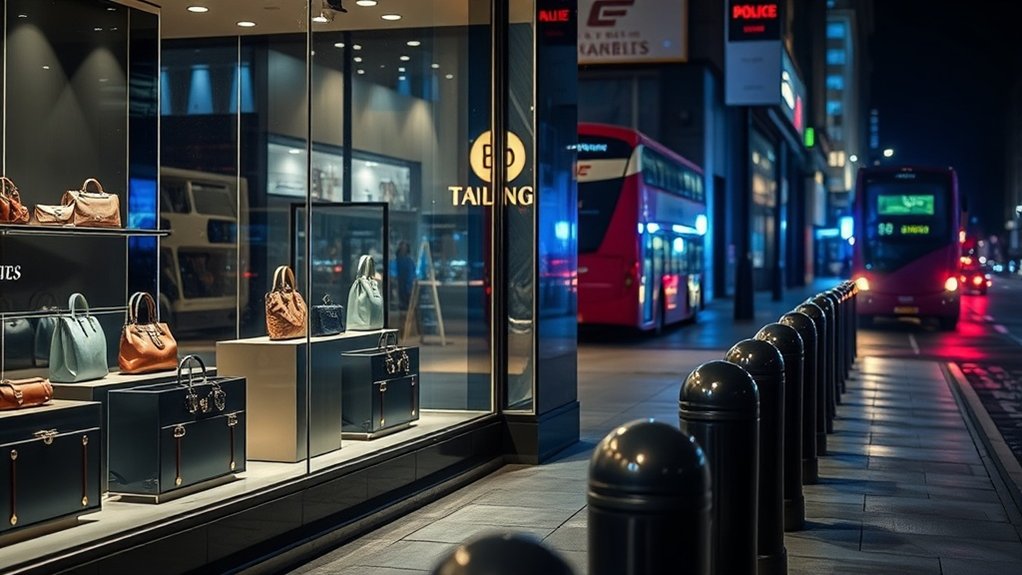
You face a fast‑evolving smash‑and‑grab threat in London, with organised teams targeting high‑value stock in seconds. To manage this risk, you must harden façades, reinforce glazing, optimise shutters, and control vehicle access, all tied to alarms, CCTV and rapid response. Mapping incidents, escape routes and response times lets you prioritise spend where loss severity and exposure are highest. If you continue, you’ll see how to design a risk‑led, layered protection strategy that actually works.
Key insights
- Map recent smash-and-grab incidents, escape routes, and police response times to identify vulnerable London sites and prioritise protection budgets.
- Harden façades with tested shutters, grilles, laminated glass, and certified locks, designed to resist scooter, e-bike, and vehicle-based attacks.
- Control high-value displays by reducing street visibility, limiting time-on-display, and keeping compact, high-value items in secured cases or back-of-house.
- Integrate alarms, glass-break sensors, and CCTV with facial capture and route monitoring, linked to 24/7 monitoring for rapid response.
- Use accredited London security specialists who apply standards (e.g. LPS 1175, EN 356) and provide integrated design, installation, testing, and maintenance.
How Bad Is Smash and Grab Crime in London?
Although London remains a relatively safe global city, smash and grab offences present a concentrated and evolving risk, especially for high‑value retail, luxury vehicles, and commercial premises. You’re not dealing with random nuisance crime, but targeted, time‑compressed attacks executed within seconds, often by organised teams using scooters, stolen cars, or e‑bikes.
You face three core issues: rising attack sophistication, shortened response windows , and displacement across boroughs as offenders adapt to policing patterns. Traditional deterrence alone can’t keep pace with agile offenders leveraging social media, encrypted messaging, and low‑cost tools.
To understand how bad the problem is for you, you must monitor hyper‑local data, integrate with urban resilience strategies, and exploit community outreach to surface near‑misses, unreported incidents, and emerging methods before they scale.
Who Really Needs Smash and Grab Protection in London?
Whether you operate a single boutique or manage a multi‑site portfolio, you need smash and grab protection if your assets are high‑value, highly visible, and quickly removable. You’re particularly exposed if you display electronics, luxury fashion, jewellery, pharmaceuticals, or compact tech near glazing or doors.
Street‑facing premises in transit corridors, nightlife zones, or regeneration areas also face correlated risks: ram‑raid attacks, artistic vandalism, and post‑incident graffiti removal costs. If you rely on uninterrupted trading, strict insurance conditions, or tight SLAs, a single event can breach contractual commitments.
You should treat smash and grab protection as essential if you manage flagship locations, hold concentrated inventory on‑site, or operate extended hours where reduced footfall, limited policing, and predictable staffing patterns create exploitable windows.
Key Smash and Grab Protection Strategies That Work
Once you’ve identified that your premises sit in the high‑risk category, the next step is to specify protection measures that actually disrupt smash‑and‑grab attack patterns rather than just creating a sense of security. You need layered, time‑based defenses that reflect Historical trends in London: rapid entry, ultra‑short dwell times, and vehicle‑enabled escape.
Prioritise solutions that measurably extend “time‑to‑breach” while remaining compliant with Legal considerations such as glazing standards, planning constraints, and health‑and‑safety rules:
- Deploy certified security film or laminated glazing to prevent instant shatter.
- Install anti‑ram bollards or planters engineered to relevant impact ratings.
- Use internal roller shutters or grilles with attack‑resistance certification.
- Implement intelligent lighting and audio deterrents triggered by glass‑break analytics .
How to Assess Your Smash and Grab Risk
To assess your smash and grab risk in London, you need to quantify how your location, assets, and security posture expose you to opportunistic attacks. You’ll start by evaluating location vulnerability (street layout, escape routes, footfall patterns), then identify which assets in your frontage or display act as high‑value, high‑visibility targets . Finally, you’ll analyse existing security controls—glass specification, physical barriers, alarm coverage, and surveillance—to determine residual risk and where controls must be strengthened.
Evaluating Location Vulnerability
Although smash-and-grab attacks can appear random, your location’s physical and operational characteristics heavily influence your risk profile. You should evaluate how recent urban development and transportation infrastructure changes affect both offender access and police response times. Map incident data, sight lines, and escape vectors around your premises, then quantify exposure.
Prioritise four dimensions:
- Access geometry – distance to main roads, alleys, cycle routes, and rail links that enable rapid approach/exit.
- Surveillance density – overlap of public and private cameras, lighting uniformity, and natural surveillance from neighbouring premises.
- Response latency – proximity to police resources, traffic bottlenecks, and average congestion patterns by time band.
- Environmental buffers – bollards, street furniture, parking layouts, and glazing orientation that either slow vehicles or shield attack surfaces.
Identifying Attractive Targets
Having analysed how your location either invites or disrupts offending, you now need to understand what makes your premises worth attacking in the first place. Offenders scan for high-value, low-friction opportunities: visible luxury stock, predictable routines, and limited guardianship. You should map your merchandise by value density, concealability, and portability to quantify smash and grab exposure beyond generic retail theft metrics.
Profile your “trophy” items, their display positions, and time-on-display versus time-under-supervision. Prioritise goods with strong secondary markets and weak serialisation, as these undermine asset recovery and make you more attractive than competitors. Finally, examine external sightlines : if offenders can identify target assets from the pavement in under three seconds, your store is signalling a clear, high-yield opportunity.
Analysing Existing Security
Once you’ve profiled what attracts offenders to your site, you need to interrogate how your existing security either deters, delays, or inadvertently facilitates a smash and grab. Start by mapping historical crime patterns within a tight geographic radius and cross‑referencing them with your façade design, glazing specification, and access points. You’re not just checking boxes; you’re quantifying exposure and economic impact.
Evaluate four core dimensions:
- Perimeter hardness – glazing strength, shutters, doors, locking hardware.
- Response timeline – alarm signalling paths, monitoring, police or guarding SLAs.
- Visibility and surveillance – camera coverage, analytics, lighting, blind spots.
- Operational discipline – closing routines, cash/jewellery handling, key control.
Prioritise remediation where asset value, offender opportunity, and system weakness intersect.
Reinforced Glass and Security Film for Smash and Grabs
Why does reinforced glass, which can still break, remain one of the most effective defences against smash-and-grab attacks in London? Because you’re engineering delay and fragmentation control, not absolute invulnerability. Laminated or polycarbonate-reinforced systems, configured as Anti shatter windows , keep broken panes structurally coherent, forcing offenders to spend critical extra seconds creating an access hole.
You can further harden performance with multi-layer security film tuned for impact resistance and tear strength. Correct specification demands you model threat tools, strike energy, and attack duration, then match glass, framing, and anchoring accordingly. Security decals aren’t just visual deterrents; they also signal hidden reinforcement, redirecting opportunistic offenders. By integrating glazing, film, and visible cues, you transform your frontage from a smash point into a controlled-resistance surface.
Using Shutters, Grilles and Barriers to Stop Smash and Grabs
To harden your premises against smash and grabs, you need to match shutters, grilles and barriers to the specific threats your frontage faces. You’ll assess impact resistance, fixings, and attack delay times when choosing the right shutters and security grilles for display windows and entrances. You’ll also evaluate reinforced barriers and bollards for vehicle ramming risks, load ratings, and integration with the building’s structural envelope.
Choosing The Right Shutters
Although no physical measure can offer absolute security, choosing the right shutters, grilles and barriers radically changes how vulnerable your frontage is to smash-and-grab attacks. You’re balancing delay, deterrence and visual impact. Artistic shutters and decorative barriers now integrate high‑strength alloys , anti-cut profiles and smart controls, so you don’t have to trade aesthetics for resistance.
Prioritise performance data and independent testing. At minimum, evaluate:
- Attack resistance – certified impact ratings , tool-resistance, lock integrity.
- System integration – links to alarms, CCTV, remote monitoring, access control.
- Operational risk – fail-safe opening , power-loss modes, maintenance intervals.
- Urban context – planning constraints, light transmission, brand visibility.
Security Grilles For Frontages
Security grilles for frontages form a primary barrier between a smash-and-grab team and your high‑value stock, converting vulnerable glazing into a reinforced envelope that’s difficult to breach quickly or quietly. You’re engineering delay: every second added to forced-entry time increases deterrence and intervention opportunities.
You should specify attack-resistant alloys , anti-jacking tracks, and tamper-proof fixings anchored into structural substrates, not just the shopfront frame. Mesh geometry and bar spacing must balance visibility, airflow, and protection against lever, sledge, and cutting attacks. In high-risk environments, you can borrow Museum security standards: laminated glass behind certified grilles creates a dual-layer system. Patterned grilles also mitigate Artistic vandalism, acting as a physical and psychological barrier while still supporting a design-led, brand-consistent frontage.
Reinforced Barriers And Bollards
When you design reinforced barriers and bollards for smash‑and‑grab resilience in London, you’re really engineering controlled denial of vehicle and pedestrian attack routes. You’re managing impact energy , approach geometry, and blast standoff while preserving brand aesthetics.
You should treat the streetscape as an integrated defensive matrix:
- Specify PAS 68 / ISO IWA‑14 compliant bollards to stop defined vehicle masses at known speeds.
- Use Decorative fencing and Landscaping barriers as shallow‑mount vehicle mitigation, masking hard security with civic design.
- Integrate bollards with shutters and grilles, aligning barrier lines to protect glazing, lobbies, and high‑value displays.
- Model attack vectors and turning radii, then position street furniture, planters, and cycle racks as secondary arresters.
Doors, Locks and Hardware for Smash and Grab Attacks
Even if you deploy advanced alarms and CCTV, vulnerable doors, locks and hardware still give smash‑and‑grab offenders their fastest route in and out. You need to treat door assemblies as engineered security systems, not just access points. Evaluate door materials for impact resistance , flex behaviour and resistance to prying; steel, composite and laminated glass doors outperform standard aluminium frames.
Prioritise hardware durability under dynamic, abusive loads. Specify continuous hinges, reinforced strike plates, and through‑bolted pull handles to prevent shear failures. Use certified high‑security cylinders with anti‑snap, anti‑drill and anti‑bump features, integrated into multi‑point locking mechanisms. Apply shrouded escutcheons and lock guards to defeat direct tool access. Finally, ensure frames, fixings and thresholds are anchored into the substrate , not just the façade.
Using Alarms and CCTV to Support Smash and Grab Protection
Although alarms and CCTV can’t physically stop a smash‑and‑grab, they radically affect an offender’s risk calculus and dwell time if you deploy them correctly. You’re engineering detection, attribution, and response, not just noise and video. Alarm installation should integrate glass‑break sensors, vibration detectors, and door contacts into zones that pinpoint attack vectors instantly.
To maximise value, design CCTV monitoring as an intelligence system, not a passive recorder:
- Position cameras for facial capture, entry/exit routes, and key assets, minimising blind spots.
- Use analytic rules (loitering, line‑crossing, rapid movement) to trigger alarms.
- Ensure independent power and network paths to resist simple disabling.
- Connect alarms and CCTV to a 24/7 monitoring centre with predefined incident playbooks .
Smash and Grab Protection for Homes, Shops and Offices
Because smash‑and‑grab tactics exploit speed and surprise, you need to tailor protection differently for homes, shops, and offices while applying the same core principles: delay, detection, and denial.
In homes, you prioritise secure glazing , laminated or polycarbonate panels, and reinforced frames, then integrate smart locks, intrusion sensors, and monitored alerts. For higher‑value collections and art theft risk, you add safe rooms, asset tracking, and obscured storage.
In shops, you harden display fronts with security film, anti‑shatter glass, and internal grilles, then decouple high‑value stock from windows using locked cases, fog generators, and rapid lockdown shutters.
In offices, you combine physical barriers with cyber security: access control, zoned networks, protected server rooms, and integrated logging that correlates physical breaches with digital anomalies.
How Much Does Smash and Grab Protection Cost in London?
When you assess smash and grab protection in London, you need to understand how glass type, film specification, frame strength, access complexity , and installation scale all influence cost. These factors directly affect material grades, labour time, and compliance requirements, which in turn set your overall risk-reduction per pound spent. You’ll typically see clear price bands emerge between basic safety film, security-rated systems, and fully engineered glazing upgrades, each offering a different cost-to-risk profile.
Key Cost Factors
Even with a clear need for security, smash and grab protection costs in London vary widely because multiple technical and risk variables drive pricing. You’re not just paying for glass; you’re funding a risk‑engineered system that must work with your brand, Vintage decor, and any eco friendly materials already in place.
Four primary cost drivers typically dominate:
- Threat profile – past incidents, local crime data, and likelihood of organized attacks determine film thickness, glazing type , and framing reinforcement.
- Glazing geometry – pane size, curvature, fixing method, and access constraints increase material and labour complexity.
- Structural integration – heritage façades, storefront reconfiguration, and load paths for impact-resistant systems.
- Technology stack – smart sensors, impact analytics, and integration with existing alarms and CCTV.
Typical Price Ranges
Those cost drivers translate into recognisable pricing bands once you start scoping a London storefront. For basic anti‑smash window films in lower‑risk locations , you’ll typically see £45–£75 per m² supplied and installed. Step up to laminated security glazing or polycarbonate overlays and you’re usually in the £180–£350 per m² band, depending on thickness, framing complexity, and out‑of‑hours work.
In crime hotspots, where Historical trends show clustered smash‑and‑grab activity, budgets shift. Integrated systems—security glazing plus bollards, grilles, and impact‑rated framing—often land between £12,000 and £40,000 for a typical high‑street frontage. Premium, innovation‑focused solutions (sensor‑linked façades, smart shutters, blast‑tested glass) can exceed £60,000, but you materially cut loss‑severity risk and may release insurance and operational savings.
Choosing a Trusted Smash and Grab Security Specialist in London
Although London has no shortage of security providers, choosing a genuinely competent smash and grab specialist requires disciplined assessment rather than brand familiarity or price alone. You’re protecting high‑value, high‑visibility environments—whether an art gallery in Mayfair or a jewelry store on Hatton Garden—so you need partners who understand attack patterns , not just hardware catalogs.
Prioritise firms that treat your premises as a system: glazing, framing, alarms, video analytics, and response all integrated and tested against real assault scenarios.
Evaluate candidates by demanding:
- Evidence of EN 356 / LPS 1270 / LPS 1175 compliant installations.
- Scenario-based risk modelling and loss-impact quantification.
- Digital design tools (BIM, 3D blast/impact simulations) for storefronts.
- Post-installation testing, maintenance SLAs , and data-driven performance reporting.
Frequently Asked Questions
Can I Get Insurance Discounts for Installing Smash and Grab Protection in London?
You can sometimes get insurance discounts when you implement targeted security upgrades, but it’s not automatic. You’ll need to evidence reduced loss exposure: laminated glazing specs, impact-resistance ratings, certified install, and integration with alarms or CCTV. Insurers assess your risk profile, claim history, and location crime data. Engage your broker early , share technical documentation, and ask underwriters to re-rate your property based on quantifiable mitigation of forced-entry and glass-break risks.
How Long Does It Take to Install Common Smash and Grab Security Measures?
You’ll typically spend 1–3 hours installing basic measures, but timelines vary by complexity. Security alarm systems with multiple zones and wireless integration take about half a day. Advanced surveillance camera placement , including ideal field‑of‑view analysis, cable routing, and network configuration, can extend to a full day. If you integrate remote monitoring, smart analytics, and redundancy, plan for phased deployment and testing over 1–2 days to minimise operational risk.
Are There Planning Permission Rules for External Shutters in London Conservation Areas?
Yes, you usually need planning permission for external shutters in London conservation areas. You face strict conservation area restrictions and, if applicable, listed building regulations. Solid or box-style shutters are often resisted; planners prefer internal or perforated systems. You should model visual impact, noise, and heritage risk, then pre-apply for feedback . Without consent, you risk enforcement, removal costs, and constraints on future façade innovation.
What Legal Liabilities Do I Have if My Security Measures Injure an Intruder?
You’re legally liable if security measures go beyond reasonable, proportionate force—no mediaeval spike pits or Star‑Wars laser turrets. UK law generally forbids deliberate or reckless setups that foreseeably cause serious intruder injury. You must design systems to deter and delay, not punish, documenting risk assessments, product standards, and installer competence. Avoid improvised traps, use certified hardware , and confirm automation, impact forces, and fail‑safes align with current safety regulations.
How Do Smash and Grab Protections Impact My Shopfront’s Appearance and Branding?
They can enhance your shopfront’s appearance if you prioritise aesthetic preservation from the outset. You’ll select solutions like clear security films, laminated glass, or discreet grills that maintain sightlines and lighting . You evaluate each option’s impact on brand consistency—colour, reflectivity, framing, and visibility of signage. Technically, you’re balancing risk reduction with visual transparency, ensuring your protective systems look intentional, premium, and aligned with an innovative, design-led retail identity.
Summary
When you weigh London’s smash‑and‑grab risks, you see it’s not paranoia; it’s risk management . By combining reinforced glass, security film, alarms, and CCTV, you’re building a barrier that’s tougher than a diamond‑plated fortress. Assess your exposure, match controls to threat levels, and cost‑justify each measure. Whether it’s a home, shop, or office, you’re not just deterring opportunists—you’re reducing loss probability and tightening your overall security posture where it matters most.