Most London windows aren’t as secure as you think, especially older sash or uPVC units that don’t meet PAS 24 or BS EN 356. You should treat each window as a potential entry point and upgrade riskier ones first with certified multi-point locks, reinforced frames, laminated glazing, and discreet sensors tied into an intruder alarm. You’ll cut burglary risk, support insurance compliance, and still protect kerb appeal, and the next sections show you how to do that step by step.
Key insights
- Prioritise PAS 24–certified windows, reinforced frames, and multi-point locks for London properties, especially at ground-floor, rear, and basement locations.
- Upgrade to laminated or toughened security glazing or apply certified security films to resist impact, prying, and quiet forced entry.
- Conduct a risk-based survey of each window’s exposure and match protection level to street visibility, concealment, and access routes.
- Ensure compliance with Secured by Design, BS EN standards, and local planning rules, particularly in conservation areas and listed buildings.
- Budget £250–£1,800+ per window depending on frame reinforcement, glazing upgrades, and optional smart sensors, with potential insurance premium reductions.
How Secure Are Typical London Windows Today?
In many London homes and flats, standard windows still fall short of modern security expectations , particularly against opportunistic burglary. You’re often relying on legacy frames, basic latches, and untested glazing that don’t align with current BS EN and PAS 24 performance benchmarks.
You may prioritise window aesthetics and ventilation solutions, but many configurations compromise resistance to forced entry, tool attack, and manipulation. Older sash and casement units typically lack secure locking points , reinforced hinges, and laminated or toughened glazing.
If you’ve not upgraded within the last decade, your windows are unlikely to achieve contemporary security classifications or integrate with smart monitoring. The baseline today is a tested, documented security specification, not just “sturdy” joinery or double glazing installed as a comfort upgrade.
Main Window Security Threats for London Homes
Often overlooked, windows are one of the most frequently exploited entry points for residential burglary in London, typically targeted for speed, low noise, and minimal visibility from the street. You face three primary threat categories: forced entry, stealth access, and manipulation of legacy hardware.
Offenders exploit brittle glazing , non-laminated panes, and frames that can’t withstand prying or sustained impact. They also take advantage of unlit façades, blind spots in CCTV coverage, and foliage that conceals window lines of sight. Older timber sashes, retained for historical preservation and window aesthetics, often rely on outdated latches that don’t meet current PAS 24 or BS EN 1627 performance expectations. Finally, offenders increasingly test your perimeter systematically, identifying windows that lack visible reinforcement or modern locking systems.
Common Window Weak Spots Burglars Target First
Because burglars work quickly and methodically, they target the weakest, quietest window vulnerabilities first: ground-floor rear windows, basement lightwells, and easily reached side elevations with poor natural surveillance. You’ll often see forced entry at timber sashes with decayed or distorted vintage frames, where leverage quietly defeats old putty, basic latches, and single glazing.
Unreinforced uPVC units with worn espagnolette mechanisms also fail under prying loads, especially where frame fixings are sparse. Hinges on outward-opening casements become weak spots if they’re surface-mounted or lack hinge-side security.
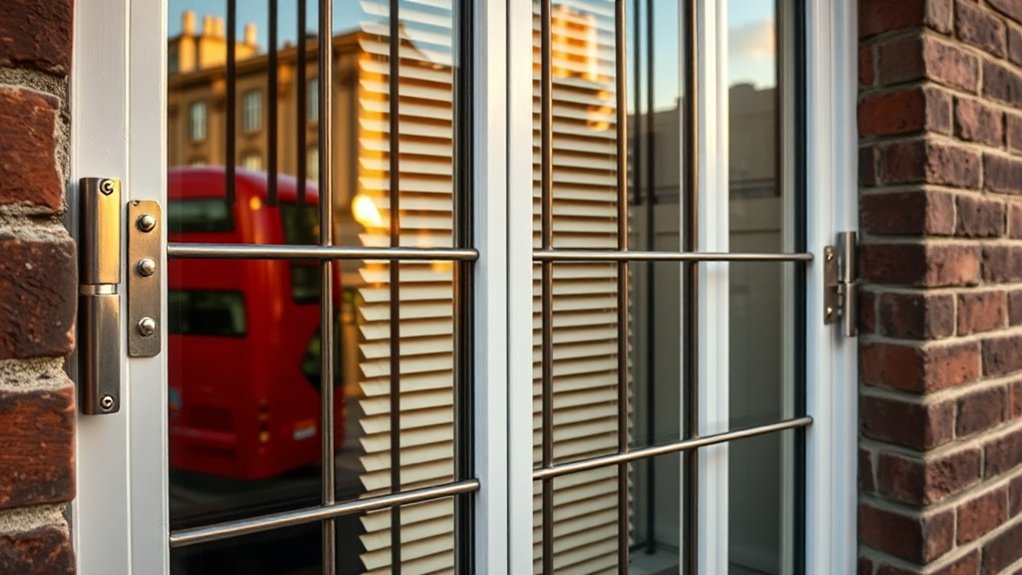
Decorative grills may create perceived protection, yet if they’re only screwed into soft masonry, spaced too wide, or non-compliant with PAS 24 or LPS 1175 principles, they simply give burglars concealment while they attack the actual sash.
How to Choose Window Security Based on Risk and Budget
Burglars aim for the weakest points you’ve just seen, so your next step is to match security upgrades to how exposed each window really is and what you can afford. Start by rating each opening: street-facing, concealed, or upper-floor, then align measures with risk, not just cost.
Prioritise certified products tested to British Standards and Secured by Design benchmarks, so you’re buying quantified performance, not marketing claims. Allocate more budget to high-risk zones, pairing impact-resistant glazing with robust frames, while using lighter measures elsewhere.
Factor in ongoing window maintenance: neglected seals, timber, and hardware reduce the effectiveness of even premium systems. Finally, select solutions that integrate aesthetic enhancements—minimal sightlines, colour-matched components, and smart-ready profiles—to keep security upgrades discreet but technically advanced.
Window Locks and Hinges That Deter Break-Ins
While glazing and frames take much of the attention, locks and hinges usually determine whether a window actually resists a forced entry or fails in seconds. You should specify multi-point espagnolette or shoot-bolt locking systems tested to PAS 24 or equivalent European standards, with key-operated locking handles and anti-drill cylinders.
Prioritise security-rated hinges with integral hinge bolts or dog-bolts to prevent the sash being levered or lifted off. On outward-opening windows, fit friction hinges with restricted-opening and anti-lift features.
For properties using Decorative window films or undergoing Historical window restoration, you can still integrate rebated locks, surface-mounted deadlocks, or retrofit hinge guards that respect heritage sightlines while meeting modern security benchmarks and insurer requirements across London’s higher-risk boroughs.
Stronger Glazing Options for Window Security
Locks and hinges control how a window resists attack, but the glazing often dictates how long an intruder needs to break through. You should treat glass as a security component, not just a visual element. In London, you’ll want glazing that aligns with PAS 24 and Secured by Design principles while still supporting Historical window preservation.
Focus on tested, impact-resistant constructions such as laminated and toughened combinations, especially at ground level and accessible roofs.
- Specify multi-pane laminated units that delay forced entry and reduce injury risk.
- Integrate Decorative window grids within sealed units to protect aesthetics while keeping smooth external glass.
- For listed façades, use slim-profile laminated glass that maintains sightlines, enabling Historical window preservation without sacrificing modern security performance.
Security Window Film vs Laminated Glass in London
Why does the choice between security window film and laminated glass matter so much for a London property? You’re balancing impact resistance, compliance, and disruption. Security window film retrofits to existing glazing, increasing shatter resistance and fragment retention to meet BS EN 356 and BS EN 12600 when correctly specified and anchored. It’s ideal where you need rapid upgrade, minimal downtime, or Historical window preservation, because you don’t disturb original frames or sightlines.
Laminated glass, by contrast, integrates polyvinyl butyral (PVB) or ionoplast interlayers within the glazing unit, delivering predictable performance, stronger edge integrity, and better resistance to forced entry. It suits full refurbishments and new builds. You can combine laminated glass with Decorative window films to add privacy, branding, or solar control without compromising security.
Smart Window Sensors and Alarm Integration
When you upgrade to smart window sensors in London, you need to choose the right mix of contact, vibration, and glass-break detectors based on your risk profile and window construction. You’ll also want to guarantee secure, standards-compliant connectivity with your intruder alarm panel or monitored system, whether that’s via hard-wired zones, certified RF, or IP integration. Finally, you should configure real-time security alerts with authenticated push notifications and event logs so you can respond quickly to forced entry, tampering, or system faults.
Types Of Smart Sensors
Although traditional window contacts still play a role, modern smart sensors add layered protection by detecting specific threat behaviours and integrating directly with your alarm and home automation systems. You’re no longer limited to simple open/close status; you can specify how each window should respond to impact, vibration, or forced movement to tighten risk controls and support robust security integration.
- Acoustic glass-break sensors analyse frequency and pressure signatures, triggering only when they detect glass fracture within calibrated ranges.
- Vibration and shock sensors identify drilling, prying, or impact attacks, allowing you to harden vulnerable basement and street‑facing windows.
- Intelligent motion and presence sensors near glazing create a protected perimeter, using adjustable sensitivity and anti-masking features that align with EN 50131 and other relevant security standards.
Alarm System Connectivity
Because smart window sensors are only as effective as the systems they talk to, robust alarm connectivity becomes a primary design concern rather than an add‑on feature. You need each sensor to integrate with your intruder alarm panel, access control, and building management systems via secure wireless connectivity, ideally on dedicated, encrypted channels (e.g., WPA3, TLS 1.3).
You should insist on open, standards‑based protocols that support Remote monitoring and dual‑path signalling (IP plus cellular) to maintain resilience if broadband fails. In London’s dense RF environment, you’ll also assess interference, channel hopping, and jamming detection. Always verify that devices comply with BS EN 50131 and graded alarm requirements, ensuring tamper protection, supervised links, and authenticated pairing between sensors, hubs, and monitoring infrastructure.
Real-Time Security Alerts
Why invest in advanced window security if you don’t get immediate, actionable intelligence the moment something’s wrong? Real-time security alerts turn passive glazing into an active detection layer. Smart window sensors monitor vibration, opening angle, and glass integrity, then push events to your alarm panel, mobile app, and, if configured, a monitoring station.
You configure thresholds, escalation paths, and fail-safe behaviours so alerts stay accurate and standards-compliant with BS EN 50131 .
- Detect forced entry, drilling, or glass cutting and trigger graded alarms in under a second.
- Integrate alerts with CCTV, access control, and lighting for measurable Emergency preparedness.
- Share anonymised event data to enhance community awareness and coordinated incident response.
Discreet Window Security for Period and Sash Windows
When you’re responsible for period or sash windows in London, you need security measures that harden access without compromising listed-building rules or original sightlines. You must treat each period window as a heritage asset and a security vulnerability, balancing aesthetics with tested protection.
Start by upgrading sash security using high-strength, surface-mounted restrictors, frame-to-frame locks, and reinforced keep plates concealed within existing timber profiles. Specify hardware that aligns with PAS 24 principles and Secured by Design guidance, even if full certification isn’t practical.
Integrate low-profile laminated glass or security film to resist impact without changing visible character. Add recessed contact sensors and vibration detectors, wired or wireless, hidden within staff beads or head boxes, so your security ecosystem monitors intrusion attempts while remaining visually invisible.
Window Security Options for London Flats and Rentals
Period properties aren’t the only ones that need discreet but robust protection; flats and rentals across London face concentrated risk from shared access, balconies , lightwells, and easily reached upper floors. You need solutions that respect lease constraints, preserve window aesthetics, and still resist forced entry to Secured by Design or equivalent standards.
For most London flats, you’ll combine mechanical and electronic measures that don’t damage fabric, especially in buildings with historical architecture or conservation controls:
- Reinforced locks , laminated glazing, and internal security film to increase delay time without altering external lines.
- Retrofit restrictors and hinge-guards that comply with child-safety and escape regulations while blocking opportunistic attack.
- Smart contact sensors and discreet vibration detection, integrated with cloud-managed alarms, to give real-time alerts without visible clutter.
Window Security Options for London Shops and Commercial Premises
When you secure a shopfront or commercial frontage in London, you need to treat windows as a critical point of forced entry and vandalism risk. You’ll typically combine laminated or toughened reinforced glass with compliant security film to improve impact resistance and slow intrusion. To meet insurers’ and local authority expectations, you’ll also assess whether externally or internally mounted shutters and security grilles provide the right balance of physical protection, visibility, and emergency egress.
Reinforced Glass And Film
Why rely on standard float glass when a single impact can expose your stock, staff, and premises to immediate risk? By upgrading to laminated or toughened glass tested to EN 356 and EN 12600, you create a controlled-failure barrier that resists forced entry and reduces hazardous shards. You can retrofit clear security film to existing glazing to achieve similar containment and delay times.
Enhance performance and aesthetics with:
- Decorative window films that integrate branding while still delivering anti-shatter properties.
- Solar window security films that cut glare and solar gain, improve comfort, and protect merchandise from UV fading.
- Multi-layer security laminates engineered to withstand repeated impacts, buying response time.
Always commission installation from accredited specialists and insist on documented test certifications .
Shutters And Security Grilles
How do you stop smash-and-grab attempts before offenders even reach the glass? You deploy engineered Window shutters and high-specification security grilles as your primary physical barrier. Modern shutters integrate extruded aluminium slats, anti-lift guides, and tamper-resistant bottom bars, specified to LPS 1175 or equivalent standards, giving you quantifiable delay times against forced entry.
You can combine solid or perforated shutters with Decorative grilles that maintain sightlines and brand visibility while still resisting prying, cutting, and levering. Fixed, retractable, or sliding grilles can be integrated within the reveal to protect both glazing and frames. Automate shutters with monitored motors , positional sensors, and UPS backup, then link them to your intruder alarm and CCTV analytics for rapid response and auditable, standards-compliant protection.
How to Improve Window Security Without Losing Light or Kerb Appeal
Although older properties often rely on fragile glazing and basic latches, you can substantially upgrade window security in London without sacrificing natural light or kerb appeal by specifying discreet, high‑performance components. Start with laminated, Energy efficient glazing tested to PAS 24 or equivalent; it resists impact, improves thermal performance, and still admits maximum daylight.
Layer security in visually light ways:
- Apply clear or subtly patterned Decorative window film with certified shatter resistance, maintaining transparency while mitigating smash‑and‑grab attacks.
- Retrofit multi‑point locking hardware and key‑locking handles with Secured by Design–approved cylinders, aligned with EN 1303.
- Integrate slimline internal steel reinforcement or concealed security bars within frames, ensuring fixings anchor into the surrounding structure so you don’t compromise aesthetics or daylight.
Costs, Insurance Savings and London Planning Rules
When you plan window security upgrades, you need clarity on typical cost ranges for compliant hardware, glazing, and installation. You’ll also want to understand how insurers assess BS EN and PAS 24-verified products, so you can secure potential premium reductions and avoid invalidating cover. At the same time, you must guarantee your chosen measures meet London borough planning rules , especially in conservation areas and for listed buildings.
Typical Upgrade Cost Ranges
While each property’s risk profile and specification differ, most London window security upgrades fall into predictable cost bands that insurers and planning officers recognise. You’ll usually scope costs by intervention layer: strengthening the window frame, enhancing glazing performance , and then adding detection or delay systems.
- Basic upgrades: expect roughly £250–£450 per opening for reinforced window frame fixings, high-security locks, and certified hinges, assuming standard apertures and no heritage constraints.
- Glazing enhancements: budget £400–£900 per opening for laminated security glass or high‑performance glass coating, depending on resistance class and pane size.
- Advanced solutions: £900–£1,800+ per opening for composite systems combining laminated glass, steel or aluminium reinforcement, and sensor‑ready profiles compatible with smart monitoring platforms.
Insurance And Planning Compliance
So how do window security upgrades in London intersect with insurance, costs, and planning rules in practice? You’ll navigate three constraints: risk reduction, regulatory compliance , and whole‑life cost. Insurers increasingly expect certified products (e.g., PAS 24, LPS 1175) and documented installation; meet these and you may access premium discounts or lower excesses, especially in higher‑crime postcodes.
In conservation areas or on listed buildings, you must protect historical architecture while improving resistance to forced entry. That usually means slimline laminated glazing, secondary glazing, or internally fixed bars, all subject to planning approval. You should evidence that upgrades don’t compromise emergency preparedness : escape routes, opening forces, and fire‑service access. Align designs with London Plan policies and local SPD guidance to avoid enforcement costs.
Planning and Installing Your Window Security Upgrades
Before you purchase any locks, films, or sensors, treat your window security upgrades as a structured, risk-based project: identify your most vulnerable windows, define your security objectives (e.g., delay forced entry by at least X minutes), and verify any planned products comply with relevant standards such as PAS 24, BS EN 356, and Secured by Design. In London’s historical architecture, integrate these measures without compromising key aesthetic considerations.
Prioritise professional installation where loads, fixings, and glazing interfaces are complex. Specify installers who can evidence manufacturer training and certification.
- Use laminated or polycarbonate glazing where threat modelling shows high impact risk.
- Deploy contact sensors, vibration detectors, and smart locks on priority apertures.
- Commission post-installation testing : check fixing torque, sensor alignment, and documented compliance.
Frequently Asked Questions
Can I Retrofit Security Upgrades to Existing Historic or Listed London Windows?
Yes, you can, but you must treat them as conservation-led engineering projects. You’ll retrofit discreet measures—laminate security glass, secondary glazing, reinforced locks and fixings—while respecting historic preservation rules and aesthetic considerations. You should commission a heritage‑qualified security consultant, obtain listed building consent , and align with PAS 24, BS 8213, and relevant conservation guidance. Always document risk assessments and design justifications to satisfy planners and insurers.
What Window Security Certifications or British Standards Should London Homeowners Look For?
You should prioritise PAS 24 for enhanced security performance and BS 7950 for older tested designs. For glass, look for laminated units meeting BS EN 356 (P2A or higher) and compatible security window films. Hardware should comply with BS EN 1303 (cylinders), BS EN 1906 (handles), and TS 007 or SS 312 for cylinders. For smart lock systems, verify adherence to latest Secure Connected Device and cyber‑security guidance.
How Do Window Security Upgrades Affect Indoor Noise Levels and Thermal Insulation?
You’ll notice your home gets pleasantly quieter and more temperate. Robust frames, laminated or thicker glass, and multi-point locking improve Soundproofing benefits by reducing vibration paths and air gaps that transmit noise. At the same time, tighter seals and low‑conductivity spacers enhance Insulation performance, cutting thermal bridging and uncontrolled air exchange. You’re not just upgrading security; you’re mitigating acoustic and energy risks in a standards‑compliant, future‑ready envelope .
Are There Eco-Friendly or Recyclable Materials for London Window Security Products?
You can specify eco friendly materials and recyclable options for many London window security products. Opt for aluminium frames with high recycled content, steel grilles that meet BS EN standards, and laminated safety glass with certified interlayers. You’ll reduce embodied carbon while retaining attack resistance and structural integrity. Make sure suppliers provide Environmental Product Declarations and end‑of‑life take‑back schemes so your innovative security solution aligns with circular‑economy and compliance requirements.
How Can I Check if a Window Security Installer in London Is Reputable and Vetted?
You verify a London installer’s reputation by treating them like a critical system vendor. First, check certifications (e.g., NSI, SSAIB), public liability insurance , and references. Validate reviews on independent platforms, not just their site. Confirm they understand integrating Security camera placement with advanced Lock mechanisms to relevant British Standards (e.g., BS3621, PAS 24). Finally, insist on written risk assessments, data-protection compliance, and product performance documentation before commissioning.
Summary
When you upgrade your London windows, you’re not just adding locks; you’re reducing risk , meeting standards, and protecting value. You deter forced entry, you disrupt opportunistic thieves, you demonstrate compliance with insurers and Part Q. You keep light, you keep kerb appeal, you keep control. By evaluating threats, selecting certified hardware, and planning professional installation, you turn vulnerable panes into tested barriers—and your home or premises into a harder, smarter target.