You can use window security bars in London, but you must balance attack‑resistance with Building Regulations, fire‑escape rules and local planning or heritage controls. Choose steel or aluminium bars tested to LPS 1175 or Secured by Design, with anti‑tamper fixings and compliant egress on escape windows. Avoid DIY kits; professional installers should provide drawings, certifications and maintenance guidance. If you want to understand legal permissions, fire safety and cost options in more depth, keep going.
Key insights
- Choose certified bars tested to LPS 1175 or Secured by Design to ensure proven resistance against break-ins and ram-raids.
- Use professional installers to guarantee structural integrity, compliant fixings, and correct integration with existing windows and façades.
- Ensure designs meet Building Regulations and London planning rules, especially for escape windows, principal elevations, and conservation or listed properties.
- Incorporate quick-release mechanisms on escape windows so bars don’t compromise fire safety or emergency egress.
- Expect costs from about £220–£350 per standard window, rising for custom designs, escape hatches, heritage constraints, and difficult access.
Why Window Security Bars Matter in London Homes
Because London homes often sit close to public pavements, alleys, and shared access ways, window security bars play a critical role in hardening your property against opportunistic break-ins. You’re protecting a high‑value perimeter asset: your glazed openings. When specified correctly, bars create a physical delay layer that works alongside locks, alarms, and CCTV.
You also have to balance protection with London’s planning constraints and historical architecture. Modern systems use slim, high‑tensile steels, anti-tamper fixings , and corrosion‑resistant coatings, so you don’t compromise façades or structural integrity. Fire-safety compliant designs integrate quick‑release mechanisms on escape windows, aligned with Building Regulations and local authority guidance. By deploying well-engineered bars, you enhance community safety, deter targeted attacks, and future‑proof your home against evolving intrusion methods.
Common Window Break-In Risks in London
London’s dense streetscape exposes windows to several predictable break‑in methods that you need to assess systematically. Typical risks include tool‑assisted prying of sash frames, levering weak latches, and silent removal of external beading to extract double‑glazed units. Opportunists also exploit unreinforced basement and alley‑side windows where natural surveillance is low.
You’re especially vulnerable if you prioritise window aesthetics without integrating security glazing, laminated glass, and tamper‑resistant hardware. Burglars frequently target fanlights and side lights because they allow quick reach to internal handles. Poorly designed ventilation options, such as permanently open trickle vents or unsecured night‑latch positions, create additional attack points. Thorough risk mapping of each elevation, access route, and window type lets you specify targeted, non‑intrusive security upgrades.
Are Window Security Bars Legal in London?
When you install window security bars in London, you must comply with relevant building regulations , especially those covering structural safety and fire protection. You’ll also need to check whether planning permission applies, particularly in conservation areas or listed buildings. Above all, you must make certain the bars don’t obstruct designated escape routes or prevent safe evacuation in an emergency.
Relevant London Building Regulations
Although window security bars are generally legal across Greater London, they’re tightly constrained by building regulations , fire safety law, and planning rules that you can’t ignore. You must treat them as part of the building’s fabric, not a removable accessory.
You’ll primarily engage with the Building Regulations 2010, especially Parts B (fire safety), K (protection from falling and impact), and Q (security for new dwellings). Bars can’t obstruct designated escape windows , reduce minimum opening sizes, or create snag hazards. In historical architecture, you must integrate bars without damaging fabric or disrupting key Urban aesthetics. For innovative designs, you’ll need engineered fixings, corrosion‑resistant materials, and documented performance data that demonstrate equivalent or better compliance than conventional grilles.
Planning Permission Requirements
Even if window security bars seem like a minor addition, planning law in London treats them as an external alteration that can trigger formal consent, especially in sensitive locations. You must assess three things: designation status (listed building, conservation area, article 4 direction), street visibility, and impact on Historical preservation and streetscape.
For listed buildings, you’ll usually need both planning permission and listed building consent, justified through detailed drawings, material specs, and an impact statement . In conservation areas, planners scrutinise aesthetic integration, favouring slimline, colour‑matched, and reversibly fixed systems.
For standard dwellings, bars may fall under permitted development if they’re modest, non‑projecting, and visually sympathetic. Always verify with the local planning authority and obtain written confirmation before commissioning fabrication or installation.
Safety And Escape Routes
Planning rules are only part of the picture; you also have to satisfy fire safety and escape requirements to install window security bars legally in London. You mustn’t compromise the “means of escape” defined in Building Regulations (notably Approved Document B). Any habitable room on upper floors typically needs at least one window that can be used for emergency egress and firefighter access.
You should specify quick‑release or internally operable bars on designated escape windows, ensuring a clear opening that meets minimum width and height criteria. Hinged or removable systems let you balance security, window aesthetics, and compliance.
Factor in practical window cleaning: operable bars must allow safe access for maintenance without using unsafe methods. Always document designs and seek confirmation from building control or a competent fire engineer.
Planning Permission and Listed Building Rules for Window Bars
When you plan window security bars in London, you must first assess whether your proposal triggers planning permission , especially if it alters the building’s exterior appearance or affects fire safety. If your property is listed, you’ll face additional restrictions, including strict controls on fixing methods, visual impact, and reversibility of the installation. To stay compliant and protect occupants, you should engage early with local planning and conservation officers, providing clear technical specifications and safety justifications.
When Planning Permission Applies
Although window security bars are often treated as a minor addition, they can trigger formal planning controls in London, especially on listed buildings or properties in conservation areas. You need permission whenever the bars materially alter the façade or conflict with window aesthetics or historical preservation objectives set by your local authority.
Typically, planning permission applies when you:
- Install bars on any principal elevation facing a highway, river, or key public view.
- Add bars that project substantially, change openings’ proportions, or appear visually dominant.
- Fit bars on buildings in designated conservation areas where character and appearance must be preserved.
- Use designs, colours, or fixing methods that depart from established architectural detailing .
Always confirm requirements with the planning department before commissioning fabrication or installation.
Listed Building Restrictions
Listed status places your windows under some of the strictest controls in the planning system, and security bars are treated as a potentially harmful alteration, not a minor add‑on. You can’t just match dimensions; you must protect sightlines , profiles, and the original window material. Any bar system that obscures glazing patterns, sash proportions, or moulding details risks refusal.
Regulators assess visual impact on the façade, reversibility, and whether fixings damage historic fabric. They’ll expect evidence that you’ve exhausted less intrusive options. Designs that sit within the reveal, use slender sections, and avoid welding to frames usually test better against historical preservation policies. You’ll also need to demonstrate that bars don’t compromise emergency egress or create additional structural loading.
Working With Local Authorities
Before you sketch a single bar design, you need to understand how your local planning authority will treat window security as a controlled alteration, not a casual upgrade. In London, you’ll often need planning permission, and for listed buildings you’ll need listed building consent, even when bars sit internally but affect window aesthetics.
Work with officers, not against them. Prepare a concise technical pack :
- Engineering drawings showing fixing methods, bar spacing, and egress strategy.
- Scaled visuals demonstrating minimal impact on façades and complementary interior design.
- Compliance notes referencing Building Regulations (fire escape, safety glazing, loadings).
- A heritage and design statement explaining why your innovative solution enhances security while respecting character.
Engage early; pre‑application advice can prevent costly redesigns or enforcement.
Fire Safety and Escape Requirements for Window Security Bars
When you fit window security bars in London, you must treat fire safety and escape routes as primary design constraints, not afterthoughts. You need at least one compliant escape window per habitable room, sized and positioned so a firefighter in breathing apparatus can access it. Integrate releases that operate intuitively in low visibility, without tools, keys, or complex sequences, while still resisting tampering from outside.
You should align bar layouts with sash openings, smoke-vent paths, and sprinkler coverage, preserving both Window aesthetics and interior decor. Specify corrosion‑resistant hardware and clearly marked release points to avoid seizure during a fire. Always cross‑check your design against Building Regulations Part B, London Fire Brigade guidance, and your fire risk assessment.
Types of Window Security Bars in London (Fixed, Hinged, Removable)
When you select window security bars in London, you’ll typically choose between fixed bars for maximum deterrence, hinged bars to maintain safe access, and removable bars for operational flexibility. Each configuration affects not only security performance but also your compliance with fire escape, Building Regulations, and insurer requirements. Understanding how fixed, hinged, and removable systems behave in an emergency helps you specify bars that protect occupants without breaching safety standards.
Fixed Bars For Deterrence
Although they’re the simplest form of window security bar, fixed bars are often the most effective visible deterrent against opportunistic break-ins across London. You bolt them directly into the masonry or steel frame, creating a permanent barrier that’s extremely hard to bypass without tools, noise, and time—exactly what criminals want to avoid.
To specify fixed bars intelligently, you should evaluate:
- Bar material and gauge – Typically welded steel, calculated to resist prying and sawing loads.
- Anchoring method – Through-bolts or chemical anchors, compliant with UK building and security standards.
- Spacing and configuration* – Clear openings sized to deter entry while meeting *safety guidance.
- Aesthetic integration – Decorative patterns that respect a façade’s historical significance, vital in conservation areas.
Hinged Bars For Access
Fixed bars maximise deterrence, but many London properties also need safe, routine access to windows for cleaning, maintenance, and emergency egress, which is where hinged window security bars come in. You mount these on side- or top-hinges with tamper‑resistant pins and a locked, key-controlled or quick‑release mechanism inside.
To comply with fire-safety guidance, you configure hinged units to open fully and unobstructedly , matching clear-opening requirements and ensuring they’re operable under low-visibility conditions. You can integrate gas struts or concealed stays for controlled movement, preventing slam-shut hazards.
From a design perspective, hinged systems let you treat bars as part of your window aesthetics and interior design strategy, aligning bar profiles, sightlines, and powder‑coat finishes with modern, minimal, or heritage schemes.
Removable Bars For Flexibility
For openings that alternate between high-risk and low-risk use, removable window security bars give you a robust physical barrier without permanently locking down the façade. You clip or lock the modules into pre-engineered receivers, then remove and store them when risk drops, preserving window aesthetics and daylight.
Design them so you can meet Secured by Design principles while still satisfying fire-escape and maintenance requirements. In London, you’ll also want to coordinate with planning officers in conservation areas.
- Specify anti-tamper locking heads and through-bolted anchors.
- Choose powder-coated steels or alloys that align with façade design.
- Ensure clear egress paths and compliant release procedures.
- Integrate coded tagging so facilities teams track which removable bars protect which openings.
Security Ratings, Materials and Build Quality for Window Bars
When you assess window security bars for a London property, you need to prioritise formally tested security ratings, structurally robust materials, and verified build quality that aligns with UK and European standards. You should look for products tested to LPS 1175 or certified under Secured by Design, as these schemes simulate real attack methods and tool-sets.
Prioritise material durability by specifying solid steel sections, corrosion‑resistant coatings, and tamper‑proof fixings anchored into the structural reveal rather than weak frames. Evaluate weld quality , bar spacing, and anti-spread features; poor build quality often fails at joints and fixings, not the bar itself. Ask suppliers for test reports, certification numbers, and maintenance requirements so the system’s performance remains reliable over its full design life.
Window Bars for Ground-Floor Flats and Basements
When you secure ground-floor flats and basements in London, you treat every low-level and obscured window as a primary attack point that needs robust, visible bars to provide clear deterrence. You’ll need to balance bar spacing, fixing methods, and anti-cut features with compliance to Building Regulations, especially for escape windows and fire safety. At the same time, you can specify finishes, profiles, and installation positions that integrate with your façade and interior décor so security upgrades don’t compromise the building’s appearance or conservation requirements.
Deterrence For Vulnerable Windows
Because ground-floor flats and basement windows sit within easy reach of opportunistic intruders, you should treat them as high‑risk access points and specify window bars accordingly. You’re aiming to create visible, credible deterrence that still respects window aesthetics and surrounding urban landscaping.
Design bars so they signal high effort, high noise, and high time to breach. To do that, you should:
- Specify solid steel sections, tight bar spacing, and tamper‑proof fixings anchored into structural masonry.
- Use certified products tested to LPS 1175 or similar burglary‑resistance standards.
- Integrate security film and laminated glazing so bars and glass work as a single barrier.
- Add smart sensors to the bar frame to trigger lighting, alarms, and alerts the instant someone tampers.
Integrating Bars With Décor
Although ground-floor and basement windows demand robust physical security, you can still integrate bars cleanly with your flat’s décor by treating them as architectural elements rather than bolt‑on hardware. Prioritise compliant bar spacing , fixing depths, and egress routes, then work on decor integration through form and finish.
Specify bespoke steel sections that echo your window geometry, balustrades, or internal joinery, so the system reads as a continuous design line. Powder‑coat bars in RAL‑matched colours for aesthetic enhancement without compromising corrosion resistance. For basements, consider recessed frames that align with light‑well walls, reducing visual clutter. Always maintain clear opening zones where fire‑escape hinges or quick‑release mechanisms are required under local regulations, ensuring visual minimalism never overrides safe evacuation.
Window Bars for Shopfronts and Commercial Premises in London
In London’s high‑risk retail environment, well‑designed window bars form a primary physical barrier that protects shopfronts and commercial premises against forced entry, ram‑raids, and opportunistic theft. You need systems that balance Window aesthetics, Energy efficiency, and rigorous security standards without compromising trading visibility.
Modern commercial bars use engineered steel or aluminium profiles, anti‑tamper fixings, and tested anchoring patterns that align with police Secured by Design guidance and insurer requirements. When you specify bars, you should prioritise:
- Certified impact and crowd‑load resistance for glazing spans.
- Integration with laminated glass and monitored alarm contacts.
- Ventilation‑friendly layouts that preserve HVAC performance and energy efficiency.
- Quick‑release or zoned access in line with fire‑safety and evacuation regulations.
This approach lets you harden your frontage while supporting contemporary retail operations.
Choosing Window Bar Designs to Suit London Architecture
Whether you’re securing a Victorian terrace, a Georgian townhouse , or a post‑war commercial block, you must choose window bar designs that respect London’s diverse architecture while meeting contemporary security and fire‑safety standards. Start by mapping the building’s façade lines, mullion spacing, and sightlines, then specify bar sections, fixings, and anchoring that comply with relevant British Standards and local fire‑escape requirements.
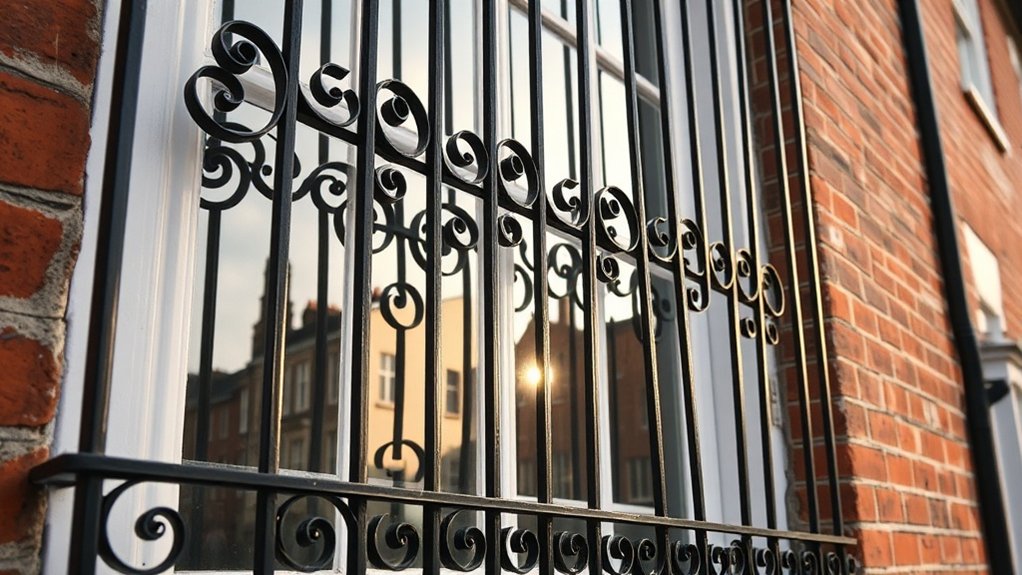
For period properties, you can echo historical styles with slim steel profiles and laser‑cut decorative patterns that align with original glazing proportions and listed‑building constraints. On modern schemes, you might favour clean, modular geometries, integrated sensor channels, and anti‑tamper fasteners. Always coordinate finishes with existing metalwork, prioritising corrosion resistance, minimal maintenance, and compatibility with future façade upgrades.
Balancing Window Security Bars With Privacy and Natural Light
Once you’ve aligned your window bar design with the building’s architecture and regulatory framework, you also need to control how those bars affect privacy and daylight performance . You’re balancing Privacy concerns, sunlight reduction, and compliance with Approved Document K and local planning constraints.
To optimise performance, focus on:
- Bar geometry – Use slimmer, high‑strength sections and wider spacing where risk allows, to limit perceived sunlight reduction while maintaining anti-intrusion resistance.
- Pattern density – Staggered or angled layouts can obstruct sightlines in, while still admitting diffuse daylight.
- Integrated screening – Add perforated metal, expanded mesh, or micro‑louvres to deliver privacy without creating a gloomy interior.
- Coatings and colours – Specify light, reflective finishes to enhance internal daylight and reduce contrast glare, supporting visual comfort and safety.
How Much Do Window Security Bars Cost in London?
Although every project is unique, you can benchmark window security bar costs in London by looking at three main drivers: specification, access complexity , and compliance requirements. For standard mild‑steel bars on straightforward ground‑floor openings, you’ll typically budget from £220–£350 per window, including fabrication and basic finishing.
Once you specify heavier gauge steel, custom patterns to protect window aesthetics, or integrated escape hatches, costs often rise to £350–£650 per opening. For properties within conservation areas or Historical architecture, expect design coordination with planners and potentially bespoke fixing details, adding 20–40%.
Difficult access (scaffolding, busy pavements, upper floors) can add £80–£250 per window. To stay compliant, factor in any required fire‑egress features and corrosion‑resistant coatings as non‑negotiable cost components.
Professional vs DIY Window Bar Fitting in London
As you weigh professional versus DIY window bar fitting in London, you need to balance apparent cost savings against structural integrity, compliance, and liability. A contractor familiar with British Standards, London Building Regulations , and fire-escape requirements will engineer fixings, spacing, and egress routes so your bars deter intrusion without creating unsafe entrapment.
DIY kits can look attractive, but mis‑specified anchors, poor alignment, or incorrect bar spacing undermine both security and window aesthetics, especially on period or architect‑designed façades .
Consider:
- Structural loading on masonry, frames, and lintels.
- Verified material durability and anti-corrosion performance.
- Compliance with insurance conditions and council guidance.
- Integrated design that preserves light, sightlines, and smart-sensor upgrades.
In many London properties, professional fitting delivers safer, future-ready security.
Maintaining and Inspecting Your Window Security Bars
Even the best‑installed window security bars in London only perform properly if you inspect and maintain them on a regular schedule. Start with a quarterly visual check: confirm bars remain rigid, fixings are tight, and welds show no cracking or corrosion, especially around decorative patterns where moisture can accumulate.
Integrate seasonal maintenance into your routine. In winter, look for rust from road salt and condensation; in summer, inspect for UV degradation of coatings and any frame movement from thermal expansion. Verify that quick‑release mechanisms (where fitted for fire safety) operate smoothly and aren’t painted shut, in line with London Fire Brigade guidance. Document inspections, note remedial work, and schedule professional re-coating or re-anchoring when you detect material loss, misalignment, or compromised masonry.
Alternatives to Window Security Bars in London (Grilles, Glass and More)
Regular inspection keeps window security bars effective, but they’re only one option within London’s broader perimeter‑security toolkit. If you’d prefer a less institutional look, you can integrate secure glazing systems and grilles that still meet UK Building Regulations and insurance standards.
Consider these alternatives:
- Security grilles – Retractable or fixed, with decorative patterns laser‑cut into steel or aluminium for daylight and design flexibility.
- Laminated or toughened glass – Multi‑layer glazing resists impact and forced entry while preserving clear sightlines.
- Polycarbonate shields – High‑clarity, impact‑resistant modern materials, ideal where you need robust protection without visual weight.
- Integrated window systems – Frames combining reinforced profiles, locking hardware, and secure glazing to create a certified, tamper‑resistant assembly.
How to Choose a Trusted London Window Bar Installer
Choosing a window security bar installer in London isn’t just about price; you’re appointing someone to modify a regulated escape route and your primary burglary deterrent. Start by checking they understand Building Regulations Part B (means of escape) and can evidence compliance with London Fire Brigade guidance.
Ask for designs that integrate with your façade, garden decor, and future window cleaning access, not just basic welded frames. A trusted installer should specify bar spacing, anchoring systems, and corrosion-resistant finishes suitable for London pollution.
Verify public liability insurance , DBS checks for residential work, and manufacturer-backed warranties. Insist on detailed drawings, structural fix schedules, and a documented risk assessment. Finally, choose a firm that offers maintenance inspections and can adapt systems for smart sensors or integrated alarm contacts.
Frequently Asked Questions
Do Window Security Bars Affect My Home Insurance Premiums in London?
They can affect your premiums , but not always predictably. Insurers may view professional security bar installation as a risk‑mitigation upgrade that reduces burglary exposure, yielding a modest Insurance premium impact or eligibility for security discounts. However, they’ll also assess emergency egress, fire safety, and conformity with UK building regulations. You should confirm policy wording, disclose all modifications, and obtain certification or compliance documentation to guarantee underwriting models treat the bars favourably.
Can I Get Temporary Window Bars for Short-Term London Rentals?
You can get temporary window bars for short-term rentals, but you must navigate rental restrictions first. Confirm your tenancy agreement allows non-permanent fixtures and verify compliance with UK fire-escape regulations. Choose tension-fit or internal clamp-on systems to avoid structural drilling and limit security deposit implications. Document pre‑ and post‑installation conditions, and get written landlord consent . You’ll boost security while preserving flexibility, reversibility, and regulatory safety compliance.
How Do Window Security Bars Impact Property Resale Value in London?
They can raise resale value when you balance security with design. You’ll attract buyers if you specify certified systems, integrate aesthetic improvements, and guarantee full compliance with UK building and fire‑escape regulations. Poorly designed bars, visible rust, or unresolved ventilation concerns can depress value and trigger surveyor red flags. Use removable or internally mounted designs, tamper‑resistant fixings, and documented approvals to position the upgrade as an innovative, safety‑led asset.
Are There Child-Friendly Window Bar Options That Prevent Falls as Well as Break-Ins?
Yes, you can specify child-friendly window bars that integrate Child safety and Fall prevention with anti-intrusion performance. You’d use fixed or tilt-and-restrict systems with narrow bar spacing, anti-climb profiles, and tamper-resistant fixings, all tested to relevant impact and loading standards. Guarantee quick-release mechanisms are inaccessible to children but operable by adults for fire egress. You’ll also want corrosion-resistant materials and modular designs that accept smart sensors or alarm integration.
Can Window Security Bars Be Integrated With Smart Home Alarm Systems in London?
Yes, you can integrate bars so smart they’d practically argue with your router. You’ll pair contact sensors or vibration detectors with your bars for full smart home integration and robust security system compatibility. Make certain components meet UK standards (e.g., EN 50131), use tamper‑proof fixings, and maintain egress routes. Work with NSI/SSAIB-approved installers so your setup talks to alarms, cameras, and apps without compromising safety or compliance.
Summary
When you secure your windows in London, you’re not just adding metal—you’re building a modern city fortress . You’ve weighed risks, regulations, and fire-escape rules, and you know guesswork isn’t an option. Now, treat bars, grilles, or laminated glass as part of an integrated security system, not a bolt-on fix. Verify planning and listed-building constraints, insist on compliant installation, and schedule regular inspections. Do that, and your home stands as guarded as any well-defended keep.