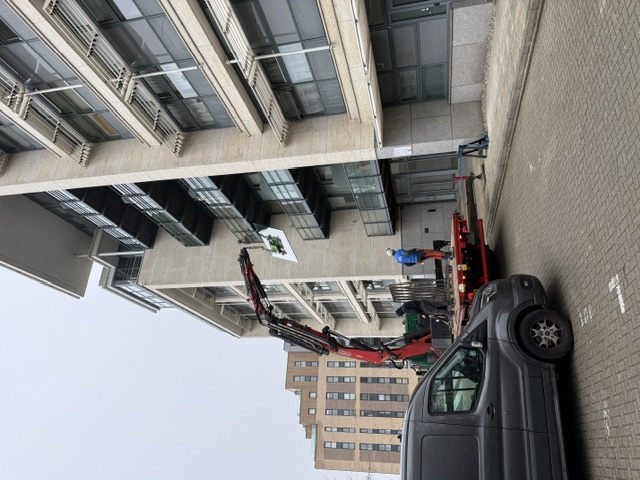
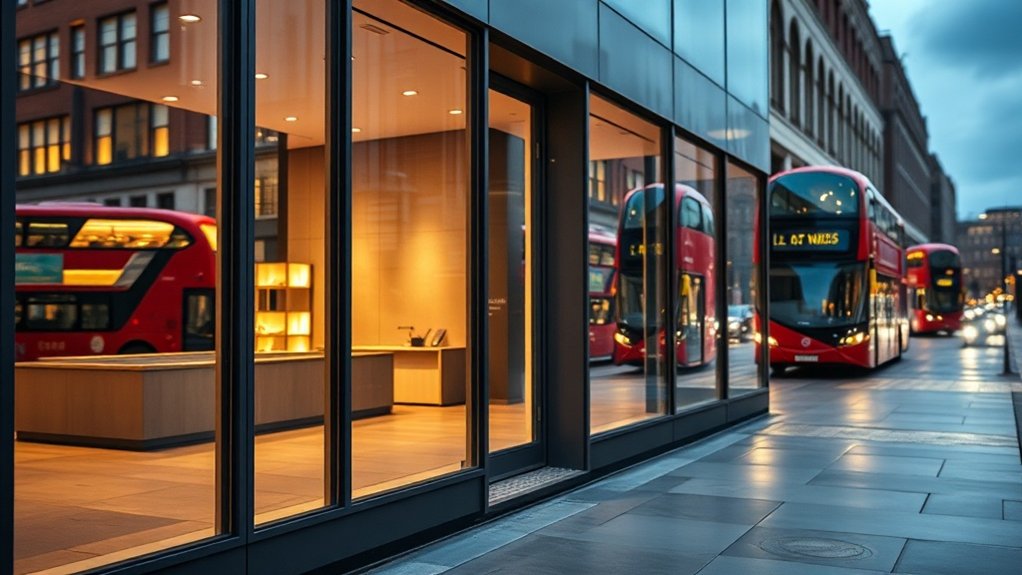
You choose aluminium shop fronts in London when you need a slim, modern façade that maximises glass, resists heavy footfall, and performs in harsh, polluted, or coastal conditions. You get robust security (multi-point locks, PAS 24-compatible systems), strong wind and weather performance, and low-maintenance powder-coated or anodised finishes that protect your brand image. You can tailor profiles, glazing, and access control around your layout, with further options that can considerably refine both appearance and operation.
Key insights
- Aluminium shop fronts in London provide slim, modern profiles with extensive RAL, metallic, and textured finishes to match brand identity and local streetscape.
- Systems are engineered for durability in busy, polluted urban environments, resisting corrosion and impact to reduce repainting, repairs, and lifecycle costs.
- High-security options include PAS 24 / LPS 1175-rated framing, laminated glazing, multi-point locking, and integrated access control suited to London high-street risk profiles.
- Experienced London façade specialists manage design, planning permission, installation phases, and integration with lighting and signage for compliant, cohesive storefronts.
- Thermally broken aluminium profiles and high-spec glazing improve energy performance, while modular systems allow future reconfiguration and technology upgrades with minimal disruption.
Why Aluminium Shop Fronts Work So Well in London
Why do so many London retailers specify aluminium for their shop fronts? You’re operating in a dense, high-traffic, weather-exposed environment, so the base specification has to be engineered, not improvised. Aluminium gives you material durability under constant vibration from traffic, airborne pollutants, and repeated opening cycles, while maintaining tight tolerances for glazing interfaces and hardware.
You can precision‑fabricate slimline profiles that carry large glass spans without visual bulk, supporting daylighting strategies and digital display integration. Its inherent corrosion resistance performs well against London’s variable climate, reducing surface degradation and repaint cycles. You also gain design flexibility: you can anodise or powder‑coat to align brand colours, achieve long‑term aesthetic appeal, and support future refits without replacing the primary structural framing.
Key Benefits of Aluminium Shop Fronts for Local Businesses
When you evaluate aluminium shop fronts specifically for a London high street or neighbourhood parade, the benefits align closely with local operating pressures: you gain a strong, lightweight framing system that supports large, secure glazed areas without bulky mullions; this maximises visual merchandising while maintaining structural integrity and security. Aluminium durability guarantees the frame resists impact, corrosion, and constant pedestrian contact, reducing lifecycle costs and callouts.
You’ll also gain material versatility that supports frequent tenant changes and brand refreshes. Profiles can be reconfigured, re-powder-coated, and integrated with upgraded locking, access control, and automation without full replacement. High-precision fabrication tolerances improve weather performance , helping you manage internal climate and energy spend while keeping entrances operational under heavy daily use and variable London conditions.
Design Options for Aluminium Shop Fronts in London
When you specify an aluminium shop front in London, you can achieve a modern aesthetic using slimline profiles, precise sightlines, and a wide range of anodised or powder-coated finishes. You’re able to customise frame geometry, glazing types, and hardware to align the façade with your internal layout and lighting strategy. In addition, you can integrate branding through colour-matched frames , applied or etched graphics, and bespoke signage zones engineered directly into the system.
Modern Aesthetic Possibilities
Although aluminium is often specified for its strength and durability, its real advantage for London shop fronts lies in the precision and range of modern aesthetic options it supports. You can engineer ultra-slim sightlines, oversized glazed panels , and crisp, mitred corners that deliver a clean, contemporary façade.
You’re not limited to standard finishes. Advanced powder-coating systems give you expansive color options, including dual-colour frames to differentiate street elevation and interior ambiance. You can specify matt, satin, gloss, metallic, or anodised effects to align with local context or emphasise historical relevance in conservation-sensitive streets.
Integrated LED channel profiles, flush thresholds, and concealed fixings ensure every visible surface looks intentional, technologically current, and visually lightweight while still meeting demanding performance and compliance requirements.
Customisation and Branding Options
Because aluminium systems are fundamentally modular and precision-engineered, they give you a high level of control over how your shop front expresses your brand on a busy London street. You can specify frame depths, sightline widths, and joint details to align precisely with your brand architecture and target customer flow.
Through advanced powder-coating, you gain virtually unlimited color options, including RAL, metallic, dual-colour, and textured finishes, all with high UV stability . You can integrate laser-cut logo panels, feature mullions, and bespoke handle designs into the aluminium profiles.
Glazing can support printed graphics, etched patterns, and privacy gradients, enabling layered branding strategies. Integrated LED trough lighting , edge-lit logos, and sensor-based illumination let you synchronise visual impact with time-of-day and footfall patterns.
Essential Security and Safety Features for London Shop Fronts
Even in low‑risk districts, a London shop front must integrate robust security and life-safety features into its design from the outset. You need a coordinated system: PAS 24 or LPS 1175‑rated framing, high-security multi-point locking, tamper-resistant hinges, and concealed fixings to deter forced entry without compromising Historical preservation or aesthetic restoration objectives.
Specify integrated access control with audit trails, zoned keying, and remote lockdown capability. Combine this with discreet anti-ram measures—structural mullions, reinforced thresholds, and, where appropriate, bollards tied into the slab.
Life-safety performance should include certified fire-exit hardware, compliant egress widths, illuminated escape signage, and fail-safe access controls that default to safe mode during power loss. Add monitored intrusion detection , vibration sensors, and CCTV sightlines engineered into the aluminium profiles from the start.
Best Glazing and Door Options for Aluminium Shop Fronts
When you specify aluminium shop fronts, you need to assess whether double or triple glazing best matches your security, acoustic, and thermal performance requirements. You’ll also need to select door styles—manual or automatic swing , pivot, sliding, or bi-fold—engineered with appropriate locking systems, access control, and anti-tamper hardware. By balancing glazing build-up, frame profiles, and sealing systems, you can optimise energy efficiency and insulation while maintaining clear sightlines and a professional façade.
Double And Triple Glazing
How do you decide between double and triple glazing for your aluminium shop front so it performs efficiently without inflating costs or compromising aesthetics? You start by mapping performance targets : U‑values, g‑values, and dB ratings. In conservation areas, you may pair slimline double glazing with narrow sightlines to respect historical preservation and showcase artistic craftsmanship in the frame detailing.
Double glazing, with argon-filled cavities and low‑E coatings, usually delivers suitable thermal performance and daylight for typical London retail frontages. You’ll gain rapid payback and minimal profile depth. Triple glazing suits high‑end or energy‑positive schemes, where superior insulation and acoustic control justify added weight and cost. Always balance glass thickness, cavity width, and coating specifications against structural limits of your chosen aluminium system.
Door Styles And Security
Ultimately, the door sets the tone for your aluminium shop front’s performance, security, and customer flow. When you specify door styles, you’re balancing clear access with controlled entry. Pivot, hinged, sliding, and automatic bi-parting doors each suit different traffic patterns and frontage widths, while thermally broken aluminium profiles maintain structural rigidity and minimise frame distortion.
For security enhancements, prioritise PAS 24–compliant systems with multi-point locking , anti-lift mechanisms on sliding leaves, and continuous hinge gear on hinged doors. Integrate laminated safety glass with security-rated glazing beads and internally beaded frames to prevent panel removal. Consider access control: electric strikes, maglocks, and integrated readers allow timed or credential-based entry. Specify robust thresholds, reinforced keep plates, and tamper-resistant hardware throughout.
Energy Efficiency And Insulation
Why treat energy efficiency as an add‑on when it can drive running costs, comfort, and compliance from day one of your aluminium shop front design? You should start by specifying high‑performance double or triple glazing with low‑E coatings and warm‑edge spacers to minimise conductive and radiative heat loss.
Use thermally broken aluminium profiles, integrating advanced insulation materials such as polyamide or polyurethane barriers within the frame to disrupt thermal bridging. For Energy conservation, guarantee perimeter seals, gaskets, and threshold details achieve airtightness targets suitable for London’s climate and Part L requirements.
Consider insulated panels for solid sections, and choose automatic or sliding doors with controlled opening cycles to reduce conditioned air losses while maintaining accessibility and visual impact.
Energy Efficiency and Thermal Performance of Aluminium Shop Fronts
Although aluminium is often associated with sleek aesthetics and durability, its energy efficiency and thermal performance are just as critical when you’re specifying a shop front in London’s climate. To maximise energy conservation, you’ll need thermally broken aluminium profiles that interrupt heat transfer between internal and external faces, markedly reducing conductive losses.
Combine these with high-performance glazing: low‑E coatings, argon-filled double or triple units , and warm‑edge spacers to enhance thermal insulation while maintaining transparency for retail display. Pay close attention to whole-system U‑values, air leakage rates, and g‑values to balance heat retention with solar gain control.
You can also specify insulated panels for solid areas, continuous perimeter sealing, and precision-engineered hardware to minimise drafts, stabilise internal temperatures, and reduce HVAC loads.
Planning Permission for Aluminium Shop Fronts in London
When you upgrade to an aluminium shop front in London, you’ll need to establish precisely when planning permission applies , particularly in conservation areas, listed buildings, or designated shopping parades. You must assess factors such as alterations to the building line, changes to external appearance, signage, and lighting against your borough’s planning policies. Working with a specialist, you can interpret local regulations, prepare compliant drawings and specifications, and manage the application process to minimise delays and planning risk.
When Planning Permission Applies
Even if you’re only updating your aluminium shop front, London’s planning rules can still apply, especially where the works materially alter the building’s external appearance or affect its structure. You’ll typically need permission when you change the frame layout, enlarge openings, remove stall risers, or alter load‑bearing elements.
Consent is also likely where your premises form part of historical architecture, a listed building , or sit within a conservation area, because any new aluminium system must respect established façade rhythms, proportions, and materials. Planning control usually engages if you introduce bold illumination, digital displays integrated into the shop front, or fully glazed frontages that alter active frontage character. You won’t rely on permitted development rights where Article 4 Directions restrict such changes under local regulations.
Navigating Local Regulations
Understanding that planning permission can apply is only the starting point; the real challenge lies in maneuvering London’s layered planning framework for aluminium shop fronts. You must align innovative façade concepts with strict local zoning and conservation constraints, especially in town centres and heritage streetscapes. Each borough publishes policy maps, design codes, and supplementary guidance that dictate profile depths, glazing proportions, and security treatments.
To move from concept to consent, you need a tightly coordinated strategy:
- Feel confident by mapping local zoning constraints against your brand’s spatial needs.
- Avoid anxiety by pre‑auditing signage regulations, illumination levels, and digital displays.
- Protect your timeline by submitting detailed aluminium system specifications, sections, and colour schedules that pre‑empt planners’ technical concerns.
Upfront Costs vs Long-Term Value of Aluminium Shop Fronts
Although aluminium shop fronts can appear more expensive at the quotation stage than basic timber or uPVC systems, their long-term value often proves higher once you factor in lifecycle performance, durability, and operational efficiency. When you carry out a detailed cost comparison, you’ll see reduced maintenance cycles, fewer replacements, and lower vulnerability to impact or weather-related distortion.
You also gain clear investment benefits around performance. Thermally broken aluminium profiles support better energy control, especially with high-spec glazing. Robust framing tolerances maintain alignment for smooth door operation, preserving security hardware integrity and access control reliability. Powder-coated finishes minimise repainting, while modular systems let you reconfigure fascias or integrate digital signage later, without full façade replacement—protecting your capital and supporting future brand upgrades.
Installation Timelines and Disruption for London Premises
When you weigh the long-term value of an aluminium shop front, you also need clear expectations around how quickly it can be installed and how it will affect day-to-day trading in a London setting. Typically, measured surveys and design finalisation take a few days, with fabrication following in 1–2 weeks, and on-site installation compressed into tightly managed phases , often overnight or during low-footfall periods.
You minimise disruption through precise planning that respects your building’s historical significance and surrounding streetscape. Advanced off-site fabrication and dry-fit assembly reduce noisy works, scaffolding time, and pavement occupation while ensuring seamless architectural integration with neighbouring facades and signage zones.
- Reduced trading downtime
- Controlled on-site activity
- Confident, scheduled project handover
Maintenance, Cleaning and Long-Term Durability of Aluminium Shop Fronts
Built to withstand London’s variable climate and high street footfall, aluminium shop fronts deliver long-term performance with comparatively low maintenance, provided you follow a clear, predictable care regime. You’ll typically implement quarterly maintenance schedules, increasing to monthly in high-pollution or coastal-influenced zones.
Clean frames with pH-neutral detergent , deionised water, and non-abrasive cloths to protect powder-coated or anodised layers, which act as the primary defence against aluminium corrosion. Rinse thoroughly to remove airborne contaminants, road salts, and particulates that can undermine surface integrity.
Inspect gaskets, drainage slots, and joints for blockages or wear, ensuring water is channelled away from structural interfaces. Lubricate hinges and locking mechanisms with manufacturer-approved products, and document all interventions to support warranty conditions and lifecycle planning.
Choosing an Aluminium Shop Front Installer in London
Choosing the right aluminium shop front installer in London directly affects structural performance, security, and lifecycle cost, so you should assess far more than headline price. Look for a contractor who proves traceable material sourcing, uses certified systems , and can model wind load, deflection, and thermal performance. Ask how they coordinate with your branding, lighting, and access-control strategy.
- You want confidence that your façade won’t rattle, leak, or corrode early because the installer cut corners on profiles, glazing, or fixings.
- You need assurance that advanced installation techniques will deliver smooth operation, tight tolerances, and rapid on-site adjustments.
- You deserve a partner who documents warranties, maintenance regimes, and upgrade paths, so your shop front keeps looking and performing like new.
Frequently Asked Questions
How Do Aluminium Shop Fronts Compare Environmentally With Timber or uPVC Alternatives?
You’ll find aluminium outperforms timber and uPVC environmentally over the full lifecycle. It uses Eco friendly materials in durable, slim profiles that reduce replacement frequency. Its key edge is Recyclability advantages: you can repeatedly recycle aluminium with minimal performance loss and relatively low energy input. Timber demands intensive maintenance and responsible sourcing; uPVC relies on petrochemicals and is harder to recycle cleanly, limiting its long‑term sustainability.
Can Aluminium Shop Fronts Be Integrated With Smart Building Management Systems?
You can integrate them seamlessly with smart building management systems —shocking, right, that doors can think now? You’ll specify smart integration for access control, occupancy sensing, and environmental monitoring. Profiles accept sensors, maglocks, and motorised gear for automated controls, linking to BACnet, Modbus, or IP-based BMS platforms. You’ll manage scheduling, fault alerts, and energy optimisation centrally, ensuring your façade becomes an active, data-driven component of your wider intelligent building strategy.
Are There Branding or Signage Limitations With Aluminium Framing in Conservation Areas?
Yes, you’ll face branding and signage constraints, but you can still innovate. In conservation areas, planning officers prioritise historical preservation and aesthetic compatibility, limiting oversized logos, internally illuminated signs, and aggressive color palettes. You’ll typically need slimline lettering, sympathetic fonts, muted RAL finishes, and discreet LED edge-lighting. Early design coordination, heritage statements , and photorealistic visuals help you justify contemporary branding while respecting conservation guidelines.
How Does Coastal or Riverside Pollution in London Affect Aluminium Finishes?
Coastal or riverside pollution in London accelerates Marine corrosion on aluminium finishes by increasing chloride concentration, acidity, and particulate deposits. You’ll see faster coating breakdown , filiform corrosion under paint, and staining where runoff concentrates contaminants. To mitigate Pollution impact, you should specify marine-grade alloys, high-performance powder coatings, enhanced pre-treatment, and sealed joint details, plus commit to a documented cleaning schedule using pH-neutral agents and periodic inspections to maintain performance.
Can Existing Non-Aluminium Shop Fronts Be Retrofitted Using Current Aluminium Frameworks?
Yes, you can retrofit most non-aluminium shop fronts with current aluminium frameworks. You’ll start by surveying structural tolerances, load paths and fixing points, then designing a bespoke system that respects Historical preservation while upgrading Material durability, thermal performance and security. Precision-measured aluminium sections, compatible anchors and interface flashings guarantee a smooth shift. You’ll gain slimmer sightlines, integrated glazing options and future‑ready adaptability without fully dismantling the existing façade.
Summary
When you choose an aluminium shop front in London, you’re not just installing a façade; you’re engineering a modern portcullis for your brand. You balance slim sightlines with robust security, precision hardware with emergency-safe exits, and high-performance glazing with energy efficiency. By partnering with a specialist installer, you’ll guarantee compliance, minimise disruption, and protect your investment—so your frontage, like a well-designed skyline, keeps working quietly in your favour, day after day.