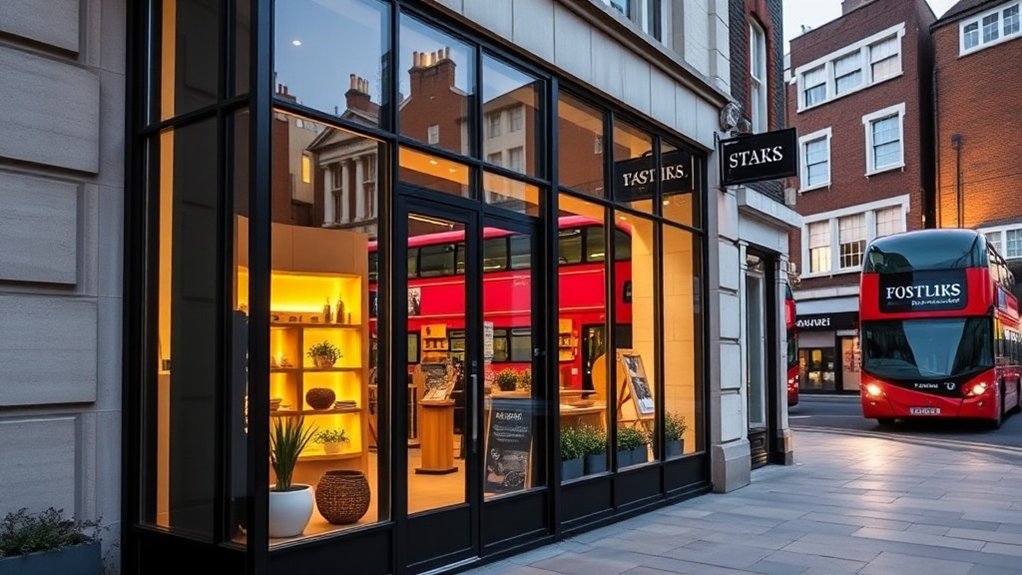
When you replace a London shop front, you’re not just swapping glass; you’re upgrading security , accessibility, and compliance with strict local planning and conservation rules. You’ll choose between glass, aluminium, timber or steel systems that suit your street, brand, and budget, while meeting UK standards for safety, thresholds, and signage. A good contractor will manage surveys, permissions, fabrication and installation to minimise downtime, and you’re about to see how to get that right.
Key insights
- Shop front replacement in London starts with a detailed site survey, including measurements, structural checks, and assessment of conservation or heritage constraints.
- Planning permission may be required, especially in conservation areas; check borough-specific shopfront design guides and seek pre-application advice.
- Common materials include aluminium, glass, engineered timber, and steel, chosen for durability, security, and compatibility with local architectural character.
- Costs range from a few thousand pounds for basic systems to significantly more for bespoke, wide, or corner shopfronts and listed-building compliant designs.
- Modern replacements integrate security shutters, laminated safety glass, accessibility-compliant entrances, and energy-efficient glazing to improve safety, comfort, and running costs.
Signs You Need A New Shop Front In London
When footfall drops, shutters stick, or your glazing no longer meets London’s safety and branding standards, your shop front is signalling it’s due for replacement. You’ll notice misaligned frames, failed double-glazing , and cold bridging that undermines thermal performance and environmental sustainability targets.
If you trade in a conservation area, worn signage, inappropriate uPVC, or ill‑matched colours indicate non‑compliance with Historical preservation guidelines from your local planning authority. Corroded roller shutters , exposed wiring to external lighting, and weak locking points increase security risk and insurance scrutiny.
You should also act when accessibility falls short: narrow entrances, high thresholds, or non‑automated doors deter customers and violate inclusive design expectations embedded in modern London retail schemes.
What A London Shop Front Replacement Involves
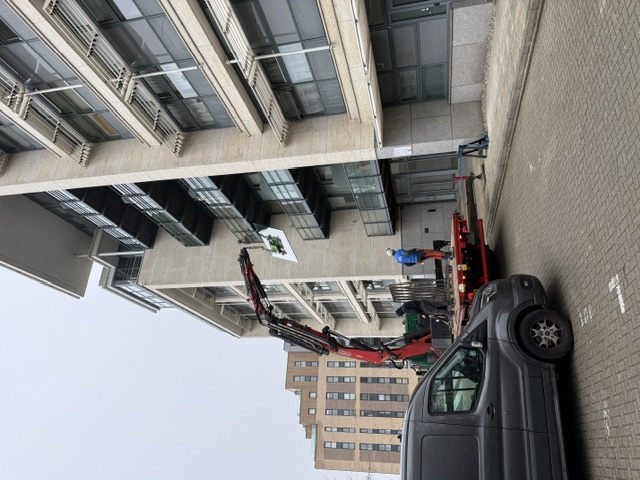
Before any glass is removed or frames are ordered, a London shop front replacement starts with a detailed site survey that captures exact openings, structural conditions, services routes, and street context, including any conservation or TfL highway constraints. From this, you’ll get coordinated drawings, glass specifications, and structural calculations tailored to London loadings and security expectations.
You then select framing systems, ventilation, and thermal performance levels that balance energy efficiency with visibility and branding. Fabrication follows, with components pre-assembled off‑site to minimise trading downtime. On site, installers phase works, protect neighbouring units, and integrate alarms, lighting, and signage cabling. Throughout, you manage historical preservation and cultural significance, ensuring new materials, proportions, and detailing respect London’s streetscape while upgrading performance.
London Planning Rules And Permissions Explained
Although a shop front can look like pure design, in London it’s effectively a small planning project governed by national planning law, borough policies , and sometimes conservation or heritage controls. You must first confirm if works fall under “permitted development” or require full planning permission and advertisement consent.
Check your borough’s shopfront SPD and design guides; they translate high‑level policy into street‑specific rules. In conservation areas or listed buildings, historical preservation and materials hierarchy become non‑negotiable, and you’ll likely need heritage statements and scaled drawings.
Councils increasingly scrutinise environmental impact : daylighting, thermal performance, light spill, and embodied carbon. Engage planners through pre‑application advice, align proposals with the London Plan’s design and sustainability policies, and document compliance clearly to compress determination times.
Choosing Glass, Aluminium, Timber Or Steel
Because London shopfronts work hard structurally, thermally, and commercially, you need to treat the choice between glass, aluminium, timber and steel as a performance specification, not just an aesthetic decision. You’re balancing material durability, design flexibility, lifecycle cost and local context.
In London’s polluted, high‑traffic streets you should benchmark each option against security, maintenance and thermal performance :
- Glass: Maximises visibility; specify laminated or toughened units for security and acoustic control.
- Aluminium : High material durability, slim profiles, excellent for large glazed areas and complex geometries.
- Timber: Best for heritage terraces; use engineered, factory-finished sections for stability and lower maintenance.
- Steel : Superior structural capacity, ultra‑slender mullions; galvanising and powder‑coating resist urban corrosion.
Combine systems where it sharpens branding and performance.
Designing A Shop Front For Your London Street
When you design a new shop front in London, you need to align with the existing streetscape character, from listed Victorian terraces in Kensington to post-war parades in Croydon, while still meeting current planning and signage guidance . At the same time, you should engineer the glazing layout, framing depths, and sightlines to maximise window display impact and capture footfall from both primary and secondary viewing angles. By treating the façade as a coordinated system—materials, lighting, security, and merchandising—you can achieve a frontage that looks native to the street yet performs as a high-yield retail showcase.
Blending With Streetscape Character
Streets across London have distinct visual rhythms, so an effective shop front design starts with reading the streetscape before you specify a single component. You’re not copying your neighbours; you’re calibrating proportion, materiality, and colour so your frontage feels inevitable on that street.
Focus on robust context analysis :
- Map facade lines, cornice heights, and pilaster widths, then align your new frame to these key datum points.
- Specify materials that echo local fabric—brick slips, timber, or metal—while meeting current performance standards.
- Integrate Street art sensitively on flank walls or shutters where borough guidance permits, keeping the primary elevation coherent.
- Coordinate with Historic preservation officers and local design codes to reconcile contemporary detailing with listed or locally significant buildings nearby.
Maximising Window Display Impact
Even on a narrow London pavement , your shop front can work like a high‑performance display system if you treat the glazing, lighting, and backdrop as integrated components rather than decoration. You start by defining clear focal zones at eye level for pedestrians and at driver height for passing traffic. Use low‑iron, high‑clarity glass to minimise reflection from London’s variable daylight and bus headlights.
Layer LED track lighting with adjustable beam angles, tuned to warm white for lifestyle displays and neutral white for products needing colour accuracy. Integrate Innovative branding into the physical structure: edge‑lit logo fins, projected graphics, and dynamic digital panels.
Prioritise Eco friendly materials: FSC-certified timber plinths, recycled metal framing, and low‑VOC finishes that withstand pollution and heavy footfall.
Security, Shutters And Safety Standards In London
Although aesthetics drive many shop front projects, in London you can’t ignore security shutters , glazing performance, and statutory safety standards that govern what you install. You’re designing against real risks: ram-raids, targeted theft, and vandalism, while staying aligned with British Standards and local planning policy.
You should treat Security upgrades as a system:
- Integrate LPS 1175-rated shutters or grilles with laminated, burglar-resistant glazing.
- Specify motorised shutters with smart timers, group controls, and monitored alarm interfaces.
- Schedule proactive Shutter maintenance to minimise downtime and ensure compliance with PUWER and manufacturer requirements.
- Validate every component against BS EN 16005 (powered doors) and relevant fire-safety standards, then document certification.
Making Your Shop Front Accessible And Compliant
When you replace your shop front in London, you must treat accessibility as a core design requirement to satisfy the Equality Act 2010 and Part M of the Building Regulations. That means you’ll need to plan for true step-free entrances, compliant threshold details, and clear manoeuvring space that works for wheelchairs, buggies, and mobility aids on typical London pavements. You should also integrate inclusive signage and wayfinding—using appropriate contrast, tactile features, and logical placement—so customers can easily locate and navigate your entrance from the street.
Meeting UK Accessibility Standards
A compliant, accessible shop front in London isn’t just good practice; it’s a legal requirement under the Equality Act 2010 and relevant Building Regulations (primarily Approved Document M). You need to demonstrate that disabled customers can approach, identify, and use your entrance independently, even within tight high-street plots and conservation areas where historical preservation also matters.
When you specify a replacement shop front, align design decisions with UK guidance by addressing:
- Clear opening widths, door furniture heights, and force-to-open limits
- Glazing manifestation for visibility, using high-contrast bands and frames
- Lighting levels at the entrance that balance accessibility with energy efficiency
- Audible/visual entry systems that integrate with security shutters and alarms
You should document these measures for building control and future refurbishments.
Step-Free Entrances And Thresholds
Compliance on paper only goes so far; the real test is whether customers can get through your door without obstruction. When you replace a shop front in London, you’ve got a rare chance to hard‑wire Accessible design into the entrance. That means a genuinely step‑free approach, not a token ramp.
You should target a maximum 1:20 gradient where possible, 1:15 absolute, with a firm, slip‑resistant finish that copes with rain and street grime. For true threshold accessibility, specify a level or low‑profile threshold (ideally ≤15 mm), thermally broken and compatible with automatic or low‑energy operators.
Coordinate with your architect, fabricator, and local building control early, especially on constrained Victorian or infill plots, so structure, drainage, and street levels all support a continuous, obstacle‑free entrance line.
Inclusive Signage And Wayfinding
Beyond kerbs and thresholds, customers still need to find, identify, and navigate your entrance quickly and safely, so your shop front signage and wayfinding must work for people with visual, cognitive, and mobility impairments . You’re not just adding signs; you’re engineering an information system that aligns with Building Regulations Part M and Equality Act duties while still expressing artistic branding and cultural symbolism that fits London’s streetscape. Prioritise legibility, contrast, and multisensory cues.
- Use high-luminance contrast lettering, matte finishes, and consistent iconography.
- Integrate Braille/tactile panels at 1400–1600mm height near the main entrance.
- Add logical, well-lit decision points from pavement to till, avoiding visual clutter.
- Deploy subtle digital wayfinding (beacons, NFC tags) to serve navigation apps.
Shop Front Replacement Costs In London
While every premises is different, shop front replacement costs in London typically range from a few thousand pounds for basic aluminium systems to considerably higher figures for bespoke frameless glass or steel installations, driven by materials, structural complexity, glazing specification, and planning or conservation constraints.
You should treat the façade as a revenue asset, not just a capital cost. High-performance glazing, integrated LED fascias, and precision metalwork align with retail branding and measurably improve customer engagement, but they push budgets upward. Corner plots, wide frontages, and oversized panes need heavier steels, specialist access, and sometimes night work, all priced at London labour rates.
In conservation areas, expect additional design iterations, heritage consultations , and higher-spec joinery or steel, which all impact cost planning.
How Long Does Shop Front Replacement Take?
A typical shop front replacement in London takes 2–6 weeks from survey to completion, with actual on‑site disruption often compressed into 2–5 working days. You’ll move through a clear sequence: initial survey, technical design, fabrication, and installation, all shaped by local planning rules, access constraints, and trading hours.
Key time drivers include:
- Existing structure complexity and any need for steelwork or lintel upgrades
- Lead times for bespoke glazing, security systems, and integrated lighting
- Coordination with your interior design refresh so signage, flooring, and thresholds align
- Phasing works around trading, night shifts, or temporary access to protect customer engagement
Choosing The Right London Shop Front Contractor
Once you’re clear on timings and scope, the critical decision is choosing a London shop front contractor with the technical depth and local compliance experience to deliver it without costly surprises. You need a team fluent in planning policy, conservation constraints, and TFL/borough highways rules around hoardings and pavement use.
Prioritise contractors who integrate structural design, security engineering, and glazing specification with retail branding strategy. Ask for data on footfall uplift or customer attraction from previous projects on similar London high streets. Check they model thermal performance, acoustics, and loading, and can coordinate with your M&E and signage suppliers. Finally, interrogate their CDM compliance, out‑of‑hours working capability, and live‑trading mitigation plans, so installation doesn’t disrupt revenue or damage brand perception.
Step‑By‑Step Shop Front Replacement In London
From first survey to final sign‑off, a London shop front replacement follows a defined sequence that minimises disruption and keeps you compliant with borough and TFL requirements. You start with a measured survey, capturing elevations, neighbouring details, and any constraints related to historical preservation or conservation area status. Your designer then models the new façade, optimising visibility, security, and energy performance with eco friendly materials.
On approval, your contractor schedules works around trading hours and loading restrictions, then prefabricates off‑site to shorten on‑street time.
- Strip‑out of the existing façade and safe disposal
- Installation of primary structure, glazing, doors, and signage infrastructure
- Integration of electrics, security hardware, and accessibility features
- Final snagging, fire‑safety checks, and certification for council or landlord sign‑off
Common London Shop Front Replacement Mistakes
When you replace a shop front in London, you can’t afford to underestimate local planning and licensing rules , especially in conservation areas and on designated high streets. You also need to align the new frontage with the building’s architectural rhythm and neighbouring façades, or you risk objections from planners and reduced customer trust. Finally, if you choose poor‑quality glazing, framing, or security hardware to cut costs, you’ll face higher maintenance, energy loss, and potential compliance issues with London’s safety standards.
Underestimating Local Regulations
Many shop front replacement projects in London run into delays and unexpected costs because owners underestimate how strict and fragmented local regulations can be across boroughs. You’re not dealing with one system; you’re dealing with 32 boroughs plus the City, each with its own planning culture , Local zoning nuances, and enforcement style.
To avoid redesigns, stop notices, and wasted contractor time, you should:
- Map conservation areas, Article 4 Directions, and frontage policies before design work.
- Align your concept with borough-specific SPDs, accessibility codes, and fire-safety constraints.
- Treat the Permit application as a mini–technical dossier: sections, materials, lighting, security, and signage.
- Coordinate with building control early to integrate structural changes, glazing specs, and thresholds.
This regulatory-first approach lets you innovate without triggering compliance conflicts.
Ignoring Building Aesthetics
Although regulations dominate most discussions about London shop fronts, you can’t treat aesthetics as an afterthought without undermining both planning success and commercial performance. Planners scrutinise proportion, rhythm, and sightlines, especially in conservation areas , town centres, and mixed-use schemes. If your fascia height, stall-riser depth, or glazing pattern clashes with neighbouring properties, you’ll trigger objections, redesign costs, and lost trading time.
You should embed aesthetic considerations into the initial survey stage. Map surrounding cornices, pilasters, and bay widths; then use these as control dimensions for your new frontage. Align colour strategy with durable finishes and long‑cycle building maintenance so the shop front ages gracefully rather than visually decaying. Integrate discreet lighting , signage, and digital displays that enhance the streetscape, not dominate it.
Choosing Poor-Quality Materials
Too often, cost-cutting on materials turns a London shop front into a high‑maintenance liability rather than a durable asset. In this city, pollution, heavy footfall, and variable weather punish weak substrates , cheap coatings, and low-spec glazing. When you choose poor-quality products, you compromise both material durability and long-term aesthetic appeal, and you’ll pay for it in accelerated failure and frequent repairs.
Focus on performance-led specification instead:
- Opt for thermally broken aluminium or engineered timber with tested material durability.
- Use laminated, low‑iron safety glass that resists impact and improves visual clarity.
- Specify marine‑grade powder coatings to withstand London’s airborne pollutants.
- Choose hardware with cycle-tested mechanisms and corrosion-resistant finishes.
This way, you create an innovative, resilient frontage that actually earns its keep.
Maximising ROI From Your New London Shop Front Replacement
When you invest in a new shop front in London, you’re not just paying for glass and framing—you’re buying visibility, footfall, and conversion potential in one of the world’s most competitive retail environments. To maximise ROI, treat the façade as a performance asset, not a cosmetic upgrade.
Specify insulated glazing, thermal breaks, and LED-integrated signage to reduce operational costs and environmental impact while improving luminance and dwell time. In conservation areas, align with historical preservation constraints using slimline double glazing, heritage-approved profiles, and reversible fixings, avoiding planning delays.
Use data: map pedestrian flows, then optimise door positioning, sightlines, and display zones around high-traffic vectors. Integrate sensors and analytics to A/B test layouts, window content, and lighting schedules for measurable uplift in conversion.
Frequently Asked Questions
How Does Shop Front Replacement Affect My Business Insurance Premiums in London?
It can lower or raise your business insurance, depending on how you upgrade. Insurers assess Insurance impact through glazing spec, security rating , and compliance with London building and security standards. High‑performance glass, certified shutters, and PAS 24 or similar systems often trigger Premium adjustments downward. Poor installation, non‑certified materials, or reduced security can push costs up. Always share designs and certifications with your broker before you commit.
Can I Claim Tax Relief or Grants for a New London Shop Front?
You can claim tax relief and potentially tap into grants that feel like money raining from the sky. You’ll treat most costs as capital expenditure, using capital allowances or structures and buildings allowances as Tax incentives. For Grant eligibility, check GLA, local borough business schemes, and heritage or accessibility funds. You should align designs with low-carbon, accessibility, and high‑street regeneration priorities, then document specs and quotes to support applications.
What Are Eco‑Friendly Shop Front Options Suitable for London’s Climate?
You should specify high‑performance glazing, thermally broken aluminium or sustainably sourced timber frames, and recycled or low‑carbon cladding as sustainable materials. Combine deep canopies with airtight doors to manage London’s wind, rain and heat‑gain. Integrate energy efficient lighting , using LED strips with smart sensors and daylight harvesting. Consider green signage, photovoltaic glazing, and permeable thresholds to handle surface water, aligning your frontage with London Plan sustainability and BREEAM benchmarks.
How Do I Maintain My New Shop Front to Prevent Weather Damage?
You prevent weather damage by proving the theory that “passive durability” works only with active care. Apply breathable sealants and check joints annually—key Weatherproofing tips for wind‑driven rain. Schedule Seasonal maintenance : inspect drainage after storms, clear guttering, and re‑silicone perimeter gaps. Use UV‑stable coatings on frames and anti‑corrosion treatments on fixings. Monitor thermal movement in glazing and recalibrate fittings yearly to keep the envelope tight and responsive.
Will Replacing My Shop Front Disrupt Neighbouring London Businesses or Residents?
Yes, it can, but you can engineer the process to minimise neighboring disruption. You’ll schedule works outside core trading hours and specify low‑noise tools to address noise concerns. Use modular, pre‑fabricated framing so installers complete structural swaps rapidly. Implement clear site logistics , defined delivery windows, and pedestrian diversions. Engage with local councils and Business Improvement Districts to align with loading restrictions, then brief neighbours in advance to maintain goodwill and predictable impact.
Summary
As it happens, the moment you’re noticing peeling paint, fogged glass, or non‑compliant signage is exactly when London’s planning rules, security needs , and footfall patterns are converging in your favour. If you act now—specifying the right glazing, framing system, and thermal performance—you’ll resolve compliance risks, cut energy loss, and sharpen your street presence. Partner with a proven London shop front contractor and you’ll turn replacement costs into a measurable, long‑term commercial asset.