You secure your London property effectively when you install correctly specified, certified security grilles tailored to local risk and building type. Choose between fixed, retractable, or roller grilles tested to LPCB LPS 1175 or similar, and guarantee installation uses approved anchors, anti-jemmy profiles, and compliant egress. In conservation or listed settings, you must follow planning and heritage controls. Integration with alarms , shutters and CCTV greatly enhances protection, and the next sections explain how to achieve that safely.
Key insights
- Choose an installer offering LPCB LPS 1175 / Secured by Design–certified grilles to meet insurer requirements and London-specific threat levels.
- Request a full site survey assessing wall construction, fixing points, escape routes, and integration with existing alarms, CCTV, and access control.
- Confirm experience with London conservation areas and listed buildings, including planning consent, heritage-friendly fixing methods, and visually sympathetic designs.
- Ensure custom fabrication from accurate digital measurements, with documented anchorage calculations and compliance with fire, egress, and building regulations.
- Verify third‑party accreditation, public liability insurance, detailed method statements, and a clear maintenance plan for long-term grille performance and safety.
How Security Grilles Protect London Properties
Although they look simple from the outside, security grilles protect London properties through a combination of physical resistance, access control , and risk reduction that’s difficult to bypass quickly or quietly. You create a delay barrier that forces intruders to generate noise, use tools, and expose themselves to detection, which strengthens overall urban security.
You can integrate grilles with alarm contacts, smart locking, and monitored CCTV, so any forced movement of the lattice triggers real-time alerts. Properly specified steel sections, anti-jemmy profiles, and tamper-resistant fixings concentrate strength at attack points.
In streets lined with historical architecture, you can position grilles within reveals to preserve sightlines while still protecting glazing and doors, maintaining conservation requirements without compromising performance or your security strategy.
Types of Security Grilles Available in London
To turn that protective concept into a practical solution, you need to choose from several distinct types of security grilles commonly installed across London’s homes, shops, and commercial buildings. Fixed bar grilles provide permanent, high-resistance protection, typically fabricated from solid steel sections chemically anchored into masonry. Retractable grilles run on top and bottom tracks, allowing you to stack them discreetly while maintaining egress routes. Sliding or concertina grilles integrate multi-point locking and anti-jemmy profiles to resist prying.
Roller security grilles and shutters use interlocking steel or aluminium laths that roll into a headbox, ideal where you need clear openings by day. Perforated or punched-lath variants support visibility, light, and compliance with modern security trends. Always assess tested performance data and verified customer reviews when comparing systems.
Choosing the Right Security Grille
When you choose a security grille for a London property, you first need to assess your specific security requirements, including threat level, access patterns, and any insurance or regulatory obligations. You’ll then match those needs to precise material specifications , such as steel grade, corrosion resistance, and impact performance. Finally, you should evaluate grille design characteristics—bar spacing, fixing methods, locking systems, and emergency egress options—to guarantee both robust protection and safe day-to-day operation.
Assessing Security Requirements
Before you specify any security grille for a London property, you need to conduct a structured assessment of the actual risk profile , access patterns, and building constraints so the system delivers protection without creating new hazards. Start by mapping historic and potential security breaches: entry points, attack methods, time-of-day patterns, and any high-value zones. Align this with insurer requirements; many underwriters reduce insurance premiums when grilles meet defined standards and are correctly zoned.
Next, analyse occupancy and egress: how many people use each route, in what scenarios, and which openings must remain fail-safe for fire evacuation. Overlay this with power availability, integration needs (CCTV, access control, alarms), and maintenance access, so the grille solution remains robust, serviceable, and compliant over its lifecycle.
Material And Design Choices
Although every London property has its own risk profile, you should select security grille materials and designs by working back from the likely attack methods , required certifications, and building constraints. Start by comparing material options: galvanised steel for high-impact resistance and corrosion control, stainless steel for coastal or polluted zones, and aluminium for weight‑constrained façades, provided you compensate with profile geometry and locking complexity.
Evaluate design styles in terms of bar spacing, section depth, and fixing methodology. Specify anti-jemmy frames, concealed fixings, and tamper-resistant fasteners . For mixed-use buildings, consider sliding or retractable grilles that integrate with access-control hardware and sensors. Always align aesthetics with SBD, LPS 1175, or equivalent standards so innovation never compromises verified performance.
London Planning Rules and Listed Buildings
When you install security grilles in London, you must first check whether planning permission applies, especially in conservation areas or Article 4 Direction zones. If your property is listed, you’ll face additional constraints that control grille design, fixing methods, and visual impact on the historic fabric. You should also coordinate early with the local conservation officer to guarantee compliance while maintaining structural integrity, fire safety, and emergency egress.
Planning Permission Requirements
Because security grilles alter a building’s external appearance and can affect escape routes, London planning rules treat them as controlled works that may require formal consent , especially on listed or conservation-area properties. You must check whether your proposal constitutes “development” under the Town and Country Planning Act and whether Article 4 Directions restrict permitted development rights locally.
You’ll need scaled drawings showing grille profiles, fixing methods, and integration with fire-egress paths. Planners will scrutinise visual impact on urban aesthetics, sightlines, and illumination, along with compatibility with historical preservation policies in the Local Plan. Engage the local planning authority early, submit a heritage and safety statement , and confirm Building Regulations compliance (Part B, K, and Q) so your innovative grille design enhances security without breaching statutory controls.
Listed Building Constraints
Even minor security grille works on a listed building in London usually count as “works of alteration” and trigger the need for listed building consent, separate from standard planning permission. You must treat the façade, windows, and internal structural openings as protected fabric, so any fixing method, grille profile, or housing box position is scrutinised for historical preservation impact.
To design compliant, future‑proof installations, you should rigorously assess:
- Fixings and loads – choose non-invasive anchors, verify masonry strength, and prevent concentrated stresses on fragile substrates.
- Architectural integration – align mullions, colour, and sightlines so grilles read as part of the original composition, not surface clutter.
- Reversibility and traceability – specify systems that you can remove without permanent loss of historic material and clearly document interventions.
Working With Conservation Officers
Although conservation officers can seem like a planning hurdle, you should treat them as technical stakeholders who’ll heavily influence whether your security grille proposal on a listed building is approved, conditioned, or refused. Engage them early with scaled drawings, grille sections, fixing details, and visibility ratios, showing how the design respects historic architecture while upgrading physical security.
You should evidence reversibility: specify minimal, non-invasive fixings into mortar joints, concealed wiring routes, and finishes matched to existing fabric. Demonstrate how open-area grilles maintain façade legibility, shopfront transparency, and night-time activation, supporting community safety and crime reduction.
Align your specification with local plan heritage policies, Secured by Design principles, and any supplementary planning guidance. Document alternatives considered, and justify your chosen system in conservation terms.
Security Standards, Certifications and Insurance Rules
When you specify security grilles in London, you need to align them with recognised standards , third‑party certifications, and your insurer’s risk requirements to guarantee they actually perform as intended in an attack. You’re not just ticking boxes; you’re engineering a defensible risk profile.
Security standards such as LPCB LPS 1175 or Secured by Design give you quantifiable resistance levels, attack tools, and test durations. Robust certification processes verify the grille’s design, materials, fixings, and locking hardware under controlled conditions.
You should:
- Map your threat profile against formal attack classifications and insurer criteria.
- Demand current test reports, product labels, and certification numbers for every grille variant.
- Confirm policy wording so your chosen specification preserves premium discounts and claim validity.
How Security Grille Installation Works in London
Because correct installation is what turns a certified grille into real-world protection, the process in London follows a tightly controlled sequence from survey to sign‑off. You’re not just fixing metal to a wall; you’re integrating a tested security component into a structural substrate that may be modern concrete, mixed masonry, or historical architecture.
Installers verify substrate strength, fixings shear load, and brick or stone condition. They set stainless or coated anchor systems at specified depths, then level and plumb the grille frame to maintain smooth operation and full locking engagement.
Throughout installation, they protect sightlines , integrate with glazing lines, and coordinate colour and pattern so the grille reinforces security without compromising aesthetic design or breaching listed-building constraints.
Site Surveys, Measuring and Custom Grille Fabrication
Before any security grille is manufactured, you’ll start with a structured on-site assessment that records wall construction, fixing points, and potential access vulnerabilities. You’ll then take precision measurements of openings, clearances, and operating space to guarantee the grille fits without compromising emergency egress or fire safety. Using this data, you’ll translate the measurements into a custom grille design, specifying materials, locking systems, and load-bearing requirements to match your site conditions.
On-Site Assessment Process
Although every London property has different risks and structural constraints, a professional security grille installation always starts with a detailed on‑site assessment that defines what can be safely and securely installed. You’ll see engineers map entry points, evaluate wall substrates, and identify load paths to verify that proposed fixings won’t compromise the building envelope or fire strategy.
They’ll also analyse accessibility concerns and aesthetic impact so the solution integrates with daily operations and your brand.
During the on-site assessment, a specialist will typically:
- Audit threat vectors, escape routes, and vulnerable glazing in relation to current regulations.
- Inspect existing frames, lintels, and services to avoid clashes with wiring, sensors, and sprinklers.
- Capture environmental factors—pollution, corrosion risk, usage cycles—to inform material specification and grille configuration.
Precision Measurements And Design
How do engineers turn a site assessment into a grille that fits millimetre‑perfectly and performs as specified? They start by logging exact structural dimensions, fixing points, and tolerances using digital laser measures and calibrated levels. You’ll see every opening mapped, including reveals, soffits, and obstructions like conduits or heritage stonework.
Next, they translate measurements into a CAD model, defining bar centres, frame depths, and load paths. Here you specify artistic patterns and decorative elements without compromising anti‑intrusion standards or egress requirements.
Engineers then run checks for deflection, torsion, and anchorage pull‑out, selecting steels, finishes, and locking hardware accordingly. The result is a custom grille fabrication schedule that’s workshop‑ready, traceable, and aligned with London’s fire and security codes.
Security Grille Installation: Step By Step
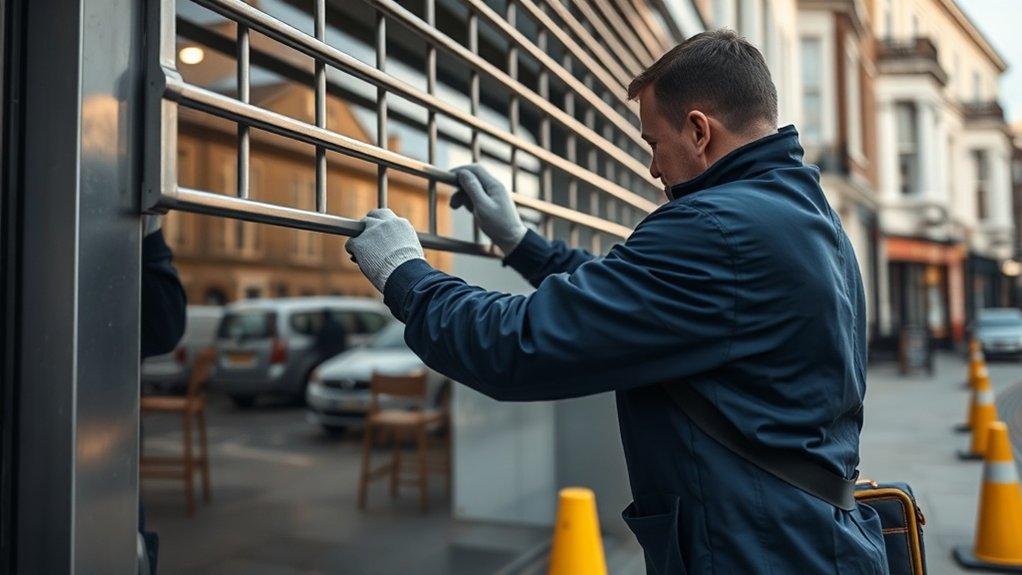
When you’re ready to install a security grille, you must follow a controlled, sequential process that starts with confirming measurements against the manufacturer’s specification and the structural capacity of the opening. You align the frame, check plumb and level, and dry‑fit fixings , validating load paths and material durability against current security trends and local risk profiles.
- Inspect substrate quality, mark fixing points, drill pilot holes with depth stops, and vacuum dust to maintain anchor performance and reduce slip hazards.
- Position the frame, insert certified anchors, torque them to specified settings, and re-check tolerances across all axes before hanging the curtain or lattice.
- Fit locking mechanisms, test travel cycles, verify clearances, and document installation data, including torque values, for compliance and future audits.
Integrating Security Grilles With Alarms, Shutters and CCTV
With the grille mechanically secure and commissioned, you get the most protection by integrating it into a layered security system that links alarms, shutters and CCTV into a single, coordinated response. You connect magnetic contacts or vibration sensors on the grille to your intruder alarm panel, so any forced opening triggers instant alerts and recording.
You then synchronise motorised shutters with the grille status, using programmable logic to define fail‑safe modes: shutters drop on alarm, but release paths stay compliant with fire regulations. CCTV analytics can track grille position, detect tampering, and bookmark events for rapid review.
Throughout, you balance security aesthetics with performance, selecting profiles that preserve sightlines while accommodating cable routing and ventilation considerations for retail, server rooms or plant areas.
Costs of Security Grille Installation in London
Costs for security grille installation in London vary widely, so you need to break them down into material, labour, structural, and compliance components rather than look at a single headline price. A disciplined cost evaluation lets you quantify performance gains , lifecycle durability, and integration with existing security systems.
You’ll typically analyse:
- Materials and design – steel grade, corrosion protection , custom perforation patterns, smart-lock compatibility, and finish coatings.
- Site and structure – opening sizes, lintel strength, anchoring method, power routing, and any fire‑egress or accessibility adaptations that increase drilling, fixing, and cabling time.
- Labour and compliance – hourly rates, certification, waste removal, and commissioning tests.
A realistic installation timeline also affects cost, especially where night work or phased shutdowns are required to maintain operational safety.
How to Choose a Reliable London Security Grille Installer
Although product specifications matter, the competence and governance of your installer determine whether a security grille in London actually delivers its stated resistance and safety performance. You should verify third‑party accreditation (e.g. LPCB, Secured by Design), public liability insurance, and documented method statements and risk assessments tailored to your site’s security risks.
Ask the installer to detail their fixing strategy : substrate assessment, anchor types, edge distances, and anti‑tamper measures. Confirm they understand London‑specific threats, including tool‑based attacks and mixed‑fabric structures (steel, brick, curtain walling).
Evaluate their installation techniques: tolerance control, alignment, load‑path calculation, and integration with access‑control or intrusion‑detection systems. Demand photographic evidence of previous projects, test certificates , and compliance with BS EN 1627‑1630, plus sign‑off documentation confirming as‑installed performance.
Maintenance and Repairs for Security Grilles
Once a competent London installer has signed off your security grille, its long-term resistance depends on systematic maintenance and prompt, technically sound repairs. You should implement a scheduled regime that aligns with manufacturer data, British Standards, and any site-specific risk assessment, especially where historical preservation constraints apply.
- Inspect at defined intervals: verify fixings , locks, hinges, and runners for wear, corrosion, or vandalism; document defects and trigger corrective work immediately.
- Maintain Security grille aesthetics: clean with non-abrasive agents, touch up coatings, and ensure finishes complement heritage façades while retaining certified performance.
- Execute repairs with OEM-grade components: replace deformed bars, faulty cylinders, or damaged meshes using compatible steel, coatings, and anti-tamper fasteners; test operation, emergency egress, and integration with alarms after every intervention.
Frequently Asked Questions
Can Security Grilles Be Painted to Match My Shopfront or Interior Design?
Yes, you can paint security grilles to match your shopfront or interior design, but you must specify aesthetic customization at the design stage. Use a zinc‑phosphate primer and a polyurethane or polyester powder‑coat system for maximum paint durability and corrosion resistance. Guarantee surface preparation by shot‑blasting or chemical etching. Avoid compromising sightlines or hinge clearances, and confirm all coatings remain non‑flammable and compliant with relevant fire and safety standards.
Will Installing Grilles Affect My Natural Light or Visibility Into the Premises?
You’ll lose some natural light and visibility, but modern grille designs minimise this. Open-mesh or lattice patterns optimise light transmission while still addressing visibility concerns and security performance. You can specify bar thickness, aperture size, and powder‑coat finishes to reduce glare and shadowing. With careful positioning behind glazing and compliant fixing methods, you maintain clear sightlines for merchandising and surveillance, while ensuring robust attack resistance and safety standards.
How Long Does a Typical Security Grille Last Before Needing Replacement?
You can typically expect a security grille to last 15–25 years before replacement, assuming consistent grille maintenance and high material durability. You’ll extend lifespan by scheduling systematic inspections, lubricating moving joints, and checking fasteners for fatigue or corrosion. Prioritize powder‑coated steel or advanced alloys with certified impact and torsion resistance. When you see structural warping, compromised welds, or locking misalignment, you should plan a proactive, safety‑driven upgrade.
Can I Remove or Retract the Grilles Myself on a Daily Basis?
Yes, you can usually handle DIY removal or daily retraction if the system’s designed for user operation. Verify the grille uses lightweight, counterbalanced tracks and lockable shoot bolts. Always disengage locks fully, maintain a stable stance, and avoid forcing misaligned sections. Inspect runners, pivots, and hinges regularly for wear. If the mechanism feels unusually stiff or asymmetric, stop and schedule a professional inspection to prevent structural or security failures.
Are There Any Grants or Local Schemes in London That Help Fund Security Grilles?
You won’t find a dedicated city-wide grant for this, but you can tap into broader Funding options. You should check Local grants for crime prevention, such as Safer Streets or Business Improvement District schemes, which sometimes cover target-hardening. Review eligibility, required specifications, and installation standards, as they may mandate certified products, professional fitting, and risk assessments. Document quotes, layouts, and safety compliance to strengthen your application and align with innovative security criteria.
Summary
When you install high‑spec security grilles, you’re not just protecting doors, you’re controlling access; not just securing windows, you’re hardening the perimeter; not just adding metalwork, you’re meeting standards and lowering risk. You assess threats, you match grille types, you comply with London regulations, you coordinate with alarms and CCTV. By choosing qualified installers, scheduling maintenance, and documenting every check, you keep your property safer, your insurer satisfied, and your security strategy truly robust.