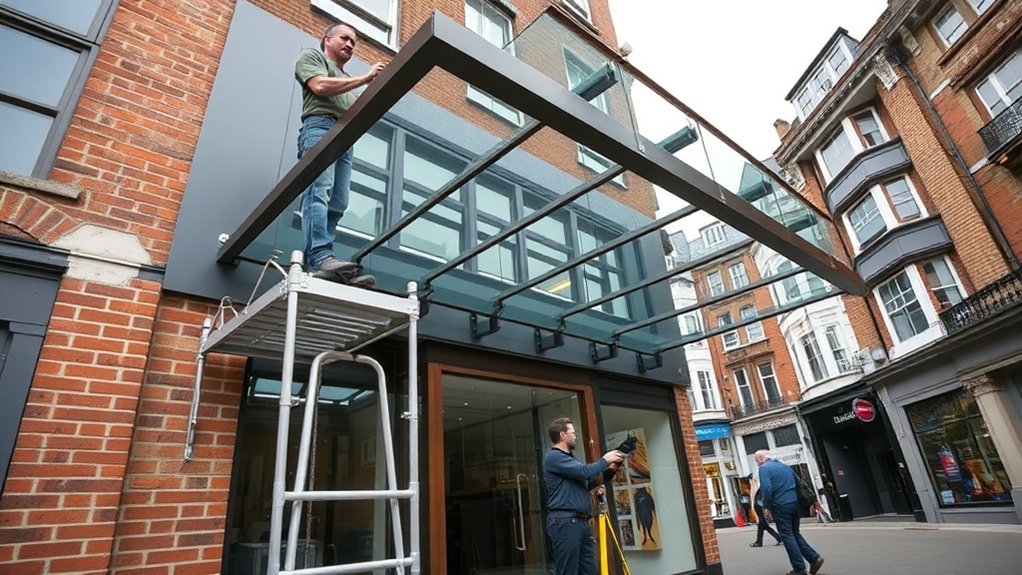
You want a London shopfront canopy that boosts visibility , protects customers from weather, and fully complies with local planning rules. Start by setting clear goals, measuring your façade, and choosing durable materials like powder‑coated aluminium, stainless steel, or laminated glass. Check conservation status, projection over the highway, wind loading, and fixings into your existing wall. Then vet installers with structural calculations, insurance, and London case studies, because the next sections show you exactly how to do this properly.
Key insights
- Check if planning permission, listed building consent, and highway licences are needed for your London location before commissioning a canopy.
- Choose durable, low-maintenance materials such as powder-coated aluminium, stainless steel, or laminated glass suitable for London’s weather and pollution.
- Ensure structural calculations cover wind uplift, snow loads, and façade capacity, complying with Eurocodes and relevant UK building regulations.
- Select experienced canopy installers with London case studies, proper insurance, and detailed CAD-based designs for accurate fabrication and fitting.
- Integrate branding, lighting, and drainage into the canopy design to enhance visibility, customer comfort, and water management on busy London streets.
Step 1: Clarify Your Goals for a London Shopfront Canopy
Before you explore materials or designs, you need to define exactly what you want your London shopfront canopy to achieve—whether that’s weather protection, brand visibility, extended trading space, or all three. Start by mapping pedestrian flows, exposure to rain and sun, and sightlines from key approaches.
Next, translate those conditions into performance criteria : minimum projection, target clearance heights, and illumination levels for signage. Use these as a lens for design inspiration, so creativity always supports function.
You should also quantify maintenance constraints and lifespan expectations to guide material durability choices, including resistance to pollution, UV, and mechanical impact. Finally, set measurable goals —footfall uplift, dwell time, or outdoor sales volume—so your canopy’s impact can be evaluated and refined after installation.
Main Types of Shopfront Canopies for London Businesses
Once you’re clear on performance goals, you can evaluate the main canopy types London businesses actually use: fixed framed canopies that provide permanent, high-stability coverage; retractable awnings (manual or motorised) that let you modulate shade and visibility; traditional Victorian-style and bullnose canopies that suit heritage frontages ; minimalist glass or polycarbonate canopies for contemporary façades; and modular, demountable systems for flexible trading or seasonal use.
You’ll balance load paths, wind exposure, and fixing conditions with brand expression and street presence . For sensitive streetscapes, you can align with Historical preservation requirements using slender steelwork, heritage fabrics, and concealed fixings. Contemporary schemes might favour structural glass with point-fixings, integrating lighting, sensors, and branding for high-impact Artistic design.
- Align canopy geometry with pedestrian desire lines
- Integrate lighting to extend trading hours
- Specify materials that age gracefully in London’s climate
Shopfront Canopy Costs in London: Setting a Realistic Budget
When you start putting numbers against canopy ideas, you quickly see that “how much does a shopfront canopy cost in London?” is the wrong question; the right one is “what performance and lifespan am I budgeting for?”. You’re balancing upfront spend against lifecycle value : engineering quality, material durability, and maintenance intervals.
You’ll typically cost by linear metre plus complexity: bespoke steelwork, integrated lighting, drainage, and branding all add defined increments. Customer preferences drive finish choices—powder‑coated aluminium, stainless steel, laminated glass, or performance fabrics—each with different replacement cycles and cleaning demands.
Factor installation access, structural strengthening, and interface with existing façades. A realistic budget aligns specification, risk tolerance, and trading goals, so you pay once for robust performance rather than repeatedly for reactive fixes.
Planning Permission Rules for London Shopfront Canopies
Although a canopy can look like a simple add‑on, London planning rules treat it as an alteration to the building’s exterior, so you can’t assume it’s “permitted development.” You need to check three things early: whether the property is in a conservation area or is listed, whether the canopy projects over the public highway (triggering separate licences from the borough or TfL), and whether the design alters the shopfront’s structural opening or character.
You’ll usually submit scaled drawings , materials specifications, and a planning statement explaining how the proposal respects local policy on urban aesthetics and canopy sustainability. Councils increasingly expect low‑impact lighting, discreet branding, and recyclable or low‑carbon materials.
- Align canopy depth and height with neighbouring frontages
- Specify drainage so run‑off doesn’t reach the pavement
- Demonstrate how materials support long‑term sustainability
Essential London Regulations for Safe Canopy Installation
When you install a shopfront canopy in London, you must coordinate planning permission requirements with strict safety and compliance standards set by local authorities and the Building Regulations. You need to guarantee the canopy’s projections, fixing methods, and load capacities meet statutory thresholds while protecting pedestrians and the public highway. By aligning design, materials, and installation methods with these rules from the outset, you reduce approval risks and secure a safer, fully compliant installation.
Planning Permission Requirements
Before you commit to a new shopfront canopy in London, you need to understand exactly how planning permission and associated consents apply to your premises. You’ll typically engage with your local planning authority, who’ll assess impact on Historical preservation, Urban aesthetics, and neighbouring uses. In conservation areas or listed buildings, expect tighter control over projection depth , fixing methods, and illumination.
Key checkpoints you should address:
- Proposed canopy dimensions, projection line, and relationship to the public highway
- Materials, colour temperature of lighting, and integration with existing façade rhythms
- Interaction with signage consent, prior approvals, and building’s heritage status
You’ll streamline approval by submitting precise drawings, sections, and load data, plus a design statement that evidences contextual fit and future‑ready visual impact.
Safety And Compliance Standards
Once you move beyond planning permission , you must align your shopfront canopy with a defined set of safety and compliance standards that apply across London. You’ll need structural calculations demonstrating resistance to wind uplift, imposed loads, and impact, plus certified fixings suitable for your façade substrate. Edge heights, minimum headroom, and projection limits must prevent conflicts with pedestrians, vehicles, and emergency access.
You also have to meet fire-performance criteria , including reaction-to-fire ratings for fabrics, glazing, and composite panels, and maintain safe separation from ignition sources. In conservation areas, you must balance historical preservation with contemporary materials, ensuring reversible fixings and minimal visual intrusion. Integrating lighting, signage, and heating into the canopy must comply with electrical and accessibility regulations while enhancing customer engagement.
Measuring Your Shopfront and Checking Structural Safety
Before you select a canopy system, you’ll need precise measurements of your shopfront opening, projection, and fixing heights to guarantee a secure, watertight fit. At the same time, you must confirm that the wall or façade is genuinely load-bearing and capable of taking the additional weight and wind forces of the canopy. By identifying any structural weak points early—such as cracked masonry, corroded steel, or loose fixings—you can address risks proactively and avoid costly reinforcement later.
Accurate Canopy Measurements
How do you make sure your new canopy actually fits your shopfront and doesn’t overload the structure? You start with precise, repeatable measurements . Capture overall width, desired projection, and mounting height with a laser measure, then verify against physical obstacles like columns, shutters, and existing canopy signage.
- Map every opening: doors, windows, vents, and access panels that the canopy must clear.
- Record façade irregularities : cladding thickness, reveals, and soffits that affect bracket positions.
- Reserve zones for upgrades: cable routes, drivers, and sensors for future canopy illumination.
Document dimensions in a scaled elevation drawing, including datum lines and tolerance bands. This lets your installer fabricate components that align perfectly with your shopfront geometry, preventing onsite modifications and ensuring clean integration with your brand-led canopy signage.
Assessing Wall Load-Bearing
Although accurate dimensions are essential, your canopy design is only viable if the shopfront wall can safely carry the added loads. You start with a structured wall assessment: identify construction type (solid brick, blockwork, framed system, or composite panel), check wall thickness, and confirm how the façade connects back to the main structure.
Next, you carry out a load evaluation. You calculate self‑weight of the canopy, imposed loads from wind and snow, and dynamic forces from uplift and vibration. You then compare these figures with the wall’s allowable bearing and pull‑out capacities, using manufacturer data and relevant Eurocodes.
Identifying Structural Weak Points
Once you’ve confirmed the wall’s basic load‑bearing capacity, you need to pinpoint any structural weak points that could compromise the canopy fixings. Start by mapping services and openings: locate lintels, vents, conduits, and any patched masonry. Measure the full shopfront width and height, then mark proposed bracket positions , checking for consistent substrate quality at each fixing point.
Pay close attention to:
- Existing cracks, spalled bricks, or blown render that could reduce anchor performance
- Corroded steelwork or decayed timber that undermines long‑term material durability
- Misaligned façades or deflected beams that might distort canopy aesthetics over time
Use a hammer tap test, moisture readings, and, where needed, borescope inspection to validate internal condition before finalising bracket layout and fixing specification.
Best Shopfront Canopy Materials for London Weather
Because London’s weather combines frequent rain, fluctuating temperatures, pollution, and occasional high winds, you need canopy materials that deliver structural strength, corrosion resistance, and low maintenance over the long term. You should prioritise Material durability first, then refine Aesthetic appeal around that performance baseline.
For primary structure, opt for powder-coated aluminium or stainless steel (grade 316 in harsher locations). Both offer high strength‑to‑weight ratios, excellent corrosion resistance, and predictable lifecycle costs. Where you need lighter loads on existing façades, aluminium is usually preferable.
For glazing or overhead panels, consider laminated safety glass with hydrophobic coatings or UV-stable polycarbonate for impact resistance and reduced weight. Advanced fluoropolymer coatings and anodised finishes help your canopy retain colour, resist grime adhesion, and minimise cleaning cycles in London’s polluted, moisture-rich environment.
Design Tips to Match Your Canopy to Your London Street
When you design a shopfront canopy in London, you need to match its proportions, profiles, and fixtures to the surrounding streetscape, especially in conservation or heritage areas. At the same time, you should coordinate colours, graphics, and lighting with your brand so the canopy supports visibility without clashing with neighbouring façades. You’ll also want to specify materials, finishes, and angles that perform in London’s rain, wind, and pollution while still looking sharp from pavement level.
Complementing Historic Streetscapes
Although every London street has its own architectural rhythm, your canopy should align with the prevailing proportions, materials, and period details rather than compete with them. You’re working within a live context of urban aesthetics and historical preservation, so you need a design that reads as contemporary yet inherits cues from adjoining façades.
- Use section heights that track existing cornice lines and shopfront transoms, avoiding awkward visual breaks.
- Specify metals, hardwoods, or slimline composite systems that echo traditional joinery while integrating concealed drainage and fixings.
- Refine edges, brackets, and soffits so profiles mirror neighbouring pilasters and arches, keeping fixings reversible to respect listed or conservation-area constraints .
This way, your canopy feels native to the streetscape while still signalling a forward-thinking brand.
Coordinating Colours And Branding
Even in a dense London streetscape, you can treat your canopy as a calibrated branding surface rather than a loud billboard. Start by mapping your palette using colour psychology : cooler blues and greens signal precision and trust, while saturated reds and oranges trigger urgency and appetite. Align these selections with your existing assets to protect branding consistency across fascia, glazing, and digital touchpoints.
Specify exact RAL or Pantone references so powder‑coated frames, fabric, and vinyl graphics match reliably under varied urban lighting. Use contrast ratios that keep your logotype legible from passing buses and opposite pavements without visual glare. Integrate subtle gradients, edge trims, or under‑canopy colour bands to differentiate your offer while still reading as one coherent, systemised brand element .
Adapting To London Weather
Because London throws rain, low sun, soot, and gusting wind at the same shopfront in a single week, you need to treat canopy design as environmental engineering, not just decoration. You’re balancing Urban aesthetics with strict performance criteria, so start by mapping sun paths , prevailing winds, and nearby pollution sources.
Specify marine‑grade aluminium or powder‑coated steel frames for canopy durability, with stainless fixings and sealed joints to resist corrosion and grime. Choose self-cleaning, UV-stable fabrics or laminated glass with hydrophobic coatings to reduce maintenance and staining.
- Prioritise integrated guttering and concealed downpipes to manage intense rainfall
- Use wind-rated brackets, cross-bracing, and load calculations based on street exposure
- Add adjustable drops or side screens to tune comfort across seasons
How to Find and Vet Canopy Installers in London
When you’re choosing a shopfront canopy installer in London, you’re not just hiring a tradesperson; you’re selecting a specialist who must understand structural loading, local planning rules, and high-traffic retail environments. Start by shortlisting firms that publish engineering credentials, project case studies , and references for similar streetscapes.
Ask each installer how they balance canopy aesthetics with wind-loading, water management, and anchoring into existing façades. Request CAD visuals or BIM models to validate design intent and integration with signage, lighting, and branding.
Interrogate their installation timeline: lead times for fabrication, site access constraints, and coordination with other contractors. Confirm they hold appropriate insurance, FENSA- or CHAS-type accreditations, and in-house or partnered structural engineers. Finally, require a written specification , not just a sketch and lump-sum quote.
What to Expect on Shopfront Canopy Installation Day
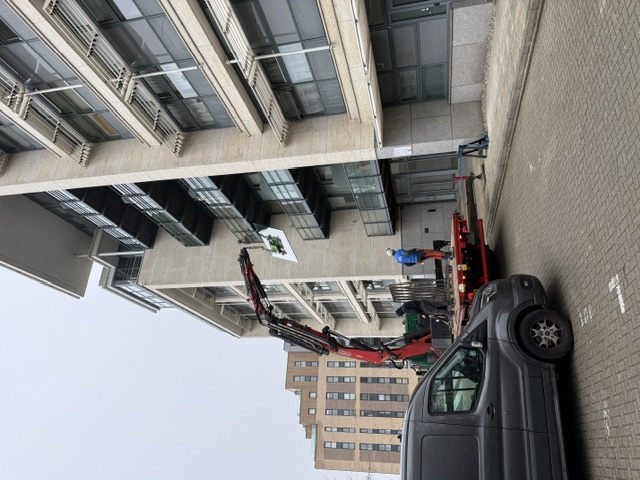
On installation day, you should expect a tightly sequenced operation that starts well before the first bracket touches your façade. The team arrives, confirms drawings , and sets out anchor positions with laser levels, ensuring tolerances match your approved design and local London conditions. You’ll see fixings, drainage components, and lighting conduits laid out in logical stages to minimise disruption to trading.
Expect the crew to brief you on access routes, noise windows, and safety zones, then proceed with structural fixing, canopy frame assembly, and cladding or glazing.
- Verify alignment, projection, and clearance against your shopfront
- Test integrated lighting and signage for creative branding impact
- Review sightlines to optimise customer engagement and street visibility
Maintaining Your Shopfront Canopy for Long-Term Value in London
Even the best-designed shopfront canopy only delivers long-term value in London if you maintain it to a clear, scheduled standard. You should implement a quarterly inspection plan covering fixings, joints, guttering, and sealants, documenting any movement, corrosion, or water ingress. Prioritise fastener torque checks, drainage clearance, and surface integrity to prevent structural fatigue.
Clean glazing, metalwork, and composite panels with manufacturer-approved agents to avoid coating failure. Integrate your maintenance with Outdoor lighting and canopy signage checks: verify IP ratings, cable integrity, and LED driver performance, and recalibrate sensors or timers for seasonal daylight shifts.
Annually, commission a professional condition survey , including load-path assessment and wind-uptift review, ensuring the canopy continues to meet local regulations and your evolving brand requirements.
Frequently Asked Questions
Can a Shopfront Canopy Include Integrated CCTV or Security Features?
Yes, you can integrate CCTV and other security features directly into a shopfront canopy. You’ll typically use concealed conduits for power and data, weatherproof camera housings, and discreet mounting points to maintain aesthetics. This security integration supports advanced surveillance options like wide-angle coverage, night vision, and AI-enabled analytics. You can also sync cameras with access control, alarms, and remote monitoring platforms for a fully networked, future-ready storefront security ecosystem.
How Do Canopies Affect My Shop’s Energy Efficiency and Indoor Temperature?
You gain energy savings because the canopy blocks direct solar gain, reducing cooling loads and stabilising internal temperature control. As the saying goes, “an ounce of prevention is worth a pound of cure” — shading glass prevents excessive heat before it enters. You’ll minimise HVAC cycling, improve comfort near windows, and reduce glare. With advanced materials and smart angles, you optimise seasonal performance while supporting a more innovative, efficient building envelope.
Are There Eco-Friendly or Recycled Materials Suitable for London Shopfront Canopies?
You’ve got strong eco friendly materials and recycled options for canopies. Specify powder‑coated recycled aluminium framing, plus fabric from recycled PET or solution‑dyed acrylics with low VOC finishes. Consider laminated glass with high recycled content or bio‑based polycarbonate for impact zones. You’ll also want BRE or Cradle to Cradle certifications, documented recycled content, and full lifecycle data to align the canopy with ESG targets and future‑focused branding.
Can I Add Heating or Lighting to My Canopy for Outdoor Customer Seating?
You can absolutely integrate heating and lighting into your canopy. For Heating options, you’ll typically use overhead infrared heaters or discreet under‑canopy radiant panels, all zoned and thermostatically controlled. For Lighting enhancements, you’ll combine dimmable LED strips, downlights, and accent spots, wired on separate circuits for task and ambience. You’ll coordinate load calculations, IP‑rated fittings , cable routes, and smart controls to keep the system safe, efficient, and future‑proof.
How Does a New Canopy Influence Business Insurance Premiums or Coverage Terms?
A new canopy can change your premiums and coverage terms because insurers reassess risk, construction quality, and compliance. You might access Insurance discounts if the design improves weather protection, customer safety, and fire resistance. Expect possible Coverage adjustments for structural damage, business interruption, and public liability. You should supply engineering specs, wind/snow load data, fire ratings, and maintenance plans so underwriters can price innovatively while keeping your policy conditions transparent and optimised.
Summary
When you plan your London shopfront canopy with care—goals, permissions, load calculations, and installers—you protect your brand, budget, and compliance record. You’re not just bolting metal above a doorway; you’re engineering a durable, street‑legal asset . Treat ongoing inspections and cleaning like scheduled software updates for your façade, and you’ll extend lifespan, minimise downtime, and keep your frontage performing flawlessly—whatever London’s weather, footfall, or planning officers decide to throw at it.