
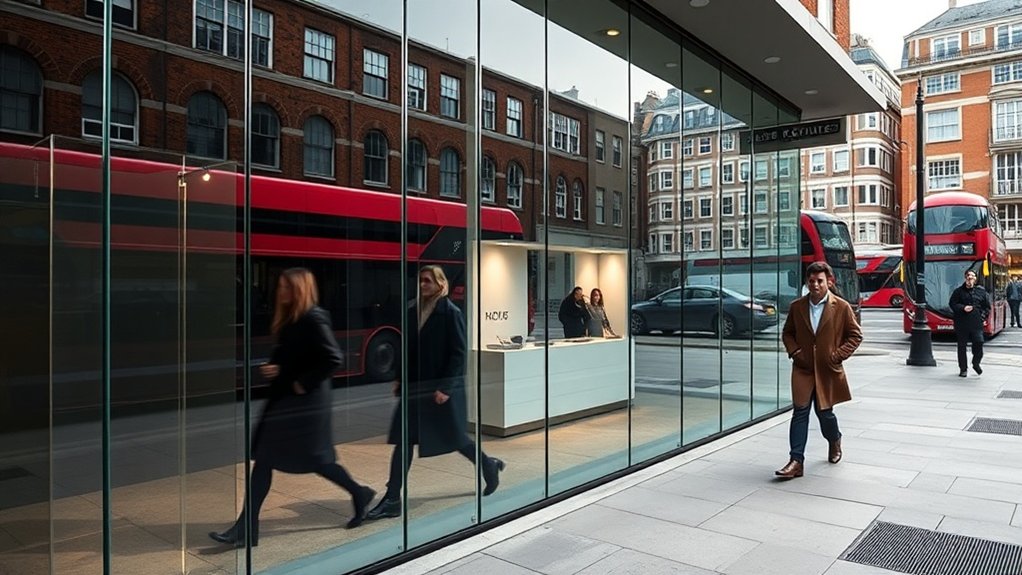
You choose a frameless glass shop front in London to maximise frontage visibility, create a continuous glazed plane and meet strict UK standards (BS 6262, BS EN 12150/14449, BS EN 1991). You’ll use toughened or laminated low‑iron glass, precision‑engineered patch fittings, head/base channels and floor springs for a clean, structurally verified façade. It’s costlier than basic aluminium but boosts daylighting, merchandising impact and long-term lifecycle value, which you can fully understand in the sections that follow.
Key insights
- Frameless glass shop fronts maximise visibility and daylight, creating a premium, modern façade ideal for competitive London retail streets.
- Systems use toughened or laminated structural glass with minimal patch fittings, channels, and spider brackets, eliminating bulky frames and mullions.
- Installations must comply with UK standards (BS 6262, BS EN 12150/14449, BS EN 1991) and London-specific planning or conservation requirements.
- Professional installers manage structural calculations, on-site lifting, weather sealing, and safety under CDM Regulations and local authority conditions.
- Although higher upfront cost than framed systems, frameless fronts offer lower maintenance, strong durability, and improved revenue potential per square metre.
Why Frameless Glass Suits London Shops
Because London’s retail landscape is dense, competitive, and visibility‑driven, frameless glass shop fronts offer a high‑performance solution that maximises frontage exposure while meeting stringent planning and building control requirements. You gain a continuous glazed plane that amplifies visual merchandising, daylight penetration, and customer sightlines without bulky mullions interrupting the façade.
You can also integrate frameless systems sensitively within Historical architecture , using low‑iron glass, discreet fixing channels, and colour‑matched ironmongery to preserve heritage character while upgrading performance. Advanced glazing specifications let you engineer U‑values, g‑values, and acoustic ratings to suit high‑street microclimates and transport noise.
From an Environmental impact perspective, optimised solar gain, daylight harvesting, and thermally enhanced glass reduce operational energy demands while maintaining a contemporary, premium aesthetic aligned with forward‑thinking London brands.
What Frameless Glass Shop Fronts Actually Are
To understand why frameless glass performs so well in London, you need a clear definition of what it actually is from a system perspective. A frameless glass shop front is a structural glazing assembly where toughened or laminated glass panels act as the primary visual and environmental barrier, with minimal visible supports . You replace bulky mullions and transoms with discreet channels, patch fittings, and spider brackets, creating a continuous transparent plane.
You integrate door leaves, sidelights, and overpanels into one coherent glass envelope. This lets you align contemporary façades with surrounding historical architecture while still showcasing products like curated glass art. In performance terms, you’re specifying a high-clarity, load-bearing façade component that manages wind loading, impact resistance, and weather-sealing without conventional framing .
How Frameless Glass Shop Fronts Are Built
When you specify a frameless glass shop front, you’re really defining a structural system that combines laminated or toughened glass panes with precision-engineered patch fittings, channels, and head restraints. You need to understand how point fixings, spider fittings, and floor springs work together with concealed steel or aluminium support frames to carry loads and control deflection. At the same time, you must guarantee the installation sequence, edge clearances, and hardware anchoring comply with BS standards and UK Building Regulations for impact safety, accessibility, and fire egress.
Structural Glass Components
Ever wondered how a frameless glass shop front stands rigid without visible support? You’re relying on a suite of engineered structural glass components that balance structural integrity with premium glass aesthetics.
You typically specify toughened or laminated safety glass, heat‑soaked to minimise spontaneous breakage. Panels are sized based on span, wind load, and crowd loading, then modelled using finite element analysis to control deflection and edge stress. Low‑iron glass maximises transparency, while laminated interlayers enhance post‑breakage performance and acoustic attenuation.
You’ll detail polished, arrissed, or mitred edges depending on exposure and alignment tolerance. Door leaves use thicker glass or laminated build‑ups to resist impact and repetitive cycling. All components are coordinated to behave as a single, load‑sharing glass façade system.
Fixings And Support Systems
Precisely how does a “frameless” shop front actually stay up? You rely on a hybrid of structural glass and precision-engineered fixings. Toughened or laminated panes slot into recessed head and base channels, typically aluminium or stainless steel, anchored into primary structure with chemical anchors or through-bolts. Neoprene setting blocks and gaskets control load transfer and tolerances.
You then supplement this with point-supported systems : countersunk bolts, spider fittings, and patch fittings that clamp the glass without bulky frames. Where you integrate doors, you use floor springs, pivot boxes, and transom patches to distribute dynamic loads. Discreet brackets and carrier profiles can double as tracks for LED decorative accents or housings for custom branding, maintaining clean sightlines while still delivering robust structural performance.
Installation And Safety Standards
Although a frameless glass shop front looks deceptively simple, its installation is a tightly controlled process governed by structural calculations , product certification, and compliance with standards such as BS 6262 (glazing for buildings), BS EN 12150/BS EN 14449 (toughened and laminated glass), and BS EN 1991 (actions on structures). You start by commissioning load-path analysis for dead, live, wind and impact loads, especially critical in narrow London streets and conserved zones of historical architecture.
You then specify glass thickness, interlayer makeup, and hardware to meet barrier-loading and crowd-safety requirements. Installers use laser-set datum lines, proprietary setting blocks, and tested point-fixings, documenting every anchor and sealant batch.
You integrate manifestation, edge protection, and anti-fall redundancy without compromising transparency or artistic designs.
Safety, Security and Durability of Frameless Glass
How do frameless glass shop fronts in London balance visual transparency with robust safety, security, and long-term durability? You achieve this by specifying laminated, toughened safety glass with multi-layer interlayers that hold shattered glass in place and maintain structural integrity under impact. For vandal prevention, you can upgrade to thicker laminates, anti-scratch and anti-graffiti coatings, and integrate hidden fixings that eliminate pry points.
You enhance security by pairing the glass with high-spec lock hardware, continuous top-and-bottom rails, and engineered patch fittings tested for dynamic loading and forced entry. To maximise durability, you select hardware in marine-grade stainless steel, use high-performance perimeter seals, and design for deflection control, thermal stress, and repetitive door cycles, ensuring stable performance under heavy footfall.
London Planning Rules and Building Regs for Shopfronts
While high‑performance glass and hardware determine how your shopfront behaves in use, London planning rules and UK Building Regulations dictate what you’re actually allowed to install on the street. You’ll navigate two parallel frameworks: planning consent and Building Regs sign‑off.
Planning officers assess visual impact, protection of historical architecture, and local zoning constraints. In conservation areas or listed buildings , frameless glass must respect existing proportions, stall‑riser heights, and transom lines, often guided by supplementary planning documents.
Building Regulations focus on compliance with Parts B, K, L, M and N: fire strategy, impact safety, thermal performance, and step‑free access. You’ll need laminated safety glass, defined manifestation bands, controlled door clear widths, and compliant ironmongery, all evidenced via specifications, calculations, and as‑built documentation.
Frameless Glass Shop Front Costs in London
When you cost a frameless glass shop front in London, you’re primarily paying for glass specification (toughened vs. laminated, thickness), hardware quality (patch fittings, floor springs, channels), and installation complexity (structural openings, access, out-of-hours fit). You also need to factor in London-weighted labour rates , glazing logistics, and compliance items like safety glass markings and manifestation. By comparing these inputs across central, inner, and outer London, you can benchmark realistic m² rates and total project budgets against traditional aluminium or timber-framed systems.
Key Pricing Factors
Several core variables drive the cost of frameless glass shop fronts in London, and understanding them lets you scope a realistic budget before you go to tender. You’ll price around three main levers: glass specification, hardware complexity, and installation constraints .
Glass thickness, lamination, low‑iron substrates, and solar-control coatings all push costs, especially where you’re reconciling historical architecture with contemporary transparency. Bespoke patch fittings, pivot systems, and minimal sightline door gear add fabrication and procurement premiums.
Site-specific constraints matter: structural openings, tolerance issues in older façades, and night‑time or high‑street logistics affect labour. Compliance with Part L, security ratings, and thermal performance further shapes specification. Finally, you’ll pay more for solutions that minimise environmental impact through higher-performing glass and recyclability-focused systems.
Cost Comparison London
So how do frameless glass shop front costs in London actually benchmark against other frontage options you’re likely considering? You’ll typically pay more upfront than for timber, uPVC, or basic aluminium systems, because you’re buying structural glazing, precision hardware, and high-spec safety glass engineered for urban impact loads and security ratings.
However, when you factor lifecycle costing , frameless glass often outperforms traditional shop fronts. You reduce ongoing maintenance, repainting, and joinery repairs, which is critical in high-footfall London zones. In conservation areas with Historical architecture or strong Cultural significance, you may incur design, planning, and heritage-consultancy fees, yet frameless systems still deliver superior daylighting, merchandising visibility, and brand presence—meaning higher revenue-per-square-metre can offset the premium capital expenditure.
Key Benefits of Frameless Glass for Retailers
Although it may look minimalist, frameless glass delivers measurable commercial advantages for London retailers by maximising visibility , floorplate efficiency, and perceived brand value. You replace bulky mullions with high-spec laminated or toughened panels, freeing usable frontage and improving circulation. In conservation zones with sensitive historical architecture, you can deploy discreet patch fittings and low-iron glass to meet planning constraints while maintaining a contemporary retail aesthetic.
Frameless systems also support ESG targets. With thermally efficient glazing , you reduce operational energy demand and overall environmental impact when compared with legacy aluminium-framed façades.
- Increase net lettable area through reduced structural footprint
- Enhance brand perception via uninterrupted, premium visual merchandising planes
- Future-proof assets with durable, low‑maintenance hardware and upgradeable glazing specifications
More Light and Visibility on Busy London Streets
By removing visual barriers at street level, a frameless glass shop front converts passing footfall on Oxford Street or Regent Street into high-value visual impressions , extending your merchandising reach well beyond the lease line. You maximise sightlines, enabling full-depth product visibility from oblique pedestrian angles and across wide crossing points.
High-clarity, low-iron glazing optimises daylight transmission, reducing reliance on artificial lighting and improving colour rendition of your artistic design schemes. Edge-to-edge glass, minimal patch fittings, and recessed head channels create an uninterrupted visual field while complying with Part L and solar-gain criteria . You can integrate fritted bands or subtle manifestation for glare control without compromising transparency. In conservation zones, frameless systems support historical preservation by retaining existing masonry rhythms while delivering contemporary permeability and street-level activation.
Creating a Premium Brand Image With Glass Fronts
A frameless glass shop front operates as a high-performance brand interface, signalling quality, precision, and confidence before a customer even crosses the threshold. You transform the façade into a seamless UX touchpoint , where structural glazing, minimal iron glass, and precision-engineered channels communicate a premium positioning instantly.
By eliminating visual noise, you foreground curated product displays, digital signage , and even rotating art installations that align with your brand narrative. In sensitive London streetscapes, you can integrate frameless systems with historical preservation parameters, using discreet fixings and recessed head tracks to respect original masonry.
- Reduce perceived barriers and invite intuitive entry
- Showcase premium materials and detailing at micro scale
- Synchronise exterior branding with in-store spatial choreography
Energy Efficiency and Comfort With All-Glass Shopfronts
When you specify an all-glass shopfront in London’s climate, energy performance and thermal comfort become engineering variables you can’t ignore, not aesthetic afterthoughts. You’re managing solar gains, conductive losses, and air permeability as part of a controlled façade system, not just a display window.
You’ll model peak cooling and heating loads, then tune the façade to deliver Energy savings while maintaining stable thermal comfort in both perimeter zones and deep-plan areas. Detailing at slab edges, junctions, and thresholds must minimise cold bridging and uncontrolled air leakage. Integrate shading strategies, night-time heat loss mitigation, and sensor-driven controls for lighting and HVAC. Done correctly, your frameless glass frontage becomes a high-performance environmental buffer, not an energy liability.
Choosing Glass Types, Hardware and Door Systems
How you specify glass types, hardware and door systems will determine whether your London shopfront feels like a precision façade assembly or a fragile display case. You’ll balance structural performance , security, and visual permeability. Specify toughened or laminated glass with heat-soak testing; upgrade to low-iron for premium transparency that showcases merchandise and glass art like a gallery frontage.
Use patch fittings, countersunk rails and minimalistic pivot or floor-spring hardware to keep mullion-free sightlines aligned with high-end interior design.
- Select glass thickness and interlayers to meet crowd-load, impact and anti-bandit requirements .
- Coordinate door leaf weight with certified floor springs and top pivots for stable, smooth operation.
- Integrate access control, soft-close, and hold-open functions into the door system, not surface add-ons.
Installation Timeline and What to Expect on Site
Before any glass or framework arrives, you’ll go through a pre-installation site survey where technicians check openings, structural substrates, access routes, and power availability against approved drawings. You can then lock in a phased installation schedule that sequences strip-out, frame fixing, glazing, sealing, and commissioning to minimise trading disruption. On site, you should expect method statements, RAMS, PPE compliance, barrier systems, and strict adherence to CDM regulations to control dust, noise, and public interface.
Pre-Installation Site Survey
Curiously overlooked yet absolutely critical, the pre‑installation site survey underpins a smooth, compliant, and on‑programme shop front installation. You’ll see the surveyor validate structural openings, slab levels , and load paths to ensure the frameless system performs as designed and elevates retail branding and customer experience, not just basic compliance.
They’ll capture millimetre‑accurate dimensions, verify datum points, and map service penetrations so glass modules, fixings, and channels are fabricated without guesswork.
You should expect rigorous checks of:
- Substrate integrity, tolerances, and suitability for concealed fixings and channels
- Interface conditions with signage, lighting, and thresholds to avoid cold bridges and trip points
- Local constraints: London street access, noise windows, and security risks influencing site logistics and glazing methodology
Typical Installation Schedule
Once the survey’s signed off and fabrication slots are locked, the installation schedule becomes a tightly sequenced programme that dictates what actually happens on your pavement and behind the hoarding. You’ll receive a phased Gantt-style timeline detailing enabling works, frame preparation, glazing, sealing, and commissioning.
Day one typically covers set-out , temporary weather protection, and any interfaces with historical architecture to guarantee heritage lines and sightlines remain uncompromised. Structural glass, channels, and point-fixings arrive in pre-batched drops to minimise street clutter and environmental impact.
Specialist crews then crane or trolley panes into position, plumb and level them, apply structural silicones, and install ironmongery. Final days focus on tolerances, air–water testing, thermal breaks, and integration with lighting and signage infrastructure.
On-Site Safety Procedures
Although the installation programme might look straightforward on paper, the live site operates under a tightly controlled safety regime governed by CDM Regulations, local authority conditions, and your principal contractor’s RAMS (Risk Assessment and Method Statement). You’ll see delineated exclusion zones , calibrated lifting gear, and safety barriers sequenced with the glazing schedule, pedestrian flows, and neighbouring trades.
Your installer’s site supervisor will run daily briefings, toolbox talks, and point-of-work risk assessments before any glass handling, drilling, or structural fixing begins. They’ll also integrate emergency protocols with the main contractor’s fire strategy and muster points.
Expect them to verify:
- Access/egress routes, loading bays, and traffic management
- Fixing substrates, temporary works, and glass storage zones
- Interface of alarms, signage, and emergency protocols with your retail operation
Cleaning and Maintaining Your Frameless Glass Shop Front
When you invest in a frameless glass shop front, rigorous cleaning and preventative maintenance become critical to preserving optical clarity, structural integrity, and brand presentation. You’re operating in London’s dense streetscape, where historical architecture, traffic particulates, and airborne pollutants accelerate surface contamination and gasket degradation.
Establish a scheduled maintenance regime : use pH-neutral, non-abrasive detergents, deionised water, and lint-free microfiber cloths to avoid micro-scratching and rainbowing. Inspect silicone joints, structural glazing seals, and patch fittings for creep, delamination, or moisture ingress. Monitor drainage channels and threshold details to prevent standing water that increases environmental impact through premature component replacement.
Calibrate an annual façade survey: check for edge chips, nickel-sulfide inclusions, and hardware fatigue. Document interventions to maintain warranty compliance and lifecycle performance.
Choosing a Frameless Glass Installer in London
Selecting a frameless glass installer in London isn’t just a procurement decision; it’s a risk-management exercise that determines structural performance, compliance, and long-term lifecycle costs . You need a contractor who understands historical architecture, conservation constraints, and high-performance glazing systems, not a generic shopfront fitter. Scrutinise their track record on structural glass, point-fixed fittings, and load paths for large panes under wind and impact.
Prioritise installers who:
- Provide project-specific structural calculations and glass specification sheets
- Demonstrate mastery of local regulations, including planning, Building Regulations, and heritage consents
- Offer transparent warranties on glass, hardware, sealants, and installation workmanship
Insist on site surveys with tolerances recorded, interface detailing (slab, soffit, returns), and coordination with M&E to avoid clashes with lighting, sensors, and security hardware.
Frequently Asked Questions
Can Frameless Glass Shop Fronts Be Integrated With Automatic Sliding or Bi-Folding Doors?
Yes, you can integrate frameless glazing with automatic sliding or bi-folding doors using structural glass , slimline tracks, and concealed headers. You’ll specify compatible door operators, access controls, and integrated security features like laminated glass, maglocks, and monitored locking points. Factor in maintenance requirements: periodic alignment checks, lubrication of tracks, sensor calibration, and glass hardware inspections to guarantee long-term operational reliability, user safety, and seamless architectural minimalism.
How Do Frameless Glass Shop Fronts Perform Acoustically on Noisy London Streets?
You’ll find acoustic performance depends on glass spec, coincidence frequency, and frame detailing. Laminated, acoustic interlayered glazing markedly boosts sound insulation and noise reduction versus single toughened glass. When you specify thicker laminates, asymmetric build-ups, and fully sealed perimeter channels, you’ll typically achieve 35–40dB Rw, enough to tame most high-street traffic. Combine this with decoupled ceilings and insulated bulkheads to prevent flanking transmission from noisy London streets.
Can I Add Branding, Frosting, or Digital Screens Directly Onto Frameless Glass?
You can integrate branding, frosting, and digital displays directly onto frameless glass . You’ll typically use high‑performance decorative window films for privacy bands, gradients, or manifest markings, while leveraging custom branding options via printed vinyl, plot‑cut logos, and reverse-applied graphics. For digital engagement, you can specify rear‑projection films or LED screens mounted on discreet brackets, ensuring cable management, thermal performance, and glass load tolerances meet manufacturer specifications.
What Happens if a Frameless Glass Panel Is Damaged During Shopfit or Operation?
If a panel’s damaged, you treat it like a compromised structural element, not a cosmetic flaw. You’ll cordon off the impact zone , engage glass safety protocols, and conduct a visual and edge-spall inspection. Glaziers then follow strict repair procedures: temporary bracing, panel deglazing, hardware decoupling, and like-for-like toughened or laminated replacement. You’ll also recalibrate alignments, re-tension fittings, and re-certify compliance with BS/EN safety standards before reopening.
Are Frameless Glass Shop Fronts Suitable for Heritage or Listed Interior Refurbishments?
They’re often suitable , provided you treat them as a reversible intervention. You coordinate with conservation officers to guarantee Historical preservation, then specify minimalist patch fittings and low-iron glass for seamless aesthetic integration with original fabric. You’ll detail discreet fixings into mortar joints, avoid chasing historic stone or timber, and integrate concealed floor springs and cappings. Done right, you maintain sightlines, protect heritage elements, and still achieve a contemporary, innovation‑driven retail envelope.
Summary
You might worry frameless glass is fragile, but with 12–21.5mm heat‑soaked toughened or laminated panes, structurally bonded joints and EN-356 compliant locksets, it’s engineered to perform like a structural element, not décor. When you specify the right glass build‑up, patch fittings, floor springs and access control, you’re not just upgrading a façade – you’re optimising sightlines, footfall conversion and brand perception on one of the world’s most demanding high streets.