
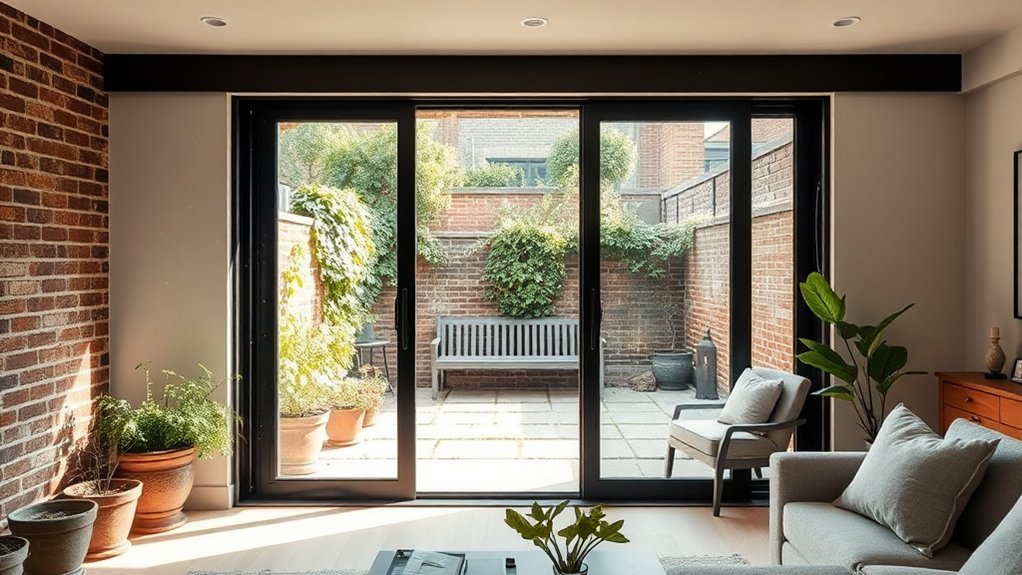
A bifold wall to your London garden replaces a standard rear wall with a slim, thermally broken aluminium façade that maximises clear opening width and daylight. You align internal and external floor levels with a flush, drained threshold, design the lintel or steel beam to span the aperture, and coordinate leaf stacking so circulation stays clear. With the right glazing, security hardware, and compliant detailing, you can turn a narrow plot into a high‑performance indoor–outdoor room, as you’ll soon see.
Key insights
- Choose thermally broken aluminium bifold systems for London’s damp, polluted climate, balancing slim sightlines, durability, and low maintenance.
- Check if your garden bifold falls under permitted development or needs planning consent, especially in conservation areas or with Article 4 restrictions.
- Design for flush internal–external thresholds with proper drainage, ensuring accessibility, weather tightness, and continuity of flooring from house to garden.
- Position the bifold along the longest garden-facing wall to maximize glazing, daylight, views, and perceived floor space in narrow London plots.
- Specify secure, energy-efficient glazing with multipoint locking, laminated units, and low U-values to improve security, comfort, and running costs.
Why London Homes Love Garden Bifold Walls
Why do so many London homes replace solid rear walls with garden bifold systems ? You gain maximum aperture width with minimal frame interruption, transforming a constrained rear elevation into a continuous glazed façade. Slim aluminium profiles, low‑profile threshold tracks, and high-spec double or triple glazing optimise indoor aesthetics while maintaining thermal performance.
You extend the perceived floor plate as sightlines run unbroken from kitchen to terrace, vital in narrow terrace plots. When open, leaf stacking configurations free up circulation space and enable seamless indoor–outdoor flow.
With correct orientation and glazing ratios, you increase daylight factor, reducing artificial lighting loads and supporting garden sustainability through better plant growth and microclimate control. Advanced seals, drainage details, and secure locking maintain envelope integrity without sacrificing spatial connectivity.
Is a Garden Bifold Wall Right for Your London Home?
You’ll first need to assess your available wall span , garden aspect, and structural load paths to determine if a bifold system can integrate cleanly with your existing envelope. Then you can quantify costs against benefits by comparing U-values, glazing ratios, and threshold configurations to your current façade. By evaluating sightlines, opening geometry, and the impact on usable floor and patio zones, you’ll see whether a garden bifold wall is a logical upgrade for your London home.
Assessing Your Space
Before specifying a bifold wall system , you need to evaluate how your London property’s existing structure, garden layout, and orientation will accommodate large glazed openings. Start by analysing wall load‑bearing capacity, lintel span requirements, and potential steel reinforcement. Check floor levels and thresholds to enable a flush internal–external transition that won’t compromise drainage or insulation.
Map how sunlight tracks across your plot; a south- or west-facing elevation maximises solar gain but may need shading solutions. Internally, assess Indoor décor, furniture arrangement, and circulation routes so open leaf stacks don’t obstruct usage. Externally, measure clearances for leaf parking zones, steps, and planting beds. Confirm there’s sufficient width for the desired aperture while maintaining structural integrity at party-wall junctions.
Weighing Costs And Benefits
Although a bifold wall can transform how your London home connects to the garden, you need to balance capital outlay, thermal performance, and spatial gains against ongoing maintenance and planning constraints. You’ll compare structural alterations, lintel upgrades, and threshold detailing with simpler window or French door replacements through a clear cost comparison .
Quantify benefits: increased daylight factor, improved visual permeability, and a wider clear opening that enhances internal circulation. Consider U‑values, glazing ratios, and potential overheating, especially on south or west elevations.
Factor in hardware longevity, re-sealing cycles, and track cleaning, plus any planning or conservation restrictions on frame profiles. Finally, weigh aesthetic appeal—slim sightlines, coherent façade rhythm, and seamless floor levels—against budget, buildability, and long‑term performance.
Transforming Small London Gardens With Bifold Walls
When you specify a bifold wall system for a compact London garden, you effectively convert a constrained footprint into a continuous, multifunctional floor plate that extends from interior to exterior. By replacing a solid rear elevation with large-format glazed panels on a flush threshold, you create seamless indoor-outdoor circulation, maximise daylight penetration , and open up axial and diagonal sightlines across the plot. At the same time, you can control privacy through glass specification, screening elements, and boundary treatments that maintain clear views out while limiting overlooking from neighbouring properties.
Maximising Compact Outdoor Space
Because London gardens often occupy narrow plots and irregular footprints, a bifold wall system can operate as a precise spatial hinge that releases usable area rather than consuming it. By stacking panels laterally along a minimal track, you replace bulky swing arcs with a compact folding radius , freeing circulation corridors and planting zones.
You can then calibrate Outdoor furniture as modular, perimeter‑based elements—built‑in benches, fold‑down tables, and slim profile loungers—so the central zone remains clear and reconfigurable. Vertical surfaces become critical real estate : integrate trellised façades, green screens and wall‑mounted planters to intensify Plant selection without expanding the footprint. Specify species by canopy spread, root behaviour, and maintenance cycle to maintain visual density while preserving every millimetre of programmable floor area.
Seamless Indoor-Outdoor Living
Instead of just extracting more function from a compact plot, a bifold wall lets you treat the garden and interior as a single, continuous volume. You dissolve the conventional threshold, specifying a flush threshold track , consistent floor build-up, and aligned ceiling datum so circulation becomes uninterrupted.
You coordinate Indoor acoustics with external finishes, using absorptive wall linings and soft garden surfaces to limit reverberation when the leaves are fully open. Structural steel or engineered timber frames carry loads above the opening, allowing slim sightlines without compromising lateral stability.
You integrate Garden lighting with interior circuits, zoning dimmable fittings, step lights, and façade washes on unified controls . When the wall folds away, you don’t just open doors; you activate one coherent living field.
Light, Views And Privacy
Although bifold walls maximise daylight and visual reach, you have to control how light, views and privacy interact across a compact London plot. You start by analysing solar orientation , then configure panel stacking so open leafs don’t obstruct natural illumination to interior zones. Use narrow sightline aluminium frames and low-iron glazing to optimise luminance while maintaining structural rigidity.
To safeguard visual privacy, integrate fritted or switchable glass on flanks exposed to neighbouring windows, keeping central panes ultra-clear for axial views to key garden features. Combine sill-height planters, slatted screening and level changes to interrupt oblique sightlines without blocking sky factor. Inside, specify layered shading —sheer blinds plus blackout tracks—so you modulate transparency, glare control and thermal performance through the day.
Costs of Garden Bifold Walls in London
When you scope the costs of a garden bifold wall in London, you’re primarily paying for the glazing specification, frame material, opening width , and installation complexity. You’ll compare material options—aluminium, alu-clad timber, or slimline steel—because sightline thickness, thermal performance, and finish durability all shift the price per linear metre. High‑performance, low‑U‑value glass and oversized panels also raise fabrication and transport costs.
Key cost drivers you’ll evaluate:
- Structural work: new steel beam, padstones, and lintel detailing for wide apertures.
- Ground interface: threshold design, drainage channels, and floor build‑up alignment to achieve level access.
- Programme risk : access constraints, craneage, and coordination of trades, which directly affect the installation timeline and labour overhead.
Planning Rules for Garden Bifold Walls in London
When you plan a bifold wall to your garden in London, you must map its height, projection, and location against national Permitted Development limits and any Article 4 directions. You’ll need to check how the new opening alters the rear elevation, boundary lines, and overall building envelope to guarantee it stays within these statutory parameters. If your property sits in a conservation area , you face tighter controls on materials, frame profiles, and façade alterations, often requiring formal planning consent before construction.
Permitted Development Limits
Even before you sketch a bifold wall from house to garden in London, you have to map its design against UK permitted development limits and any local Article 4 Directions. You’re working inside a tight matrix of height envelopes, projection depths, and façade alterations, all influenced by Historical restrictions embedded in your street’s planning history.
Key dimensional triggers usually include:
- Overall height of the bifold aperture and any supporting lintels or goalpost frame
- Extent of rear projection relative to the original rear wall and garden boundary lines
- Percentage of rear elevation converted to glazing and frame
If you exceed these thresholds, you’ll need formal Building permits. Always cross‑check structural opening width, head height, and threshold level against both PD guidance and your engineer’s calculations so innovation stays compliant.
Conservation Areas And Restrictions
How does a seemingly simple bifold wall to your garden become a complex planning exercise the moment your London home sits in a conservation area ? You’re not just inserting glass; you’re intervening in a controlled heritage streetscape. Local authorities prioritise historical preservation, so they’ll scrutinise your bifold’s profile depth, frame material, and opening geometry.
You must evidence aesthetic integration with existing façades: mullion alignment , cill heights, and brickwork junctions all matter. Expect conditions on visible frame colour, glazing reflectivity, and threshold detailing where inside–outside levels are rationalised. Section drawings should show how lintels, steel beams, and cavity closers sit behind retained masonry. To secure consent, you’ll harmonise advanced thermal performance and slimline aluminium systems with the area’s established spatial rhythm.
Choosing the Right Bifold Style for London Homes
Although London homes vary in age and layout, you’ll select a bifold style primarily by analysing aperture dimensions , opening direction, and threshold conditions. You’ll map clear opening width against structural support, ensuring the folding stack doesn’t obstruct circulation paths or compromise Garden aesthetics. Decide whether you want a single traffic door within the configuration for everyday access.
Key parameters to define include:
- Panel module size, sightline width, and head height to align with existing lintels and floor buildup
- Track system (top‑hung or bottom‑rolling) and threshold profile to balance weather performance with flush, step‑free passage
- Bifold materials and glazing ratios to optimise daylight, thermal efficiency, and visual continuity with your façade
Aluminium vs Timber: Best Bifolds for London Gardens
When you specify bifolds for a London garden, you’re really choosing between aluminium and timber frames with very different performance profiles in humidity, rainfall, and temperature fluctuation. You’ll need to assess how each material resists warping, corrosion, and surface breakdown, how often you must sand, seal, or repaint, and what that means for life‑cycle cost . At the same time, you’re balancing initial outlay, long‑term value, and the way frame thickness, sightlines, and finish textures control the visual shift from interior to garden.
Durability In London Climate
Because London’s microclimate combines frequent rain, high humidity, airborne pollutants, and occasional freeze–thaw cycles, durability becomes a core performance criterion when you specify bifold doors between wall and garden. You’re effectively inserting a dynamic façade element into a highly stressed boundary zone, so Weather resilience and Material longevity must drive your choice.
Aluminium systems use thermally broken profiles and factory-applied polyester powder coating to stabilise performance at the sill and head where water and cold concentrate. Timber responds differently: its hygroscopic structure swells and contracts, so you must anticipate tighter tolerances at the jambs and rebated joints.
- Aluminium: excels in frame rigidity under cyclical loading.
- Engineered timber: offers robust structural integrity when correctly detailed.
- Hybrid frames: optimise internal warmth with external shielding.
Maintenance, Cost And Style
Once you move past durability, aluminium and timber bifolds diverge sharply in maintenance regimes, lifecycle cost , and visual expression, and you need to weigh all three together for a London garden elevation. With aluminium, you’re fundamentally managing hardware checks, track clearance, and occasional seal replacement; Garden maintenance barely intersects the frame beyond keeping debris off threshold drainage channels.
Timber demands cyclical coating , joint inspection, and moisture monitoring. You’ll need to budget for sanding, repainting or re‑oiling, and potential splice repairs on weather‑exposed mullions and bottom rails.
Cost considerations span initial capital outlay, coating cycles, and long‑term hardware upgrades. Aluminium often wins on lifecycle cost; engineered timber wins on tactile depth and façade warmth, especially where you’re curating a biophilic, materially expressive garden interface.
Best Floor Plans for Garden Bifold Walls
Although every London property has its own constraints, the best floor plans for integrating a garden bifold wall share common spatial principles: clear circulation paths, optimized sightlines , and structurally efficient openings. You’ll want a plan that aligns the bifold with the primary activity zone—kitchen island, dining table, or living cluster—so the threshold reads as one continuous volume.
- Position the bifold along the longest exterior elevation to maximize glazing , then coordinate color options with interior finishes to visually extend the room.
- Specify opening mechanisms that stack externally or into a recessed pocket, preserving internal usable floor area.
- Integrate a flush threshold detail, with structural steel (RSJ or box frame) concealed in the ceiling zone to keep head heights generous and views uninterrupted.
Alternatives for Small London Gardens
When a full-width bifold wall isn’t feasible in a tight London plot, you can still achieve strong inside–outside continuity by deploying slimmer, more surgical interventions that respect limited footprint and context. You might specify a single large-format pivot door combined with a fixed structural glazing panel, maintaining lateral stability while maximising clear opening.
Consider a hybrid threshold: a recessed steel channel drains under a minimal step, so floor buildup stays lean yet compliant. Use clerestory side returns to extend sightlines into vertical planting that supports urban wildlife without increasing footprint.
Where historical preservation constraints apply, integrate slimline steel or aluminium sliders within existing masonry apertures, retaining original brick reveals while inserting high‑performance frames, acoustic seals, and thermally broken cills for precise, contemporary performance.
More Natural Light With Garden Bifold Doors
In tighter London plots where you’ve used selective apertures and hybrid thresholds , the next performance gain comes from using bifold doors to pull far more daylight into the plan depth. You’re effectively swapping opaque wall for a glazed façade, increasing vertical daylight factor and improving visual connectivity to the garden. Slim sightlines and large glazed modules reduce structural interruption, so light penetrates deeper into the layout and uplifts indoor aesthetics.
You can tune performance by:
- Aligning bifold stacking with structural gridlines to minimise visible clutter
- Using high-spec low-iron glass and reflective internal finishes to bounce light
- Calibrating material selection (frame colour, reveal depth, floor finish) to modulate glare and contrast
This way, bifold doors act as a precise daylighting instrument, not just a view corridor.
Year-Round Bifold Use in London’s Climate
Because London’s maritime climate cycles rapidly between damp cold, low-angle sun, and humid summer peaks, you need to detail bifold doors as a robust environmental interface rather than a simple seasonal opening. You treat the system as an external façade: assess wind exposure, rain tracking, and solar angles to define threshold height, sill geometry, and drainage routes.
You prioritise material selection : thermally broken aluminium for slim profiles and stability, engineered timber only where you can strictly control moisture, and stainless hardware to resist airborne pollutants. You schedule seasonal maintenance as an operational protocol—lubricating tracks, recalibrating hinges, clearing debris from drain slots, and checking perimeter seals. This keeps panels running smoothly and preserves precise alignments for reliable, year-round operation.
Bifold Thermal Performance in London Homes
Although bifold doors read as lightweight glazing, you need to treat their thermal performance as a critical envelope decision, not a lifestyle upgrade. You’re effectively inserting a giant heat-exchange surface into your London façade, so the frame, glass specification, and threshold detailing must work as a single thermal insulation system.
You should interrogate whole-door U-values, not just glass figures, and insist on warm-edge spacers , low‑e coatings, and argon-filled units. Pay attention to frame conductivity and gasket continuity at every hinge stack.
- Specify thermally broken aluminium or composite frames to balance slim sightlines with energy efficiency.
- Detail a fully insulated, level threshold to prevent linear cold bridges.
- Integrate airtight perimeter tapes and sealants to stabilise internal surface temperatures and reduce convective losses.
Security and Privacy for London Garden Bifold Walls
Treating the bifold wall as part of the building envelope naturally extends from thermal to security and privacy performance, especially on a London garden elevation that often sits within easy reach from the street or side access. You address Security concerns first through certified multipoint locking, anti-lift running gear, laminated security glazing, and reinforced aluminium or steel sections at hinge and lock stiles. You integrate low-profile magnetic contacts and vibration sensors into frames to link with your intruder alarm.
For Privacy solutions, you specify glass with variable opacity: fritted bands, switchable PDLC interlayers , or external-grade blinds recessed in head tracks. You control sightlines by configuring panel stacking to minimise direct views while preserving daylight, and by coordinating sill height with internal floor level.
Pairing Bifold Walls With Garden and Landscaping Design
When you pair a garden bifold wall with considered landscaping rather than treating it as an isolated facade element, the opening becomes a calibrated spatial hinge between interior and exterior. You choreograph movement from slab to softscape with aligned thresholds, consistent levels, and controlled sightlines, so the leaf stack reads as part of a continuous plane , not an interruption.
- Use decking boards or stone modules that run orthogonally to the bifold track, visually extending the interior grid into the garden and amplifying outdoor aesthetics.
- Coordinate planting heights with mullion locations to frame views while preserving transparency.
- Specify robust, low-porosity finishes and drainage detailing at the sill/terrace interface to simplify material maintenance and protect hardware from London’s prevailing moisture.
Choosing London Architects and Installers for Bifolds
Because bifold walls operate as structural apertures rather than decorative inserts, selecting London-based architects and installers who understand load paths, weathering, and tolerances is critical to performance. You need someone who’ll model deflection, specify appropriate steel or engineered timber supports, and coordinate threshold levels so inside–outside circulation remains seamless.
Prioritise practices that integrate structural calculations with elevation studies, aligning mullion positions with your garden geometry and interior decor. Ask how they’ll control air and water ingress at the head and track, and what testing data their preferred systems carry.
Your installer should manage construction permits with borough planners, demonstrate experience in retrofit lintel insertion, and sequence works to protect finishes, maintain temporary stability, and deliver precise frame alignment for long-term operability.
How Garden Bifold Walls Affect London Home Values
With robust design and competent installation in place, a garden-facing bifold wall starts to operate as an asset in valuation terms, not just as a lifestyle upgrade. You’re effectively recalibrating your property’s spatial hierarchy , converting a solid perimeter into a transparent, thermally efficient façade.
Agents read this as premium habitable square meterage: daylight factor rises, visual depth extends, and the garden becomes an annexed living zone. In London, that’s especially valuable where plot sizes are constrained and Historical preservation limits extensions.
- You mitigate Urban noise with high-spec acoustic glazing and airtight seals.
- You enhance energy performance through low‑U‑value frames and glass.
- You future‑proof resale appeal by aligning with biophilic, flexible‑plan design trends .
Frequently Asked Questions
How Do Garden Bifold Walls Impact Noise Levels From Nearby London Streets?
They reduce London street noise only when closed, acting as a partial acoustic insulation barrier. You’ll gain meaningful attenuation with double- or triple-glazed units, laminated glass, and thermally broken aluminium frames. Pay attention to perimeter sealing, threshold detailing, and cavity construction to avoid flanking transmission . When you open the bifold set, you effectively remove the acoustic buffer, so integrate landscape berms, dense planting, and boundary walls as complementary noise-control layers.
Can Existing Openings Be Retrofitted to Accommodate Full-Width Garden Bifold Walls?
You can usually retrofit existing openings for full‑width garden bifold walls. With over 60% of UK homes pre‑1970, you’ll first assess load paths and introduce a new steel or engineered‑timber lintel. You must coordinate with Historical preservation officers where façades are protected and verify Building regulations for structural alterations, thermal performance, and safety glazing. Precise floor‑level datum, threshold detailing, and lateral restraint connections guarantee a seamless, innovative indoor‑outdoor span .
What Maintenance Schedule Keeps London Garden Bifold Walls Operating Smoothly Long Term?
You keep them smooth by scheduling quarterly operational checks and annual deep servicing. Inspect hinges, tracks, and drainage channels every three months; clear debris to protect garden wall aesthetics and sightlines. Lubricate rollers and pivot hardware with manufacturer‑approved products, matched to your bifold door materials. Annually, realign frames, test seals, and tighten fixings to maintain structural tolerances, thermal performance, and precise movement envelopes for long‑term, innovation‑ready outdoor connectivity.
How Do Garden Bifold Walls Perform in Strong Winds and Storms Common Around London?
They behave like a hinged shield in rough weather: with proper Wind resistance specs, they’ll stay stable in strong gusts. You’ll need reinforced frames, multi-point locking, and laminated glazing to maximize storm durability. Make certain anchors transfer lateral loads into the slab and surrounding structure. Configure panels to stack leeward , not windward, and integrate robust gaskets and drainage thresholds so pressure differentials and driven rain don’t compromise performance.
Can Smart Home Systems Integrate With Garden Bifold Wall Locks and Sensors?
Yes, you can integrate smart home systems with garden bifold wall locks and sensors. You specify smart lock integration using Zigbee, Z-Wave, or Matter modules tied to your central hub. Guarantee sensor compatibility for magnetic contact sensors on each panel, multipoint locking status switches, and frame-embedded vibration or glass-break detectors. You then map each leaf as a zone, enabling automated locking , geofenced arming, and real-time structural access monitoring.
Summary
When you step back and test the theory that a bifold wall simply “opens the garden,” you see it actually recalibrates your whole domestic layout. Thresholds flatten, sightlines extend, and the envelope of the building flexes with the seasons. If you resolve the detailing—tracks, drainage, security glazing, and frame depth—you don’t just add glass; you re‑engineer the interface between interior volume and external courtyard, increasing functional area and perceived spatial continuity.