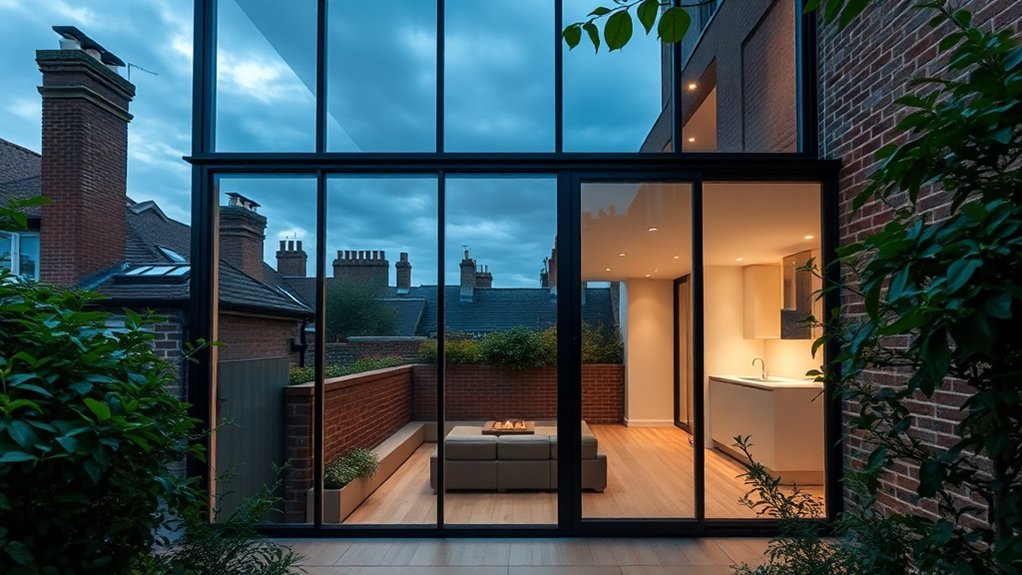
You use glass extension walls in London to recalibrate space, light, and circulation, turning tight plots into open, visually continuous zones between house and garden. Rear, side-return, or wraparound configurations deploy large-format glazing, slim thermally broken frames, and flush thresholds to maximise daylight and views while meeting strict planning, structural, and thermal standards. With the right solar-control coatings, privacy strategies, and detailing, you can achieve a refined, high-performance envelope that the next sections unpack in more depth.
Key insights
- Glass extension walls in London maximise light and views, dissolving boundaries between home and garden while making interiors feel larger without increasing footprint.
- Popular configurations include rear, side-return, and wraparound extensions, tailored to tight plots, orientation, and existing building geometry.
- Planning permission is often required, especially in conservation areas; proposals must address privacy, overlooking, solar gain, and impact on neighbouring properties.
- High-performance glazing, thermally broken slim frames, and solar-control coatings are essential to meet UK energy, safety, and overheating standards.
- Structural strategies typically hide steel supports in floors/ceilings and may use glass fins or cantilevered beams to achieve minimal framing and clean lines.
How Glass Walls Transform Space and Light in London Homes
When you introduce large-format glass walls into a London home, you fundamentally recalibrate how space, light, and circulation operate. You dissolve traditional envelope boundaries, allowing daylight to penetrate deep into the plan and reducing reliance on artificial illumination. Glare control , solar gain, and U‑values become active design parameters, not afterthoughts.
You re-orient sightlines so interior zones visually plug into gardens, mews, or courtyards, increasing perceived volume without expanding the footprint. Historical influences from Victorian winter gardens and Modernist curtain walls inform this move, while London’s Cultural symbolism of transparency, openness, and global outlook underpins it. You choreograph thresholds with minimal frames, flush floor build-ups, and continuous ceiling planes , creating seamless transitions and an intelligent, light-led spatial narrative.
Popular Glass Extension Types in London (Rear, Side Return, Wraparound)
Across London’s housing stock, three glass extension typologies dominate—rear infill, side return, and wraparound—each aligning differently with plan geometry, orientation, and boundary conditions . Rear infill extensions project into the garden, letting you reprogram cellular ground floors into open-plan living zones while maintaining the legibility of historical architecture from the street.
Side return schemes exploit underused lateral strips, inserting slender glazed volumes that enhance daylight penetration and visual porosity between interior and courtyard. You retain the party-wall rhythm yet radically recalibrate spatial depth.
Wraparound extensions combine both moves, tracing the perimeter to form an L-shaped envelope. You choreograph continuous glazing , corner frameless junctions, and rooflights to orchestrate views, reinforce urban aesthetics, and negotiate tight boundary conditions.
Pros and Cons of Glass Extension Walls in London
When you specify glass extension walls, you’re balancing enhanced natural light and perceived spatial volume against thermal performance and potential glare. You’ll need to assess energy efficiency through glazing specs, orientation, and shading strategies, while also resolving privacy through screening, sightline control, and glass treatments. At the same time, you must factor in maintenance demands , including cleaning access, frame durability, and long-term weathering in London’s climate.
Natural Light And Space
How does a full-height glass extension wall recalibrate natural light and spatial perception in a London home? You effectively convert a solid boundary into a luminous plane, extending sightlines into the garden and dissolving the threshold between interior and exterior. Daylight penetrates deeper, reducing reliance on artificial lighting and enhancing visual comfort.
You can modulate transparency with decorative glazing, using fritted, patterned, or tinted glass to control glare, preserve privacy, and create layered spatial hierarchies. Slimline framing systems and flush thresholds maintain continuity of floor and ceiling planes, making compact London rooms feel volumetrically expanded.
However, increased openness can amplify external noise and visual exposure. You’ll need high-spec acoustic insulation in the glazing assembly to retain serenity and protect internal spatial intimacy.
Energy Efficiency Considerations
In energy terms, a full-height glass extension wall operates as both a solar collector and a potential thermal liability, so you need to design its envelope performance with forensic care. You’ll balance solar gain, conductive losses, and airtightness against London’s variable climate and tight urban grain.
Prioritise high-performance glazing : low‑E coatings, warm‑edge spacers, argon fills, and thermally broken aluminium or steel frames. Integrate dynamic shading, external fins, and brise‑soleil to modulate incident radiation while preserving depth and legibility of the façade.
Material innovation lets you specify vacuum‑insulated glazing, electrochromic glass, and aerogel interlayers that deliver slim profiles compatible with historical preservation constraints, particularly in conservation areas. Tie the glass wall into underfloor heating, MVHR, and smart controls to stabilise internal comfort with minimal operational energy.
Privacy And Maintenance
Balanced thermal performance only pays off if the glass extension also works for privacy and long‑term care. You’ll need to balance visual permeability with controlled seclusion. Window tinting, switchable smart glass , and fritted patterns let you curate sightlines while preserving luminous interiors and views toward the garden.
On urban plots, consider boundary conditions: overlooking, adjacent storeys, and night‑time illumination. Integrate layered privacy—external planting, internal sheer blinds, and zoned lighting—to avoid the “display case” effect.
Maintenance is primarily about surface management. Specify high‑performance coatings to reduce dirt adhesion, and design accessible cleaning routes, including safe access to roof glazing. Robust frames, quality seals, and good acoustic insulation detailing limit condensation, traffic noise, and long‑term degradation of the interior envelope.
Planning Permission Rules for London Glass Extensions
Although glass extensions often look light and unobtrusive, London’s planning rules treat them as significant alterations to a building’s envelope, massing, and overlooking potential. You’ll need to assess whether your proposal falls under permitted development or requires full planning permission, especially in conservation areas or near listed structures where historical preservation is critical.
Planners scrutinise glazing ratio, extension depth, boundary proximity, and sightlines into neighbouring gardens and rooms. You should demonstrate how the transparent façade manages privacy, solar gain, and reflectivity while respecting the original architecture. Elevation drawings, daylight–sunlight analyses , and materials schedules are essential.
Align your interior decor strategy with the external composition: integrated blinds, fritted glass, and structural mullion grids can satisfy both regulatory requirements and your innovative spatial vision.
Costs of Glass Extension Walls in London
Once you understand how planners will read your drawings and glazing ratios, the next constraint is budget. You’ll price glass extension walls by square metre, but costs shift with span, height, structural loading, and specification. Slimline thermally broken frames, low‑iron glazing, and large uninterrupted panels sit at the upper end, especially where you remove load‑bearing masonry and introduce steel goalposts or box frames.
You’ll also factor bespoke glass textures, fritting, and decorative patterns, which increase fabrication complexity but let you tune privacy and light diffusion. High‑performance coatings, solar control interlayers, and acoustic laminates add layered cost. Don’t forget integration of floor build‑ups, drainage thresholds, and concealed fixings; these spatial junctions often drive fabrication and installation premiums.
Building Regulations for London Glass Extensions
When you plan a glass extension in London, you must align the spatial layout and envelope design with local planning permission requirements, especially in conservation areas and tight urban plots. You’ll need to specify glazing systems that meet Part K safety criteria and incorporate toughened or laminated glass in all critical impact zones. At the same time, you must design the façade build-up to satisfy Part L thermal performance standards, optimising U‑values, solar gain, and airtightness across the entire glazed envelope.
Planning Permission Requirements
Before you finalise a glass extension wall in London, you need to map your design decisions directly against planning permission thresholds and Building Regulations constraints . You’ll assess volume increase, footprint expansion, and elevation impact to confirm whether your scheme qualifies as permitted development or needs full planning consent.
If your property lies in a conservation area or is listed, historical preservation policies become a primary design driver. You must evidence how your glazing geometry , framing depths, and junction details respect the existing façade hierarchy and roofline.
Planners will also interrogate material sourcing: they’ll expect durable, context‑sensitive glass and framing systems, not just visually lightweight solutions. Early dialogue with planning officers lets you refine alignment, transparency levels, and structural rhythm to minimise perceived bulk and overlooking.
Safety And Thermal Standards
A compliant glass extension wall in London doesn’t just look refined; it must satisfy stringent Building Regulations for structural safety, impact resistance , fire performance, and thermal efficiency. You’ll specify laminated or toughened glazing to meet critical Safety standards in areas prone to human impact, especially full-height panes and doors.
You also need to coordinate glass thickness, interlayer type, and fixing details with a structural engineer to resist wind loading and limit deflection along large spans. For fire strategy, you’ll define compartmentation lines and, where required, fire‑rated framing or boundary treatments.
Thermal insulation is equally non‑negotiable: target low U‑values, warm‑edge spacers, and argon‑filled double or triple glazing, integrating thermally broken frames to minimise cold bridging and maintain a stable internal microclimate.
Structural Support for Glass Extensions in London Homes
Because glass extensions rely on minimal visible framing , structural support in London homes depends on a carefully engineered combination of slim steel sections, cantilevered beams, structural glass fins, and discreet connection details that transfer loads back into the existing building fabric. You’re effectively turning the extension into a finely tuned structural shell that respects historical preservation while pursuing radical transparency and aesthetic integration.
Visualise how support works:
- Slim perimeter steels concealed in floors and ceilings, anchoring loads into party walls.
- Cantilevered roof beams projecting over fully glazed corners , eliminating bulky posts.
- Vertical glass fins acting as compression and bending elements, stabilising large panes while keeping sightlines clean.
You coordinate these components early with structural engineers to lock in stability, slenderness, and spatial drama.
Best Glazing Specs for London’s Climate
While London’s temperate but variable climate might seem forgiving, glass extension performance depends on specifying glazing that tightly controls solar gain, heat loss, and acoustic comfort without compromising transparency. You should target low U‑values (≤1.0 W/m²K for fixed panes) with argon-filled double or triple units and warm-edge spacers to minimise perimeter losses.
Prioritise glazing materials with high Glass durability: heat‑treated or toughened outer panes and laminated inner panes for impact resistance, safety, and enhanced acoustic damping against street noise. Apply low‑emissivity coatings tuned for London’s moderate insolation, balancing g‑values around 0.35–0.45 to stabilise internal temperatures. Specify selective coatings on the most exposed orientations and pair them with thermally broken aluminium or composite frames to maintain continuous insulation and reduce condensation risk.
Design Strategies for Light, Views and Overheating Control
You need to configure your glass extension so it captures high-quality daylight and long sightlines while still maintaining visual comfort and thermal stability. By calibrating window orientation , frame-to-glass ratios, and sill and head heights, you can optimise outlook and sky exposure without compromising privacy or usable wall space. Layering external shading, selective coatings, and internal glare control lets you modulate solar gain and luminance levels to prevent overheating and screen reflections.
Optimising Daylight And Views
How can a glass extension wall maximise daylight and views without turning the space into a glare-filled, overheating box? You start by analysing orientation, sky angle, and neighbouring structures, then choreograph glass placement to harvest diffuse daylight while framing key sightlines.
Use layered transparency. Combine clear vision panels with decorative frosted bands at eye level to filter adjacent boundaries, and integrate privacy films where you want luminosity without visual exposure.
Visualise the experience:
- A low sill line draws your gaze horizontally into the garden, extending perceived depth.
- A frameless corner dissolves the threshold, merging interior and exterior planes.
- A high-level clerestory slot washes ceilings with daylight, distributing luminance uniformly and reducing contrast, while preserving uninterrupted outward views below.
Managing Glare And Heat
Paradoxically, the same expansive glazing that releases daylight and views can also introduce disabling glare and unwanted solar gains if it’s not precisely controlled. You need to treat the glass façade as an environmental interface , not just a visual one. Start by specifying high‑performance coatings with selective g‑values, so you modulate solar gain without flattening daylight quality.
Combine this with external shading geometry—projecting fins, overhangs, or brise‑soleil—tuned to London’s solar angles. Inside, use adjustable blinds or screens to fine‑tune luminance contrast at task surfaces.
Decorative films let you pattern the glass, diffusing hotspots while maintaining visual permeability. Paired with UV filters, they cut fading and radiant load. Integrate opening lights and purge ventilation to dissipate stored heat efficiently.
Privacy Solutions for London Homes With Glass Walls
While glass extension walls maximise daylight and visual connection to gardens and city views, they also require deliberate privacy strategies tailored to London’s dense urban fabric. You’ll want to control sightlines without sacrificing spatial depth or daylight autonomy.
Consider a layered approach:
- Glass treatments – Use frosted privacy interlayers or switchable glass on lower panels to diffuse views while keeping the ceiling line visually open.
- Decorative films – Apply graphic, gradient, or perforated films to modulate transparency, framing targeted vistas while screening neighbouring windows.
- Spatial zoning – Offset fully transparent areas from direct street or mews views using planters, half-height walls, or perpendicular fins to create visual baffles.
Combining these elements lets you keep a sleek, innovative envelope while calibrating intimacy and openness.
How to Choose and Brief Architects and Glazing Specialists
Before you commit to a particular glass extension concept, you need a team that understands both architectural space-making and complex glazing specification within London’s planning and regulatory context . Shortlist architects with proven envelopes that integrate structural glazing, thermal performance, and daylight modelling, not just generic extensions.
When you brief them, define spatial priorities: circulation, sightlines, privacy gradients, and how Interior decor and furniture placement will interact with the glazed boundaries. Ask glazing specialists about U-values, g-values, acoustic performance, and compatible framing systems (minimal frames, structural fins, or rooflights).
Require coordinated drawings showing junction details, drainage, and shading strategy. Guarantee they’ll handle planning negotiations, Party Wall matters, and coordination with M&E engineers so the extension operates as a climatically responsive, fully integrated living volume.
Glass Extension Ideas for Victorian and Period Terraces
When you extend a Victorian or period terrace in glass, you need to calibrate every intervention against original features such as brick bond , cornices, and sash window proportions. You’re aiming to create a clear junction between old and new while aligning mullion grids, sill heights, and roof pitches so the extension reads as a coherent elevation. In narrow plots, you can use full-height glazing, frameless corner junctions, and rooflights to pull daylight deep into the plan and mitigate the typical corridor-like feel.
Respecting Original Architectural Details
Because a glass extension reads as a contemporary intervention against a Victorian or period façade, you need to calibrate every new line, junction, and proportion to the original architectural language. You’re not copying ornament; you’re aligning geometries. Historical preservation becomes a design driver: you map cornice heights, window rhythms, and brick coursing, then key your glass planes into those datum lines with millimetre accuracy.
- Visualise a razor-thin glass wall aligning exactly with the sill level of the rear bay window.
- Imagine a steel frame powder‑coated to echo the depth and colour of original cast‑iron railings, ensuring material compatibility.
- Picture a flush threshold where heritage brick meets structural glass via a recessed shadow gap, so the extension appears to hover off the masonry yet respects its hierarchy.
Maximising Light In Narrow Spaces
Aligning new glass with historic fabric sets the groundwork; now you can use that calibrated framework to drive daylight deep into a typically narrow London terrace. You prioritise full-height glazing aligned with existing structural bays, minimising opaque junctions that block lateral light spread.
You specify ultra-slim thermally broken frames, rooflights along party-wall edges, and slot glazing at stair cores to pull light into the plan’s darkest zones. Consider low-iron glass and selective solar-control coatings to refine luminance and prevent overheating.
You treat Interior decor as a reflectance tool: pale finishes, satin joinery, and lightweight furnishings amplify daylight penetration. For historical preservation, you retain original sash proportions and architraves, allowing the glass extension to read as a luminous, reversible layer, not a competing structure.
Sustainable Glass Extensions and Energy-Efficient Options
How can a fully glazed extension maximise light and space while still meeting London’s demanding energy standards? You start with eco friendly glazing: low‑emissivity coatings, argon-filled cavities, and warm-edge spacers cut U‑values while preserving transparency. You then integrate airtight framing and thermal breaks , so the glass envelope performs like an insulated wall, not a heat sink.
Visualise your sustainable scheme:
- A south-facing facade with solar-control glass, bouncing excess summer gain while harvesting low winter sun across an elongated floor plate.
- Roof lights angled to capture diffuse northern light, reducing artificial lighting demand.
- Structural glass fins doubling as channels for discreet photovoltaic integration, linking the extension to on-site renewable energy systems and future-ready, low‑carbon operation.
Maintaining Glass Extension Walls: Cleaning and Durability
When you treat a glass extension wall as a high‑performance façade rather than just a view, maintenance becomes part of its design logic. You plan glass maintenance alongside structural loading, thermal performance, and drainage, so the façade operates as a long‑life building element, not a decorative afterthought.
Specify low‑iron, self‑cleaning or photocatalytic coatings to minimise manual cleaning intervals while preserving optical clarity. Incorporate discreet access zones , integrated tracks, and tie‑off points so specialists can safely service large panes without compromising the spatial experience.
Durability considerations extend to edge detailing and interfaces: select UV‑stable sealants, high‑performance gaskets, and thermally broken aluminium or steel frames to resist London’s moisture and temperature cycling. You protect fixings from corrosion and design for component replacement without dismantling the whole elevation.
Common Mistakes With London Glass Extensions to Avoid
Although London’s best glass extensions look effortless, many underperform because early design decisions ignore urban context , fabric performance, and day‑to‑day use. You need to treat the envelope as a high‑performance system, not a decorative afterthought, otherwise Glass durability, thermal comfort, and privacy all suffer.
Common errors usually fall into three spatially critical categories:
- You under‑specify Glass durability, choosing standard units instead of laminated, heat‑soaked panels that tolerate impact, deflection, and pollution.
- You overlook orientation, so solar gain, glare, and night‑time heat loss compromise usability and disrupt adjacent rooms.
- You chase glazing aesthetics without integrating structure and services, so frame depths, junctions, and drainage lines appear awkward, breaking the continuity between interior volume, garden sightlines, and skyline views.
Frequently Asked Questions
How Do Glass Extension Walls Affect Home Insurance Premiums in London?
They typically raise your home insurance premiums because you’re increasing glazed surface area, structural complexity, and potential impact points. Insurers may anticipate higher Insurance claims from weather damage, breakage, or thermal stress, triggering premium adjustments. You’ll need to document glazing specs , safety glass ratings, and locking systems. If you integrate laminated panes, smart sensors, and robust framing, you can sometimes negotiate more favorable terms due to improved risk mitigation and performance.
Will a Glass Extension Wall Impact My Property’s Resale Value Locally?
Yes, it’s likely to boost your resale value—if you execute it precisely. Buyers seeking innovation will pay a premium for strong Design customization, clean spatial geometry, and seamless indoor‑outdoor continuity. You’ll need high-performance glazing for Energy efficiency, solar gain control, and acoustic insulation. If orientation, thermal bridging, and structural detailing are optimized, you transform the extension into a high-spec architectural asset that differentiates your property in the local market.
Can I Live in the House During Glass Extension Wall Construction?
You can usually live in the house during construction, but you’ll navigate noise, dust, and temporary spatial disruption. Confirm Building permits first, then plan zoning of active work areas, circulation paths, and protected living zones. Expect short-term loss of privacy and heightened Privacy concerns as contractors access interior spaces. Use temporary partitions , acoustic barriers, and alternative entry routes to maintain functionality while you monitor alignment, structure, and thermal performance details on-site.
How Long Does a Typical London Glass Wall Extension Project Take?
You’ll see a typical project run 8–14 weeks, though the transformation feels faster than light. You’ll spend 2–4 weeks on design aesthetics, specifying glazing modules, sightlines, and thresholds. Structural integrity checks, calculations, and approvals add 2–3 weeks. On-site works, including foundations, steel installation, and glass alignment, usually take 4–7 weeks, depending on spans, access constraints, existing fabric tie-ins, and your appetite for innovative detailing.
Are There Neighbourhood or Conservation Objections Specific to Glass-Walled Extensions?
Yes, you’ll face potential objections, especially around neighbourhood aesthetics and conservation area regulations . Planners may challenge excessive transparency, reflectivity, light spill, and loss of historic character. You’ll need to justify massing, sightlines, and materiality—often using low-iron glass, fine framing, and muted detailing. A robust design statement, heritage impact assessment, and 3D visualisations usually help demonstrate that your glass volume enhances, rather than competes with, the established streetscape.
Summary
In the end, you’re not just adding glass ; you’re calibrating a lens for your home. Each pane becomes a controlled aperture, regulating daylight, sightlines, and circulation. When you resolve U‑values, thermal bridges, and solar gain, that transparent plane turns into a precise instrument. Your extension stops being a bolt‑on box and becomes a clear boundary layer—symbolic skin—where London’s sky, brick, and light are all carefully framed, filtered, and structurally choreographed.