
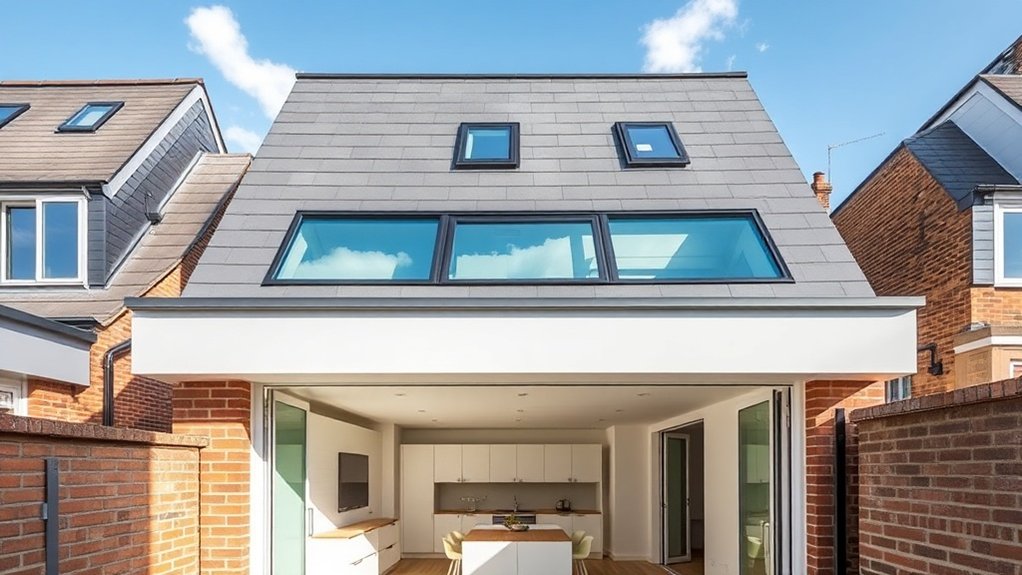
Solid roof glazing in London replaces cold, noisy glass or polycarbonate roofs with an insulated, part-solid, part-glazed system that optimises U‑values, g‑values and airtightness. You get better thermal performance, solar control and acoustic attenuation while still pulling in overhead daylight and satisfying tight planning or conservation constraints. It’s ideal if you want a London conservatory or extension that’s usable year-round, and the next sections show how to specify, install and maintain it effectively.
Key insights
- Solid roof glazing combines insulated roof panels with rooflights or lanterns to improve thermal performance while retaining overhead daylight in London homes and extensions.
- These hybrid roofs significantly cut heat loss and summer overheating compared with older conservatories, improving comfort, EPC/SAP scores, and reducing energy bills.
- Systems are tailored for London conditions: conservation areas, tight terraces, overlooking issues, and planning constraints on roof profiles and external appearance.
- High‑performance glass, acoustic membranes, and airtight detailing provide better noise reduction from traffic and aircraft while maintaining bright, usable rooms year‑round.
- Professional design and installation with structural checks, condensation control, and manufacturer-backed warranties are essential for durable, compliant solid roof glazing in London.
What Is Solid Roof Glazing in London?
Although the term can sound broad, solid roof glazing in London specifically refers to insulated roofing systems that integrate high‑performance glazed elements—such as rooflights, lanterns, or integrated panels—within a mainly solid, thermally efficient roof structure. You’re engineering a hybrid envelope: part opaque, part transparent, calibrated for U‑values, g‑values, and airtightness .
You use it to drive daylight deep into extensions, pod rooms, and infill developments while maintaining acoustic control and energy performance demanded by London’s planning policies and Part L. It lets you respect historical architecture by keeping external massing sympathetic, yet introducing contemporary glazing geometries. In dense urban landscaping contexts, you capture overhead light, mitigate overlooking, and future‑proof roofscapes for potential solar and smart‑building integrations.
Solid Roof Glazing vs Glass and Polycarbonate
When you compare solid roof glazing with conventional all‑glass or polycarbonate roofs, you’re really choosing between a controlled, insulated building envelope and a largely unmanaged solar gain surface. Solid systems integrate high‑performance roof insulation with targeted glazing apertures, so you modulate daylight and thermal loads instead of reacting to them.
With full glass or polycarbonate, U‑values are higher, solar gain’s harder to regulate , and acoustic attenuation is weaker. You’re effectively creating a lightweight buffer zone, not a stable interior environment. Solid roof glazing lets you specify structural support to accommodate heavier composite decks, triple‑glazed units, and integrated shading or PV. That combination improves thermal performance, limits glare, and delivers a future‑ready platform for smart controls and low‑energy HVAC strategies.
Is Solid Roof Glazing Right for Your London Home?
So how do you know if solid roof glazing is the suitable specification for your London property rather than an over‑engineered upgrade? Start by mapping your thermal performance targets , solar gain control, and acoustic attenuation requirements. If you’re aiming for year‑round usability with stable internal temperatures, a solid roof system with integrated glazing apertures is often the ideal configuration.
You’ll also need to reconcile aesthetics with planning constraints and historical preservation. Many London boroughs and conservation areas favour low‑glare finishes and sympathetic color options that visually recess the structure. Solid roof glazing lets you tune daylighting, U‑values, and g‑values while maintaining an exterior profile that satisfies conservation officers, neighbours, and your design brief, especially where full‑height glass or polycarbonate would be visually intrusive.
Why London Conservatories Need Solid Roof Upgrades
London’s increasingly volatile weather patterns mean your existing glazed conservatory roof is probably underperforming on thermal regulation and solar control. By upgrading to a solid roof system with high-performance insulation and low U-values, you’ll stabilise internal temperatures and achieve genuine year-round usability. This specification-led approach also reduces heat loss and solar gain, cutting your energy consumption and improving EPC performance.
Combatting London’s Changing Climate
Why are so many traditional conservatory roofs in London no longer fit for purpose? Because they were engineered for a milder, more predictable climate. You’re now dealing with higher solar gain, heavier rainfall events, and wider temperature swings that old polycarbonate or single-glazed systems simply can’t regulate.
A solid roof upgrade lets you future‑proof without compromising historical architecture or surrounding urban greenery. By specifying multi-layer insulation, low‑emissivity solid glazing panels , and thermally broken rafters, you reduce heat loading and mitigate cold-bridging. Advanced vapour control layers prevent interstitial condensation during humid spells, while engineered drainage details handle intense downpours.
You’re not just retrofitting; you’re re‑calibrating the building envelope to align with London’s evolving microclimates and emerging environmental performance standards.
Boosting Year-Round Comfort
Even with efficient glazing in the vertical frames, a poorly performing conservatory roof still drives thermal discomfort and erratic internal temperatures. A solid roof system stabilises the internal microclimate, cutting overheating from solar gain while preventing cold downdrafts and radiant chill. You transform the space from a seasonal annex into a true habitable zone integrated with London’s historical architecture and urban greenery.
By specifying high-performance insulation build-ups, vapour control layers, and low-thermal-bridge junctions, you guarantee predictable comfort profiles across all seasons. Acoustic damping further shields you from city noise, enhancing perceived comfort beyond simple temperature control.
- Stop abandoning the conservatory each winter
- Eliminate glare that ruins relaxed evenings
- Enjoy quiet refuge from traffic and trains
- Feel genuinely “indoors” without losing skyward connection
Improving Energy Efficiency
How much energy does your conservatory waste through an ageing polycarbonate or single-glazed roof acting as a giant thermal bridge? With U-values often >2.0 W/m²K, you’re leaking heat straight into London’s microclimate. A solid insulated roof system with multi-layer foil, PIR boards, and ventilated counter-battens can cut heat loss by up to 70%, stabilising internal temperatures and lowering HVAC runtimes.
You’re not just upgrading glass; you’re retrofitting the building envelope to modern Part L performance while respecting historical architecture and tight urban landscaping constraints. High-performance solid roofs integrate low-g solar-control glazing, airtight membranes, thermal breaks at junctions, and warm-edge detailing, minimising cold bridging. The result: reduced kWh consumption, improved SAP scores, and a future-ready, energy-optimised conservatory.
Year-Round Comfort in a London Climate
Although London’s weather shifts constantly between damp chill, low-angle glare, and brief heatwaves, a well‑specified solid roof glazing system stabilises internal conditions so your room performs like a true habitable space, not a seasonal add‑on. You gain a calibrated envelope where U-values, g-values, and solar control coatings are tuned to your specific orientation and garden landscaping.
By integrating high-performance insulation with selectively positioned glazing panels, you mitigate cold downdraughts while avoiding summer overheating. That means you can specify premium outdoor furniture and fabrics without worrying about UV bleaching or condensation.
- Feel your conservatory function as a seamless extension of your living space
- Enjoy sunrise coffee without glare or draughts
- Host late-night gatherings in consistent thermal comfort
- Look out over curated garden landscaping all year
How Solid Roofs Improve Energy Efficiency in London
When you upgrade to a solid roof system , you considerably reduce conductive and convective heat loss through the glazed envelope, cutting unnecessary demand on your primary heating plant. In summer, high-performance insulation and controlled solar gain lower cooling loads, so your HVAC system doesn’t have to work as hard to maintain setpoints. The result is more stable internal temperatures, improved thermal comfort, and measurable gains in the overall energy performance of your London property.
Reduced Heat Loss
In London’s variable climate , a solid conservatory roof dramatically cuts heat loss by replacing thin polycarbonate or single glazing with high‑performance, insulated roof panels. You’re upgrading to a thermally engineered envelope that delivers low U‑values, reduced air leakage, and consistent internal temperatures.
By integrating precision‑designed roof ventilation and advanced solar control layers, you minimise conductive, convective, and radiative heat losses without sacrificing comfort. This isn’t just cosmetic; it’s a building‑physics‑driven retrofit that aligns your home with modern energy standards and net‑zero goals.
- Feel the space transform from “cold void” to usable living zone
- Experience lower heating bills without sacrificing architectural impact
- Enjoy stable, predictable room temperatures through winter
- Gain confidence that you’ve future‑proofed your property’s thermal performance
Lower Cooling Demand
Because London’s summers are getting hotter and more unpredictable, a solid conservatory roof becomes a critical control layer for cutting cooling demand and preventing overheating. You’re no longer fighting constant solar gain through inefficient glazing; instead, you’re deploying a high‑performance roof insulation system that stabilises internal temperatures and reduces reliance on active cooling.
Improved Thermal Comfort
Unlike a traditional glass conservatory that swings from stifling to icy, a solid roof system moderates the building’s operative temperature so occupants experience a stable, comfortable environment with far less energy input. By upgrading to insulated panels with high thermal resistance and controlled solar gain, you minimise radiant temperature asymmetry and cold downdraughts , especially critical in London’s variable climate.
Solid roofs create a balanced interface between Historical architecture and Modern design, integrating ventilation strategies and airtight detailing to eliminate hotspots and cold spots. You get predictable comfort profiles that align with Part L and emerging net‑zero targets.
- Feel consistent warmth without over-reliance on heating
- Enjoy a usable room across all seasons
- Trust the envelope to buffer extreme weather
- Experience innovation that respects your building’s heritage
Noise Reduction for Busy London Streets and Flights
Ever wondered why some London conservatories stay peaceful despite traffic, sirens, and low-flying aircraft? You’re hearing the impact of high-spec roof insulation and acoustic engineering, not luck. A solid glazed roof uses dense board build‑ups, decoupled layers, and acoustic membranes to attenuate airborne noise from roads and flight paths while preserving light.
You specify U-value and dB reduction in tandem, selecting multi-layer systems that break up sound transmission paths through rafters and glazing interfaces. Correctly detailed seals, edge trims, and service penetrations prevent acoustic flanking, so impact and vibration don’t re-enter the room.
Solid Roof Designs for London Terraces and Semis
Acoustic performance is only half the brief in London; the roof build-up also has to work hard within tight terrace and semi-detached geometries, party wall constraints, and planning lines. You’re balancing U-values , build-up depth, and load paths while protecting historical architecture and surrounding urban aesthetics.
You’ll typically deploy lightweight structural steels or engineered timber cassettes to achieve long spans with minimal structural zone. Hybrid warm-roof assemblies let you push insulation above deck, keeping internal ceiling lines clean for recessed profiles and integrated services.
Your solid roof should read as a coherent extension of the original envelope: parapet alignment , brickwork datum continuity, and eaves detailing all matter.
- Feel your home intelligently re‑engineered
- Feel peace in a previously harsh city soundscape
- Feel pride in enhancing London’s skyline
- Feel future-ready in a constrained plot
Choosing Glazing for Light Without Overheating
You’ll need to balance daylight and shade so your solid roof glazing achieves high visible light transmittance without excessive solar heat gain , especially under south-facing London exposures. By selecting the right glass types and low‑e or solar control coatings, you can tune g‑values, U‑values, and SHGC to maintain comfort and cut cooling loads. Next, you’ll see how different glazing specifications, tints, and coatings help you control glare, overheating, and year‑round thermal performance.
Balancing Daylight And Shade
Although a solid roof dramatically improves thermal control, its glazing still needs careful specification to admit generous daylight without driving up solar gains. You’re not just chasing lumens; you’re engineering a controlled daylight environment that protects comfort, Roof aesthetics, and Material durability. You’ll balance visible light transmission against solar heat gain, then layer in shading strategies tailored to London’s changeable sky.
Prioritise orientation‑specific design: deeper overhangs south‑facing, minimal obstruction north‑facing. Integrate fixed rooflights with internal blinds or external brise‑soleil to modulate lux levels through the day. Aim for uniform luminance to avoid glare bands across working or relaxation zones.
- Imagine a room that glows, not glares.
- Feel cool air while sunlight traces the floor.
- Watch colours stay true, furnishings unbleached.
- Sense calm as daylight stays predictable, all year.
Glass Types And Coatings
When you specify glass for a solid roof in London, you’re really tuning a set of optical and thermal properties—visible light transmittance (VLT), solar heat gain coefficient (g‑value), U‑value, and selectivity—to deliver daylight without overheating. You’ll typically combine low‑E coatings , solar‑control layers, and laminated make‑ups to decouple light from heat.
High‑selectivity solar‑control glass lets in useful daylight while aggressively filtering near‑infrared gain, stabilising summer conditions in south‑ and west‑facing rooms. Spectrally selective coatings on surface #2 or #3 optimise g‑value without killing sky clarity.
You can specify fritted or etched decorative patterns to diffuse hotspots, improve glare control, and enhance privacy. Custom finishes—tinted interlayers, gradient frits, coloured back‑paints—let you tune aesthetics while still hitting your thermal performance targets.
Planning Permission and Building Regs in London
Because solid roof glazing alters the external envelope and structural load paths of a property, it typically triggers both planning and building control considerations under London’s local authority frameworks. You’ll need to evidence structural adequacy, fire performance, and thermal efficiency in line with current Building codes and the London Plan. Planners also examine street-facing aesthetics, overlooking, and overshadowing, especially in conservation areas.
You should commission precise load calculations, condensation risk analysis, and U‑value modeling tuned to London’s changing weather patterns. A lawful development check or pre‑app advice can de‑risk the process and compress timelines.
- Feel confident your scheme’s fully compliant
- Avoid costly enforcement or retrofit demands
- Protect your home’s long-term performance and safety
- Access bolder, more future-ready glazing design
Solid Roof Glazing Costs, Savings and Payback
So what does solid roof glazing in London actually cost once you factor in fabrication, install, and long‑term performance? You’re typically looking at a premium over standard glazing due to insulated panels, structural reinforcement, and bespoke detailing. However, better U‑values and airtightness unlock measurable energy savings, especially in poorly performing conservatories.
Capex varies with span, load paths, and design flexibility: integrated rooflights, oversized panels, and complex geometries all increase fabrication and labour. To assess payback, you’ll model reduced space‑heating demand, lower cooling loads, and lifecycle maintenance versus a conventional glazed roof. In many London properties, you’ll offset upfront cost within 8–15 years, with ROI improving when you combine solid roof glazing with smart controls and high‑performance perimeter insulation.
Finding a Trusted Solid Roof Installer in London
Although high‑performance products matter, your solid roof glazing will only perform to spec if a competent London installer details, fixes, and seals the system correctly. You need a contractor who understands London’s planning nuance, from Historical architecture in conservation areas to Modern design in new‑build penthouses.
Prioritise firms with MCS or equivalent accreditation, robust PI insurance, and a proven solid‑roof portfolio. Ask for U‑value calculations , condensation risk analysis, and load‑path justification for your specific substrate. Insist on manufacturer‑backed warranties and documented QA procedures.
- Feel confident your investment’s engineered, not improvised
- Protect the character of your home while upgrading performance
- Avoid leaks, cold bridges, and long‑term remedial costs
- Enjoy future‑ready glazing that aligns with your vision for innovation
Installation Steps and How Much Disruption to Expect
Once you’ve secured a competent installer, the solid roof glazing programme follows a defined sequence that aims to minimise risk and downtime on site. First, the team undertakes a measured survey, confirms load paths, and sets out the structural grid. They then strip existing coverings, install new rafters or reinforcement, and weatherproof the envelope the same day to avoid water ingress.
Next, they integrate high‑performance roof insulation , vapour control layers, and proprietary glazing cassettes, coordinating Ventilation strategies—trickle vents, eaves vents, or mechanical extract—to maintain airflow and prevent interstitial condensation.
Internally, they complete first‑fix wiring, plasterboard, and skim in a tightly phased schedule. You can typically expect two to five days of on‑site activity, with noise and access disruption carefully zoned and sequenced.
Common Solid Roof Mistakes London Homeowners Make
When you upgrade to a solid roof in London, two high‑risk pitfalls are ignoring planning regulations and under‑specifying ventilation. If you overlook permissions, permitted development limits, or conservation constraints, you can face enforcement action and costly remedial work. If you don’t design robust cross‑ventilation, vapour control layers, and trickle vents, you’ll create interstitial condensation, thermal bridging, and long‑term fabric damage.
Ignoring Planning Regulations
Even if your new solid roof transforms comfort and energy performance, ignoring planning regulations in London can put the entire project at risk. You’re operating in a dense planning ecosystem: conservation areas, historical architecture, protected views, and strict policies on urban greenery all shape what you can legally install.
Failing to obtain consent can trigger enforcement notices , mandatory strip‑outs, and serious devaluation. Instead, front‑load compliance: commission scaled drawings, section details, and U‑value calculations aligned with local Supplementary Planning Documents and the London Plan.
- Imagine a knock at the door and a formal enforcement letter
- Picture your investment dismantled, panel by panel
- Feel the stress of a sale falling through over missing approvals
- Visualise seamless sign‑off and future‑proofed value
Poor Ventilation Planning
Although solid roofs excel at cutting glare and heat loss, poor ventilation planning can trap warm, moisture‑laden air and rapidly degrade both comfort and building fabric. You risk interstitial condensation, mould growth behind plasterboard, and corrosion of fixings if you don’t design a defined airflow strategy.
Specify continuous eaves‑to‑ridge ventilation, vapour‑permeable underlays , and trickle vents integrated into frames. Pair these with humidity‑sensitive mechanical extract to cope with London’s variable climate and dense urban pollution.
Don’t rely on Indoor plants or trickle gaps alone; they’re not a substitute for engineered air changes. Coordinate ventilation with your home insulation specification so U‑values, airtightness, and moisture control work as a single system, keeping your solid roof performing efficiently for the long term.
Maintenance, Lifespan and Warranty for London Solid Roofs
Because a solid glazed roof is a long‑term building asset rather than a decorative upgrade, you need to understand its maintenance regime, service life expectations, and warranty coverage in a London context of high rainfall, pollution, and planning constraints. You’ll schedule annual inspections focusing on seals, flashing interfaces, Roof insulation continuity, and Structural support fixings, plus glass coatings exposed to particulates and acid rain.
Manufacturers typically quote 25–40‑year system lifespans, contingent on documented maintenance logs and use of approved cleaners and access methods. You should demand tiered warranties: product, installation, and weather‑tightness, with clear clauses on storm events and movement tolerances.
- Protect your capital investment
- Avoid disruptive, costly leaks
- Preserve thermal and acoustic performance
- Future‑proof your building’s skyline profile
Frequently Asked Questions
Can Solid Roof Glazing Integrate Solar Panels or Renewable Energy Systems in London?
Yes, you can integrate solar panels and other renewable energy options directly into a solid glazed roof system . You’ll specify structural loading, mounting rail interfaces, waterproofing membranes, and cable routing during the design phase to guarantee seamless solar panel integration. Use high-efficiency PV modules, optimized tilt angles, and microinverters or optimizers to maximize yield, while coordinating with MCS-compliant installers to meet UK regulations and grid-connection standards.
How Does Solid Roof Glazing Affect My Home’s Resale Value in London?
You’ll typically boost resale value because buyers read upgrades like code-compliant thermal insulation the way investors read strong balance sheets. One client saw offers jump 5–7% after replacing a dated roof with a high‑performance system. You enhance aesthetic appeal, reduce U‑values, improve EPC ratings, and future‑proof against energy regulations. In London’s premium segments, that combination of design-led engineering and efficiency differentiates your property and accelerates time‑to‑sale.
Are There Eco-Friendly or Recycled Materials Available for Solid Roof Systems?
You can absolutely specify eco-friendly options and recycled materials in modern solid roof systems. You’ll see recycled aluminum rafters, PIR or wood-fibre insulation with high R-values, and roof decks using FSC-certified or recycled-content boards. Some systems integrate recycled metal or composite tiles, low-VOC membranes, and rainwater-harvesting detailing. You should also evaluate lifecycle assessments (LCA) and EPD-certified components to guarantee genuine sustainability, not just greenwashed marketing.
Can I Add Skylights or Roof Windows Later to an Existing Solid Roof?
You can retrofit an existing solid roof with skylights or roof windows, but you must treat adding skylights as a structural alteration , not a cosmetic upgrade. A competent installer will calculate load paths, specify reinforced rafters, and integrate BBA-approved flashing kits. During roof window installation, they’ll address condensation risk, ventilation strategy, and U‑values, ensuring the new openings align with Part L/Part K compliance and preserve the roof’s thermal and airtightness performance.
How Does Solid Roof Glazing Impact Listed Buildings and Conservation Areas in London?
You must treat solid roof glazing as a controlled intervention: it directly affects historic preservation, statutory setting, and architectural compatibility. In listed buildings and conservation areas, you’ll need Listed Building Consent and design-led justification, proving minimal visual impact, reversibility, and material harmony. Work with a heritage consultant and conservation-accredited architect to specify slimline units, conservation rooflights , and discreet detailing that satisfy planners while still delivering performance and daylight gains.
Summary
With a solid roof glazing upgrade, you’re not just patching a problem—you’re rewiring the whole thermal and acoustic performance of your conservatory. In London’s variable climate, you gain U‑value compliance, solar control, and real year‑round usability. Choose an installer with proven detailing on junctions, ventilation, and load paths, and you’ll transform that space from a seasonal bolt‑on into the thermal engine room of your home, humming efficiently in the background.