
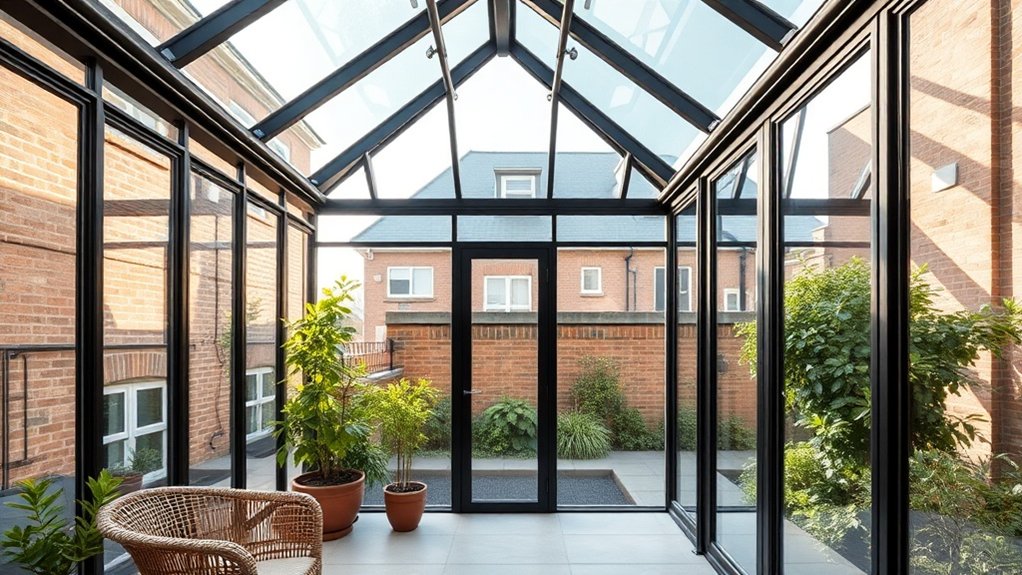
For orangery glazing in London , you balance low‑U‑value, solar‑control glass with slim, thermally broken aluminium or alu‑clad timber frames to manage low winter sun, high summer gain and tight urban plots. You’ll specify low‑E coatings, argon‑filled units, warm‑edge spacers and carefully model g‑values to avoid overheating. Conservation‑area success depends on slim sightlines, low‑reflectance glass and precise junction details, all coordinated with ventilation, shading and lighting strategies that the next sections unpack in more depth.
Key insights
- Specify high‑performance, low‑E, argon‑filled glazing with warm‑edge spacers and solar‑control coatings to handle London’s low winter sun and high summer gains.
- Tailor glass type, thickness, and lamination to each elevation and height for safety, acoustics, and privacy in dense urban plots.
- Combine slimline thermally broken aluminium or alu‑clad timber frames with carefully designed mullion spacing to maximise views while meeting U‑value targets.
- Integrate ventilation, shading, and lighting early: roof vents, clerestory windows, external blinds, and LED channels improve comfort and usability year‑round.
- Ensure designs satisfy London planning requirements, especially in conservation areas, using low‑reflectance glass, slim profiles, and balanced glass‑to‑solid ratios.
Why Orangery Glazing Works for London Homes
While London’s housing stock is diverse—from Victorian terraces to contemporary infill developments—orangery glazing consistently performs well because it’s engineered to address the city’s specific environmental and architectural conditions. You’re dealing with low winter sun, high summer gain, and tight urban plots, so high-performance glass specifications matter: low‑E coatings, warm‑edge spacers, argon fills, and selective solar control coatings optimize U‑values without sacrificing visible light.
You can integrate orangery glazing into historical architecture without visual conflict by using slimline thermally broken aluminium or timber-clad frames that respect existing sightlines and brickwork modules. Internally, you leverage the roof lantern and perimeter solid roof to curate interior aesthetics: controlled daylight gradients, reduced glare on work surfaces, and stable thermal comfort that supports flexible, year‑round space usage.
Orangery vs Conservatory in London: Key Differences
When you compare an orangery with a conservatory in London, you’re really evaluating distinct approaches to structural design, thermal performance, and lifecycle cost . You’ll need to take into account factors such as wall-to-glass ratios, roof configuration, and glazing specifications, as these directly affect insulation values, year-round usability, and compliance with UK Building Regulations. By understanding how each option performs regarding structural form, U-values, intended use, and installed cost, you can specify the extension type that best matches your property and budget.
Structural Design And Shape
Although both structures extend your living space into the garden, an orangery in London typically relies on a solid perimeter construction—often brick or stone piers—with a flat or parapet roof and a central roof lantern, creating a more “room-like” enclosure with defined massing. You prioritise structural aesthetics through pronounced columns, deep fascias, and a lantern that reads as an engineered object rather than a lightweight add‑on.
Insulation, Use And Cost
Because London’s climate demands year‑round thermal stability, the insulation strategy is one of the clearest technical distinctions between an orangery and a conservatory, and it directly drives how you’ll use the space and what you’ll pay for it. In an orangery, high‑performance roof lanterns, insulated parapet walls, and low‑U‑value floor buildup create a semi‑extension envelope, optimised for continuous occupation.
You typically specify advanced glazing systems with warm‑edge spacers, argon fill, and solar-control coatings, balancing window aesthetics with strict g‑value and light‑transmission criteria . That boosts glazing durability, reduces thermal stress, and stabilises internal temperatures.
Conservatories usually rely on lighter polycarbonate or simpler glass roofs, cutting upfront cost but limiting winter usability and increasing summer gains, so heating, cooling, and long‑term comfort become more variable.
London Planning Rules and Conservation Areas for Orangeries
Despite their elegant, lightweight appearance, orangeries in London sit squarely within a strict planning and heritage framework that governs everything from glazing ratios to sightlines and junction details with the host building. You must demonstrate that new glazing respects the host façade hierarchy, especially in conservation areas and around listed buildings. Planners will interrogate vertical and horizontal module, mullion depths, and roof lantern profiles to avoid visual dominance.
You’ll need CAD-elevations, section details, and materials schedules showing low‑reflectance glass , slimline framing, and discreet ventilation. Internal window treatments and integrated lighting design also come under scrutiny where light spill could affect townscape character or neighbouring amenity. Early pre‑application engagement with the borough’s conservation officer de-risks specification, programme, and budget.
Sizing and Positioning Orangery Glazing in Tight Plots
Once you understand how planners read façades and glass ratios, you can start sizing and positioning orangery glazing to work within London’s typically tight rear plots. You’ll treat each elevation as a calibrated composition: solid‑to‑void balance, cill heights aligned with existing datum lines, and transom positions echoing original sash geometry to support historical preservation.
Work backwards from boundary conditions and overlooking angles. Use vertical emphasis to pull daylight deep into the plan while limiting lateral spread that can dominate modest gardens. Prioritise primary glazed modules on the best solar‑orientation axis, then deploy high‑level clerestory bands on flank walls to protect privacy and garden aesthetics. Maintain clear structural zones for steel or engineered timber framing, avoiding visually intrusive posts within key view corridors.
Energy‑Efficient Orangery Glazing for Year‑Round Comfort
When you’re designing orangery glazing for London’s climate, you balance solar gain, thermal losses, and occupant comfort through a tightly specified glass and frame system. You start with low‑U‑value insulated glass units , typically argon‑filled double or triple glazing with warm‑edge spacers to suppress perimeter heat loss.
You then specify low‑E coatings and calibrated solar control layers to fine‑tune g‑values , limiting summer heat ingress while preserving useful winter gains. Selective coatings on the inner pane optimise radiant comfort, reducing mean radiant temperature swings near large glazed areas.
You coordinate these properties with thermally broken aluminium or hybrid timber‑aluminium frames, ensuring consistent performance. Glass aesthetics still matter: neutral‑tint, low‑reflection products maintain daylight quality and colour rendering while delivering rigorous energy metrics.
Ventilation, Shading and Overheating in London Orangeries
Alongside high‑performance glass and frames, you must control air movement and solar exposure to prevent overheating in a London orangery. You should design cross‑flow natural ventilation using high‑level roof vents, automated clerestory windows, and trickle vents integrated within the glazing system. Intelligent actuators linked to temperature and CO₂ sensors optimise air change rates without sacrificing security.
For solar control, specify low‑g‑value coatings, external blinds, and dynamic shading louvres calibrated to London’s solar angles. You can combine balcony greenery and climbers on pergolas or balustrades to create a vegetative shading layer that cools incoming air via evapotranspiration. Coordinate ventilation pathways with airtightness, purge‑vent strategies, and night‑time cooling cycles to stabilise internal temperatures and protect finishes, sealants, and structural interfaces.
Orangery Glazing Styles That Suit London Properties
Although performance specifications drive the glass you choose, the glazing style must also align with London’s varied architectural typologies and planning context. You’ll typically balance daylight transmittance, solar control, and privacy while respecting street-facing character.
For period terraces, you might specify slimline, vertically proportioned panes with fine sightlines and subtly patterned interlayers, echoing historic subdivision without compromising U‑values. In conservation areas , you can use neutral solar-control coatings that read “clear” from the public sphere.
For infill sites and roof-level additions, larger-format panes with minimal mullions deliver modern aesthetics and deep light penetration, ideal for Indoor plants and biophilic schemes. Consider corner-to-corner glazing, clerestory bands, or asymmetric compositions to manipulate solar gain, framed views, and the bridge between primary interiors and garden zones.
Frames and Roof Designs for London Orangeries
Because the frame and roof architecture dictates structural behaviour, thermal performance, and planning acceptability, you need to resolve these elements in tandem with your glazing specification . Specify thermally broken aluminium or alu-clad timber frames to achieve slender sightlines without compromising U-values or structural stiffness. In London, wind loading, parapet integration, and existing masonry tolerances must inform mullion spacing and connection details.
For roof designs, assess flat warm-roof systems with lanterns versus fully glazed structural roofs. Incorporate solar-control and low-iron glass where you’re optimising light for indoor plants while limiting summer gains. Coordinate lighting design early: integrate recessed LED channels into rafters, discreet cable routes in box gutters, and provision for automated blinds or external shading to stabilise internal temperatures and visual comfort.
Privacy, Noise and Security in London Orangeries
Once you’ve fixed the frame and roof strategy, you need to address how the glazing will manage privacy, noise, and security within London’s dense urban context. You’ll typically specify laminated, low‑iron units with interlayers tuned for both impact resistance and acoustic damping.
To mitigate privacy concerns from overlooking neighbours, combine solar-control or reflective coatings with gradient or switchable privacy glass on the most exposed elevations. Internally, you can zone visibility using satin‑etched units in side returns while keeping rooflights clear.
For noise reduction against traffic or rail, deploy asymmetric double or triple glazing with varied pane thicknesses and widened cavities filled with argon. Upgrade hardware to multi-point locking, hinge-side security bolts, and PAS 24-compliant doorsets integrated into the glazing envelope.
Matching Orangery Glazing to Period and Modern London Homes
When you align orangery glazing with a London property’s architectural language, you balance heritage constraints, thermal performance, and contemporary living requirements in one specification.
In period terraces or stucco villas, you’ll typically mirror original sightlines with slimline timber or thermally broken steel systems , using true or applied glazing bars to maintain proportional harmony. You can specify low-iron, high-clarity units to retain crisp detailing while deploying low‑E coatings and warm‑edge spacers to meet Part L.
For modern infill or rooftop extensions, you’ll favour large-format panes , minimal frames, and structurally bonded corners that dissolve boundaries between indoors and out, optimising plant integration and interior aesthetics. Here, solar-control coatings, ceramic frits, and brise‑soleil interfaces prevent overheating without compromising transparency.
Orangery Glazing Costs and Budgeting in London
When you plan orangery glazing in London, you need to understand typical price ranges for units, installation, and associated structural works so you can benchmark quotes accurately. You’ll weigh material specifications, U-values, glass coatings, and frame systems against their cost impact to prevent overspecification. You can then apply targeted cost-saving strategies—such as optimising glazing ratios, phasing upgrades, or mixing premium and standard units—to keep the project within budget without compromising performance.
Typical Orangery Glazing Prices
How much should you expect to invest in orangery glazing in London, given local labour rates, planning constraints, and specification options? For a typical London property, you’ll usually allocate £1,600–£2,400 per m² of glazed area for a mid‑range specification, rising to £2,800–£3,500+ per m² for premium systems driven by glass innovation and cutting‑edge design trends.
High‑performance double glazing with low‑E coatings, warm‑edge spacers, and argon fill generally sits at the lower band, while solar‑control, acoustic‑laminated or triple glazing pushes you toward the upper band. Bespoke aluminium or engineered timber roof lanterns often represent 35–45% of the total glazing package. Structural glass corners, minimal‑frame sliders, and oversized roof panels add both fabrication complexity and cranage costs, which London contractors price into final quotations.
Cost-Saving Budget Strategies
With London orangery glazing frequently pricing in the £1,600–£3,500+ per m² range, cost control depends on engineering value into the specification rather than simply stripping it back. You start by optimising glass performance-to-cost ratios: deploy high-spec solar-control or low‑E units only on critical orientations, and standard toughened units elsewhere. Rationalise module sizes to suit stock glass and standard roof lantern systems, minimising cutting and waste.
You then push spatial planning to work harder. Strategic furniture placement and lighting design let you reduce glazed area without sacrificing perceived openness, by using solid wall zones for services and storage. Standardise frame colours and hardware , negotiate batch fabrication, and phase works so you can pre‑wire for future automation without immediate motorised spend.
Choosing Orangery Glazing Specialists in London
Selecting orangery glazing specialists in London demands a rigorous evaluation of technical competence, regulatory compliance, and material specification. You should interrogate their understanding of Glass durability under London’s microclimates , including thermal stress, pollution, and wind loading. Ask for documented U‑values, solar heat gain coefficients, and acoustic attenuation data for each system proposed.
Verify they hold MTC-certified installers, manufacturer-approved training, and robust warranties on both frames and sealed units. Assess their capability to integrate advanced glazing technologies—solar-control coatings , low-iron glass, and structural silicone systems—without compromising drainage, ventilation, or sightlines.
Review how they manage color options, ensuring consistency between coated glass, spacer bars, and aluminium or timber profiles. Finally, demand project-specific performance simulations and detailed as-built technical drawings before sign‑off.
Permissions, Timelines and Build Stages for London Orangeries
Once you’ve identified competent orangery glazing specialists , you must align their proposals with planning permissions, statutory approvals, and a realistic construction programme specific to London. You’ll typically need to coordinate planning consent, building control sign‑off, and, in conservation areas, heritage input. Your glazing package must evidence U‑values, safety glass, ventilation rates, and structural loading for London clay and basement-prone plots.
Key stages you should programme:
- Site survey and concept design, integrating landscaping aesthetics and sightlines.
- Planning submission with detailed glazing schedules, sections, and drainage strategy.
- Technical design and procurement, resolving structure, services, and interior lighting control.
- Construction, glazing installation, commissioning, and final compliance inspections.
Lock timelines to lead times for bespoke units, access constraints, and seasonal installation windows.
Common Orangery Glazing Mistakes in London to Avoid
When you plan orangery glazing in London, you can’t afford errors in glass specification , thermal performance, or regulatory compliance. You need to match glazing specifications to span, load, solar gain, and acoustic requirements, or you risk structural stress, overheating, and noise issues. You also must guarantee the U-values, G-values, and sightlines align with London’s energy standards and local planning constraints to avoid cold spots, condensation, and enforcement action.
Incorrect Glazing Specifications
Although high-performance glass is now the norm for quality orangeries in London, incorrect glazing specifications still undermine thermal efficiency, structural integrity, and compliance. You can’t rely on generic “conservatory glass” descriptions; you need quantified, project‑specific performance criteria. Misaligned specs often ignore wind loading, impact risk, solar control , and long‑term glass durability, leading to premature failure or non-compliant installations.
Key areas to specify precisely include:
- Laminated vs. toughened glass selection by zone and height
- Glazing transparency, solar factor, and light transmission targets
- Spacer type, cavity depth, and gas-fill to match structural spans
- Edge sealant systems compatible with your frame and drainage strategy
Poor Thermal Performance
Even if your orangery looks well detailed on paper, poor thermal performance in the glazing will turn it into a seasonal space that overheats in summer and bleeds heat in winter. You need a façade strategy that manages solar gain, conduction, and convection as an integrated system.
Specify low‑E, argon‑filled units with warm‑edge spacers to minimise thermal gaps at the perimeter. These gaps drive condensation, mould risk, and occupant discomfort. Prioritise glazing durability by choosing units with robust edge seals, UV‑stable spacer compounds, and tested gas‑retention ratings.
Combine selective solar control coatings with correctly oriented rooflights and perimeter shading to prevent excessive g‑values. Validate U‑values and ψ‑values through thermal modelling , not brochure data, so your orangery performs as a genuine, year‑round living zone.
Ignoring Planning Regulations
Optimising thermal performance is only half the battle; in London, many orangeries fail on paper long before they fail on site because planning regulations and permitted development limits are ignored. You can’t treat glazing, roof lantern heights, and frame dimensions as purely aesthetic or structural decisions; they’re compliance drivers.
You need to interrogate local constraints before you finalise your specification:
- Maximum projection, eaves height, and overall ridge level relative to the original dwelling
- Proportion of glass to solid elements, especially on boundaries and upper floors
- Conservation area and listed-building controls on frame profiles, colours, and outdoor aesthetics
- Interface between structural glazing, drainage details, and plant integration that might trigger full planning
How a Well‑Designed Orangery Adds Value to Your London Home
When you commission a well‑designed orangery for a London property, you’re not just adding floor area, you’re creating a high‑performance glazed extension that can materially increase market value, saleability, and day‑to‑day usability. By optimising orientation, glass specification, and solar‑control coatings, you achieve superior thermal performance and year‑round comfort, which surveyors increasingly recognise in valuations.
You also create a flexible zone that blurs indoor–outdoor boundaries. Intelligent plant integration, using built‑in planters and controlled irrigation, supports biophilic design and improves perceived luxury. Layered lighting options—integrated LED profiles in rafters, perimeter uplighting, and dimmable task fittings—extend usable hours and highlight architectural lines. Combined with discreet structural steelwork , slimline frames, and flush thresholds, these features differentiate your property in a competitive London market.
Frequently Asked Questions
How Do I Maintain and Clean Orangery Glazing in Polluted London Air?
You clean the glazing with deionized water, a non-abrasive squeegee, and pH‑neutral detergents to prevent micro‑scratching that traps particulates. Apply pollution resistant coatings to reduce adhesion of soot and NOx residues, extending cleaning intervals. Use a telescopic, soft‑bristle brush for frame interfaces, then rinse top‑down to avoid streaking. Implement a quarterly maintenance schedule , increasing frequency near main roads, and document surface performance to refine Cleaning techniques over time.
Can Orangery Glazing Improve My Home’s Acoustic Comfort From Street Noise?
Yes, it can, provided you specify the right glazing system. You’ll leverage laminated acoustic glass, wider air gaps, and asymmetric panes to maximize soundproofing benefits against traffic and rail vibration. Combine these with precision-engineered seals, thermally broken frames, and decoupled mounting profiles as targeted noise reduction techniques. You can also integrate secondary glazing or acoustic interlayers to fine‑tune performance to specific dB targets and dominant street-noise frequencies.
What Warranties and Guarantees Should I Expect on Orangery Glazing Products?
You should expect written warranties covering glass units (typically 10–20 years against seal failure), frames, hardware, and coatings, plus installation guarantees (often 5–10 years). Verify performance guarantees for energy efficiency (U-values, solar gain, gas-fill retention) and structural integrity (wind/snow loads). Guarantee coverage extends to specialist design options, including bespoke geometries, oversized panes, and advanced coatings, with clear transferability terms and documented maintenance requirements to keep guarantees valid.
How Does Orangery Glazing Impact My Home Insurance or Premiums in London?
It can slightly raise or reduce insurance premiums, depending on glazing impact on risk . Think of it like tuning a performance engine: better parts, better outcome. If you install security‑rated, laminated, or toughened units with certified locks, insurers may reward reduced burglary and impact risk. Poorly specified or non‑compliant glazing can trigger higher premiums due to escape‑of‑water and storm‑damage exposure. Always notify your insurer pre‑installation and submit technical specs.
Are There Eco‑Friendly or Recycled Materials Available for Orangery Glazing Systems?
Yes, you’ve got solid eco‑friendly options. You can specify thermally broken aluminium frames with high recycled content, low‑iron double or triple glazing using Recycled materials, and warm‑edge spacers to cut thermal bridging. Specify low‑E coatings , argon or krypton fills, and cradle‑to‑cradle certified components. You’ll reduce embodied carbon, enhance U‑values, and future‑proof the system for evolving Part L and sustainability‑driven performance standards.
Summary
You might worry an orangery will overheat or underperform in London’s variable climate, but modern high-spec glazing (low‑E coatings, warm‑edge spacers, argon fill, solar‑control tints) delivers stable, year‑round thermal performance . When you pair that with correct U‑values, airtight installation, and compliant ventilation, you don’t just gain a glass box—you gain a high‑performance, value‑adding living space precisely engineered for London’s tight plots, planning rules, and demanding energy‑efficiency standards.