
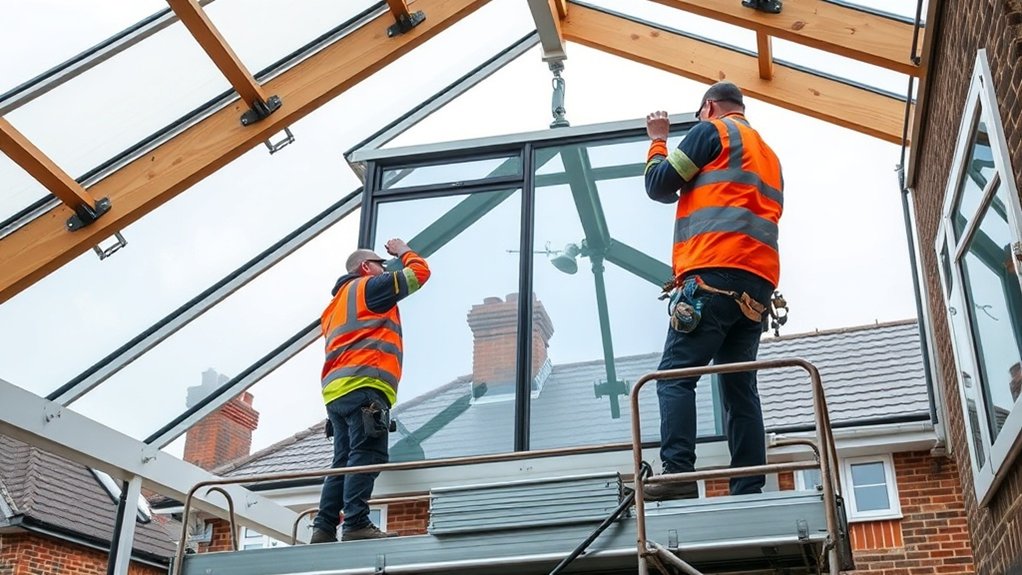
If your London conservatory roof is leaking , misted, or too hot and cold, you likely need a full replacement that upgrades glazing, insulation and ventilation to current standards. You’ll need a system that meets Building Regulations (Part L, A, B), respects any conservation or listed status, and doesn’t overload existing frames. Choosing between a warm tiled roof or high-spec glass depends on U‑values, g‑values, noise and access, which the next sections unpack in practical detail.
Key insights
- Identify if your roof needs replacing by checking for leaks, failed seals, cold draughts, structural movement, or UV-degraded panels.
- In London, ensure planning permission and Building Regulations approval, especially in conservation areas or for listed buildings.
- Choose between solid tiled warm roofs or high‑performance glass systems, comparing U‑values, solar control, acoustic performance, and weight.
- Expect higher London costs due to labour and access; focus on whole-system performance, load calculations, and long warranties over headline m² prices.
- Typical on-site replacement takes 2–5 days, including removal, structural checks, installation, detailing, and final commissioning.
Signs Your Conservatory Roof Needs Replacing
Although a conservatory roof can last many years, specific warning signs indicate it’s approaching the end of its serviceable life and needs replacing rather than patch repairs. You should inspect for failed glazing seals, evidenced by internal condensation, fogging, or algae growth within units. Consistent leaks at junctions, rafters, or the wall plate show membrane or flashing fatigue, not just defective mastic.
Distorted rafters, slipped panels, or cracked polycarbonate suggest structural movement that can’t safely support modern plant integration or automated shading. Excessive cold bridging, draughts, and high solar gain indicate obsolete insulation performance. If you’re pursuing historical restoration, mismatched profiles, corroded fixings, and UV-degraded plastics also signal that a full, specification-led roof replacement will deliver better longevity and energy performance.
What Happens in a London Roof Replacement
When you commission a conservatory roof replacement in London, the process typically follows a tightly sequenced programme: pre-survey and design confirmation , safe strip-out of the existing roof, preparation of the ring beam and wall plate, installation of the new structural framework, fitting of insulation and vapour control layers, and then glazing or solid roof coverings, followed by final detailing and commissioning.
Your contractor starts by laser-measuring, checking load paths, and confirming compliance with London-specific structural and thermal requirements. They then decouple the old roof, protect finishes, and inspect the existing frames for deflection or decay. Next, they install engineered rafters, integrate high-performance roof insulation, and tape-critical junctions for airtightness.
Finally, they commission ventilation options, test drainage performance , and complete internal trims and lighting interfaces.
Choosing the Right Roof Type for London
Once you understand the installation sequence, the next decision is which roof system best suits a London property’s structure, climate, and planning context. You’ll assess load-bearing capacity, existing frames, and tie-ins with the main roofline, then match these to compatible roof materials and glazing specs.
London’s variable weather conditions demand systems with proven thermal performance, robust drainage detailing, and high wind‑uplift resistance. You should compare U-values , g‑values, and acoustic ratings, not just aesthetics. Consider self-cleaning glass, solar-control coatings, and insulated composite panels where overheating or heat loss are issues.
Also factor in planning sensitivities in conservation areas, sightlines from neighbouring properties, and access for future maintenance. The right roof type balances engineering performance, regulatory compliance, and long-term adaptability.
Solid Tiled Roofs for London Conservatories
For many London conservatories, a solid tiled roof provides the most effective upgrade route when you want to turn a seasonal glass box into a genuine year‑round room. You replace lightweight polycarbonate with a structural deck, high‑performance insulation, and a ventilated tile finish that complements the main house.
You’ll benefit from traditional craftsmanship combined with modern build‑up details: vapour‑control layers, warm‑roof insulation, and engineered timbers sized to London loading standards. Tile options with proven material durability—concrete, slate, or composite—resist frost, impact, and UV .
- Reduce summertime overheating and winter heat loss
- Integrate LED lighting, downlighters, and concealed cabling
- Achieve lower reverberation and external noise ingress
- Align tile profile, colour, and pitch with your existing roof
Glass Roofs and Modern Glazing Options
When you’re considering a glass conservatory roof in London, you’re weighing natural light gains against performance, so the glazing specification becomes critical. You’ll need to choose from high-performance units such as low‑E, solar control, or argon‑filled double/triple glazing to optimise thermal efficiency and comfort. At the same time, you must factor in laminated or toughened glass for security, along with coatings that cut UV transmission to protect furnishings and reduce overheating.
Benefits Of Glass Roofs
Although polycarbonate panels still appear on many older conservatories, modern glass roofs now offer far superior performance, especially when you specify advanced glazing systems. You gain higher visible light transmission, cleaner sightlines , and a roof structure that works as an architectural feature rather than a bolt‑on enclosure.
Glass roofs support:
- Precise solar control coatings that balance brightness and glare, ideal for plant integration and curated seasonal aesthetics.
- Slimline aluminium or steel rafters, maximising glass area while maintaining structural integrity and wind/snow load compliance.
- Laminated safety glass options that enhance impact resistance, acoustic attenuation, and intruder deterrence.
- Self-cleaning and hydrophobic surface treatments that reduce maintenance cycles and preserve optical clarity.
Energy-Efficient Glazing Choices
As UK energy standards tighten and household bills keep rising, the glazing you specify for a conservatory roof in London now performs as a core thermal component rather than a cosmetic upgrade. You’re no longer choosing “glass”; you’re engineering a high‑performance envelope.
Prioritise low‑U‑value, soft‑coat low‑E double or triple glazing with warm‑edge spacers and argon or krypton fill to cut conductive and convective losses. Specify selective solar control coatings to balance winter gains against summer overheating, integrating them with your roof insulation strategy rather than treating glazing as separate.
Pair advanced glazing with designed‑in ventilation systems —trickle vents, automated roof vents, or MVHR—to manage moisture and purge excess heat. The result is a stable, usable room with predictable energy performance year‑round.
Security And UV Protection
Beyond thermal performance, a London conservatory roof in glass has to resist forced entry and filter aggressive UV radiation that degrades interiors. You’ll want laminated security glass with multi-layer interlayers that hold shards in place and dramatically increase impact resistance. When you pair this with high-spec locking cappings and secure glazing beads , you reduce leverage points and opportunistic break-ins.
Modern glazing units integrate Roof insulation, UV protection, and safety into one build-up: low‑E coatings, warm-edge spacers, argon fill, and spectrally selective films.
- Laminated inner pane with PVB/ionoplast interlayer
- Through-bolted aluminium rafter caps and anti-lift brackets
- UV-selective coatings blocking up to 98% of harmful rays
- Integrated blinds or switchable glass for dynamic solar control
Lightweight and Hybrid Conservatory Roof Systems
Why do so many London homeowners now specify lightweight or hybrid conservatory roof systems when upgrading a tired structure? Because you’re chasing high thermal performance, reduced load on existing frames, and faster installation with minimal disruption . Lightweight tiled or composite panels integrate advanced roof insulation, reflective membranes, and thermal breaks to stabilise internal temperatures and cut energy demand.
Hybrid systems combine solid insulated sections with high‑performance glazing, giving you solar control, daylight, and acoustic attenuation in one build‑up. You can integrate mechanical or passive ventilation systems at ridge or eaves level to manage moisture, prevent condensation, and maintain air quality. Pre‑engineered panels, adjustable aluminium rafters, and precision flashings let installers achieve clean junctions, reliable drainage paths, and long-term weathertightness on complex London properties.
London Planning and Building Rules for New Roofs
When you replace a conservatory roof in London, you must first establish if the design triggers full planning permission or if it remains within permitted development. You’ll also need to prove compliance with Building Regulations Part L (thermal performance), Part A (structure), and Part B (fire safety), often via a Building Control application and installer certifications. If your property is in a conservation area or is listed, you must factor in stricter controls on materials, appearance, and fixing methods, and get the proper consents before work starts.
When Planning Permission Applies
Although a conservatory is often treated as a “permitted development,” London’s planning and building rules still trigger full planning permission in specific scenarios that directly affect your new roof design. You’ll usually need consent when you alter the structure’s scale, silhouette, or relationship to neighbouring properties , or when Historical preservation controls apply.
You should seek planning advice if your roof proposal involves:
- Raising the ridge height or changing the roof pitch beyond the existing envelope
- Adding solid or hybrid roofing in a conservation area or on a listed building
- Introducing dominant rooflights, lanterns, or solar technologies visible from the street
- Switching to contrasting finishes where colour, reflectivity, or Material durability could impact townscape character
Early drawings and spec notes help planners assess visual impact quickly.
Building Regulations Compliance
Securing planning consent is only half the job; your new conservatory roof also has to satisfy Building Regulations that govern structure, insulation, moisture control, fire safety, and ventilation across London. You’ll need structural calculations to demonstrate load paths, wind resistance, and deflection limits, especially when upgrading from polycarbonate to a solid, heavier system.
Target at least current Part L U‑values, using thermally broken rafters, warm-roof build-ups, and airtight membranes to minimise cold bridges and condensation risk. Specify materials with proven Material durability, BBA certification , and fire classifications suitable for your proximity to boundaries.
For historical preservation contexts, you still must evidence compliance, typically via a Building Control application, as-built SAP calculations, and installation sign-off, ensuring your innovative roof system remains fully certifiable for future valuation and resale.
Conservation And Listed Considerations
Even in a modest London conservatory, swapping the roof becomes more complex the moment you’re in a conservation area or dealing with a listed building, because planning and heritage controls now drive the specification as much as performance targets. You must prove that any new system respects historical significance while improving thermal performance and solar control. Local conservation officers will scrutinise profiles, sightlines, and material preservation, so you’ll often pair advanced glazing or solid insulated panels with heritage-compatible frames and cappings.
You should front‑load feasibility and pre‑app discussions to de‑risk abortive design work and delays.
- Map conservation and listed status, including curtilage listing
- Capture existing details: sections, photos, material samples
- Develop like‑for‑like visual replacements using modern build‑ups
- Prepare a clear planning and heritage justification statement
London Conservatory Roof Replacement Costs
How much you’ll pay to replace a conservatory roof in London depends on the roof system, glazing material, and structural work required, but you should expect higher costs than the UK average due to labour and access constraints. Premium tiled warm roofs typically sit at the top end, especially where Historical preservation and brickwork integration matter.
You’ll also pay more for high-spec glass roofs with solar-control coatings, self-clean technology, and enhanced material durability. Complex access (mews, terraces, tight side passages) increases scaffolding and handling costs. Structural upgrades to take heavier hybrid or tiled systems add design, steelwork, and certification fees.
To control costs, you should compare like-for-like U‑values, imposed loads, and warranties, not just headline m² rates.
How Long Roof Replacement Usually Takes
While each project’s specification and access dictate the exact schedule, a typical conservatory roof replacement in London usually runs from 2–5 working days on site , plus lead-in time for survey, design sign-off, and fabrication. You’ll see old glazing stripped, the ring beam checked, new structural rafters installed, and external roofing and trims completed in a tightly sequenced programme.
Key time drivers typically include:
- Existing structure condition and any remedial steelwork or timber reinforcement
- Complexity of new roof insulation build-up and integration with ventilation systems
- Bespoke elements such as lanterns, wide-span openings, or integrated shading tracks
- Site logistics: scaffold design, skip placement, and material handling routes
A well-planned contractor will phase works to keep disruption and downtime to a minimum.
Insulation, Temperature Control and Energy Bills
Once you understand the programme on site, the next priority is what that new roof actually delivers in thermal performance and running costs. You’re looking to hit low U‑values , cut thermal bridging at eaves and rafters, and specify high‑density insulation that maintains performance over time.
In London’s variable climate, a warm‑roof build‑up with continuous insulation above rafters stabilises internal temperatures, so you’re not over‑reliant on heating or cooling. Pair this with engineered ventilation strategies—trickle vents, controlled ridge ventilation, and mechanical extract where needed—to avoid overheating while retaining heat in winter.
Robust moisture control is critical: vapour‑control layers, taped joints, and ventilated voids prevent interstitial condensation, protecting timbers and insulation performance, and ensuring your conservatory genuinely reduces energy bills.
Light, Privacy and Noise in London Conservatories
Although thermal performance drives most roof specifications, you also need to treat light, privacy, and noise as core design parameters for a London conservatory, not afterthoughts. Your replacement roof can integrate advanced glazing or hybrid solid-glass systems that balance daylight with strict sunlight control, especially under intense south-facing exposure.
To address Privacy concerns in dense London streetscapes, you can combine obscured boundary panels, self-tinting glass, or integrated blinds within the roof build-up, not as clip-on accessories.
For acoustic performance, specify multi-layer insulated panels, acoustic laminates, and decoupled rafters to diffuse rain impact and filter urban noise.
- Mix solid and glazed roof sections
- Use solar-control or electrochromic glass
- Add acoustic underlay above plasterboard
- Integrate concealed, motorised blind systems
How to Choose a Reliable London Roof Installer
When you shortlist London installers for your conservatory roof, you’ll first want to verify their certifications, manufacturer approvals, and up-to-date public liability insurance. You should then compare detailed, like-for-like quotations that specify system type, U‑values, ventilation details, and installation methods. Finally, assess warranty terms on materials and workmanship, checking who underwrites them and how long they protect you against leaks, structural movement, or thermal performance issues.
Checking Certifications And Insurance
Why does a reputable conservatory roof installer in London always lead with proof of qualifications and cover? Because they’re handling structural alterations, advanced roof insulation systems, and precision‑designed ventilation options that must comply with UK Building Regulations and London borough requirements.
You should verify:
- Trade certifications: Look for NVQ Level 2/3 in Roofing, manufacturer approvals for tiled conservatory systems, and MCS if integrated solar is proposed.
- Accreditations : Check NFRC, TrustMark, and CompetentRoofer or similar CPS membership for self‑certification of works.
- Insurance cover: Demand evidence of public liability, employer’s liability, and contractor’s all‑risks insurance, matched to project value.
- Documentation trail: Ensure you’ll receive compliance certificates, method statements, and risk assessments, protecting you if issues arise later.
Comparing Quotes And Warranties
You’ve checked qualifications and insurance; now you need to see whether each installer’s numbers and promises actually stack up. Don’t just compare headline prices; demand a fully itemised quote covering labour, waste removal, roof insulation specification, vapour control layers, trims, and finishing details.
Interrogate material durability claims: ask for datasheets showing expected lifespan, UV stability, fire rating, and wind/snow load performance specific to London conditions. Confirm the quote states the exact system (manufacturer, product line, thickness).
With warranties, separate product, workmanship, and weather‑tightness cover. Verify who backs each warranty—the installer or manufacturer—and whether it’s insurance-backed and transferable if you sell. Check call‑out procedures, exclusions, and maintenance requirements, so you know exactly what’s protected and for how long.
Common Mistakes With Conservatory Roof Replacement
Although a conservatory roof replacement can transform thermal performance and usability, many homeowners undermine the upgrade by making avoidable mistakes such as choosing incompatible roofing systems, ignoring existing structural load limits, or relying on poor-quality glazing and insulation. You often see inadequate roof insulation specified, leading to cold bridging, condensation, and disappointing U‑values. Equally, overlooking modern ventilation systems creates overheating and poor air quality, especially in south-facing London conservatories.
Common errors you should avoid include:
- Skipping a structural survey before increasing roof dead load
- Mixing dissimilar materials that expand at different rates
- Ignoring drainage detailing around box gutters and abutments
- Failing to integrate wiring routes for future smart shading and lighting systems
Frequently Asked Questions
Can I Live in My Home While the Conservatory Roof Is Replaced?
Yes, you can usually live in your home while the conservatory roof is replaced. Installers isolate the work zone , maintain structural stability, and sequence trades to minimise disruption. You’ll experience noise and brief power/tool use, but core services remain live. Use this project to upgrade Home design, improve Energy efficiency with insulated panels or high‑performance glazing, and integrate smart shading or lighting for a more innovative, future-ready living space.
How Does Roof Replacement Affect Existing Underfloor Heating or Radiators?
It affects performance, not the underfloor heating or radiators themselves. When you upgrade the roof, you improve thermal insulation and reduce heat loss, so emitters can run at lower flow temperatures while maintaining comfort. You must preserve structural integrity to avoid movement that could stress pipework or radiator connections. After installation, rebalance the system, fine‑tune controls, and consider smarter zoning to exploit the improved envelope and optimize energy efficiency.
Will Replacing My Conservatory Roof Impact My Home Insurance Policy?
Yes, it can—quiet Sunday mornings can turn into urgent policy reviews . Insurers assess Insurance implications whenever you alter structure, thermal performance, or Roof material options. A solid, insulated roof often reduces risk (less glazing, fewer leaks), but non‑disclosure can void cover. You should notify your insurer pre‑installation, submit specifications, U‑values, load calculations, fire ratings, and certification, then request written confirmation of premium, exclusions, and any updated rebuild cost.
Can I Keep and Reuse My Existing Conservatory Frames and Guttering?
Yes, you can often reuse existing frames and guttering, but you must first assess conservatory frame compatibility with the new roof system’s load, fixing points, and tolerances. Check frame integrity, anchoring, and compliance with current structural standards. For guttering material options, make sure profiles match new eaves details and consider upgrading to aluminium or high-grade uPVC for improved flow, durability, and integration with modern fascia and rainwater management systems.
How Do Conservatory Roof Replacements Affect Property Value in London?
You typically see a noticeable uplift in property value because you’re upgrading performance, not just appearance. By improving energy efficiency through better U‑values, solar-control glazing, and insulated panels, you reduce thermal loss and boost EPC appeal. Simultaneously, aesthetic enhancement from slimline rafters, bespoke glazing patterns, and integrated lighting creates a premium architectural feature. You’re effectively future‑proofing fabric , increasing buyer demand, and strengthening valuation reports based on condition and specification.
Summary
When you upgrade your conservatory roof, you’re not just fixing a problem—you’re optimising performance. Modern solid and high-spec glass roofs can cut heat loss by up to 50%, which you’ll feel in both comfort and energy bills. By choosing the right system, insulation package and an accredited London installer, you’ll turn an underused space into a stable, year‑round room that performs like a proper extension, not a bolt‑on afterthought.