
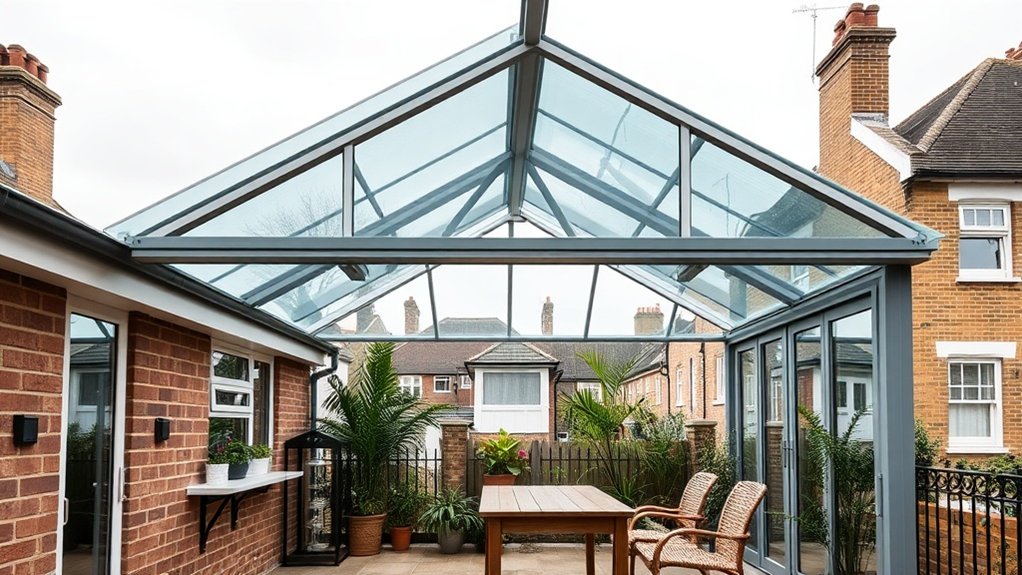
Lean‑to conservatory glazing in London lets you create a high‑performance, mono‑pitched glass envelope that maximises usable floor area while staying subordinate to the existing elevation. You’ll weigh U‑values, g‑values, acoustic laminates, and privacy treatments against planning constraints, conservation policies, and structural load paths. Specifying low‑e, argon‑filled units, thermally broken frames, and self‑cleaning or solar‑control coatings helps you meet Part L and urban comfort targets, and you’re about to see how each option affects outcomes.
Key insights
- Lean-to conservatory glazing in London must balance slim sightlines with U-value and g-value compliance to meet Part L and local energy-efficiency standards.
- Double or triple-glazed low-E units with argon fill and warm-edge spacers optimise thermal performance while respecting London’s conservation and historic building constraints.
- Planning in London often requires demonstrating visual subordination, appropriate projection depth, and aligned mullion grids, especially in conservation areas and on terraced plots.
- Solar-control, acoustic, and privacy glazing—such as laminated or satin-etched glass—help address traffic noise, overlooking, and overheating in dense urban settings.
- Choice between high-performance glass and polycarbonate depends on weight limits, structural capacity of the host wall, cost, and maintenance expectations for London properties.
What Lean-To Conservatory Glazing Actually Is
When you talk about lean-to conservatory glazing , you’re referring to the specific system of glass or polycarbonate panels, framing profiles, seals, and fixings that form the vertical walls and mono‑pitched roof of a lean-to structure abutting an existing elevation. You’re defining an engineered envelope that mediates between Historical architecture and contemporary performance criteria.
You’re working with U‑value targets, solar gain coefficients , and sightline control to align the glazed plane with your property’s existing datum lines. Mullions, rafters, and eaves beams interface via pressure plates, thermal breaks, and gasketed joints, creating a drained and ventilated façade zone. Internally, the glazing specification directly informs interior decor decisions—controlling light temperature, glare, and transparency to support adaptive, tech‑ready living spaces.
Is a Lean-To Conservatory Right for Your London Home?
Although a lean‑to conservatory is often promoted as a universal solution, it only truly suits your London home if its geometry, load paths, and performance metrics align with the property’s existing fabric and planning constraints. You’ll need to verify that the host wall can accept additional point loads, that roof pitch and sightlines respect neighbouring amenity, and that U‑values meet London’s tightening energy standards.
If you’re in a conservation area or working with historical architecture, a lean‑to’s linear roofline can either discreetly recess beneath existing eaves or clash with ornamental cornices. You should also assess garden integration: does the lean‑to create a clean threshold between interior slab and external terrace, optimise solar gain from a south‑facing plot, and maintain functional circulation across a typically compact London garden?
Pros and Cons of Lean-To Conservatories in London
In evaluating lean‑to conservatories for a London property, you’re fundamentally trading structural and spatial efficiency against tighter design and performance margins. The mono‑pitch roof interfaces neatly with party walls and parapets, minimising structural interventions into historical architecture while maximising usable floor area along constrained elevations.
- You gain a streamlined load path and reduced steelwork, cutting install time and on‑site disruption.
- The shallow pitch can underperform for drainage during intense local climate downpours.
- Solar gain on south‑ or west‑facing elevations can create overheating without advanced glazing specs .
- The linear form integrates cleanly with period brickwork, but any misaligned datum lines visually jar.
- Planning officers often favour lean‑tos as “subordinate additions,” improving consent prospects in conservation areas.
Glazing Design Tips to Make a Small Lean-To Feel Bigger
To make a compact lean-to conservatory read as larger, you need to optimise the glazing specification and sightline geometry. You’ll focus on maximising vertical glass lines, selecting high-transparency low-iron units with appropriate solar control coatings, and minimising frame sightlines to blur the threshold between inside and outside. By coordinating pane dimensions, mullion spacing, and threshold detailing, you create a continuous visual field that extends the perceived volume of the space.
Maximising Vertical Glass Lines
When you maximise vertical glass lines in a lean‑to conservatory, you manipulate sightlines and light transmission to exaggerate perceived height and depth in a constrained footprint. You prioritise uninterrupted mullion runs, slimline framing , and tight joint tolerances so the eye tracks upwards, not sideways. Align transoms sparingly and keep glazing modules tall and narrow to stretch the envelope visually.
- Specify thermally broken, ultra‑slim mullion profiles to reduce visual mass.
- Stack glass units vertically from datum to eaves to create a continuous “glass wall”.
- Use decorative patterns that run vertically, referencing historical styles without visual clutter.
- Align door leaves and fixed lights on a single vertical grid for clean geometry.
- Coordinate gutter and fascia heights so they don’t interrupt the vertical rhythm.
Using High-Transparency Glazing
Vertical sightlines only work at full effect if the glass itself disappears as much as possible, so you specify high‑transparency glazing to minimise visual barriers and maximise daylight factor. You prioritise low‑iron glass with a high visible light transmittance (typically >75%) to avoid the green edge tint that compromises glazing aesthetics in compact lean‑to footprints.
You then pair this with selective solar control coatings that preserve neutral colour rendition while optimising g‑value for London’s mixed climate, supporting architectural sustainability by reducing reliance on artificial lighting and active cooling.
Specify warm‑edge spacers, argon fill, and low‑emissivity inner panes to maintain U‑values without sacrificing clarity. You also coordinate frame sightlines and mullion modules so the glass, not the structure, dominates perception of volume.
Blending Indoors And Outdoors
Although the footprint of a London lean‑to is inherently constrained, you can deploy glazing strategies that dissolve the perceived boundary between interior and garden, making the space perform as an extension of the landscape rather than a bolt‑on room. To optimise indoor harmony and outdoor connection, treat glass as an architectural interface, not just a weather barrier.
- Specify full‑height structural glazing with minimal mullion profiles to maximise sightlines and perceived depth.
- Align door thresholds as flush, low‑profile systems to maintain continuous floor planes.
- Use matching floor finishes inside and out to reinforce spatial continuity.
- Integrate frameless rooflights to draw daylight deep into the plan and reduce visual enclosure.
- Calibrate g‑values and coatings so thermal comfort supports year‑round biophilic occupation, not just seasonal use.
Glazing Choices for Your Lean-To Conservatory
Because glazing is the performance backbone of a lean-to conservatory, your choice of glass or polycarbonate directly dictates thermal efficiency, solar gain, acoustic control , and long‑term maintenance. You’re effectively specifying the building envelope, so you must balance U‑values, g‑values, light transmission, and self‑weight against the constraints of historical architecture and dense urban landscaping.
Start by defining orientation, overshadowing, and privacy requirements, then select glazing that tunes visible light and infrared transmittance to that micro‑context. In London, you’ll typically prioritise low‑maintenance coatings, impact resistance, and robust edge sealing to mitigate pollution, traffic noise, and wind uplift.
Polycarbonate delivers lightweight, cost‑efficient performance, while advanced glass units let you refine clarity, durability, and design intent for a streamlined, contemporary lean‑to profile.
Double, Triple and Solar Control Glass Compared
When you compare double, triple, and solar control glass for a London lean‑to conservatory , you’re weighing thermal performance, solar gain management, unit thickness, and structural loading against cost and frame compatibility. Double glazing gives you a leaner unit, lower dead load, and simpler integration with existing frames in historical architecture. Triple glazing increases U‑value performance but adds weight and demands higher-spec framing and fixings.
Solar control glass overlays these options with spectrally selective coatings that filter short‑wave radiation, supporting climate adaptation in dense urban microclimates.
- Double: balanced cost, moderate insulation.
- Triple: enhanced thermal envelope, heavier units.
- Solar control: reduced g‑value, glare mitigation.
- Laminated options: better acoustic attenuation, security.
- Low‑iron substrates: superior daylight transmittance, crisp visual clarity.
Energy-Efficient Lean-To Glazing for London Homes
How do you design a lean‑to conservatory in London that maximises energy performance without over‑engineering the glazing build‑up? You start by treating the roof and façade as an integrated thermal envelope, not bolt‑on glass. Specify low‑e, argon‑filled units with warm‑edge spacers, tuned to your elevation and overshadowing.
You’ll balance solar gain (g‑value) against U‑value to avoid winter losses and summer overheating, especially on tight London plots. Use selective coatings that respect adjacent Historical architecture while delivering a clean, Modern design aesthetic. Pair high‑performance glass with thermally broken rafters, insulated upstands, and airtight perimeter junctions to eliminate linear thermal bridges. Finally, integrate trickle ventilation and purge‑vent windows to manage internal gains without undermining your carefully modelled glass performance.
Self-Cleaning, Low-Maintenance Glass Options
When you specify self-cleaning glass for your London conservatory, you’re typically choosing a unit with a photocatalytic and hydrophilic surface coating that breaks down organic contaminants and sheets rainwater evenly to wash residues away. This surface treatment reduces manual washing cycles, minimizes streaking, and helps maintain ideal light transmittance and solar performance over time. As a homeowner, you gain lower maintenance costs, reduced access equipment requirements, and more consistent visual clarity compared with conventional float or standard toughened glazing.
How Self-Cleaning Glass Works
Ever wondered why some conservatory roofs seem to stay clearer for longer in London’s grime-prone environment? Self-cleaning glass uses a factory-applied, photocatalytic and hydrophilic surface coating. Under UV exposure , the photocatalytic layer breaks down organic contaminants at a molecular level. Then, when it rains, the hydrophilic surface causes water to sheet uniformly, sweeping loosened dirt off the glazing.
You can specify self-cleaning units that integrate:
- Nano-structured coatings bonded to the outer pane
- Solar control layers that complement solar shading strategies
- Smart tinting interlayers paired with self-cleaning externals
- Low-iron glass for higher light transmittance through the active coating
- Warm-edge spacer bars to maintain unit performance over time
This system keeps your lean-to roof optics optimised without altering its architectural geometry.
Maintenance Benefits For Homeowners
Seldom acknowledged but immediately felt, the main maintenance benefit of self-cleaning and low-maintenance conservatory glass is the significant reduction in manual roof and façade cleaning cycles. You minimise reliance on ladders, access towers, and external contractors, lowering operational risk and lifecycle costs.
Photocatalytic and hydrophilic coatings degrade organic soiling, then sheet rainwater across the surface, preventing particulate build-up and streaking. This preserves optical clarity, sustaining both daylight penetration and aesthetic appeal with minimal intervention.
Noise-Reducing Lean-To Glazing for Busy London Streets
How do you cut intrusive traffic noise without compromising the slim, space-efficient profile of a lean-to conservatory in London? You specify acoustic glazing that targets urban decibel levels while still respecting surrounding historical architecture and optimising interior lighting. By combining laminated acoustic interlayers with asymmetric double or triple glazing, you disrupt sound transmission without thick, clumsy frames.
You’ll typically pair low-iron outer panes with a denser inner pane, tuned air gaps, and warm-edge spacers to avoid thermal bridges and resonance.
- Laminated acoustic glass with viscoelastic interlayers
- Asymmetric pane thicknesses to break up sound frequencies
- Optimised cavity depth and argon fill for sound attenuation
- Thermally broken aluminium or composite framing systems
- Precision installation with perimeter acoustic sealants
Privacy Glazing for Overlooked London Gardens
When your conservatory faces neighbouring windows or elevated terraces, you need glazing that controls sightlines while still achieving acceptable daylight factors. You’ll compare frosted, etched, and solar-tinted units with different visible light transmittance (VLT) and privacy gradients to optimise both illumination and obscuration. At the same time, you must account for London planning guidance, boundary distances, and neighbour amenity considerations so your chosen specification complies with oversight from the local planning authority.
Balancing Light And Privacy
In dense London terrace layouts , overlooked gardens make glazing specification a privacy‑critical decision while you still need high visible light transmittance for a usable conservatory. You’re trying to reconcile neighbour sightlines, historical architecture, and your interior decor palette without downgrading daylight factor or solar gain control.
You prioritise glass assemblies that modulate visual transparency rather than simply block it. That means evaluating:
- External reflectance versus internal glare risk
- Visible light transmittance (VLT) thresholds for year‑round usability
- Selective coatings that manage solar heat gain without darkening the room
- Pane configurations that interrupt direct sightlines while maintaining sky views
- Frame sightlines, mullion spacing, and roof pitch to minimise mutual overlooking
Frosted And Tinted Options
Sometimes the cleanest way to resolve privacy in an overlooked London garden is to specify purpose‑designed privacy glazing —typically frosted or tinted assemblies engineered to diffuse views while preserving usable daylight. You can deploy acid‑etched or ceramic‑frit glass to achieve stable frosted privacy, avoiding films that delaminate under UV exposure. Specify obscuration levels by light transmission (VLT) and haze values so you precisely control silhouettes and contrast.
For roofs and large lean‑to elevations, you might prefer solar‑control laminates that blend tinted aesthetics with selective spectral filtering, cutting glare and solar gain while maintaining external transparency. Consider low‑iron substrates for neutral colour, or grey/bronze tints for a more expressive, tech‑driven façade language aligned with contemporary London infill projects.
Planning Rules And Neighbours
Although privacy glazing is primarily a design decision, in London it also functions as a planning risk‑mitigation tool for overlooked gardens and boundary conditions. You’re not just choosing glass; you’re managing sightlines, overlooking thresholds , and daylight factors so your lean‑to conservatory passes scrutiny under local building codes and neighbour consultation.
To future‑proof approvals, you should integrate privacy strategies early in the design brief:
- Specify obscure or satin‑etched units to any pane within 1.7m of finished floor level.
- Use laminated acoustic/privacy glass on elevations facing tight urban plots.
- Align mullion grids with neighbouring windows to respect historical architecture rhythms.
- Deploy switchable smart glass where planners want screening without permanent opacity.
- Document glazing performance (U‑values, g‑values, light transmittance) in your planning pack.
Planning Rules for Lean-To Conservatories in London
Before you commit to a lean‑to conservatory in London, you need to verify whether the design qualifies as permitted development under the Town and Country Planning (General Permitted Development) (England) Order 2015, as amended. You must interrogate constraints on projection depth, eaves height, and overall ridge line relative to the original rear elevation, especially on terraced and semi‑detached plots.
You’ll also need to overlay these rules with local planning policy, conservation area appraisals, and Article 4 Directions , which frequently disapply baseline GPDO allowances to protect historical architecture and embedded cultural influences in the streetscape. In practice, you should commission scaled elevations, a site location plan, and a design and access statement to evidence visual subordination and mitigation of perceived townscape impact.
Building Rules and U-Value Standards for Lean-Tos
Once you move beyond planning consent, your lean‑to conservatory in London must satisfy Part L of the Building Regulations and associated U‑value benchmarks for the building envelope. You’re targeting low U‑values for roof glazing, vertical frames, and junctions with the existing façade, so you minimise thermal bridging while respecting nearby historical architecture. You’ll specify thermally broken aluminium or advanced composite profiles, warm‑edge spacers, and argon‑filled low‑E units to meet or exceed notional values.
- Verify roof and sidewall U‑values via manufacturer test data or BRE‑based calculations
- Detail insulated upstands and cills to prevent cold bridging at interfaces
- Use trickle vents and purge openings to balance airtightness with ventilation
- Integrate solar‑control coatings to reduce overheating and cooling loads
- Align all choices with forward‑looking sustainability practices and lifecycle performance
Glazing Styles to Match London Property Types
With performance and compliance resolved, you can focus on glazing compositions that suit London’s dominant property typologies while still meeting your U‑value brief. For Victorian and Edwardian terraces, you’ll typically specify slender sightline aluminium systems with heritage mullion grids or applied astragals that echo historical architecture while integrating low‑iron, solar‑control double or triple units .
For inter‑war semis and post‑war stock, you can deploy larger format panes, using structural silicone glazing and warm‑edge spacers to maximise daylight while controlling g‑values. In contemporary infill or rooftop schemes, minimal‑frame lean‑to assemblies with floor‑to‑ceiling laminated units create seamless thresholds to urban landscaping, balconies, and pocket gardens. Here you’ll prioritise selective coatings, acoustic laminates, and neutral tints to balance transparency, privacy, and environmental performance.
Lean-To Conservatory Glazing Costs in London
How do lean‑to conservatory glazing costs in London actually break down when you move from concept sketch to a priced schedule ? You’re primarily paying for glass specification, structural interface with historical architecture, and compliance with London‑specific thermal standards.
You’ll see cost bands shift as you upgrade from basic double glazing to high‑performance, low‑e, solar‑control units designed for climate adaptation and year‑round use.
- Glass spec: U‑values, g‑values, and coatings for south‑facing or overlooked sites.
- Framing: aluminium vs. timber vs. hybrid, with different sightlines and load paths.
- Integration: flashing, parapet abutments, and party‑wall conditions push detailing costs.
- Performance add‑ons: acoustic laminates, self‑clean coatings, security laminates.
- Approvals: conservation constraints and heritage statements for listed or period stock.
Choosing an Installer, Maintenance, Guarantees and Lifespan
When you’re choosing a conservatory glazing installer in London, you need to assess technical credentials, accreditation (such as FENSA or CERTASS), and a proven track record with complex roofline interfaces and thermal bridging control. You’ll also want a clear maintenance regime for the glazing system—covering sealant inspections, drainage channel clearance, and periodic checks for unit failure or frame movement. Finally, scrutinise guarantees for glass units, hardware, and installation workmanship, and understand the realistic service lifespan of each component under London’s urban climate conditions.
Selecting Qualified London Installers
Before you sign a contract for conservatory glazing in London , you need to vet installers as rigorously as you’d assess the glass specification itself. You’re not just buying labour; you’re securing technical competence, regulatory compliance, and long‑term performance.
Look for firms that understand London’s historical architecture and can integrate lean‑to structures without compromising façades or sightlines. Insist they source profiles and glass from local suppliers to streamline lead times and aftersales support. Prioritise installers who can evidence:
- MCS/FENSA membership and documented Part L/Part O compliance
- In‑house structural calculations for snow‑load and wind‑load
- Proven detailing of interfaces to existing walls and eaves
- Experience with high‑performance coatings, self‑cleaning, and solar‑control units
- Digital surveying (laser measurement/BIM) for precision fabrication
Care, Guarantees And Lifespan
Although glass specification and installation quality define initial performance , the real value of London conservatory glazing emerges in how it’s maintained, warranted, and expected to age over 20–30 years. You should insist on an installer that provides documented maintenance protocols: approved cleaners, inspection intervals, and sealant compatibility, all calibrated to London’s pollution load and wind exposure.
Prioritise systems that optimise glass durability through toughened or laminated panes, warm-edge spacers, and low-emissivity coatings with integrated UV protection to minimise delamination and fading. Demand written guarantees covering unit integrity, coated-surface performance, and hardware corrosion, with clear exclusion clauses. Verify insurance-backed warranties and service-response SLAs, so any blown units, water ingress, or frame movement are rectified promptly, protecting both lifecycle performance and asset value.
Frequently Asked Questions
How Does Lean-To Conservatory Glazing Perform in Extreme London Heatwaves or Cold Snaps?
It performs reliably if you specify high‑performance units. You’ll want low‑E, argon‑filled double or triple glazing to stabilise internal temperatures in heatwaves and cold snaps, maximising energy efficiency . Warm‑edge spacers, thermally broken framing, and tight gaskets minimise thermal bridging and convection. Advanced coatings enhance UV protection while maintaining solar gain control, so you reduce overheating, fading, and peak‑load demand on HVAC, enabling a more future‑proof, innovation‑led envelope.
Can Existing Conservatory Roofs Be Retrofitted With New Lean-To Glazing Systems?
Yes, you can retrofit most existing conservatory roofs with new lean‑to glazing systems, provided the host structure achieves adequate load‑bearing capacity and anchorage. You’ll upgrade Conservatory aesthetics while enhancing glazing durability through advanced IGU specs , low‑E coatings, and warm‑edge spacers. Installers typically deploy structural rafters, eaves beams, and adjustable wall‑plates to integrate new modules, ensuring compliant U‑values, minimized thermal bridging, and optimised solar gain management.
Are There Smart-Glass or App-Controlled Glazing Options for Lean-To Conservatories in London?
Yes, you can specify Smart glass with full App control for your lean‑to conservatory. Imagine a clear roof shifting to cool opacity in seconds—electrochromic or PDLC interlayers modulate visible light, g‑value, and solar heat gain dynamically. You’d integrate low‑iron, argon‑filled IGUs with warm‑edge spacers, then link drivers to a smart hub for zoned dimming, scene presets, IFTTT triggers, and real‑time lux/temperature‑responsive automation.
How Does Lean-To Glazing Impact Home Insurance or Property Valuation in London?
It can positively influence both home insurance and property valuation if you specify compliant lean‑to glazing . You’ll see Insurance implications around structural loading, laminated safety glass, Secured by Design hardware, and U‑values meeting Part L. Underwriters may require FENSA/Certass certification. For property value, surveyors benchmark EPC uplift, thermal performance, and solar gain control; high‑spec low‑E or solar‑control units usually enhance perceived asset quality and resale competitiveness.
What Ventilation Options Pair Best With Different Lean-To Glazing Types?
You’ll match ventilation options to glazing types by focusing on ventilation efficiency and glazing material compatibility. With correctly specified systems, you can cut overheating incidents by up to 30%. Use trickle vents and automated roof vents for high-performance double glazing, ensuring balanced airflow and U‑value integrity. For solar-control or polycarbonate glazing, pair sensor-driven roof vents with low-level slot vents, optimised gaskets, and thermally broken frames to prevent thermal bridging and condensation.
Summary
In the end, your lean-to conservatory is a well‑calculated bridge deck between indoors and out, not a decorative afterthought. You’re the project manager of a micro‑extension, specifying U-values, gaskets, and sightlines like a structural engineer tuning a span. Choose the right glazing spec, ventilation strategy, and installer accreditation, and you’re not just adding glass—you’re future‑proofing thermal performance, daylighting, and asset value in London’s dense, ever‑shifting urban landscape.