
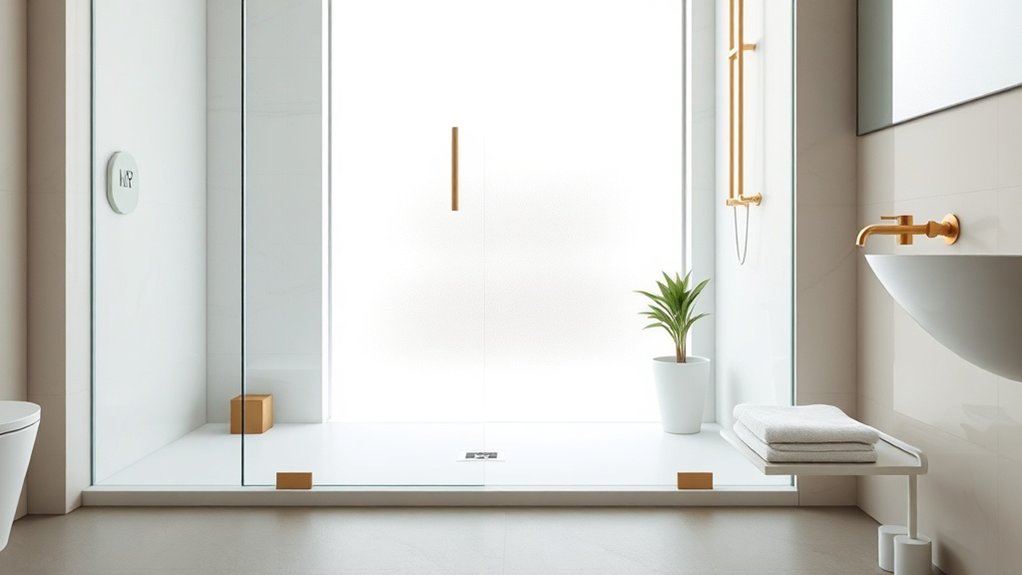
You can transform a London bathroom with a frameless shower screen that’s precisely templated to your uneven walls, sized for compact space, and compliant with UK safety standards (BS EN 12150, Part K, Part M, Part C). Specify low-iron 8–12 mm toughened glass, discreet channels, and marine-grade brass or stainless hardware for a bright, minimal, watertight enclosure that’s easy to maintain. Next, you’ll see how to choose styles, glass options, and the right installer for London homes.
Key insights
- Bespoke frameless shower screens in London are laser-measured on site to suit compact, uneven or period bathrooms while maximizing space and light.
- Toughened safety glass (typically 10mm) to BS EN 12150 with compliant hardware meets UK regulations for impact safety, access and moisture control.
- Clear low-iron or tinted glass, with matching brassware and minimal channels, creates a contemporary, gallery-like look with subtle privacy options.
- Installation includes precise templating, secure stainless/brass fixings, optimized drainage falls and minimal seals for long-term water tightness.
- Eco-conscious options use recyclable safety glass, low-VOC sealants and corrosion-resistant fittings, and can integrate with home automation for lighting, extraction and demisting.
Are Frameless Shower Screens Right for London Homes?
Although frameless shower screens suit many contemporary bathrooms, you’ll want to assess whether they’re right for a London home’s specific constraints: compact floor plans, older plumbing, and sometimes uneven walls. You need accurate site measurement, especially where walls taper or bow, so the glass can be templated and hardware set out with millimetre precision.
You’ll also want to integrate the screen into any Home automation strategy . For instance, specify demisting controls, humidity‑triggered extraction, and lighting scenes that react to shower use. Choose Eco friendly materials: low‑iron, fully recyclable safety glass; durable, low‑VOC sealants; and corrosion‑resistant fittings that minimise replacement cycles. When you coordinate screen geometry, drainage gradients, and door swing with your existing fabric, you achieve a future‑ready, low‑maintenance enclosure.
Key Pros and Cons of Frameless Shower Screens in London
When you assess frameless shower screens for a London property, you need to balance their visual lightness and space-enhancing impact with realistic expectations around maintenance and long‑term durability. You’ll also weigh material and hardware quality against overall project cost, including specialist installation in compact or irregular bathrooms. Finally, you must account for safety standards, glass specifications, and fixing methods to guarantee the system performs reliably under daily use.
Aesthetic And Space Benefits
Frameless shower screens deliver a clean, architectural look that can immediately elevate a London bathroom, especially where space is at a premium. By removing visual bulk, you open up sightlines, making even narrow Victorian footprints feel wider and more coherent. The glass reads as a planar surface rather than a solid barrier, so floor and wall finishes run unbroken, enhancing continuity.
You can still customise aesthetics through subtle hardware choices, using Color options in hinges, brackets, and handles to coordinate with taps or radiators. Although you’re eliminating bulky profiles, you’ll still specify minimal fixing components, so you should assess compatible Frame materials for those elements. This lets you balance structural integrity with a refined, almost invisible presence that maximises light and spatial clarity.
Maintenance And Durability Factors
Once you move beyond aesthetics, you need to assess how a frameless shower screen will perform under daily London use regarding cleaning effort, hardware longevity, and glass integrity. Mineral‑rich water, dense steam, and compact layouts all stress-test the system, so you need strategies that preserve both performance and alignment with cutting‑edge design trends.
- Glass care: Use hydrophobic coatings and soft squeegees; pair with targeted cleaning tips to prevent limescale etching and maintain optical clarity.
- Hardware resilience: Specify marine‑grade stainless or brass fittings, routinely check fixings, and lubricate moving parts to avoid sagging or misalignment.
- Seal management: Inspect discreet seals and channels, replacing worn components before micro-leaks stain stone, grout, or terrazzo, keeping the installation sharp and future‑proof.
Cost, Installation, And Safety
Although the visual impact tends to dominate the conversation, cost, installation, and safety will ultimately determine whether a frameless shower screen is the right specification for a London bathroom. You’ll pay a premium for toughened glass, precision hardware, and bespoke cuts around skirting or boxed‑in services, but you gain long-term value through durability and visual lightness.
During installation, a specialist must verify wall plumb, floor falls, and plumbing compatibility so the screen aligns with drains and doesn’t trap water. You’ll also coordinate fixing finishes with your brassware for coherent color coordination.
From a safety perspective, insist on EN‑12150 compliant toughened or laminated glass, correctly positioned support bars, and anti-slip thresholds to mitigate impact, shatter, and slip risks.
Frameless vs Framed: Which Shower Screen Suits London Bathrooms?
When you’re weighing frameless against framed shower screens for a London bathroom, you’re really balancing spatial efficiency , structural performance, and visual impact. In compact zones, frameless glass amplifies light, reduces visual clutter, and simplifies color coordination with brassware, tiles, and architectural hardware.
-
Performance & water pressure If you’ve got high water pressure or a rainfall head, a well-sealed framed screen contains spray more predictably, while frameless relies on precision tolerances and careful layout.
-
Structure & maintenance Framed systems use slimmer glass supported by profiles; frameless demands thicker glass but offers fewer dirt-traps, cutting long‑term cleaning time.
-
Design flexibility Frameless suits bespoke angles and minimal sightlines; framed can integrate storage, towel bars, or contrasting metal finishes cost‑effectively.
Popular Frameless Shower Screen Styles for London Homes
After you’ve compared framed and frameless performance , the next step is choosing a frameless configuration that actually suits a London floorplan, water system, and aesthetic. For narrow terraces, a fixed walk-in panel with a minimal channel delivers strong shower waterproofing while preserving sightlines and bathroom ventilation.
In tighter ensuites, a single pivot door with discreet hinges lets you control splash paths and preserve existing drainage, critical in older properties. Where you’ve got a recess, a full-width frameless slider optimises access without needing extra swing clearance.
Corner configurations using a fixed panel plus door maximise light in basement conversions, supporting both ventilation strategies and underfloor heating layouts, while maintaining clean, easily sealable junctions with tiles and trays.
Choosing Glass Type and Thickness for Frameless Screens
When you choose glass for a frameless shower screen, you’re balancing structural performance with visual impact. You’ll need to select a suitable safety glass thickness that resists flexing while working with your hardware and fixing conditions. From there, you can assess clear versus tinted glass to control light, privacy, and how the screen interacts with your bathroom’s colour palette and finishes.
Recommended Glass Thickness
How thick should frameless shower glass really be to feel solid, look refined, and meet safety standards in a London home? You’re balancing glass durability, structural performance, and evolving style trends, so thickness isn’t just a number—it’s a design decision.
-
8mm Toughened Glass* Ideal for smaller enclosures and bath screens. It feels light yet secure, reduces hardware load, and suits *minimalist, space‑conscious bathrooms.
-
10mm Toughened Glass The London standard for premium frameless screens. It delivers a satisfyingly solid feel, excellent rigidity, and clean alignment with ultra-slim hinges and channels.
-
12mm Toughened Glass Best for oversized, walk-in, or doorless wet-room designs. It offers superior stability with fewer fixings, but demands robust wall construction and precision engineering to keep lines perfectly true.
Clear vs. Tinted Glass
Because glass is both structure and surface finish in a frameless shower, choosing between clear and tinted panels is as much a technical decision as an aesthetic one. Clear low‑iron glass maximises light and colour accuracy, ideal when you want stone or terrazzo to remain the visual focus. It suits minimal, gallery-like bathrooms and enhances the sense of volume in compact London spaces.
Tinted glass—smoked, bronze, or grey—adds subtle Privacy options without reverting to heavy framing or sandblasting. It manages glare, softens silhouettes, and visually “grounds” large expanses of glass, especially with darker brassware.
When you explore Frame alternatives, pair clear glass with ultra-slim channels; for tinted glass, consider matching hardware finishes so the screen reads as a deliberate architectural element , not an afterthought.
Safety, Building Rules and Water Tightness for Frameless Showers
Although frameless shower screens look minimal, they must meet strict safety, regulatory and performance standards in London homes. You’ll specify toughened, BS EN 12150-compliant glass, precision-engineered hinges, and secure fixings that work seamlessly with your chosen bathroom accessories and plumbing fixtures.
To keep your design innovative yet compliant, focus on three core areas:
- Safety glazing – Use heat-treated or laminated glass, polished edges, and anti-slip thresholds; guarantee impact zones meet Part K requirements.
- Building rules – Coordinate with Part M (access), Part C (moisture) and local water regulations, especially where screens interface with concealed plumbing fixtures.
- Water tightness – Combine minimal seals, accurate falls to drain, and carefully aligned channels so the floor reads continuous while containing splash effectively.
Frameless Shower Screens in Small London Bathrooms
In a compact London bathroom, you can use a frameless shower screen to visually extend the floor area while maintaining strict functional efficiency. By specifying clear or low-iron glass , strategic hardware placement, and a considered lighting scheme, you’ll maximize light flow without sacrificing privacy through options like frosted bands, textured glass, or smart film. With the right layout, glass thickness, and hardware finish, you can achieve a clean, contemporary look that balances space optimization, comfort, and style.
Maximizing Space With Glass
Even when a London bathroom feels constrained by awkward dimensions or period pipework, a frameless glass shower screen can reclaim usable space and visual calm. By eliminating bulky frames and trays, you create a precise wet zone that’s compact, efficient, and easy to navigate.
You maximize performance by coordinating glass layout with drainage gradients, bathroom ventilation, and shower head placement, so water stays contained without additional barriers.
-
Recessed or Wall-to-Wall Layouts – Use a single glass pane to span tight widths, aligning it with existing pipework to avoid intrusive boxing.
-
Pivot or Sliding Mechanisms – Specify low-profile hardware that prevents door swing clashes with basins or WCs.
-
Flush Thresholds – Detail level-access floors and linear drains to extend usable floor area and streamline circulation.
Light, Privacy, And Style
Once you’ve optimised the footprint, a frameless screen also becomes your main tool for controlling light, privacy, and visual hierarchy in a tight London bathroom. You start by specifying glass type: low‑iron clear glass maximises daylight, while satin‑etched or fluted glass delivers privacy without sacrificing luminosity.
You can treat the screen as a calibrated filter. Varying opacity bands or graduated frosting aligns with sightlines from the door or window, ensuring privacy exactly where you need it. Hardware and seals support this strategy; slim, polished profiles keep reflections clean and continuous.
Color coordination matters too. Tie channel finishes, hinges, and handles to tapware, then tune light temperature to flatter those tones. Finally, confirm water pressure and spray pattern to prevent oversplash and maintain visual clarity.
Frameless Shower Screens for Awkward Layouts and Period Homes
How do you introduce contemporary glazing into a tight attic ensuite, a dog-leg bathroom, or a listed townhouse without compromising character or usability? You start by treating frameless shower screens as bespoke architectural components, not generic bathroom products. In London, constraints like Historical preservation and complex Victorian renovations mean you must tune glass geometry and junctions to the building’s quirks.
-
Attic and loft spaces – Use templated glass following sloping ceilings, with stepped or angled edges that maximise headroom while containing spray.
-
Dog-leg and L-shaped rooms – Design multi-panel configurations that align with circulation routes and existing drainage.
-
Period homes and listed properties – Float ultra-clear, low-iron panels away from cornices and panelling, maintaining sightlines so original detailing remains visually dominant.
Hardware, Hinges and Minimal Fittings for Frameless Screens
While the glass defines the volume of a frameless shower, the hardware dictates how refined, robust, and truly “frameless” the installation feels. You’re balancing engineering tolerances with visual lightness, so focus on precision hinges , slim U-channels, and low-profile brackets that align perfectly with your tile grid.
Specify solid brass or stainless-steel components with adjustable hinges to fine-tune door alignment and prevent binding over time. Soft-close or rising-butt hinges improve sealing and water efficiency by ensuring consistent closure against minimal clear PVC or magnetic strips.
Use discreet wall fixings and linear support bars rather than bulky frames, then treat handles and hinges as intentional decorative accents —coordinated in finish, proportion, and geometry—to echo your wider bathroom fittings without visually crowding the glass.
Cleaning and Maintaining Frameless Shower Screens in London
A frameless shower screen only looks truly architectural if you maintain the clarity of the glass and the precision of its hardware, and London’s hard water makes that a technical issue, not just a housekeeping one. You need Cleaning tips and Maintenance routines that protect both the glazing and the minimal fittings.
-
Daily hydrophobic strategy After each shower, squeegee the glass and wipe the hinges with a microfiber cloth; this prevents mineral nucleation and preserves optical transparency.
-
Weekly chemical control* Use a *pH‑neutral, non-abrasive cleaner; avoid acids that etch protective coatings and compromise seals.
-
Quarterly performance check Inspect hinges, wall channels, and silicone lines; tighten fixings, clear drainage gaps, and replace failing seals before water ingress stresses the structure.
What Frameless Shower Screens Cost in London
Maintaining that level of clarity and precision primarily pays off if you’ve specified a frameless shower screen that fits both your space and your budget, and in London the cost variables are highly structured. You’re fundamentally paying for three inputs: glass specification, hardware quality , and installation complexity.
Expect standard enclosures in toughened safety glass to start at an accessible level, with costs rising as you specify thicker custom glass, oversized panels, or complex layouts such as wet rooms and walk‑in configurations. Precision‑engineered hinges, minimalist channels, and high‑performance seals that minimise water leakage add to the price but materially improve performance and longevity.
Allow for survey, templating, edge‑polishing, and any bespoke cut‑outs ; in compact London bathrooms, this detailing often defines the final cost.
How to Choose a London Frameless Shower Screen Supplier
When you choose a frameless shower screen supplier in London, you need to assess glass quality standards, from safety compliance to edge finishing and clarity. You’ll also want to compare design options and hardware systems—hinges, brackets, channels, and seals—to guarantee they match your bathroom’s layout and performance needs. Finally, verify how the supplier manages installation tolerances and aftercare, including warranty terms on glass, hardware, and workmanship.
Assess Glass Quality Standards
Before you compare quotes or finishes, you need to understand the glass quality standards that separate a safe, durable frameless shower screen from a risky installation. In London, you’re not just buying transparency; you’re investing in engineered performance that must align with strict safety regulations and forward-thinking Glass craftsmanship.
-
Certification & compliance Confirm BS EN 12150 (toughened) or BS EN 14428 compliance. Ask for documentation, not just verbal assurances.
-
Glass specification Verify thickness (typically 8–10 mm) and edge finishing. Precisely polished, arrised edges reduce stress points and enhance visual purity.
-
Surface and treatment quality Inspect for optical distortion, inclusions, or waves. Ask about nano-coatings that improve hydrophobic performance and longevity without compromising structural integrity.
Compare Design And Hardware
Once you’ve verified the glass meets the right standards, the differentiator between London suppliers often comes down to design intelligence and hardware engineering. You’re not just buying a screen; you’re buying hinge geometry, fixing methods, and long-term alignment stability .
Evaluate how precisely the supplier integrates hardware with your layout: wall tolerances, door swing, and drainage lines. Ask for CAD-based layouts and check hinge specs, weight ratings, and corrosion performance .
Look closely at handle and bracket design, not just aesthetics. Confirm available color options in architectural finishes (polished, brushed, PVD tones) and how consistently they’re applied across components. Even with “frameless” systems, micro-profiles and minimal frame materials matter—insist on marine-grade alloys, concealed fixings, and adjustability for real-world walls.
Verify Installation And Warranty
Although hardware quality sets the foundation, the real test of a London frameless shower screen supplier is the precision of their installation process and the robustness of their warranty. You need a team that can work cleanly within historical architecture, align glass to millimetre tolerances, and coordinate complex plumbing considerations without compromising waterproofing.
Ask suppliers to detail their on-site methodology and what’s actually covered post‑installation .
-
Technical survey – Confirm laser-measured layouts, substrate assessment, and checks for pipe routes, gradients, and drainage.
-
Accredited installers – Verify training, glazing certifications, liability insurance, and experience in heritage and new-build projects.
-
Warranty structure – Separate coverage for glass, hardware, seals, and labour; look for written terms covering leaks, movement, and corrosion, plus defined response times.
Frameless Shower Screen Installation: What to Expect
When you book a frameless shower screen installation in London, you should expect a tightly structured process that starts with a final site survey and ends with meticulous sealing and alignment checks. The installer confirms stud locations, underfloor buildup, and falls to drain, then verifies that bespoke glass sizes match site realities.
You’ll see Historical influences in the clean geometric sightlines and minimal hardware, echoing early modernist bathrooms, but delivered with contemporary engineering. Installers position laser levels, then dry‑fit panels, checking reveals and hinge clearances in millimetres. Fixings are anchored to maximise load transfer and Material sustainability, favouring durable brass and stainless steel. Finally, they apply precision silicone joints, test door swing and watertightness, and walk you through maintenance and adjustment points.
Common Mistakes With Frameless Shower Screens to Avoid
Precise installation in London bathrooms only performs as intended if you avoid a handful of recurring design and specification errors. Frameless systems are unforgiving: any misalignment or under‑engineering quickly shows as leaks, rattles, or stress cracks.
-
Misreading site tolerances Don’t assume walls are plumb or floors level. Specify glass sizes after final tiling, and select shower enclosure styles that accommodate minor deviation with minimal hardware.
-
Underspecifying structural support Frameless doors load heavily on hinges. Verify stud positions, reinforce where necessary, and coordinate wall mounted fixtures so they don’t clash with fixing points or weaken substrates.
-
Overlooking water management Avoid minimal thresholds without proper gradient and drain placement. Design seals, sweep gaps, and hinge orientation to contain spray under real London water pressures.
London Bathroom Design Ideas to Pair With Frameless Shower Screens
Because frameless shower screens visually recede, they let you treat the rest of your London bathroom as a clean canvas for bolder, more architectural moves. Start by aligning sightlines: run large-format porcelain or terrazzo across floor and walls so the glass feels integrated, not added on.
Specify minimal, wall-mounted plumbing fixtures in brushed stainless, black PVD, or living brass to create sharp, engineered contrast against the transparency. Pair linear drains with concealed valves to maintain a continuous plane.
Select bathroom accessories as part of the architecture rather than afterthoughts: recessed niches, magnetic towel rails, and flush-mounted LED profiles. In compact London footprints, integrate mirrored cabinetry and wall-hung storage to float above the floor, preserving the visual volume your frameless screen reveals.
Frequently Asked Questions
How Do Frameless Shower Screens Affect London Property Resale Value?
They typically nudge resale value upward by elevating perceived quality and spatial flow. You showcase luxury aesthetics that align with high‑end, design‑led buyers, especially in compact urban bathrooms. When you manage installation costs efficiently—using safety‑certified glass, minimal hardware, and precise waterproofing—you create a low‑maintenance, future‑proof feature. You’ll differentiate your property from dated enclosures and signal an innovative, premium spec that supports stronger offers and faster sales.
Can Frameless Shower Screens Improve Energy Efficiency or Warmth in London Bathrooms?
Yes, they can, but indirectly. You enhance warmth by reducing draughts and containing steam, not by adding true thermal insulation. A precisely fitted screen limits convective heat loss and improves moisture control, so surfaces stay warmer and dry faster. Specify full-height panels, minimal gaps, and high‑quality seals around edges. Combine this with underfloor heating or a heated towel rail to build a high‑performance, energy‑aware bathroom envelope.
Are There Eco-Friendly or Recycled Glass Options for Frameless Shower Screens in London?
You can specify recycled glass options and eco friendly materials for your frameless screens, but you must select suppliers carefully. Look for low‑iron toughened safety glass with 20–40% post‑consumer content and certified life‑cycle data. Pair it with minimal stainless or aluminium hardware, solvent‑free sealants, and FSC‑certified timber blocking. You’ll balance structural performance, optical clarity, and sustainability while keeping the design clean, future‑proof, and highly customizable.
How Do Frameless Shower Screens Impact Accessibility for Elderly or Disabled London Residents?
You’re redesigning a city gate: remove thresholds and visual clutter, and you facilitate Elderly mobility and Disabled accessibility. Frameless glass lets you create wider, unobstructed entries for walkers or wheelchairs, align flush-level trays, and integrate linear drains to eliminate trip edges. You can specify structural glass with offset grab rails, anti-slip coatings, contrasting ironmongery, and carefully calculated turning circles, so the “invisible barrier” becomes a precision-engineered, inclusive passageway.
What Insurance or Warranty Considerations Apply to Frameless Shower Screens in London Homes?
You’ll want cover that treats the glazing as a high‑value fixture , checking policy clauses on glass durability, impact damage, and water‑ingress from seal failure. Prioritize manufacturers offering 10‑year tempered glass guarantees and hardware corrosion cover. Demand written installation warranties from London installers, tying workmanship to Building Regulations and wet‑room standards. Document specifications, photos, and maintenance logs so future claims validate your investment in minimal, innovation‑led bathroom architecture.
Summary
When you treat your frameless shower screen like the “glass hinge” of the bathroom, everything else falls into a clean, efficient rhythm. You’ve weighed pros and cons, compared framed options, chosen glass and hardware, and understood installation. Now you can brief your London supplier confidently, avoid common pitfalls, and integrate the screen into a cohesive design scheme that maximises light, space, and performance in even the most compact London bathroom.