
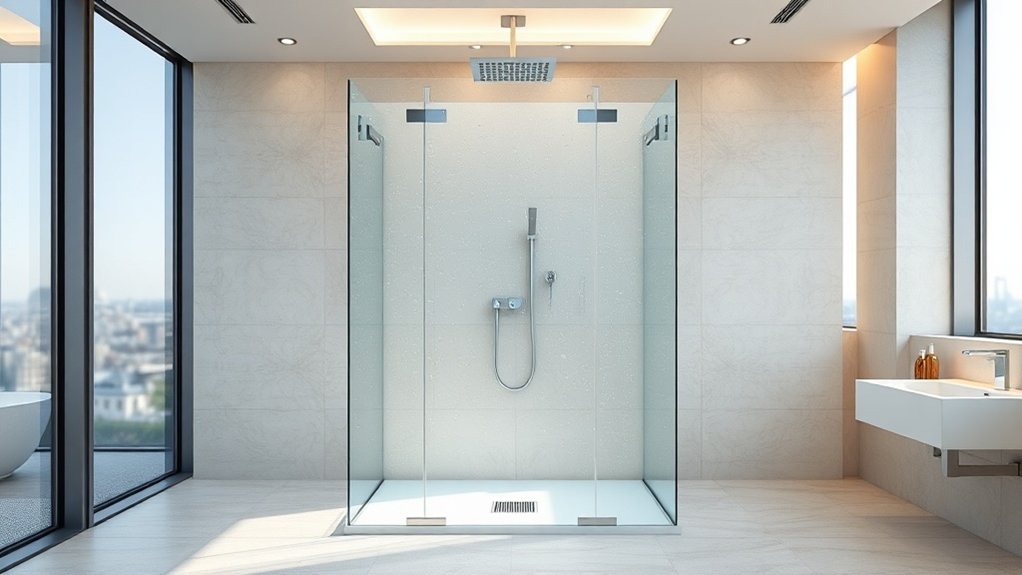
You choose a shower enclosure in London by combining millimetre-accurate measurement with design-led planning. Check wall angles, door clearances, and drainage falls, then match an enclosure style—framed, semi-frameless, or frameless—to your layout and budget. Specify toughened safety glass (to BS EN standards), quality brassware, and discreet ventilation to prevent leaks and condensation. For small flats or period homes, tailored glass and slim trays protect space and character, and there’s much more that can shape your decision.
Key insights
- Bespoke shower enclosures in London can be tailored to awkward spaces, including alcoves, sloped ceilings, and period properties, using precise millimetre-accurate measurements.
- Popular styles range from budget-friendly framed units to premium frameless glass enclosures, with sliding, hinged, or bi-fold doors to suit room size and layout.
- London suppliers typically use toughened safety glass (6–12mm) compliant with BS EN 12150 and BS EN 14428, with options for clear, frosted, tinted, or textured finishes.
- Effective water management includes correctly sloped trays or wet-room floors, well-positioned linear or point drains, and high-quality seals to minimise leaks.
- Costs vary by size, glass thickness, hardware, and customisation; London installations often combine design consultation, made-to-measure manufacture, and professional fitting.
Key Factors When Choosing a Shower Enclosure in London
When you’re choosing a shower enclosure in London, you’re balancing spatial constraints, water management, and aesthetic coherence with the rest of your bathroom. You start by mapping the footprint: measure clearances for door swing, circulation, and existing services. Prioritise toughened, easy-clean glass and precision-engineered seals to control splash and humidity in compact London layouts.
You also consider how the enclosure integrates with Bathroom accessories and storage lines , ensuring profiles, finishes, and hardware align with taps and towel rails. Specify corrosion-resistant fittings to cope with London’s hard water. Plan Shower lighting early, coordinating IP-rated downlights or integrated LED profiles with the enclosure geometry to avoid glare and shadows, while maintaining access for maintenance and future smart-control upgrades.
Most Popular Shower Enclosure Types for London Homes
When you’re planning a new shower enclosure in London, you’ll typically compare compact, space‑saving sliding systems with more open, luxurious walk‑in designs. You need to understand how each option performs regarding footprint, waterproofing, access, and long‑term maintenance . By aligning these technical considerations with your layout and aesthetic goals, you can select the enclosure type that delivers the best balance of function and style for your home.
Space-Saving Sliding Enclosures
How do you gain a generous showering area without sacrificing precious floor space in a London bathroom? You specify a sliding enclosure that runs on ultra-slim, low-friction tracks, eliminating door swing and freeing circulation space. By optimising Shower enclosure materials—typically 8–10mm toughened glass with anodised aluminium or stainless-steel profiles—you achieve structural rigidity with a minimal visual footprint.
You can select clear, tinted, or low-iron glass to coordinate with refined bathroom lighting schemes, allowing LEDs in niches or perimeter strips to refract through the panels and expand the room visually. Soft-close mechanisms, concealed rollers, and flush-fitted handles keep the lines clean, while anti-limescale coatings reduce maintenance—crucial in hard-water London postcodes and high-usage urban homes.
Luxurious Walk-In Designs
Few upgrades transform a London bathroom as decisively as a well-planned walk-in shower, effectively turning the room into a calm, open wet zone rather than a cluster of fixtures. You gain step-free access, uninterrupted sightlines, and a canvas for precise detailing.
To achieve a genuinely luxurious walk-in, you’ll focus on proportion, drainage engineering, and luxury materials. Large-format porcelain , book-matched stone, or terrazzo floors integrate with linear drains to keep gradients subtle and safe. Minimal-framed or frameless glass with specialist coatings maintains clarity and reduces maintenance.
Current design trends favour ceiling-mounted rainfall heads, recessed wall profiles, and integrated LED niches. You can also specify digital controls , allowing pre-set temperatures and flow rates, giving your London bathroom spa-level performance in daily use.
How to Measure Your London Bathroom for a Perfect Fit
To achieve a precise, made-to-measure enclosure in your London bathroom, you’ll first assess the room’s layout, including alcoves, radiators, and any awkward angles. You’ll then take accurate wall-to-wall and floor-to-ceiling measurements, checking for out-of-true walls that affect glass alignment and sealing. Finally, you’ll allow for door clearance and circulation space so the enclosure opens smoothly without clashing with basins, WCs, or towel rails.
Assessing Your Bathroom Layout
Before you choose a shower enclosure, you need a precise understanding of your bathroom’s dimensions, structure, and constraints—especially in compact or irregular London spaces. Begin by mapping circulation paths , door swing arcs, and the relationship between existing services, heating, and Bathroom lighting. You’re not just finding empty space; you’re defining a functional wet zone that integrates seamlessly with the room.
Focus on how layout decisions affect:
- Access and flow – Ensure clear entry, no clashes with doors, radiators, or sanitaryware.
- Visual balance – Align the enclosure with key sightlines, windows, and feature walls for a coherent design grid.
- Technical feasibility – Confirm drainage falls, ventilation routes, and compatible Shower enclosure materials for your chosen footprint.
Taking Accurate Wall Measurements
Once you’ve defined where the shower will sit in the room, the next step is to measure the walls with the accuracy of a joiner, not a rough sketch. Use a calibrated tape and laser level ; note dimensions in millimetres for precision.
Measure each wall at floor level, mid-height, and 2m. London properties rarely have perfectly plumb walls, so record every variation. Check both width and height, and mark any nibs, boxed-in pipework, or radiators that could influence framing and future shower accessories.
Plot these measurements onto a scaled plan . This lets you coordinate glass thickness, profiles, and fixing points while protecting bathroom aesthetics, ensuring your chosen enclosure sits seamlessly within tiles, grout lines, and existing architectural features.
Allowing For Door Clearance
Although your wall measurements might be spot on, your enclosure will still fail if the door can’t swing or slide freely in real-world use. You need to calculate door clearance as rigorously as you measure tile lines or waste positions, especially in compact London bathrooms.
Start by mapping the full travel of your shower doors on the floor plan. Include skirting, radiators, vanity projections, towel rails, and even inward-opening bathroom doors.
- Verify the pivot or hinge point and trace the door’s arc to its maximum open position.
- For sliding systems, measure overlap, track length, and handle depth to avoid collisions.
- Maintain ergonomic passage widths , so you can enter without turning sideways, even with future grab rails or underfloor heating controls installed.
Space-Saving Shower Enclosures for Small London Flats
When you’re planning a bathroom in a compact London flat, the shower enclosure must deliver efficient use of every millimetre without compromising performance or aesthetics. You prioritise ultra-slim profiles, minimal hardware, and precise tolerances so the enclosure reads as clean architectural glazing rather than bulky kit.
Opt for corner or recessed configurations , with sliding or bi-fold doors to eliminate swing. A low-profile or flush tray maximises perceived floor area and improves accessibility. Specify Luxury materials such as 8–10mm toughened glass with nano-coatings and refined aluminium or stainless tracks. Integrate eco friendly options: high-efficiency brassware, water-saving heads, and recyclable components. Custom heights, made-to-measure panels, and integrated storage niches allow you to solve awkward layouts without visual clutter.
Best Shower Enclosures for Period London Homes
Small-space strategies don’t just apply to new-build flats; they’re just as relevant in London’s Victorian terraces, Edwardian mansions, and Georgian townhouses, where you have to respect original architecture while upgrading to a high-performance shower. You’re looking for enclosures that protect period fabric, optimise water efficiency , and reinforce bathroom aesthetics rather than fight them.
Prioritise slimline, low-profile trays to reduce step-up while preserving original skirtings and floorboards. Pair them with minimal-framed or heritage-style brassware in PVD-coated finishes for longevity.
- Specify custom-sized glass to follow eaves, chimney breasts, or bay projections.
- Use clear, low-iron glass with high-quality seals to maximise light and minimise leaks.
- Integrate concealed valves and linear drains to keep the room’s historical lines visually uninterrupted.
Walk-In and Wet Room Enclosures for Modern London Apartments
Even in compact London apartments, walk-in and wet room enclosures let you create a seamless, high-performance shower zone that reads as part of the architecture rather than an add-on. You replace visual clutter with a continuous floor plane , precision-fall screeds, and discreet linear drains that keep water where you need it.
You’ll coordinate gradients, tanking membranes, and underfloor heating so the space performs as a single waterproof shell. Elevate the experience with bathroom lighting integrated into niches and ceiling channels, avoiding glare on glass while defining the shower envelope. Specify streamlined shower accessories—recessed storage, minimal rails , and overhead drench heads—to maintain a clean profile. The result is a future-facing, low-threshold environment that maximises space, light, and usability.
Framed, Semi-Frameless and Frameless London Shower Enclosures
Although all three sit under the same “glass box” umbrella, framed, semi-frameless and frameless shower enclosures in London behave very differently regarding structure, sightlines , and long-term performance. You’re fundamentally choosing how visible you want the engineering to be. Fully framed systems use aluminium perimeter profiles, giving maximised rigidity and budget efficiency, ideal when walls or floors aren’t perfectly true.
Semi-frameless options strip back metal to the outer edges, letting glass dominate while still controlling deflection and tolerances. Frameless enclosures push current shower enclosure trends further: thicker, precision-tempered glass, minimal hardware , and ultra-clean junctions that showcase high-end tiles.
When comparing bathroom renovation ideas, consider:
- Structural stability versus visual lightness
- Maintenance access and seal replacement cycles
- Alignment with future resale expectations
Sliding, Hinged and Bi-Fold Doors for London Bathrooms
Once you’ve chosen how much glass and framing you want, the next decision is how that enclosure actually opens: sliding, hinged, or bi-fold doors each manage space, water control, and daily use in very different ways.
In tighter London bathrooms, sliding doors run on precision-engineered tracks, minimising projection into the room while showcasing premium shower enclosure materials. Hinged doors suit larger layouts, giving you a clean, gallery-style entrance with minimal hardware and sharp alignment tolerances. Bi-fold doors deliver a compact solution, folding inward or outward to clear radiators, basins, or towel rails.
Across all three, you’ll coordinate hardware finishes, threshold profiles, and seals with your glass customization choices so the opening method, aesthetics, and performance work as a single, integrated system.
Glass Options, Thickness and Safety Standards for Shower Enclosures
When you choose a shower enclosure in London, you need to balance glass aesthetics with engineered strength and compliance to UK toughened glass safety standards . We’ll look at ideal glass thickness options so your enclosure feels solid, operates smoothly, and meets daily-use demands. You’ll also compare clear, frosted, and tinted glass so the final specification supports both your privacy requirements and your bathroom’s design language.
Toughened Glass Safety Standards
As you refine a shower enclosure design for a London property, choosing the right toughened glass means balancing aesthetics with strict safety performance. You’re working within UK and European safety standards, so every panel must comply with BS EN 12150 for thermally toughened safety glass and BS EN 14428 for shower enclosures.
To protect users while preserving design freedom, you should guarantee:
- Impact resistance: Glass undergoes controlled heating and rapid cooling, increasing glass durability and surface compression, so it withstands daily use and accidental knocks.
- Safe breakage: If failure occurs, the pane fragments into small, blunt particles, reducing injury risk.
- Verification markings: Permanent kitemarks and classification codes confirm compliance with relevant safety standards and building control expectations across London projects.
Optimal Glass Thickness Choices
With safety standards defined, the next decision is selecting glass thickness that supports your layout, hardware choice, and daily use in a London property. You’ll typically evaluate 6mm, 8mm, 10mm, and 12mm toughened glass, balancing glass durability, enclosure aesthetics , and structural performance.
For smaller alcove or over-bath enclosures, 6mm can be sufficient, keeping weight low and hardware minimal. For walk-in and frameless designs, 8mm offers a strong equilibrium between rigidity, streamlined fittings, and a refined profile.
When you’re pursuing ultra-lux frameless or oversized panels, 10–12mm delivers superior stability and a more architectural feel, but demands reinforced hinges, channels, and substrates. Throughout, you should confirm that fixing details, door widths, and panel spans are engineered to the chosen thickness, not adapted afterwards.
Clear, Frosted And Tinted
Beyond thickness, you also need to decide whether your shower enclosure glass should be clear, frosted, or tinted, as each option shapes light levels, privacy , and the overall design language of your bathroom. Clear glass maximises openness and showcases premium brassware, but it offers minimal visual screening. Frosted glass introduces diffuse light, soft silhouettes, and stronger Privacy options without feeling heavy.
Tinted glass feels more architectural, controlling glare and adding tonal depth, especially in south-facing London bathrooms. You can push the concept further with subtle Glass patterns that integrate with tiles and metal finishes.
- Clear: best for compact spaces and feature tiles
- Frosted: ideal for shared or family bathrooms
- Tinted: suits contemporary, spa-like, or darker schemes
Balancing Style and Privacy in London Shower Enclosures
While London bathrooms often have to work within tight footprints and strict planning constraints, you can still create a shower enclosure that feels both visually refined and comfortably private. Start by treating Privacy enhancement and Style integration as a single design problem, not competing objectives.
You might specify switchable smart glass to shift from transparent to opaque on demand, or use fluted, reeded, or gradient glass that shields the body’s core while keeping the room visually open. Consider door height, sightlines from adjacent spaces, and the reflectivity of metal finishes to prevent unintended views.
Slim, colour‑matched profiles, concealed fixings, and integrated channels let you maintain clean lines, while hardware detailing, proportional framing, and minimal ironmongery preserve a contemporary, gallery‑like aesthetic.
Waterproofing, Drainage and Ventilation Around London Shower Enclosures
Although the enclosure’s glass and hardware define the look, its performance in a London property depends on how rigorously you manage waterproofing, drainage, and ventilation. You need a continuous tanked zone behind tiles, with modern Waterproofing techniques such as liquid-applied membranes, pre-formed shower trays, and sealed junctions at floors, corners, and pipe penetrations.
Specify drainage systems that clear water rapidly, even with high-flow rain heads. Position the linear or point drain to suit the enclosure layout, then laser-check falls so water can’t pool at thresholds.
- Detail silicone and profiles so glass meets tiled surfaces without capillary leaks.
- Integrate a quiet, high-capacity extractor linked to the light or humidity sensor.
- Use trickle vents or undercut doors to maintain airflow and prevent condensation.
Typical Costs of Shower Enclosures in London
When you budget for a shower enclosure in London, you’re dealing with three main cost drivers: the enclosure type (framed, semi-frameless, or fully frameless), the glass specification (thickness, low‑iron clarity, coatings), and the installation complexity in your existing bathroom.
At entry level, framed systems using standard Shower enclosure materials typically start around £450–£700 supplied and installed. Semi‑frameless enclosures with 8mm glass usually sit in the £800–£1,400 range. Fully frameless designs with 10–12mm low‑iron glass, premium hardware, and nano‑coatings often run from £1,500 to £3,000+, especially in compact or irregular London spaces.
Allow extra budget if you’re coordinating with bathroom lighting trends—integrated LED profiles, illuminated niches, or smart controls—since these require electrical works and precise alignment with glass and hardware.
Best Places to Buy Shower Enclosures in London
Even in a city as saturated with bathroom showrooms as London, you’ll get the best results by matching the supplier to the type of enclosure and level of customisation you need. Start with specialist bathroom boutiques in areas like Clerkenwell and Chelsea; they’ll walk you through advanced Shower enclosure trends, from framed minimalism to fully flush walk‑ins with integrated drainage.
For tighter budgets, you can still specify precision-engineered hardware and eco friendly materials through national chains’ flagship London stores, where ranges are standardized but finishes are upgradeable.
Look for suppliers that offer:
- CAD-based design consultations and VR visualisation
- Short lead times on bespoke glass cutting and anodised profiles
- Transparent data sheets covering recyclability and low-VOC components
Installation Options, Local Fitters and Ongoing Maintenance Tips
Now you’ll need to decide whether professional installation or a carefully managed DIY approach best protects your enclosure’s performance and warranty. You should also know how to assess local London fitters for credentials, detailing, and respect for your bathroom’s design intent. Finally, a clear cleaning and maintenance schedule will keep glass, seals, and hardware looking sharp and functioning reliably for years.
Professional Installation Versus DIY
Although a well–designed enclosure starts on the drawing board, its performance depends on how it’s installed and cared for over time, so you’ll need to weigh professional fitting against a DIY approach from the outset. If your scheme pushes Creative design or advanced Material durability, professional installers typically deliver tighter tolerances, cleaner junctions, and better sealing integrity.
DIY installation can work if you’re confident with plumbing, levelling, and sealing systems, but any misalignment risks leaks, glass stress, or tray movement. Evaluate your tolerance for disruption and rework.
- Professional fitting: calibrated tools, tested fixing methods, validated warranties
- DIY: lower up‑front cost, greater control, but higher risk of performance issues
- Either route: follow manufacturer specs, document installation, schedule periodic checks
Choosing Local London Fitters
When you move from design to installation in London, the right fitter becomes as critical as the enclosure specification itself. You’ll want a specialist who understands complex layouts , high-pressure systems, and the subtleties of London’s varied building stock.
Prioritise installers who can integrate concealed pipework, low-profile trays, and smart controls while maintaining fall, waterproofing integrity , and compliance with WRAS and Building Regulations. Ask how they address water conservation through precise valve calibration, flow-limiting components, and leak-prevention detailing.
Choose fitters comfortable specifying eco friendly materials such as low-iron recyclable glass, aluminium profiles, and solvent-free sealants. Check portfolios for bespoke London projects, request CAD-based layout proposals, and confirm they provide clear documentation, product warranties, and responsive aftercare for adjustments or minor performance issues.
Cleaning And Maintenance Schedule
Even the best-specified shower enclosure in London will only perform as designed if you commit to a clear, realistic cleaning and maintenance schedule from day one. You’re protecting glass coatings, precision hardware and waterproofing integrity, so your Cleaning routines must be structured, not improvised.
- Use a daily rinse and squeegee on glass and profiles to prevent limescale crystallisation and staining.
- Specify a weekly neutral-pH clean on glass, frames, seals and tracks, avoiding abrasives that degrade coatings and chrome.
- Implement quarterly Maintenance tips: inspect silicone lines, tighten fixings, lubricate hinges and rollers with manufacturer-approved products.
Align your schedule with your fitter’s documentation and warranty conditions . When you treat maintenance as part of the design specification, your enclosure delivers long-term clarity, performance and visual impact.
Frequently Asked Questions
Can I Install a Shower Enclosure in a Listed London Building?
You can, but you must treat the building’s fabric as sacrosanct. You’ll coordinate with conservation officers, then design reversible fixing methods that don’t damage original finishes. You’ll select minimalist shower enclosure styles that visually recede, using low‑iron toughened glass meeting current glass safety standards. Integrate discreet drainage and ventilation upgrades, and route services invisibly. A heritage‑sensitive, bespoke solution lets you innovate while fully respecting statutory protections.
What Planning Permissions Affect Outdoor or Rooftop Shower Enclosures in London?
You’ll need planning permission if the rooftop shower alters the building’s silhouette, impacts neighbours’ amenity, or sits on a listed or conservation-area property. Assess Building Regulations for structural loading, waterproofing, drainage, and safe access/guarding. Prioritise Privacy considerations through screening, height control, and sightline analysis. Consult an architect early to integrate services, fall protection, and materials, then obtain landlord/freeholder consent before submitting pre-app advice and a full application.
How Do London Hard-Water Conditions Impact Long-Term Shower Glass Maintenance?
You’ll find London’s hard water, like Victorian espresso , accelerates water mineralization, causing etching and haze on shower glass over time. To maintain clarity, you’ll prioritize hydrophobic coatings, precise Glass cleaning protocols, and minimalistic hardware that reduces limescale traps. Specify low-iron, nano-coated glass, design accessible joints, and schedule regular mild-acid descaling. This approach preserves transparency, extends service life, and keeps your enclosure visually sharp for future-forward interiors.
Are There Accessibility Grants for Adapting London Bathrooms With Walk-In Enclosures?
Yes, you can access several UK schemes that support Accessible design in London bathrooms. Start with Disabled Facilities Grants via your local council; they often fund level-access or walk‑in enclosures if you meet grant eligibility and clinical need. You’ll need an occupational therapist assessment, detailed drawings , and compliant specifications. A specialist designer can optimise layout, drainage, and glazing to integrate safety, aesthetics, and future-proofed innovation within funding limits.
What Insurance Considerations Apply When Renovating London Bathrooms With New Enclosures?
Around 1 in 4 home claims link to water damage, so you’ll want your insurance coverage precise before installing new enclosures. You should notify your insurer in writing, confirm renovation policies cover structural changes, and insist contractors hold current public liability and contractor’s all‑risk insurance. Photograph pre‑works, retain specs, and get completion certificates ; they’ll protect warranties, validate future claims, and support any premium recalculation for your upgraded, design‑driven bathroom.
Summary
When you choose a shower enclosure in London, you’re not just boxing in water – you’re framing a daily ritual. The right glass, hardware and layout turn a tight footprint into a precision‑engineered retreat, like a well‑cut gemstone in a complex setting. If you balance measurements, drainage and style with expert installation, your bathroom won’t simply function; it’ll perform, reliably and beautifully, every single day in the city’s constant rhythm.