
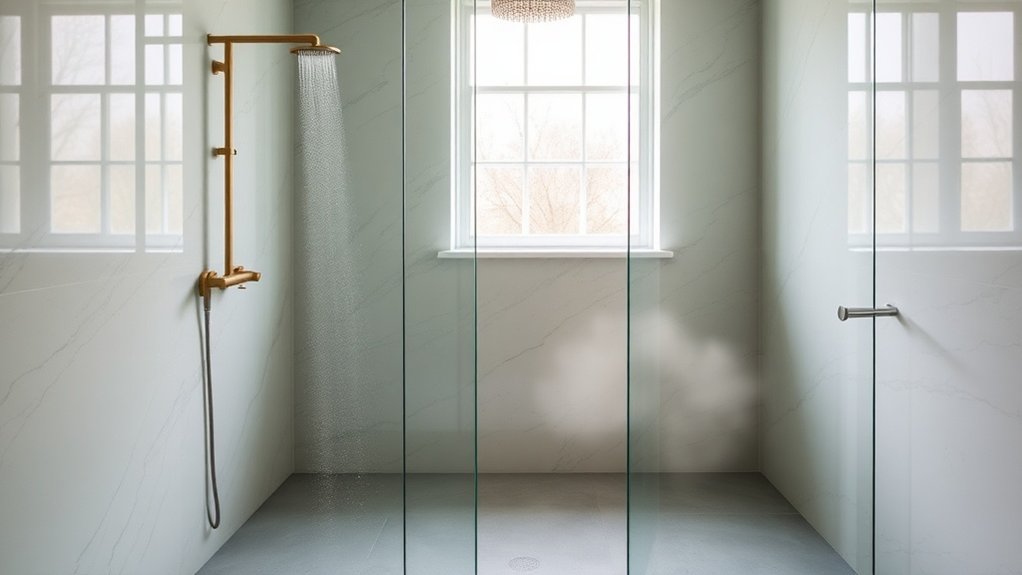
Wet room glass panels in London bathrooms let you maximise tight floor areas , control water accurately, and achieve a clean, architectural look that feels bigger than it is. You’ll gain a flush, tanked shower zone, better light, and easier long‑term maintenance with the right coatings, drainage, and gradients. Specifying 8–10 mm toughened glass, quality hardware, and specialist installation guarantees durability, safety, and value—especially in compact period properties—while the next sections show you how to get this right.
Key insights
- Wet room glass panels maximise space and light in compact London bathrooms, replacing bulky trays with a sleek, watertight shower zone.
- Custom-sized panels (typically 8–10 mm toughened glass) are designed around your room’s layout, drainage, and existing structure.
- Options include fixed walk‑in screens, return panels, sliding-entry doors, and full-height partitions to control spray while keeping the room open.
- Proper waterproofing, gradients, and linear drains are essential; panels are installed with precision channels and seals to protect surrounding finishes.
- Costs vary with thickness, coatings, and customisation, from around £110–£220 per m² for glass, plus similar or higher professional installation fees.
Why Wet Room Glass Panels Suit London Homes
Because space, light, and practicality are at a premium in London homes, wet room glass panels offer a compact, high‑performance way to modernise your bathroom without a full structural rework. You gain a watertight shower zone that maximises every millimetre, eliminates bulky trays, and keeps circulation routes clear.
With minimal framing and low‑iron safety glass, you enhance natural light and achieve a clean, architectural aesthetic appeal that complements contemporary refurbishments and period conversions alike. Precision‑engineered channels and seals control water spread, protecting adjacent finishes and underfloor heating systems.
You’ll also streamline glass maintenance. Hydrophobic coatings, quality squeegees, and correctly specified ventilation reduce limescale, soap residue, and mould risk, so your installation stays visually sharp and performs reliably in London’s hard‑water conditions .
Is a Wet Room Glass Panel Right for Your London Bathroom?
Before you commit to a wet room glass panel in your London bathroom, assess three core factors: space, structure, and plumbing. You need enough clear floor area for safe circulation, a substrate that can accept full tanking , and waste runs that support a low-profile or linear drain without excessive build-up.
Next, decide whether the aesthetic and maintenance profile suits you. Glass panels amplify light and make innovative color schemes and textures more visible, so pair them with large-format tiles, microcement, or terrazzo for a seamless look. Evaluate privacy glazing options and hardware finishes so your fixture choices align with existing brassware and heating elements. Finally, consider cleaning habits; frameless, minimal-iron glass offers a high-end, contemporary feel but demands consistent after-care.
Planning Your Wet Room Layout in a London Property
Once you’ve confirmed a wet room is viable, planning the layout in a London property means working backwards from drainage , gradients, and clearances, not just where you’d like the glass to sit. You’re designing a controlled water zone, so think in planes and flow paths, not just fixtures.
Prioritise:
- Drain position aligned with joists and existing fall, minimising structural intervention.
- Floor gradients (typically 1:50–1:60) directing water away from the entrance and WC.
- Glass panel length and height to contain spray without visually shrinking the room.
- Access widths that meet usability standards while respecting door swings and radiators.
- Surfaces and detailing that support Bathroom trends yet allow straightforward DIY maintenance (removable panels, accessible traps, silicone-light junctions).
This layout-first approach lets glazing feel integrated, not added.
Benefits of Wet Room Glass Panels in Small London Bathrooms
In a compact London bathroom , glass panels let you claim every millimetre by removing the visual bulk of traditional enclosures. You create a continuous plane of light, openness, and flow, which aligns with current minimalist, spa-style trends and makes the room feel considerably larger. By specifying clear, low-iron, or frameless glass, you control how space, natural light, and circulation work together to optimise performance in a small footprint.
Maximising Space With Glass
Although London bathrooms are often constrained by awkward footprints and tight dimensions, wet room glass panels let you reclaim visual and functional space without compromising performance. By replacing bulky trays and framed enclosures with precision-cut glass, you streamline circulation zones and sharpen bathroom aesthetics. Slim profiles, aligned with floor gradients and linear drains , eliminate visual breaks and make every centimetre work harder.
You can engineer a space-optimised layout through:
- Tailored panel sizing to follow existing pipework and alcoves
- Minimal hardware that reduces projection from walls
- Fixed return panels that control spray without boxing in volume
- Recessed channels for a flush, easy-clean junction detail
- High-spec material durability that withstands intensive urban use
The result is a compact bathroom that feels engineered, not cramped.
Light, Openness And Flow
Space-optimised layouts only perform fully when they also improve how light moves through the room, and wet room glass panels excel here. By eliminating opaque barriers, you extend sightlines, making even narrow London bathrooms feel continuous rather than compartmentalised. Clear or low-iron glass maximises natural light penetration , reducing shadows and visual clutter.
You can refine this openness with strategic lighting enhancements. Linear LED profiles recessed into ceilings or niches wash light across glass surfaces, amplifying brightness without glare. Pair these with precise color coordination: pale, cool-toned tiles, seamless grout lines, and reflective finishes bounce light, reinforcing the perception of volume. Frameless or ultra-slim profiled panels maintain visual flow, delivering a clean, future-ready aesthetic that upgrades both functionality and spatial psychology.
Main Types of Wet Room Glass Panels and Screens
While every wet room in London has its own layout and constraints, the glass you choose typically falls into a few proven categories that balance performance and aesthetics. You’ll select thickness, coating, and Color coordination to support both durability and visual impact, then refine everything with Custom designs .
- Fixed walk-in panels – streamlined sheets that anchor directly to floor and ceiling for ultra-clean zoning.
- Return panels – L‑shaped configurations that improve splash control in compact plans.
- Full-height partition screens – floor‑to‑ceiling glass that replaces traditional walls for maximum openness.
- Sliding-entry screens – space-saving systems that maintain uninterrupted sightlines.
- Curved or angled panels – bespoke engineering to follow awkward perimeters, alcoves, or loft eaves.
Each type lets you integrate advanced coatings , privacy treatments, and minimal hardware to suit your architecture.
Framed vs Frameless Wet Room Glass Panels: Which to Choose
Even before you finalise layouts or tile choices, you’ll need to decide whether your London wet room will use framed or frameless glass panels, because that decision drives both engineering details and visual character . Framed panels give you clear structure, precise junctions and easier integration with uneven walls or heritage substrates. They’re ideal if you want bolder lines or to coordinate profiles with existing brassware.
Frameless panels maximise openness, light flow and continuity with large-format tiles, suiting minimalist schemes and compact footprints. They visually recede, so your Color schemes and textures lead. You can specify ultra-slim channels or discreet brackets for a near-invisible fix.
In both cases, you’ll choose Material options for profiles and hardware that align with your design language and performance expectations.
Glass Thickness, Height, and Safety Specs for London Wet Rooms
When you specify wet room glass in London, you need to get the basics right: recommended thickness, panel height, and compliance with current safety regulations . You’ll balance structural performance against a minimal look, choosing glass dimensions that resist deflection while still feeling light and contemporary. Let’s map out ideal thicknesses, typical height ranges, and the essential British and European safety standards your installer must follow.
Recommended Glass Thickness
Because a wet room combines open access with constant exposure to water and impact risk, glass thickness and height aren’t just aesthetic choices—they’re core safety specifications you must get right for London projects. For most residential wet rooms, you’ll specify 8–10 mm toughened safety glass ; in high-traffic or luxury schemes, 10–12 mm delivers better rigidity and a more architectural feel that pairs well with advanced color schemes and lighting options.
Key guidelines you should work to:
- Use 8 mm minimum for fixed panels in low-traffic homes.
- Upgrade to 10 mm where spans exceed ~900 mm.
- Choose 10–12 mm for door panels or walk-through zones.
- Combine thicker glass with minimal hardware for a frameless look.
- Guarantee all glass is BS EN 12150 toughened, heat-soak tested where possible.
Optimal Panel Heights
How tall should a wet room panel really be to control spray, meet UK safety standards, and still feel light in a compact London bathroom ?
You’ll typically aim for 1850–2100mm, tuning height to your ceiling level, shower type, and how much you want to contain spray. For overhead or rainfall heads, lean toward 2000mm+ to prevent overspray while maintaining clean sightlines. In tight London spaces, pairing 8–10mm glass with a 1900mm panel often balances Material durability, stiffness, and aesthetic appeal.
Align the top edge with existing architectural lines—door heads, window transoms, or bulkheads—to keep the room visually coherent. For lofts and sloping ceilings, use made-to-measure heights, shaping glass to the pitch so you maximize enclosure without visually lowering the room.
Essential Safety Standards
Three core factors define safe wet room glass in London: thickness, height, and compliance with UK and European safety standards. You’ll typically specify 8–10mm toughened safety glass , balancing structural integrity with minimal visual bulk. Heights must align with BS 6180 and Part K, ensuring impact zones are protected while preserving that open, seamless look.
Key elements you should lock in:
- Use toughened or laminated safety glass certified to EN 12150/EN 14449
- Confirm edge clearances and fixing details meet current Safety regulations
- Integrate anti-slip thresholds and robust bracing for walk-in configurations
- Specify hardware tested for wet environments to avoid corrosion and loosening
- Build a Glass maintenance plan: inspect fixings, check seals, and clean with non-abrasive products to sustain long-term performance
Slip Resistance, Drainage, and Waterproofing: What You Must Get Right
Even with the most elegant wet room glass panels, the project fails if you don’t get slip resistance, drainage , and waterproofing precisely right. You start with a rated anti-slip floor finish, then align color coordination so gradients and falls remain visually legible, not hidden. Specify linear drains or tile-in channels positioned away from primary circulation but within the glass line to prevent overspray.
You then design falls (typically 1:60–1:80) that work with your drain capacity and any integrated water filtration or greywater reuse system. Underneath, you install a continuous tanking membrane , fully wrapped upstands, and sealed penetrations around drains and fixing channels. Precision detailing at glass thresholds, changeover, and perimeter joints ensures that water never bypasses the system.
Ventilation, Heating, and Condensation Control Around Wet Room Glass Panels
While glass defines the visual language of a London wet room, it also reshapes how you manage ventilation, heating, and condensation at a building-physics level. You’re effectively enclosing a microclimate, so you must coordinate air changes, surface temperatures , and moisture extraction to avoid humidity issues, mould, and frame corrosion.
Think in terms of controlled airflow paths and warm, stable surfaces:
- Specify a humidity-sensing, high-capacity MVHR or extract fan as your primary ventilation solutions.
- Position inlets/outlets to sweep moist air across glass and out of the enclosure.
- Integrate underfloor heating plus low-temperature towel rails to lift mean radiant temperature.
- Use thermally-broken glass channels and well-insulated external walls to limit cold bridges.
- Apply hydrophobic glass coatings to reduce droplet retention and speed evaporation.
Design Ideas Using Wet Room Glass Panels to Make Small London Bathrooms Feel Bigger
Although London bathrooms often have tight footprints, you can use wet room glass panels to manipulate light, sightlines, and circulation so the space reads considerably larger than its actual dimensions. Opt for a single, fixed frameless panel to remove visual breaks; align it with a flush, linear drain so the floor finish runs uninterrupted.
Choose ultra-clear, low‑iron glass to avoid the green edge that visually compresses space. Pair it with integrated lighting solutions: concealed LED profiles in ceiling coves or wall niches will wash light along the glass, dissolving boundaries.
Anchor the scheme with restrained, Personalized decor—monochrome tiles, slimline brassware, and a floating vanity—so the glass remains the dominant spatial device rather than competing with busy surfaces.
Typical Wet Room Glass Panel and Installation Costs in London
When you’re planning a wet room in London , you need clear benchmarks for average glass panel prices and the installation charges you should expect to see on quotes. You’ll weigh up factors like glass thickness, coatings, bespoke sizing, and hardware, alongside London-specific cost drivers such as labour rates and access constraints. By understanding these cost components, you can specify a solution that’s on trend and high performance without letting the budget spiral.
Average Glass Panel Prices
Curious what wet room glass actually costs in London right now? For innovative, frameless panels, you’ll typically see prices driven by glass thickness , coatings, and customisation such as color options and decorative patterns. You’re not just buying a sheet of glass; you’re specifying performance and aesthetics.
Typical glass-only price bands you’ll encounter:
- 8mm clear toughened panels: from £110–£150 per m²
- 10mm premium toughened panels: around £150–£220 per m²
- Low-iron “ultra-clear” glass: typically +20–30% over standard clear
- Tinted, frosted, or digital-printed decorative patterns: +25–40% uplift
- Easy-clean nano coatings and anti-limescale treatments: +£35–£70 per panel
Typical Installation Charges
Once you’ve costed the glass itself, you need to factor in London’s installation charges, which often equal—or exceed—the panel price . For a straightforward single-panel wet room, you’ll typically see installation starting around the same figure as the glass, rising with complexity, panel weight, and access constraints.
Specialist fitters charge a premium because they laser-check levels, integrate drain gradients, and use high-performance sealants to prevent micro-leaks. When you run a cost comparison, include labour for templating, delivery, on-site cutting (if allowed), and silicone curing visits . Different material options for fixings and channels—stainless steel, black anodised aluminium, minimal structural glazing hardware—also influence installation fees, as they demand different drilling tolerances, reinforcement, and alignment time to achieve a seamless, future-proof finish.
Cost Factors in London
London pricing for wet room glass isn’t random; it follows a pattern shaped by panel size and thickness, hardware grade, installer pedigree, and the realities of working in tight urban bathrooms. You’re paying for engineering as much as for “glass.” Costs rise as you specify larger spans, thicker toughened glass, and precision hardware that maintains performance under daily thermal and impact loads.
Key London cost drivers include:
- Panel spec: extra‑clear, low‑iron glass and coatings that boost material durability.
- Hardware: minimalist hinges, channels, and bracing with high corrosion resistance.
- Site complexity: awkward access, floor build‑ups, and rerouting services.
- Labour : specialist installers, waterproofing integrity, and compliance sign‑off.
- Design intent: bespoke geometry and framing that amplifies aesthetic appeal and spatial flow.
How to Choose a Reliable Wet Room Glass Panel Installer in London and Keep Your Glass Spotless
Wondering how to avoid leaks, costly call-backs , and etched glass a year down the line? Start by shortlisting installers who specialise in wet rooms, not just generic glazing. Ask for CAD layouts showing falls, drain positions, and fixing points relative to your interior lighting plan; this guarantees minimal glare and shadowing on the glass.
Verify experience with 10mm–12mm toughened glass, structural silicone, and linear drains, plus evidence of tested material durability in high-humidity environments. Insist on written warranties covering watertightness and hardware corrosion.
For spotless glass, specify low-iron, easy-clean coated panels and request a maintenance protocol: squeegee type, compatible cleaners, and water-softening options. Check reviews with photos of projects after 12–24 months, not just completion-day shots.
Frequently Asked Questions
Can Wet Room Glass Panels Be Installed in Listed or Period London Properties?
Yes, you can install wet room glass panels in listed or period properties, but you must coordinate with conservation officers. You’ll specify toughened or laminated panels to maximise glass durability while keeping sightlines minimal and discreet. Structural surveys check joists and subfloors before drilling or channel fixing. Installation costs rise due to bespoke templating, heritage approvals, and careful waterproofing, but you still achieve a contemporary, low‑profile, future‑ready shower space.
How Do Wet Room Glass Panels Affect London Property Resale Value?
You typically boost resale value because buyers see a turnkey, design‑led upgrade—proof you’re not cutting corners. When you specify high Glass durability (toughened, safety‑rated, low‑iron options), you reduce perceived maintenance risk. Strong aesthetic appeal, aligned with current spa‑inspired bathroom trends, helps listings stand out in a crowded market. You should integrate flush thresholds, minimal hardware, and smart drainage so the installation reads as premium, future‑proof engineering.
Are There Planning Permission Issues for Wet Rooms in London Flats?
You usually won’t need full planning permission, but you must comply with Building Regulations. In London flats, freeholder consent and sometimes a licence to alter are critical, especially if you’re changing drainage or acoustics. Focus on compliant wet room ventilation to control moisture migration between units. Specify robust Glass panel maintenance strategies (frameless, easy-clean coatings, accessible seals) to reassure managing agents and future-proof the installation against regulatory or service-charge disputes.
What Building Insurance Considerations Apply to Wet Rooms With Glass Panels in London?
You need to tell your insurer you’ve installed a wet room , as it changes risk profiling, water‑ingress exposure, and glass safety liabilities. Confirm your policy covers tempered/laminated panels, drainage failures, and waterproofing defects. Insurers may ask for evidence of compliant installation, including slipped‑tray details and certified membranes. Document maintenance requirements—sealant renewal, grout checks, screen inspections—to prove risk mitigation. Keep photos, invoices, and specifications to support any future claim and premium negotiation.
Can Wet Room Glass Panels Reduce Noise Between Adjoining London Bathrooms?
Yes, they can, but only if you specify them correctly. You’ll need laminated or thicker glass combined with targeted soundproofing materials at junctions and frames. When you integrate high‑performance acoustic insulation in walls, ceilings, and service voids, the panels help contain shower noise and water impact sound. For best results, you should detail seals, thresholds, and fixings to meet or exceed London’s typical 45–50 dB airborne sound benchmarks.
Summary
You’ve seen how wet room glass panels can turn a cramped London bathroom into a high‑performance, future‑proof space—almost like upgrading from dial‑up to fibre. By planning layout, drainage, ventilation, and heating correctly, you’ll boost usability, safety, and visual space. Choose toughened, coated glass, a reputable installer, and a simple cleaning routine. Do that, and your wet room won’t just follow current trends—it’ll outlast them.