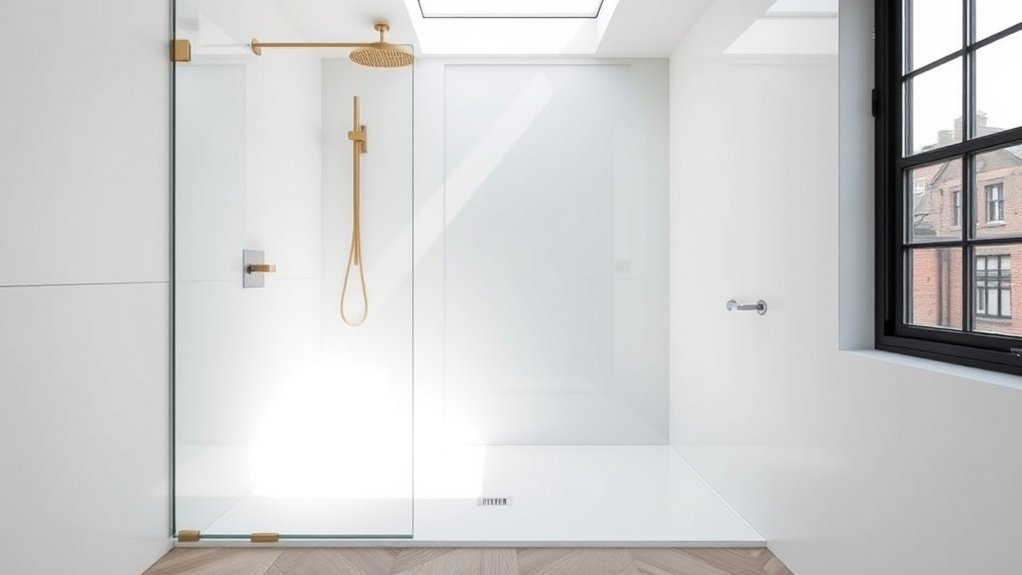
Walk-in shower screens let you turn a compact London bathroom into a streamlined, high-performance zone. You’ll free up floor space, improve ventilation, and gain threshold-free access with clean, uninterrupted lines. Choose frameless for a minimal, gallery look or slim framed profiles to better define wet and dry areas. Specify 8–10mm toughened glass, accurate gradients to the drain, and robust waterproofing so your installation stays watertight, elegant, and more rewarding to plan.
Key insights
- Walk-in shower screens maximise space and accessibility in compact London bathrooms, offering threshold-free entry, improved ventilation and a clean, contemporary look.
- Choose between frameless (minimal, gallery-like) and framed (more forgiving, defined wet/dry zones) screens based on structure, maintenance and desired visual impact.
- Typical London installations use 8–10mm toughened safety glass, with options for low-iron clarity, fluted or tinted privacy glass, and anti-limescale coatings.
- Careful planning of measurements, drainage falls and full waterproofing is essential in older London properties with uneven walls and floors.
- Costs vary with glass thickness, bespoke fabrication, finishes and installation complexity; select suppliers offering CAD design, quality hardware and long-term maintenance guidance.
Why Walk-In Shower Screens Suit London Homes
Because London homes often combine compact footprints with high expectations for performance and style, walk‑in shower screens solve multiple layout and usability challenges at once. You free the floor plan from the constraints of bulky enclosures, allowing tighter tolerances and cleaner lines around windows, doors, and vertical services.
With an open entry and minimal framing, you optimise bathroom ventilation, reducing moisture build‑up in small internal rooms. That lets you specify more advanced finishes and underfloor heating without overloading extraction systems.
Walk‑in layouts also streamline tile selection. You can run large‑format porcelain or terrazzo seamlessly from dry to wet zones, minimising cuts and grout joints. This continuity enhances spatial perception, supports barrier‑free access, and integrates neatly with bespoke storage and concealed drainage.
Benefits of Walk-In Shower Screens in London
When you specify a walk-in shower screen for a London property, you’re optimising space efficiency while keeping the layout visually clean and flexible. The open, low-threshold design improves accessibility for all users and reduces trip hazards compared with raised shower trays or traditional enclosures. By integrating non-slip surfaces, precise screen positioning, and robust hardware, you enhance both day-to-day safety and long-term usability of the bathroom.
Space-Saving Bathroom Design
In dense London homes where every square metre counts, a walk‑in shower screen lets you refine the bathroom layout without feeling constrained by walls and bulky enclosures. By eliminating the need for a full cubicle, you free floor area for streamlined storage, integrated Bathroom accessories, and a more generous circulation zone.
You can specify minimal framing, clear glass, and linear drains so surfaces flow continuously, visually expanding compact rooms. Calibrated Shower lighting , recessed into ceilings or niches, amplifies depth and defines wet and dry zones without visual clutter.
- Feel your studio flat become calmly ordered
- See lines stay clean, uninterrupted, and architectural
- Enjoy every millimetre working with intent
- Sense light bouncing, not being blocked
- Experience small-scale luxury that feels bespoke
Enhanced Accessibility And Safety
Freer, threshold‑free access is one of the most measurable advantages of a walk‑in shower screen in a London bathroom, immediately improving safety for all age groups and mobility levels. With a flush tray or tiled wetroom floor, you minimise trip points and create a continuous, slip‑resistant surface that works seamlessly with underfloor gradients and linear drains.
You also gain clearer sightlines . When you pair a frameless or semi‑framed screen with targeted bathroom lighting, you reduce glare and shadows, helping prevent missteps. Specify toughened, safety‑rated glass with anti‑slip coatings and consider integrated grab rails, fold‑down seating, and thermostatic controls as core shower accessories, not extras. Together, these elements deliver an accessible, future‑ready shower zone that meets modern performance and compliance standards.
Popular Walk-In Shower Screen Styles and Layouts
Although every London bathroom has its own constraints, walk-in shower screens typically fall into a handful of proven styles and layouts that balance performance with aesthetics. You’ll choose a configuration that controls splash, optimises water pressure at the shower head, and keeps the room visually light .
- Feel the impact of a single fixed panel, aligned with your shower head for a clean, gallery-like look.
- Enjoy the precision of recessed, doorless enclosures that turn awkward niches into sleek zones .
- Maximise corners with L-shaped layouts, directing spray while preserving openness.
- Stretch space using wet-room style screens , graded to guide water efficiently to the drain.
- Unlock narrow rooms with offset entries, positioning glass to work around windows, pipework, and storage.
Frameless vs Framed: Which Suits Your London Bathroom?
Once you’ve settled on a layout, the critical design decision becomes whether a frameless or framed walk‑in shower screen will serve your London bathroom better. Frameless systems give you a minimal, gallery‑like aesthetic, ideal if you’re maximising light and visual continuity in compact zones. They rely on precision engineering , so you must prioritise hardware quality and material durability.
Framed screens introduce a clear perimeter, helping you define wet and dry areas in busy households. They’re typically more forgiving structurally and can integrate slimmer glass while still feeling robust. With framed designs, you also access stronger color options : black, brass, brushed nickel, or colour‑matched profiles that tie into taps, radiators, or window frames.
Your choice hinges on structure, maintenance expectations, and visual impact.
Glass Thickness, Finishes and Privacy: What to Know
Because your shower screen is effectively a large piece of architectural glass in a wet zone, its thickness, finish, and level of privacy need as much consideration as the layout itself. In London homes, you’ll usually choose 8–10mm toughened safety glass; thicker panels increase glass durability, reduce flex, and feel more premium under everyday use.
Finishes then tune performance and atmosphere: low‑iron glass gives truer colour; anti‑limescale coatings cut maintenance; textured or tinted glass shapes light and sightlines.
Use privacy options to engineer how exposed or cocooned you feel:
- Frosted bands to blur sightlines, not light
- Full‑surface satin for spa-like calm
- Reeded fluting for graphic, modern rhythm
- Bronze or grey tint for moodier contrast
- Switchable smart glass for on‑demand seclusion
Best Screens for Small London Bathrooms
When you’re working with a compact London bathroom, the shower screen becomes a space‑planning tool as much as a waterproof barrier. You’ll want a frameless or minimal‑frame panel with concealed fixings to reduce visual clutter and keep lines clean.
Choose a single, fixed walk‑in screen paired with a linear drain ; it removes the need for a swinging door and preserves floor area. Opt for low‑iron glass to maximise light transmission, then coordinate bathroom lighting with the screen’s geometry so reflections feel intentional, not chaotic.
Consider folding or sliding panels as high‑end shower curtain alternatives; they deliver better containment and a more engineered aesthetic. Specify made‑to‑measure glass to negotiate boxed‑in soil stacks, bulkheads, and awkward London alcoves efficiently.
Walk-In Shower Screens for Period and Victorian Homes
Although a walk‑in shower feels unapologetically contemporary, the right screen lets you integrate it seamlessly into a period or Victorian London home without erasing historic character. You’ll balance innovation with authenticity by treating the screen as a refined, almost invisible envelope for your Victorian decor.
Specify low‑iron glass for crystal clarity , then pair it with precision‑engineered metalwork colour‑matched to your existing Vintage fixtures. Slim, squared profiles feel modern; softly chamfered or stepped profiles echo original joinery.
- Preserve your cornicing and ceiling roses
- Showcase encaustic tiles and cast‑iron radiators
- Align brass finishes across taps, valves, and frames
- Retain sightlines to sash windows and high skirtings
- Contrast minimalist glazing with richly detailed cabinetry
This way, your bathroom reads as elegantly updated, never compromised.
How to Plan and Measure Your Walk-In Shower
Once you’re clear on the aesthetic you want your walk‑in to support, you need a precise plan and set of measurements to make it work in your London bathroom. Start by mapping the footprint : measure overall room length, width, and ceiling height, then the proposed shower zone, confirming minimum clearances for access and door swing nearby.
Check wall plumb and floor level; even small deviations affect screen alignment and the continuity of tile patterns. Mark stud positions and any services to avoid clashing with fixing points. Plot lighting fixtures in relation to glass edges to prevent glare and shadows. Finally, confirm screen height, width, and bracing requirements, allowing for tolerances, seal profiles, and any future upgrades to fittings or technology.
Drainage and Waterproofing for Walk-In Showers
You’ll need to treat drainage and waterproofing as core design elements, not afterthoughts, if you want a walk-in shower that performs flawlessly. By engineering the correct floor slope and selecting the right drain type, you control water flow and prevent pooling around your screen. Then, by specifying robust waterproof membranes and precision seals, you protect the subfloor and adjacent walls, ensuring your London bathroom stays structurally sound and leak-free.
Slope Design And Drains
How does a walk-in shower stay watertight without a traditional raised tray? You engineer it. The key is a precisely calculated gradient —typically 1.5–2%—that pulls water directly to a linear or point drain. This lets your floor flow seamlessly from dry zone to wet zone while your walk-in shower screen holds spray exactly where you want it.
- Feel the calm of water disappearing instantly, no pooling.
- Enjoy a barrier-free threshold that still protects your bathroom.
- Appreciate drains aligned with your screen’s hardware styles and color options.
- Trust gradients tuned for London’s older, often uneven substrates.
- Relish a minimalist floor that looks monolithic yet performs like infrastructure.
Waterproof Membranes And Seals
Beneath every elegant walk-in shower screen in London sits an invisible system of waterproof membranes and seals that keeps moisture exactly where it belongs. You’re not just protecting structure; you’re future‑proofing your entire bathroom concept.
Specify a continuous tanking membrane beneath your tile patterns, wrapping floors, walls, and niches, then integrate flexible sealing tapes at corners, glass channels, and linear drain edges. Use compatible primers and system-tested adhesives so no weak interfaces develop over time.
At thresholds, pair compressible gaskets with clear silicone to maintain a minimalist junction with the screen. Around recessed lighting fixtures and controls in wet zones, extend the membrane and use IP-rated housings . This way, your visual detailing remains sleek while the hidden envelope stays absolutely watertight.
London-Inspired Walk-In Shower Screen Design Ideas
When you draw from London’s architectural vernacular, your walk-in shower screen can become a precise reflection of the city’s character rather than a generic glass partition. You translate skyline geometry, industrial railings, and townhouse proportions into glass thickness, hardware finishes, and door geometry.
Use London’s layers—heritage to high-tech—to guide your detailing:
- Echo warehouse lofts with black grid-framed screens and linear bathroom lighting.
- Channel Mayfair elegance using low-iron glass, brass profiles, and warm, dimmable lighting.
- Reference Underground iconography with coloured fritted bands and tubular handles.
- Capture riverside calm through fluted glass, ceiling-mounted rails, and concealed shower accessories.
- Evoke tech districts via smart glass, app-controlled lighting, and precisely milled stainless fixings.
Each decision turns the screen into engineered urban storytelling .
Walk-In Shower Screen Costs in London
Although a walk-in shower screen looks like a simple pane of glass, in London its cost reflects a precise balance of specification, fabrication complexity, and installation conditions. You’re typically investing in 8–10mm toughened safety glass, precision hardware, and site-specific measuring, so entry-level modular screens might start relatively low, while bespoke, ceiling-height panels , low-iron glass, or fluted finishes push prices higher.
You’ll also factor in trackless channels, anti-slip detailing, and discreet bracing, which add engineering value as well as visual lightness. Advanced coatings reduce glass cleaning frequency and long-term shower maintenance costs, offsetting the initial premium. Installation in period properties, tight access stairwells, or uneven substrates often requires templating and specialist fitting , which can substantially influence your final budget.
Where to Buy Walk-In Shower Screens in London
Understanding how specification drives cost makes it much easier to choose where to buy your walk-in shower screen in London, because different suppliers specialise in different levels of customisation and installation complexity . You’ll compare boutique bathroom showrooms, technical glass fabricators, and high-end merchants focused on minimal hardware and precision-aligned profiles.
Look for suppliers who provide CAD-supported design, anti-limescale coatings that simplify Shower maintenance, and guidance on Glass cleaning products that won’t damage seals or nano-coatings .
Consider how each option makes you feel about your project:
- Confidence in structural integrity
- Excitement about ultra-clear, low-iron glass
- Relief from low-maintenance protective finishes
- Pride in a perfectly aligned, frameless aesthetic
- Assurance that components are future-proof and replaceable
Professional Installation for Walk-In Showers in London
Even with a perfectly specified screen, professional installation is what turns a design concept into a watertight, structurally sound walk‑in shower that performs for years. In London’s housing stock, walls are rarely perfectly plumb and floors rarely level, so you need an installer who can precision‑scribe profiles, adjust channels, and correctly set fall to drain.
They’ll coordinate screen placement with bathroom lighting to avoid glare on glass and shadows at floor level, optimising both safety and ambience. A specialist will also align screen geometry with your chosen showerhead types—ceiling, wall‑mounted, or rainfall—so spray patterns don’t escape the enclosure. Professional fitting includes robust waterproofing, correct fixings for your substrate, and calibrated hinges or stabiliser bars to minimise flex and future movement.
How to Keep Your Walk-In Shower Screen Spotless
When you treat your walk‑in shower screen as a designed surface rather than just a barrier, keeping it spotless becomes a simple, repeatable process. Think of shower cleaning as part of your bathroom’s performance tuning: you’re protecting clarity, light transmission, and material longevity.
Use a pH‑neutral cleaner and a soft squeegee daily to prevent mineral build‑up , then schedule weekly glass maintenance with a microfibre cloth to remove fine residue. Hydrophobic coatings or nano‑sealants add an invisible shield that repels water and soap, preserving that gallery‑like transparency.
- Feel the satisfaction of crystal‑clear glass every morning
- Protect your investment with disciplined glass maintenance
- Enjoy sharper reflections and brighter tiles
- Reduce cleaning time with smarter materials
- Experience a bathroom that always looks newly installed
Common Walk-In Shower Screen Mistakes in London Homes
When you plan a walk-in shower screen for a London home, poor layout decisions can lead to awkward access, tight clearances, and water escaping into the rest of the bathroom. You also risk long-term damage if you underestimate the importance of high-quality waterproof sealing at junctions, edges, and floor connectivity. By understanding these two common mistakes, you can specify a layout and sealing strategy that keeps your bathroom both functional and watertight.
Poor Layout Planning
Although a walk-in shower screen can transform a London bathroom, poor layout planning often undermines performance, comfort, and compliance. When you misjudge clearances, door swing, or drain position, you create a space that looks refined but feels awkward and inefficient. Misaligned bathroom lighting and randomly placed shower accessories also fracture the visual flow .
You prevent this by treating the shower as a spatial system, not an isolated feature. Map movement lines, storage zones, and sightlines before fixing screen dimensions or hardware locations. Consider how each element will feel during daily use:
- Bumping elbows on mispositioned screens
- Stepping into cold spray every morning
- Squinting under badly aimed downlights
- Tripping over cluttered bottles
- Regretting a premium screen that never feels “right”
Inadequate Waterproof Sealing
Layout issues don’t just affect comfort; they also expose how vulnerable a walk‑in shower screen is to poor waterproof detailing in London homes. When junctions between glass, tray, and walls aren’t precisely aligned, you amplify waterproofing issues and invite sealing failures along perimeters and thresholds.
You should treat the screen as part of a continuous tanked envelope, not an afterthought. Specify high‑performance membranes up behind tiles, then integrate compatible silicone and compression seals at every interface. Pay attention to micro‑gradients at the floor, ensuring water is driven back to the drain, not towards the bathroom. Detail movement joints around the screen to absorb structural shifts without cracking grout or sealant. Finally, pressure‑test the enclosure before final finishes to validate performance.
Frequently Asked Questions
Are Walk-In Shower Screens Suitable for Renters in London Apartments?
Yes, they’re suitable if you choose non-invasive, modular systems . You prioritise lightweight, freestanding or pressure‑fit frames that avoid drilling into tiles, preserving your deposit. For bathroom aesthetics, you use clear or fluted glass, slim black or brushed-metal profiles, and minimal hardware to visually enlarge compact spaces. For shower maintenance, you select nano‑coated glass, accessible seals, and easy‑clean channels, ensuring you can dismantle, relocate, and re-install the screen efficiently.
Do I Need Planning Permission for a New Walk-In Shower Screen?
You usually don’t need planning permission for a new walk‑in shower screen; it’s internal work . Still, don’t fly blind: you must comply with Building Regulations, especially structure, waterproofing, and Fire Safety routes. If you’re in a flat, check lease terms and any management-company rules. Prioritise slim, toughened glass and minimal framing to reduce load, ease future removal, and keep your design agile for potential layout upgrades.
Can Walk-In Shower Screens Improve My London Property’s Resale Value?
Yes, you can boost your London property’s resale value with a walk-in shower screen . Buyers increasingly prioritise a luxury bathroom with clean sightlines and modern design. Specify frameless or minimal framing, 8–10mm toughened glass, and anti-limescale coatings to reduce maintenance. Pair with recessed drainage, wall-mounted fittings, and integrated LED niches. You’ll create a contemporary, spa-like environment that photographs well and differentiates your property in a competitive market.
Are Walk-In Shower Screens Safe and Practical for Elderly London Residents?
Yes, they’re safe and practical when you design the shower as a “transparent handrail” rather than just glass. You’ll specify low- or zero-threshold entry , anti-slip flooring, and grab-rail-compatible screens to support elderly users. Opt for toughened safety glass, wider openings for mobility aids, and thermostatic valves. You’ll preserve bathroom aesthetics, improve water conservation with efficient showerheads, and future‑proof the space with discreet, integrated accessibility features.
How Noisy Are Walk-In Showers Compared to Traditional Enclosed Shower Cubicles?
They’re typically a bit noisier because you’ve removed the full enclosure that naturally boosts sound insulation. With open entries, water impact and spray sound disperse into the room. You can counter this through strategic noise reduction: specify thicker glass, soft-close fittings, and overhead instead of wall-mounted shower heads. Add acoustic underlay beneath tiles and use silicone rather than rigid grout at junctions to dampen vibration and reverberation.
Summary
When you plan your walk-in shower screen in London, you’re not just buying glass—you’re engineering performance. You’ve weighed layouts, hardware, thickness, and finishes, so now you can specify a solution that’s watertight, low‑maintenance, and visually coherent with your space. Remember, “measure twice, cut once”: precise surveying and professional installation prevent leaks, flex, and premature wear. With the right screen, you’ll turn a tight London bathroom into a durable, light‑filled, future‑proof sanctuary.