
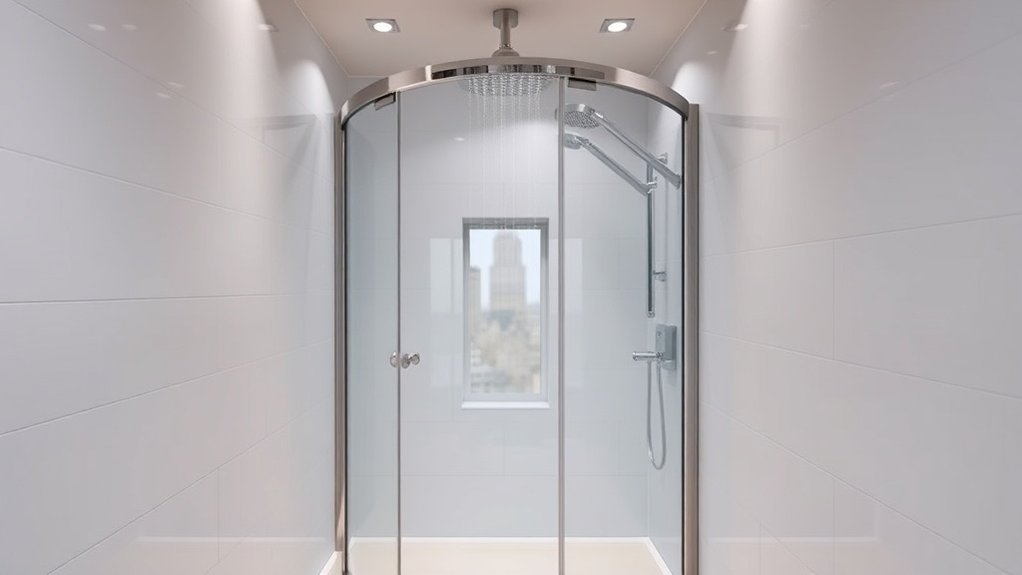
You’ll maximise tight London bathroom footprints with a quadrant shower enclosure by converting a corner into a compact 800×800 to 1000×1000mm wet zone, maintaining at least 500mm circulation to adjacent WC or vanity. Specify 6–8mm toughened safety glass, nano-coatings, and precision roller or pivot doors, checked against door-swing arcs and services. Correct tanking, tray radius alignment, and engineered seals prevent leaks. Stay on this page to see how to specify and install it correctly.
Key insights
- Quadrant shower enclosures maximise space in small London bathrooms by using corners efficiently with compact footprints like 800×800, 900×900, and 1000×1000mm.
- Curved fronts reduce projection into the room, improving circulation space while maintaining comfortable standing and showering areas.
- Accurate laser measurement and checking walls, pipework, and tray radius are essential to ensure a perfect fit in existing London housing stock.
- Choose between standard or offset quadrants, 6–8mm toughened glass, and door types (sliding or pivot) to suit layout and access routes.
- Professional installation with proper tanking, sealing, and ongoing low‑abrasive maintenance prevents leaks and extends enclosure lifespan.
Why Quadrant Showers Work So Well in London Homes
In dense London housing stock , quadrant shower enclosures optimise constrained bathroom footprints by converting an otherwise under‑utilised corner into a defined, high‑performance wet zone with a reduced projection radius. You gain usable circulation space while still achieving a generous standing area due to the curved frontage and tight wall-to-glass tolerances.
Measuring for a Quadrant Shower in a London Flat
Before you specify a quadrant enclosure for a London flat, you need accurate, constraint‑aware measurements of the existing fabric: finished wall‑to‑wall dimensions, corner squareness , and available radius from the shower corner to all obstructions. Use a calibrated laser measurer and check both heights and diagonals to quantify out‑of‑plumb and out‑of‑square tolerances; record deviations in millimetres.
You’ll also map services: waste position, riser zones, and any containment that could impact tray footprint or frame fixings. Set a datum line relative to finished floor level, then verify clearances to doors, towel rails, and proposed lighting options. Capture natural and artificial light fall, since glazing choice interacts with color schemes and reflectance values across tiles, brassware, and ancillary finishes.
Best Sizes and Layouts for Quadrant Showers in London Bathrooms
Accurate site data then informs which quadrant footprints actually work in a London bathroom: typically 800×800, 900×900, and 1000×1000mm radiused trays, plus offset variants such as 1000×800 or 1200×900mm. You’ll align size selection with door-swing arcs, WC/vanity clearances, and towel-warmer projections to avoid operational clashes.
Specify enclosure geometry to coordinate with underfloor gradients, waste positions, and your planned color schemes and lighting options. A compact 800×800 works in micro-baths, but 900×900 often delivers better turning circles and valve access.
- Position the quadrant on the “dark” wall, then layer directional lighting options across glass and tray.
- Use contrasting color schemes between tray, frame, and tile module.
- Maintain minimum 500mm circulation from enclosure edge to opposing sanitaryware.
Quadrant vs Offset Quadrant Shower Enclosures
Although both solutions share the same curved-front aesthetic, you’ll specify a standard quadrant enclosure when you want a symmetric 800×800, 900×900, or 1000×1000mm footprint, and an offset quadrant when the room geometry or door clearances demand a longer leg—typically 1000×800, 1100×800, or 1200×900mm. You’re effectively choosing between a compact, square-based radius and an asymmetric plan that recovers circulation space in tight London bathrooms.
With offset quadrants, you must interrogate waste location, fall to drain, and compatible shower tray options, because the longer leg shifts the trap position and often the joist penetrations. You’ll also align water pressure considerations with enclosure geometry: an offset layout lets you recess digital valves or high-flow mixers on the long wall, optimising pipe runs and maintaining stable delivery to multi-outlet systems.
Door and Glass Choices for Easy-Clean Quadrant Enclosures
When you specify a quadrant enclosure for a London project, door architecture and glass specification are inseparable from cleanability and lifecycle maintenance . You’ll prioritise low-friction kinematics, minimal dirt traps, and hydrophobic glass technologies to reduce manual intervention and downtime.
For doors, specify precision roller assemblies on ball-bearing carriages or high-tolerance pivot hinges with concealed fixings. This supports material durability while preserving aesthetic appeal and access compliance in tight London footprints.
For glass, use 6–8mm toughened safety glass with factory-applied nano-coatings that resist limescale and biofilm. Pair this with slimline profiles and sealed channels.
- Sliding quadrant doors with top-hung rollers and quick-release bottom guides
- Semi-frameless pivot doors with continuous magnetic seals
- Easy-clean coated glass with structural bracing instead of heavy framing
Budgeting for a Quadrant Shower Enclosure in London
Once you’ve fixed door architecture and glass specification, you can map a realistic budget envelope for a quadrant shower enclosure in London by itemising each cost driver rather than working to a generic “mid-range” figure. You’ll break costs into hardware package, glazing , tray, waterproofing interfaces, and ancillary components.
Define your hardware tier first: standard chrome brassware vs luxury materials such as PVD-coated stainless, black anodised aluminium, or brushed nickel for modern aesthetics. Next, price glass thickness upgrades, hydrophobic nano-coatings, and custom radius profiling.
Factor in tray type (stone resin vs low-profile acrylic vs wet-room former), waste position modifications, and required upstands. Don’t ignore London-weighted delivery , access constraints, and bespoke manufacturing tolerances, all of which can push your enclosure from mainstream to premium spend.
Quadrant Shower Installation in London: DIY vs Pro Fitters
Because quadrant enclosures combine curved geometry with tight tolerances at the wall and tray interface, deciding between DIY installation and a professional fitter in London hinges on your competence with setting out, wet-area preparation, and compliance with WRAS and Part H drainage requirements. You’re not just swapping a shower curtain; you’re integrating glass, brassware, waste, and waterproofing into a high‑performance assembly .
DIY works if you can laser-level trays, true walls to ±2 mm, and size wastes to match actual water pressure and flow rates. Pro fitters bring certification, indemnity, and rapid fault-finding.
- Validate subfloor loadings, trap access, and fall gradients.
- Specify seals, profiles, and glass alignment tolerances.
- Commission system: leak-test, verify water pressure, and adjust door mechanisms.
Daily Care and Long-Term Maintenance for Quadrant Showers
A correctly installed quadrant enclosure in London only performs to spec if you treat daily care and maintenance as part of the system design, not an afterthought. You should implement a shower cleaning protocol that specifies non-abrasive, pH-neutral agents compatible with toughened glass, plated brassware, and anodised aluminium profiles. Daily squeegeeing mitigates limescale accretion and preserves hydrophobic coatings.
Define a sealant maintenance schedule: visually inspect silicone bead continuity quarterly, checking for micro-fissures, edge-lift, or biofilm ingress along tray–profile interfaces. Where degradation’s detected, you must de-bond, de-grease, and re-silicone using a sanitary, low-modulus, fungus-resistant product.
Lubricate roller mechanisms and pivot pins annually with manufacturer-approved, non-petroleum lubricants to prevent flat-spotting and maintain calibrated door alignment, closure pressure, and splash-containment performance.
Common Quadrant Shower Mistakes in London Homes to Avoid
You’ll avoid most quadrant shower failures in London flats and terraces by getting three fundamentals right: accurate footprint and height measurements , door-swing geometry, and sealing specification. If you miscalculate available clearance or position the door against radiators, basins, or WC pans, you’ll create operational conflicts and premature hardware wear. When you overlook continuous waterproof sealing—especially around the tray perimeter, wall junctions, and enclosure profiles—you risk capillary ingress, substrate degradation, and costly remedial works.
Incorrect Space Measurements
How often do London bathroom refurbishments fail simply due to inaccurate space measurements for a quadrant enclosure? When you miscalculate, you compromise both space optimization and aesthetic appeal, creating alignment conflicts with existing services and fixtures. You must validate every dimension—width, depth, and diagonal—against the manufacturer’s technical datasheet, not guesswork.
Key checks you should always run:
- Verify wall-to-wall tolerances , squareness, and out-of-plumb deviation with a calibrated laser level.
- Measure finished-floor-to-ceiling height after screed, underfloor heating, and tile build-up, not from raw substrate.
- Cross-check tray radius, offset configuration, and glass footprint against obstacles such as pipe chases, towel radiators, and WC projections.
Poor Door Positioning
Often overlooked yet critical, poor door positioning on a quadrant enclosure creates access conflicts , non-compliant clearances, and accelerated hardware wear in London bathrooms. When you hinge the door on the wrong side or specify the incorrect swing radius, you risk collisions with basins, towel rails, or WC pans, breaching BS 8300 circulation guidelines.
You need to model door alignment against real user pathways, not just plan-view geometry. Map the opening arc, handle projection, and frame tolerances, then validate against minimum 500–600 mm clear access zones. Misaligned pivot points induce racking forces on the curved glass, compromising glass durability and stressing seals and profiles. Always coordinate door handing, swing direction, and hinge geometry with your bathroom layout and user ergonomics.
Overlooking Waterproof Sealing
Surprisingly, many London quadrant enclosures fail not through glass or hardware, but through inadequate waterproof detailing at the tray–wall and profile interfaces. You often rely on generic silicone beads instead of a specified Waterproof sealing system with defined cure times, expansion capability, and substrate compatibility. That’s where capillary creep, micro-movement, and eventual mould ingress start defeating your Leak prevention strategy.
You should design the junctions as engineered interfaces, not cosmetic lines of sealant:
- Specify pre-formed internal corner seals and continuous backer rod to control sealant depth and geometry.
- Use tanking membranes behind tile backer boards, lapped over tray upstands, not just surface silicone.
- Detail vertical profiles with dual-seal configurations and periodic re-seal intervals in your maintenance schedule.
Frequently Asked Questions
Can Quadrant Shower Enclosures Add Value to a London Property at Resale?
Yes, you can enhance resale value when you specify quadrant shower enclosures with Luxury finishes and Stylish designs. By optimizing footprint efficiency, you free up circulation space while maintaining a high-spec wet area. Select toughened safety glass, corrosion-resistant profiles, and precision-engineered rollers. Align hardware with contemporary brassware finishes and integrate low-profile trays. You’ll signal a premium, future-ready bathroom spec to London buyers, supporting higher perceived asset value.
How Do Quadrant Showers Perform With London’s Older Plumbing and Low Water Pressure?
Like tuning a vintage engine, you can make older systems feel reborn. You’ll find quadrant showers generally perform efficiently with low water pressure if you specify low-flow, high-velocity shower valves and pressure-compensating heads. Focus on Plumbing compatibility: confirm pipe bore (usually 15mm), static/dynamic Water pressure (≥0.3–0.5 bar), and mixer type (thermostatic vs manual). Where pressure’s marginal, integrate a negative-head pump or mains-boosting unit for stable performance.
Are Quadrant Shower Enclosures Suitable for Accessible or Mobility-Friendly Bathroom Designs?
Yes, you can specify quadrant enclosures for accessible design if you manage thresholds, clearances, and hardware. You’ll optimize space via the curved radius while maintaining 800–900 mm minimum clear openings. Use ultra-low or flush trays, anti-slip ratings (R11+), and Part M-compliant entry widths. Integrate offset waste positions, reinforced panels for grab rails, and sliding or powered doors to balance space optimization, maneuvering zones, and future-proofed mobility requirements.
Can I Fit a Quadrant Shower Over an Existing Bath or Only on Trays?
You can’t correctly fit a quadrant enclosure over a standard bath; it’s engineered for level trays or tiled wetroom bases only. In your bathroom renovation, think of shower enclosure types as precision instruments: radius-matched tray, plumb walls, 90° corners, rigid substrate, and compliant waste falls. Innovation here means specifying purpose-built, reinforced quadrant trays or tanked wetroom decks, not retrofitting onto curved or flexible bath shells.
What Planning or Building Regulations Affect Quadrant Shower Installations in London Flats?
You must comply with UK Building Regs Parts G, M and P, plus Water Regs . In London flats, you’ll prioritise Bathroom ventilation per Part F (mechanical extract, humidistat/timer, correct l/s rates) and robust waterproofing to protect neighbouring units. Specify Glass material safety to BS EN 12150/14428 (toughened/safety-laminated), non-slip flooring, and IP-rated electrics. Always coordinate waste fall, acoustic performance, and fire-stopping penetrations with building control and freeholder consent.
Summary
By coincidence, the quadrant tray radius you choose often aligns exactly with existing London soil pipe runs, minimizing offsets and costly boxing-in. When you validate wall plumb, corner squareness, and waste fall, your enclosure integrates cleanly with existing services. Combine 6–8mm toughened glass, anti-limescale coating, and CE-marked hardware, and you’re not just saving floor area—you’re commissioning a compact, high-spec wet zone that performs reliably under London’s tight footprints and variable water pressure.