Balustrade repair in London isn’t cosmetic; it’s safety‑critical and must meet Parts K and M, plus BS 6180. If you’ve got loose handrails, wobbly spindles, cracked glass, or corroded fixings, you need a regulation‑compliant assessment before anything fails. A good specialist will check structure, anchors, spacing, and glass specification, then advise repair vs replacement, costs, and permissions. You’re about to see how to approach this properly and avoid costly non‑compliance.
Key insights
- Specialist London contractors inspect balustrades for movement, cracks, corrosion and failed fixings, ensuring compliance with Building Regulations and BS 6180 before recommending repairs.
- Services typically include timber, metal and glass balustrade repairs, from tightening or replacing fixings to splicing, welding, or upgrading to laminated toughened glass.
- Period properties in London often need sensitive repairs that preserve original handrails, newels and spindles while discreetly strengthening anchors and joints for modern safety standards.
- Reputable firms provide full structural assessments, documented load-path checks, and certified materials to guarantee long-term safety on stairs, landings, balconies and roof terraces.
- Many companies offer on-site surveys across London, followed by detailed quotations outlining repair options, expected lifespan and costs versus full balustrade replacement.
Early Warning Signs Your Balustrade Isn’t Safe
Although a balustrade can look sound at a glance, subtle changes often reveal it’s no longer safe or compliant with current standards. You should treat any unexpected movement as a red flag: if the handrail flexes when you apply lateral force, the fixing points or anchors may be failing. Hairline cracks in newel posts, treads, or adjacent walls can signal overstressed connections.
Pay close attention to Balustrade aesthetics. Distorted lines, uneven spacing, or tilted uprights often indicate structural displacement behind the finishes. Corrosion, staining, or loosening around glass clamps and fixings shows moisture ingress compromising integrity.
Inspect decorative elements too. If caps, infill panels, or trim detach easily, they may expose inadequate fixings, substandard materials, or non-compliant retrofits.
Common Balustrade Problems in London Homes
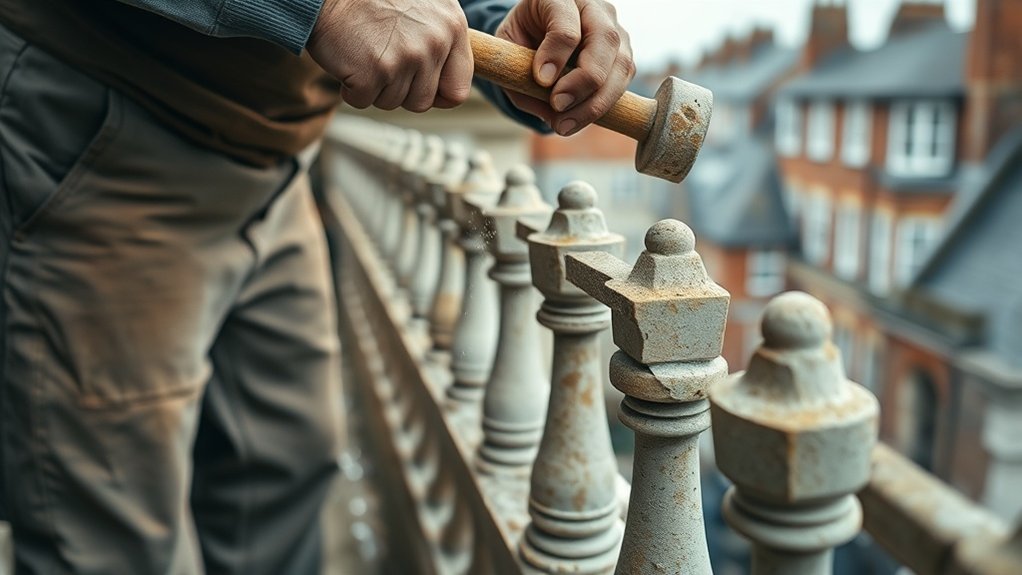
Once you know the early warning signs, it becomes easier to recognise the recurring balustrade issues found in many London homes. You’ll often face loose fixings where old timber or brickwork no longer grips balusters or posts, creating dangerous lateral movement under load. Historic terraces frequently suffer from decayed timber handrails, rusted wrought-iron spindles, or cracked stone, where beautiful historical craftsmanship masks serious structural weakness.
In newer properties, poorly aligned glass panels , underspecified brackets, and corroding stainless steel are common, especially where modern materials weren’t detailed for London’s moisture, pollution, and thermal cycling. You may also encounter inconsistent spacing between balusters, over-flexible handrails, and damaged anchoring into cantilevered stair treads, all of which compromise containment integrity and impact resistance in everyday use.
How London Building Regs Impact Balustrade Repair
London’s building regulations sit at the centre of any balustrade repair, because you’re not just fixing what’s broken, you’re restoring full compliance with current safety standards . Every decision you make—materials, fixing methods, spacing, and height—must align with Parts K and M, fire routes, and structural loading requirements.
You need to reconcile Historical preservation with current codes, especially in listed or conservation-area properties. That means upgrading structural integrity, glass specification , and handrail continuity without compromising original character.
For Modern design solutions, regs shape what’s feasible: minimum barrier heights, maximum opening gaps, and glass performance values dictate how slim, frameless, or transparent your system can be. A compliant repair strategy integrates testing data, manufacturer certifications, and engineer sign-off to guarantee audited, future-proof safety.
Balustrade Repair vs Replacement: How to Decide
When you’re choosing between repairing or replacing a balustrade in London, you need to assess its structural integrity against current and anticipated loads, not just its appearance. You’ll also weigh the immediate repair cost against the remaining lifespan of the existing system and the long-term value of a compliant replacement. Throughout this decision, you must guarantee the chosen option can reliably meet UK and London-specific safety standards for impact resistance, height, and guarding over the years ahead.
Assessing Structural Integrity
Before you decide whether to repair or replace a balustrade, you need to establish its structural integrity in a systematic, safety-led way. You start by confirming load‑bearing capacity , anchor performance, and post rigidity against relevant British Standards and Building Regulations. You don’t let Balustrade aesthetics or historical significance override objective test data.
Inspect every fixing point, substrate condition, and joint for corrosion, cracking, or creep. For masonry or heritage substrates, you commission non‑destructive testing to map hidden voids, delamination, or previous unsympathetic interventions. For metal and glass, you verify material grade, section loss, and edge damage using calibrated instruments.
You then document tolerances, deflection, and failure risks, creating a clear line between components that are safely repairable and those that warrant full replacement.
Cost, Lifespan And Safety
Ultimately, you decide between repairing or replacing a balustrade by weighing three linked factors: whole‑life cost, remaining lifespan , and residual safety margin under current regulations. You don’t just compare today’s invoice; you model inspection, maintenance, and potential liability over 10–30 years.
You first quantify the remaining lifespan of core elements – fixings, substrate, and protective coatings – then ask whether targeted repairs can reliably achieve compliance with current loading, containment, and glass standards. If safety margins remain narrow , full replacement often proves cheaper over the asset’s life.
In London, you also balance Balustrade aesthetics and historical significance. You might retain heritage stone or ironwork while introducing concealed stainless reinforcement, laminated glass, or smart monitoring to achieve both regulatory robustness and innovative performance.
Timber Balustrade Repair for Period London Homes
When you repair timber balustrades in a period London home, you first need to identify decay such as rot, insect damage, and structural looseness that could compromise safety and Building Regulations compliance. You’ll then choose repair techniques appropriate to historic woodwork—such as splicing, resin repairs, and targeted replacement—so you stabilise the structure without over-removing original material. Throughout, you must preserve original mouldings, profiles, and joinery details, ensuring the repaired balustrade remains both structurally sound and architecturally authentic.
Identifying Timber Balustrade Decay
How do you distinguish harmless surface wear from decay that compromises safety and breaches regulations? You start by probing, not just looking. Press a bradawl into the handrail, newel posts, and balusters; if it sinks easily, you’re facing structural breakdown , not cosmetic ageing. Tap components: a dull, hollow sound often signals internal rot that’ll undermine any future timber restoration or decorative finishing.
Check moisture-prone zones first—stringer junctions, balcony terminations, and external thresholds—where failed paint films, open joints, and rusted fixings invite fungal attack. Look for cupping, fibre separation, and crumbly end grain , particularly at baluster bases. Map all defects against load‑bearing paths; any decay along these lines risks non‑compliance with contemporary balustrade height, load, and continuity standards.
Repair Techniques For Period Woodwork
Although every Victorian staircase and Georgian landing has its quirks, effective balustrade repair in period London homes follows a clear hierarchy: first stabilise the structure, then conserve original fabric, and only then refine appearance. You begin by installing temporary propping and checking handrail, stringer, and newel fixings against current load and guarding requirements.
Next, you cut out localised decay and splice in matching timber , using structural epoxy only where compatible with historical restoration guidance. You pin loose balusters with concealed stainless fixings and upgrade anchor points into masonry with resin anchors tested to modern standards.
For decorative carvings, you use reversible fillers and micro‑dowels, avoiding over-sanding. Finally, you integrate discreet fire-retardant and anti-slip coatings without altering profiles.
Preserving Original Architectural Detail
Only by understanding the original joinery and profiles can you preserve the architectural character of a period timber balustrade while meeting London’s current safety standards. You start by documenting every component: handrail sections, baluster spacing, newel geometry, and fixing methods. This lets you upgrade performance without compromising balustrade design or historical significance.
You can then model discreet strengthening measures, such as concealed steel flats or resin anchors, ensuring compliance with current loading and guarding regulations. When elements are beyond repair, you reproduce them with CNC or 3D-scanned templates , matching grain orientation and moisture content to avoid future distortion.
Use a methodical approach:
- Record original profiles and junctions.
- Test structural capacity and fixings.
- Prototype any new intervention before full installation.
Repairing Metal Balustrades on Stairs and Balconies
When metal balustrades on stairs and balconies start to corrode, loosen, or deform, they can quickly become a serious safety hazard and a compliance issue under UK building regulations. You need a methodical approach: structural assessment , material testing, and documented measurements of loading, spacing, and handrail heights.
Begin by exposing all fixings, checking for hidden rust, metal fatigue, or cracked welds. Replace compromised sections with compatible steel or aluminium, using welded or mechanically fixed joints designed to meet current BS and Building Regulations standards.
You can upgrade balustrade aesthetics while retaining load performance by integrating laser‑cut or cast decorative elements, precision‑engineered brackets, and concealed fixings. Finish with a high‑performance coating system—zinc‑rich primers, powder coating, or specialist anti‑corrosion paints—suited to London’s polluted, high‑traffic environment.
Glass Balustrade Repair for Modern London Apartments
In a modern London flat, even a small chip, crack, or loosening of a glass panel can compromise both safety and compliance with current balustrade regulations. You need technicians who can carry out controlled, on-site repairs or replacements while protecting adjacent glazing, structure, and occupants. Where existing panels don’t meet standards or show edge damage, you should consider upgrading to toughened or laminated safety glass for improved impact resistance and code compliance.
Common Glass Panel Issues
Modern glass balustrades in London apartments commonly develop issues such as cracked or chipped panels, loosening at fixings, edge damage from impact, and visible delamination in laminated glass. These defects don’t just undermine Glass panel aesthetics; they also compromise compliance with BS 6180 and current Building Regulations, especially on balconies and mezzanines.
You’ll often notice problems first as subtle clouding, fine star fractures near clamp points, or misalignment where channels have shifted. These faults can distort sightlines, restrict Balustrade color options during refurbishment, and reduce perceived quality in high-spec schemes.
Key red flags you shouldn’t ignore include:
- Movement or rattle when you apply lateral pressure
- White, milky bands creeping in from glass edges
- Corrosion staining around base shoes and point fixings
Safe On-Site Repairs
Safely repairing glass balustrades on site in London starts with stabilising the area and treating the installation as a temporary working-at-height system , not just a decorative feature. You begin by isolating the balcony, installing compliant edge protection, and verifying anchor points so operatives can work in full fall-arrest or restraint.
You then assess glass and fixings in line with current Building Regulations and BS 6180 , documenting any load-path weaknesses. For modern apartments, you’ll insist on dust-minimising, low-noise cutting or drilling methods to protect residents while preserving balustrade aesthetics. Where properties sit in conservation areas, you coordinate with planners so replacement components respect historical authenticity while still meeting contemporary impact and line-load criteria, ensuring both visual continuity and verifiable safety performance.
Upgrading to Toughened Glass
Although many London apartments were originally fitted with basic toughened glass, today you’ll often need to upgrade to laminated toughened glass to achieve compliant balustrade performance under BS 6180 and current Building Regulations. You’re not just replacing damaged panels; you’re future‑proofing safety, durability, and Balustrade aesthetics.
A laminated build-up keeps the glass in place if it fractures, maintaining a protective barrier on balconies, winter gardens, and internal galleries. You can also specify low‑iron or tinted glass to refine sightlines without compromising impact resistance.
When you upgrade, you should consider:
- Verified load testing data and third‑party certification
- Edge treatments and fixings compatible with laminated constructions
- Material sustainability, including recyclable interlayers and responsible glass sourcing
How to Fix Loose or Cracked Balusters and Handrails
When balusters or handrails become loose or develop cracks, you need to act quickly to prevent structural failure and protect users from falls. Start by isolating the area, then assess whether the issue is with fixings, substrate, or the component itself. Check alignment, spacing, and Balustrade aesthetics so replacement elements match existing decorative features and meet UK load and spacing standards.
Tighten or replace mechanical fixings with corrosion‑resistant, structural‑grade screws or bolts set into sound substrate. For timber, inject structural epoxy into splits, clamp, then sand and refinish. For metal or composite systems, use manufacturer‑approved repair kits or modular replacement sections. Always verify handrail continuity, rigidity, and height after repairs, and document materials, torque settings, and test results for compliance records.
Dealing With Balustrade Rust, Rot and London Weather
London’s constant rain, pollution, and freeze–thaw cycles can accelerate rust in metal balustrades and rot in timber, undermining structural integrity and compliance with safety regulations. You need to identify weather-driven corrosion and decay early, then apply appropriate protective coatings, drainage details, and maintenance schedules to prevent further damage. By selecting durable, certified materials and finishes designed for external use in the UK climate, you’ll extend service life and reduce the risk of future safety failures.
Common Weather-Driven Damage
Because London’s climate is consistently damp, windy and often polluted , balustrades here face accelerated rust, rot and surface degradation that can quickly compromise safety and regulatory compliance. You’re not just managing appearance; you’re protecting structural integrity, balustrade aesthetics and, in many cases, historical significance.
Prevailing south-westerlies drive rain into joints, fixings and micro-cracks, where moisture lingers and initiates:
- Ferrous corrosion: Steel fixings expand as they rust, cracking masonry, loosening anchor points, and breaching load-bearing standards.
- Timber decay: Repeated wet–dry cycling breaks down fibres, leading to soft spots, deflection and potential guardrail failure.
- Stone and concrete spalling: Freeze–thaw and pollutants degrade covers, expose reinforcement, and reduce impact resistance.
Unchecked, these weather-driven mechanisms rapidly move a compliant balustrade toward non-conformance and elevated liability.
Preventing Rust And Rot
Rather than treating rust and rot as inevitable side effects of the climate, you can design and maintain balustrades so moisture has nowhere to linger, surfaces stay sealed, and vulnerable metals and timbers remain protected. Start with balustrade design that eliminates water traps: specify positive falls on handrails, drainage gaps at base plates, and fully welded junctions instead of bolted overlaps where feasible.
Use custom fabrication to integrate concealed drip edges , stand-off fixings, and continuous cappings that shed rain and minimise capillary action. Seal all terminations into masonry with compatible, flexible sealants and maintain them on a strict inspection schedule.
You also need a documented cleaning regime, prioritising salt and pollutant removal, plus prompt touch-up of damaged coatings to keep corrosion and decay within controllable limits.
Best Materials For Longevity
Even before you think about profiles and aesthetics, you need to choose balustrade materials that tolerate constant moisture, airborne pollutants , and freeze–thaw cycles without quietly failing behind the finishes. In London, that means prioritising corrosion resistance and dimensional stability as highly as visual impact.
For long‑life balustrade design , you typically get the best performance from:
- Marine‑grade stainless steel (A4 / 316), correctly isolated from dissimilar metals
- Powder‑coated aluminium with certified pre‑treatment and periodically renewed finish
- Engineered hardwood or modified timber, detailed to drain and ventilate
You can still push innovation and refined decorative details, but you should integrate them into a robust structural core. Always verify that chosen products carry test data and third‑party certification to meet current UK building regulations and loading requirements.
DIY Balustrade Repairs or a London Specialist?
When you notice a loose handrail, cracked spindle, or wobbling newel post, you face a key decision: attempt a DIY balustrade repair or call a London specialist who understands local building regulations and safety standards.
If you’re confident with tools, minor tasks—like tightening fixings or replacing a single spindle—can be safe, provided you follow strict DIY safety tips: isolate the work area, use certified PPE, and never alter load‑bearing components. You must also preserve required baluster spacing and handrail height, or you’ll breach UK regulations and compromise Balustrade aesthetics.
For structural issues, glass systems, or listed buildings , a London specialist is the safer, more compliant route, ensuring calculations, fixings, and materials meet BS 6180 and local planning constraints.
What to Expect From a Balustrade Repair Visit
Once you’ve decided to bring in a London balustrade specialist instead of attempting complex DIY repairs, it helps to know how a typical visit will run. First, they’ll carry out a safety-led inspection, checking anchorage, load paths, corrosion, and any breaches of current UK and London Building Regulations. They’ll also photograph details to document Balustrade aesthetics and historical significance.
You can expect a structured process , usually including:
- Diagnostic survey: measuring spans, testing fixings, and evaluating materials (timber, stone, metal, or glass).
- Compliance review: comparing existing details with relevant height, spacing, and impact-resistance standards.
- Repair strategy : outlining options that integrate discreet structural reinforcement, low-visual-impact fixings, and upgrade opportunities such as smarter materials or modular components.
They’ll finish by confirming risks, next steps, and likely timescales.
Typical Balustrade Repair Costs for London Homes
Typical balustrade repair costs for London homes vary widely, but you can usually expect anything from a few hundred pounds for minor tightening and re-fixing through to several thousand for structural strengthening or heritage-sensitive restoration. Budget work typically involves re-securing loose fixings, spot-replacing corroded anchors, and upgrading handrail continuity to current loading and height standards.
As complexity rises, so do costs. Expect mid-range prices for partial spindle replacement, glass panel renewal, or discrete steel reinforcement that preserves balustrade aesthetics. High-end projects focus on historical preservation, custom metalwork, and stone or timber replication that must satisfy Building Regulations and, where applicable, conservation officers . Factor in access constraints, design detailing, and test certification, which can all materially influence your final spend.
How to Choose a Reliable London Balustrade Company
Although London has no shortage of firms claiming to “fix” balustrades, you need a contractor who can evidence structural competence, regulatory understanding, and high-quality workmanship. Start by confirming they design to current Building Regulations, including loadings, barrier heights, and glass specification. Ask for engineer-backed calculations , not just “experience-based” assurances.
Insist they demonstrate sensitivity to Balustrade aesthetics and historical significance while still exploiting modern materials, fixings, and fabrication methods. A reliable company should comfortably align conservation, performance, and innovation.
Check they can provide:
- Detailed method statements and risk assessments for access, removal, and reinstatement
- Certifications for welders, fixings, glass, and protective coatings used on your project
- References for similar London properties, with photographs showing before/after structural upgrades
Planning and Leasehold Rules for Balustrade Repairs
After you’ve identified a technically competent balustrade contractor, you still need to confirm you’re legally allowed to carry out the repair. In London, you must check three layers: planning control, building regulations , and leasehold covenants.
If your property’s listed or in a conservation area, any change to balustrade aesthetics or materials may trigger Listed Building Consent, especially where there’s historical significance. Even like‑for‑like repairs can require approval, so get written confirmation from your local planning authority.
As a leaseholder, you usually need your freeholder’s formal consent for structural works, drilling into slabs, or modifying fixings. Share drawings, load calculations, and compliance details (e.g. height, loading, glass specification). Clear approvals de‑risk disputes, enforcement action, and forced reinstatement.
Ongoing Maintenance to Keep Balustrades Safe and Smart
Even when a balustrade’s been correctly designed and installed, it only stays safe and presentable if you maintain it on a planned schedule. You should implement a documented regime aligned with UK Building Regulations and your fire and access strategies. Prioritise structural integrity first, then Balustrade aesthetics and usability.
Use periodic inspections to detect corrosion, loose fixings, glass delamination, and timber decay early. For listed or heritage assets, coordinate with conservation officers so maintenance supports historical preservation while still meeting current load and containment standards.
Focus your maintenance plan on:
- Scheduled inspections, testing, and tightening of fixings
- Surface protection: cleaning, sealing, recoating, or cathodic systems
- Prompt repairs and digital records to evidence compliance and lifecycle planning
Frequently Asked Questions
Can Balustrade Repairs Improve My Home’s Value or Help With Resale in London?
Yes, you can boost both value and resale appeal. When you upgrade balustrade design with modern lines and high Material durability, buyers see compliant, future-proof detailing rather than a maintenance risk. You’re improving structural safety, meeting current UK building regulations, and reducing long‑term liability. In London’s competitive market, a well-specified balustrade signals quality, enhances light and space, and helps your property stand out to design‑conscious , innovation‑focused buyers.
Are There Eco-Friendly or Sustainable Materials for Balustrade Repairs in London Homes?
Yes, you can use eco friendly materials like FSC‑certified timber, recycled aluminium , and low‑carbon stainless steel, plus recycled glass infill for sustainable balustrades. You’ll pair these with non‑toxic finishes and durable fixings to maximize lifespan and reduce waste. Always verify compliance with UK Building Regulations (Part K and Part M), London planning requirements, and relevant BS standards to guarantee safety, structural performance, and low environmental impact.
How Disruptive Is Balustrade Repair Work for Neighbours in Shared London Buildings?
It’s moderately disruptive, mainly due to noise levels and temporary access restrictions. Studies show construction noise is a top complaint in 60% of dense urban buildings, so you’ll want precise repair scheduling and clear communication with neighbours. You coordinate works within permitted hours , use low-vibration tools where possible, and phase tasks to maintain fire-escape routes. When you plan methodically, you minimise disturbance while still meeting structural, safety, and UK Building Regulations requirements.
Can I Coordinate Balustrade Repairs With Other Renovation Projects to Save Costs?
Yes, you can, and you should. You align balustrade work with other trades through tight project scheduling and proactive contractor coordination. Bundle scaffolding, access systems, and inspections to avoid duplicate costs. Make certain every contractor understands structural load paths, fire routes, and temporary edge protection. Embed compliance checks to BS standards into your programme. Use digital planning tools and shared method statements so innovation doesn’t compromise safety or regulatory approval.
Are There Heritage Grants or Funding Options for Restoring Historic London Balustrades?
Yes, you can access heritage grants and funding for restoring historic London balustrades. To kill two birds with one stone, you’ll first check if your property’s listed or in a conservation area, then consult Historic England, the Heritage Lottery Fund, and local council historic preservation officers. You must use approved materials, follow structural safety standards, and evidence compliance with relevant Building Regulations to secure and retain funding.
Summary
When you repair your balustrade , you’re not just fixing rails and posts; you’re restoring the guardrail of your daily life. Each secure fixing is a promise that stairs, landings, and balconies stay safe underfoot. In London’s dense maze of regs, leasehold clauses, and period details, your balustrade becomes a compliant shield, not a hidden hazard. Treat it like a safety belt: checked regularly, upgraded when needed, and always trusted to hold when it matters.