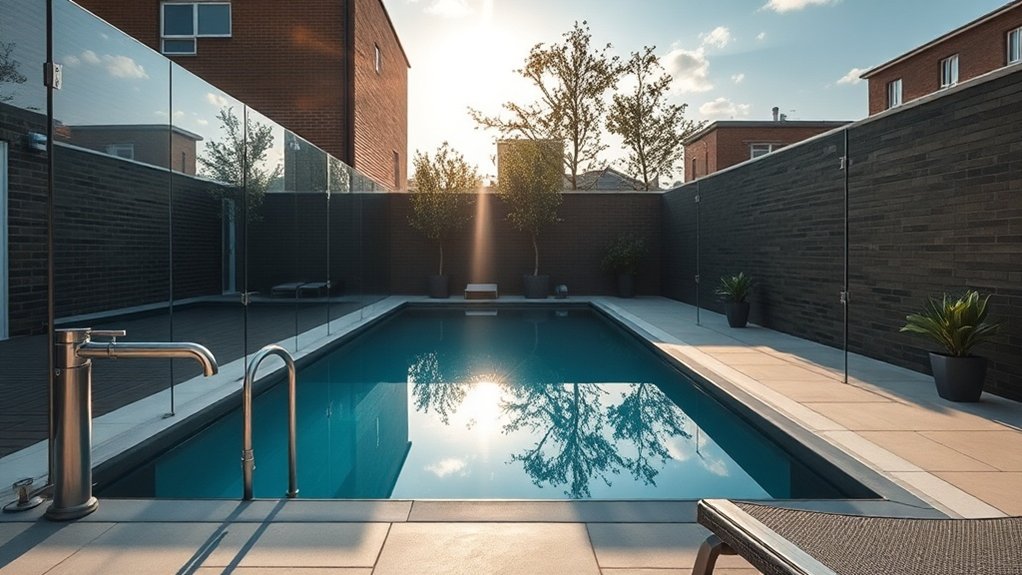
Pool glass fencing in London lets you secure your pool with a compliant, impact‑resistant barrier that maintains clear sightlines for constant supervision and CCTV coverage. You’ll typically use 10–15 mm safety glass with corrosion‑resistant stainless steel hardware, self‑closing, self‑latching gates, and a barrier height around 1.1 m to align with UK regulations. You can choose framed or frameless systems, manage privacy with frosted panels, and understand how design, cost, and installation all fit together next.
Key insights
- Toughened or laminated glass pool fencing provides a clear, modern safety barrier that maintains unobstructed views and easy supervision around London pools.
- Systems must comply with UK Building Regulations and BS glazing standards, including typical 1.1m height, non-climbable design, and self-closing, self-latching gates.
- Frameless and semi-frameless designs use marine-grade stainless steel hardware, engineered for impact resistance, tamper resistance, and London’s variable weather conditions.
- Installed costs in London usually range from about £350–£650 per metre, depending on glass thickness, hardware quality, and site complexity.
- Many London installations require early liaison with local planning and building control, especially in conservation areas or near boundaries and neighbouring properties.
Why Choose Pool Glass Fencing in London
Why does pool glass fencing stand out as the preferred safety barrier for London properties? You get a high-performance solution that aligns pool safety with minimalist design. Toughened, often heat-soaked glass panels resist impact and temperature variation, while precision-engineered spigots and fixings provide structural stability without visual bulk.
Unlike opaque fencing materials, glass gives you uninterrupted sightlines, so you can constantly monitor the pool zone and detect risk early. You reduce climbing points with flush surfaces and minimal hardware , limiting footholds for children. Corrosion-resistant stainless steel components handle London’s variable climate, maintaining integrity over time. You also gain compatibility with automation: self-closing hinges, magnetic latches, and integrated access control systems can be specified to create a smart, future-ready safety barrier.
London Pool Safety Rules and Legal Requirements
Although pool glass fencing enhances safety by design, you still need to align your installation with London’s specific regulatory framework. You must comply with UK Building Regulations (Part K and Part M), local planning guidance, and product standards such as BS EN 12150 for toughened safety glass.
For pool safety , specify glass with appropriate impact resistance, non-climbable panel layouts, and minimal footholds. Maintain a minimum barrier height (typically around 1.1m), ensure gaps under and between panels don’t exceed child‑safe limits, and position the fence to fully enclose the water’s edge with controlled access points.
Self-closing, self-latching gates with outward opening are essential. Integrate hardware and fixings that preserve fencing aesthetics while delivering tested, corrosion‑resistant performance in humid pool environments.
Framed vs Frameless Pool Glass Fencing Options
When you compare framed and frameless pool glass fencing for a London property, you’re really choosing between different structural systems, fixing methods, and visual outcomes rather than just “with posts” or “without posts.” Framed systems use continuous or post‑and‑rail aluminium or stainless‑steel frameworks that clamp or channel the glass, offering strong containment, clear load paths , and predictable performance under wind and impact.
You’ll typically select framed if you prioritise tactile handrails, clearer edge definition, and integration with gates or existing balustrades. Frameless uses concealed spigots or perimeter channels, maximising transparency and visual continuity between house, terrace, and water. It suits minimal, technology‑driven schemes, where you might specify etched decorative patterns, integrated lighting options in base channels or capping details, and seamless junctions with landscaping elements.
Glass and Hardware Specs for London Pool Fences
When you’re planning pool glass fencing in London , you need to specify the correct glass thickness, hardware materials, and fixings from the outset. You’ll assess tempered or laminated safety glass in the 10–15 mm range, paired with marine-grade stainless steel or similarly corrosion-resistant hardware that can withstand chlorinated and occasionally saline environments. Throughout, you must guarantee every component complies with relevant UK and London regulations, including BS EN safety glass standards and local pool safety requirements.
Recommended Glass Thickness
Because pool glass fencing must resist impact, wind load, and crowd pressure, glass thickness isn’t a design preference—it’s an engineered safety requirement governed by UK and London-specific standards. For frameless systems up to typical residential heights, you’ll usually specify 12 mm to 15 mm toughened safety glass; higher loads, extended spans, or public-use pools often justify 15 mm or 19 mm.
You should treat glass thickness as integral to your fencing materials strategy, not an isolated decision. Panel width, fixing method, and substrate stiffness all interact with thickness in structural calculations. Always insist on heat‑soaked, BS EN 12150/BS EN 12600–compliant safety glass, with documented load testing for your exact configuration, especially on exposed rooftops or riverfront sites where wind and crowd loads peak.
Corrosion-Resistant Hardware Options
Ever wondered why two pool fences of identical design age so differently in London’s climate? It usually comes down to hardware. In a city with high humidity and airborne pollutants, you need corrosion-resistant components engineered for long-term stability , safety, and material sustainability.
Prioritize systems that balance structural performance with refined decorative design, not just basic function:
- 2205 or 316/316L marine-grade stainless spigots, clamps, and handrails
- Through-bolted fixings with isolation pads to prevent galvanic corrosion
- Duplex or nano-ceramic coatings on metal surfaces near waterlines
- Precision-engineered hinges and latches with sealed bearings and drainage paths
- Non-staining, UV-stable gaskets and setting blocks compatible with toughened glass
These choices reduce maintenance, preserve clarity, and keep your glass fence performing safely for decades.
Compliance With UK Standards
How do you make sure a sleek glass pool fence in London isn’t just attractive, but legally safe and certifiable? You start by aligning every component with BS EN 12150 and BS EN 12600. Use fully toughened or laminated safety glass, minimum 10–12 mm thick, with polished, arris-free edges and compliant impact ratings.
Specify 316 or higher marine-grade stainless steel spigots, clamps, and fixings, tested for load resistance in accordance with BS 6180. Gate hardware must be self-closing, self-latching , and mounted at child-resistant heights.
When you add decorative accents and lighting options, ensure they don’t create climbable points, glare, or distraction. Integrate low-voltage, IP-rated LED systems and ensure every modification preserves structural integrity and certification trails.
Safety, Privacy, and Security With Pool Glass Fencing
Why does pool glass fencing matter so much for safety, privacy, and security in a dense city like London? You’re managing pool safety, privacy concerns, and urban risk all at once. Toughened or laminated safety glass, precision-engineered fixings, and anti-climb layouts form a controlled barrier without blocking visibility.
- Limits unsupervised access, reducing drowning risk for children and pets.
- Maintains clear sight lines , so you can monitor activity from your home or CCTV.
- Integrates locking gates and self-closing, self-latching hardware to secure entry.
- Uses height, frosted or tinted panels, and strategic positioning to address privacy concerns.
- Resists impact, tampering , and wind loads with engineered glass thickness and tested hardware.
Design Ideas for Pool Glass Fencing in London Gardens
Although safety and compliance come first, pool glass fencing in a London garden also needs to resolve tight footprints, overlooking neighbours, and architectural context with considered design. You can specify ultra-clear, low‑iron glass to keep sightlines open, then use strategic frosted panels near seating to preserve privacy without creating visual bulk.
Prioritise landscape integration: align fence runs with paving joints, existing walls, and planting beds so the barrier reads as a continuation of the hardscape. Cantilevered or channel-set systems minimise visible fixings and reduce trip hazards in compact spaces.
Integrate lighting options into posts, base channels, or adjacent planters, using low‑glare , IP-rated LEDs to define edges at night, highlight water movement, and maintain safe navigation around the pool perimeter.
Planning Permission and Council Rules in London
Before you specify any pool glass fencing system in London, you must confirm whether your project triggers formal planning permission, particularly in conservation areas or near boundaries. You’ll need to understand key London regulations on height, glazing standards , child safety, and guarding requirements so your design complies with both planning and Building Regulations. It’s also essential that you engage early with your local council’s planning and building control teams to clarify constraints, approval routes, and required documentation.
When Permission Is Needed
Even when a glass pool fence sits within your own garden, London’s planning rules and council policies can still require formal permission , particularly where safety, overlooking, and visual impact are involved. You’ll usually assess this at the same time as your pool design and outdoor lighting strategy, because all three can alter sightlines, privacy, and neighbourhood character.
Typically, you’ll need to seek planning permission if your proposal involves:
- Fencing that exceeds height thresholds relative to ground level
- Structures near boundaries that could affect neighbours’ amenity
- Properties in conservation areas, near listed buildings, or protected views
- Significant level changes, decking, or raised platforms around the pool
- Integrated lighting or smart controls that may cause light spill or glare
Confirm requirements with your local London borough before commissioning fabrication.
Key London Regulations
So how do London’s rules actually shape what you can build around your pool? You’ll navigate three main frameworks: planning control, building regulations , and safety standards. In most boroughs, pool glass fencing must meet minimum barrier heights, non‑climbable zones, and toughened or laminated safety glass specifications, often aligned with BS EN standards.
You must also respect sightline and reflectivity limits so glare from panels and outdoor lighting doesn’t create hazards for neighbours or road users. Where properties sit in conservation areas or near listed buildings, councils typically demand that pool aesthetics remain visually lightweight, with low visual clutter and minimal hardware. Drainage, load‑bearing fixings, and proximity to boundaries are scrutinised to prevent structural risk and overlooking issues.
Working With Local Councils
Wondering how your local council might affect the design and timing of your pool glass fence in London? You’ll need to align innovative detailing with strict safety and planning controls, especially in conservation areas or listed properties. Planning officers typically review how your fence impacts neighbours, sightlines, and overall pool aesthetics.
When you prepare your application, you should clarify:
- Exact fence height, location, and boundary offsets
- Type of fencing materials and glass specification (toughened/laminated)
- Compliance with Building Regulations Part K and relevant BS standards
- Drainage, slip-resistance, and proximity to utilities or basements
- Lighting, privacy screening, and reflection/glare management
Submit scaled drawings, structural details for fixings, and a safety statement . Early pre‑application advice reduces redesigns, delays, and enforcement risks.
Installing Pool Glass Fencing in London: Steps and Timelines
Before you commit to pool glass fencing in London, you need a clear view of the installation process, from site assessment through final safety checks. Your installer first surveys levels, services, and poolside aesthetics, then confirms compliant layouts and suitable fencing materials. Expect this design and planning phase to take a few days, longer if structural calculations are required.
Next, technicians set out fixing points, core‑drill or bolt spigots, and ensure precise alignment with laser levels. Toughened safety glass panels are then installed, plumbed, and secured, usually within one to two days for a standard pool.
Finally, they fit self‑closing, self‑latching gates, apply edge protection, seal penetrations, and perform load, latch, and clearance tests before issuing documentation for your records.
How Much Does Pool Glass Fencing Cost in London?
When you assess pool glass fencing costs in London, you need to account for technical factors like glass thickness, fixing method (spigot, channel, or post), structural load requirements, and compliance with BS EN safety standards. We’ll outline the typical London price range per linear metre, including materials, certified hardware, and professional installation. You’ll also see practical ways to reduce costs without undermining structural integrity or compromising safety performance.
Key Price Factors
Although no two projects are identical, pool glass fencing in London typically ranges from a few hundred to several thousand pounds, depending on a defined set of technical and site-specific factors. To understand where your project may fall, you’ll need to analyse the performance requirements, installation complexity , and compliance demands behind different fencing options.
Key price drivers include:
- Glass specification: thickness, heat‑soaking, lamination, and low‑iron “ultra clear” pool glass.
- Hardware system: spigots, channels, or posts, plus marine‑grade stainless steel or aluminium.
- Site conditions: slopes, waterproofing layers, hidden services, and access constraints.
- Safety and compliance : UK Building Regulations, load calculations, and certified fixing methods.
- Customisation: curved panels, integrated lighting, and minimal‑frame detailing for seamless views.
Each factor alters material, engineering, and installation time.
Typical London Price Range
Those cost drivers translate into a fairly defined London price band for modern pool glass fencing. You’ll typically see installed costs in the region of £350–£650 per linear metre for compliant systems around residential pools. At the lower end, semi-frameless designs using standard fencing materials and simpler layouts come in near £350–£450/m.
For premium pool aesthetics with fully frameless glass, minimal hardware, and high-spec stainless fixings, expect £500–£650/m, especially in complex geometries or tight urban gardens. This usually includes 10–12 mm toughened safety glass, corrosion-resistant posts or channels, engineering checks, and BS EN 1090/BS 6262-compliant installation . Custom tints, low-iron glass, and integrated LED handrails add 10–25% to the headline figure, depending on specification and site access constraints.
Ways To Reduce Costs
Even with London’s premium price bands, you can control pool glass fencing costs by adapting the design, specification, and installation method without undermining safety or compliance. You’ll reduce spend by treating the system as engineered infrastructure, not décor.
- Use modular panel sizes to minimise glass wastage and fabrication time.
- Combine glass with lower-cost fencing materials (e.g., aluminium on non‑view sides) while maintaining pool safety lines.
- Opt for spigot or channel systems that allow faster installation and simpler ground preparation.
- Keep runs straight; avoid complex curves and stepped levels that increase hardware and drilling.
- Plan compliant gate positions early to reduce structural steelwork, power runs for locks, and rework.
Always confirm changes still meet UK pool safety standards and manufacturer testing data.
Cleaning, Maintenance, and Long‑Term Durability of Glass Pool Fences
When you invest in a glass pool fence, its long‑term performance depends heavily on disciplined cleaning, correct products, and proactive inspection. Establish precise Cleaning routines: rinse panels with low‑pressure water, then apply a pH‑neutral, non‑abrasive cleaner and microfiber cloth to avoid micro‑scratching and optical distortion . Integrate Maintenance tips into a quarterly checklist: inspect spigots, anchors, and brackets for corrosion, loosened fixings, and grout failure, particularly in London’s freeze‑thaw cycles.
Verify that toughened or laminated glass remains chip‑free along edges; any impact damage demands immediate professional assessment. Keep gate hardware calibrated so self‑closing and latching functions remain compliant with safety standards. For maximum durability, specify nano‑ceramic or hydrophobic coatings that repel limescale, chlorine residue, and airborne pollutants, reducing maintenance loads over time.
Frequently Asked Questions
Can Glass Pool Fencing Increase My London Property’s Resale Value?
Yes, it can. When you install high-spec glass pool fencing, you enhance perceived value through verified pool safety compliance and strong visual appeal. Buyers see a modern, low‑maintenance barrier that preserves sightlines, optimizes natural light, and supports smart landscaping. If you specify toughened, laminated glass, corrosion‑resistant hardware, and certified child‑resistant gates , you signal innovation and meticulous risk management—features that typically translate into stronger offers and faster resale.
How Does Glass Pool Fencing Perform in London’s Winter Weather?
It performs reliably if you specify toughened, heat‑soaked safety glass with marine‑grade stainless fixings. Winter durability depends on correct edge polishing, high‑quality seals, and drainage that prevents freeze–thaw stress. You’ll need scheduled glass maintenance : periodic de‑icing using non‑corrosive products, hardware inspection for pitting, and swift repair of damaged sealant. With these measures, you maintain structural integrity, slip‑resistant access, and long-term clarity even under London’s cold, wet conditions.
Can I Integrate Smart Locks or Alarms With My Glass Pool Gate?
You can absolutely integrate smart locks and alarms with your glass pool gate—almost turning it into a mini high-security vault. With smart lock integration, you’ll use weather‑rated, marine‑grade electric strikes or magnetic locks, wired through concealed conduits in posts or channels. For alarm compatibility, you’ll add gate‑position sensors, tamper switches, and interface modules tied into your home automation or EN‑compliant pool alarm, ensuring failsafe operation and automatic lock/alert on breach.
Are There Eco‑Friendly or Recycled Glass Options for Pool Fencing?
Yes, you can specify eco‑friendly or recycled glass options. Many manufacturers use high‑recycled‑content safety glass produced through controlled recycling processes that preserve structural integrity and compliance with pool‑safety standards. You’ll typically get toughened or laminated glass incorporating eco friendly materials in interlayers or coatings. Confirm impact ratings, slip‑resistant fixings, and corrosion‑resistant hardware, and request documented lifecycle data to validate sustainability and long‑term performance.
How Does Glass Pool Fencing Affect Insurance Premiums for London Homes?
Glass pool fencing can slightly lower your insurance premiums if you meet strict safety regulations. Insurers often view compliant, toughened-glass barriers with self‑closing, self‑latching gates as risk‑reducing, which can grant Insurance discounts. You’ll need documented conformity with British Standards, adequate fence height, and non‑climbable design. Insurers may also require professional installation certification and regular maintenance evidence to validate risk assumptions and preserve any premium advantages over time.
Summary
By now, you can see pool glass fencing in London isn’t just stylish—it’s a precise safety system. When you choose compliant glass, certified hardware, and correct installation, you reduce risk, meet legal duties, and protect users. You’ll also simplify maintenance and extend long‑term performance. Why leave your pool area exposed to preventable hazards when you can engineer a transparent, code-compliant barrier that safeguards family, guests, and property every day?