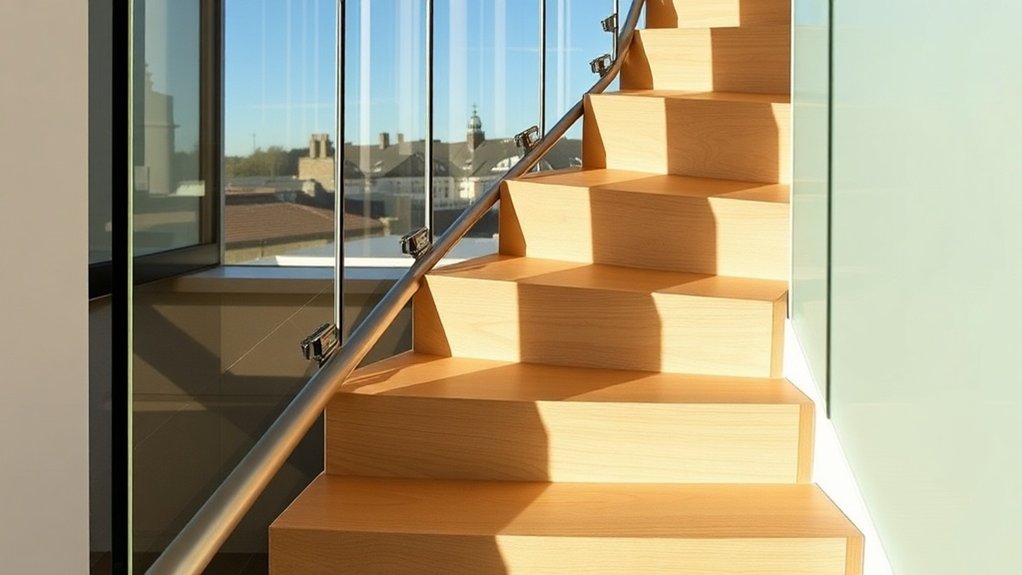
You transform your staircase in London with glass panels that maximise daylight , make tight spaces feel larger, and meet strict UK safety standards. You’ll typically use toughened or laminated glass, engineered to BS 6180 and Part K/M, with options like low‑iron clear, tinted, or etched finishes for privacy and glare control. Specialist installers handle surveys, structural calculations, and compliant fixings so your stair feels seamless, robust, and future‑proofed—as you’re about to see in more detail.
Key insights
- Glass staircase panels in London maximise daylight in narrow homes, creating a brighter, more spacious feel while maintaining a sleek, contemporary look.
- Specify toughened or laminated glass compliant with UK Building Regulations and BS 6180 to ensure safety, durability, and appropriate load-bearing performance.
- Choose from clear, low-iron, tinted, etched, or back-painted finishes to control privacy, glare, and visual impact in your staircase design.
- Professional installers should laser-survey, structurally assess, and provide certified fixing methods and documentation to meet London planning and building-control requirements.
- Opt for high-quality hardware, hydrophobic coatings, and simple maintenance routines to keep glass stair panels clean, secure, and long-lasting in high-traffic areas.
Why Choose Glass Staircase Panels in London
Why do so many contemporary London homes and commercial spaces now rely on glass staircase panels instead of traditional balustrades? You’re prioritising light, precision detailing, and spatial efficiency. Glass panels maximise daylight penetration , making narrow London stairwells feel larger and more connected to adjacent rooms.
You also gain tight control over performance. Toughened or laminated glass delivers high material durability, resisting impact, scratches, and daily wear in high-traffic zones. You can specify thickness, edge polishing, and fixing systems to meet exact structural and safety requirements, including Part K compliance.
Advanced Color options—clear, low-iron, tinted, or back-painted—let you calibrate transparency, privacy, and visual emphasis, aligning the staircase with your wider interior concept while preserving a clean, engineered aesthetic.
Are Glass Stair Panels Right for Your Property?
When you’re deciding if glass stair panels suit your property, you’ll need to assess structural conditions , layout, and light levels to guarantee a precise fit. You must also balance safety and style by considering glass thickness, edge detailing, handrail integration, and compliance with UK Building Regulations. Finally, you should weigh maintenance and longevity, looking at glass coatings, fixing systems, and cleaning access so your installation remains clear, secure, and cost‑effective over time.
Assessing Property Suitability
Although glass stair panels suit many London properties, you should first assess whether your building’s structure, layout, and usage patterns can safely and practically accommodate them. Begin with a structural survey: confirm your stair stringers, landings, and fixing points can carry the added point loads from glass and its hardware.
Next, map how interior lighting interacts with the staircase. Transparent or low‑iron panels can maximise natural light, but you’ll need to model reflections and glare across adjacent floors. Evaluate circulation intensity—homes, HMOs, and mixed‑use schemes impose different performance expectations.
Finally, review material sustainability. Specify laminated, toughened glass from suppliers with verifiable environmental credentials, and check recyclability, transport distances, and compatibility with low‑carbon framing systems such as aluminium or engineered timber.
Balancing Safety And Style
Once you’ve confirmed your staircase can physically and environmentally support glass, you need to balance regulatory safety with the clean, contemporary look you’re aiming for. You’ll typically specify toughened or laminated glass that meets BS 6180, with thickness calibrated to span length, loading, and fixing method. Handrail integration, edge protection, and fixing hardware all need stress‑checked detailing, especially for cantilevered or “floating” concepts .
To achieve visual impact, you can exploit Color options and Lighting effects without compromising compliance. Low‑iron glass maximises clarity, while subtle tints, interlayers, or frit patterns add privacy and contrast. LED channels in handrails or base channels can define the stair’s geometry and improve step visibility, ensuring the installation remains both visually striking and inherently safe.
Maintenance And Longevity
How do you judge whether glass staircase panels will stand up to daily use in your property without becoming a maintenance burden? You start by specifying the right glass. Toughened or laminated systems deliver high glass durability, resisting impact, scratches, and edge chipping when correctly detailed and installed.
You’ll also want hardware in marine‑grade stainless steel or powder‑coated aluminium, which prevents corrosion in London’s humid, polluted air. Choose panel layouts that minimise dirt‑trapping junctions and specify easy‑clean coatings to reduce fingerprints and water spots, preserving long‑term aesthetic appeal.
Routine care remains simple: periodic wiping with non‑abrasive cleaners, inspection of fixings, and resealing if required. With proper specification, your staircase glass panels offer decades of performance, not a recurring maintenance issue.
Safety Standards for Glass Staircases in the UK
Why do glass staircases in the UK feel so light and open yet still have to perform like structural workhorses? Because you’re balancing glass aesthetics with rigorously tested safety features. You’ll typically specify laminated, toughened glass that retains fragments if it fails, maintaining a partial barrier.
You must choose glass thickness based on span, loading category, and fixing method, then verify impact resistance and line loads through certified testing. Edge treatments, polished arrises, and high‑grade interlayers reduce crack propagation and delamination.
You also need robust balustrade restraint: continuous handrails, engineered fixings, and tested point or channel systems that prevent displacement. Anti‑slip treads , contrasting nosings, and controlled reflectivity ensure users see every step, even in dramatic, minimal designs.
Planning and Building Regulations for Glass Staircases in London
When you plan a glass staircase in London, you must align every design decision with UK Building Regulations, British Standards, and relevant local planning requirements. You’ll need to confirm structural performance, impact resistance , balustrade heights, and load capacities while also checking whether your project needs planning permission or falls under permitted development. By mapping your concept against these codes and obtaining the correct approvals early, you reduce redesign risk, control costs, and guarantee full compliance.
Compliance With UK Building Codes
Steering UK building codes for glass staircases in London demands precise attention to both Planning Permission and Building Regulations from the outset. You must evidence how your design responds to privacy concerns, aesthetic considerations, and the character of the existing building, while aligning with local planning policies and any conservation or Article 4 constraints.
For compliance, you’ll map your proposal against the relevant sections of the Building Regulations, particularly Parts K and M, and reference current British Standards in your specification. Prepare scaled drawings, structural details, and a performance narrative that demonstrates how the glass, fixings, and supporting structure meet code intent. By resolving compliance issues on paper first, you streamline approvals, minimise redesign, and keep innovative concepts viable within a tightly regulated London context.
Safety Standards And Permissions
How do you turn a striking glass staircase into a fully compliant feature that planning officers and building control will actually sign off? You start by aligning your concept with London’s specific safety regulations, then mapping every detail to Building Regulations Part K and Part B. You’ll need structural calculations for glass thickness, fixing methods, and load paths, plus documented impact resistance and balustrade performance .
Visualise the outcome:
- Transparent balustrades that still meet minimum guarding heights
- Low‑iron glass treads engineered for slip resistance and point loads
- Seamless fixings concealed within fully certified structural details
Next, you streamline permitting procedures: confirm if your scheme is permitted development or needs planning consent, secure building control approval (local authority or approved inspector), and maintain a clear audit trail of drawings, test data, and installation sign‑offs.
Types of Staircase Glass Panels and Finishes
Although all staircase glass may look similar at a glance, the panel type and finish you specify will determine safety performance, maintenance needs, and the overall aesthetic of your stairs. You’ll typically choose between toughened, laminated, or toughened-laminated combinations, balancing impact resistance , post-breakage integrity, and long-span capability.
For a more tailored look, you can specify clear, ultra-clear low-iron, tinted, or back-painted glass, using color options to align with brand palettes or smart-home lighting schemes. Acid-etched, sandblasted, or ceramic-frit finishes help control glare, fingerprints, and privacy while preserving visual lightness.
In high-traffic London stair cores, prioritise material durability: select thicker glass, high-quality interlayers, and factory-applied hydrophobic coatings to simplify cleaning and extend lifecycle performance.
Framed vs Frameless Glass Balustrades
Once you’ve settled on glass type and finish, you’ll need to decide whether a framed or frameless balustrade best suits your staircase’s structure, safety requirements, and visual intent . A framed system gives you defined lines, precise fixing points, and predictable load paths, which is invaluable in older London properties with variable substrates. It also lets you highlight material durability by pairing toughened or laminated glass with engineered steel or aluminium profiles.
By contrast, frameless balustrades rely on high-spec base channels, point-fixings, and thicker glass to achieve a minimal, floating edge while still meeting British Standards.
- Light washing seamlessly across uninterrupted glass runs
- Shadow lines from slender metal frames defining each flight
- Artistic patterns embedded in glass, glowing under integrated LEDs
Design Ideas for Glass Staircases in London Homes
When you start planning a glass staircase for a London home, treat it as a structural lighting tool as much as a circulation route. You’ll get the best results by mapping sightlines, daylight paths, and electrical routes together. Use low‑iron toughened glass for maximum clarity, then introduce subtle Color options via interlayers, fritted patterns, or rear‑painted stringers so the staircase reads as a calibrated feature, not a novelty.
Prioritise lighting integration from the outset. Recess LED channels into handrails, treads, or wall reveals, allowing for tunable white or RGB controls that respond to time of day. Specify anti‑slip surface treatments only where needed to preserve transparency. Minimise visible fixings with countersunk point‑supports or concealed base shoes for a clean, engineered aesthetic.
Glass Stair Panels for London Businesses and Offices
Glass stair panels in London workplaces do more than satisfy circulation and safety requirements; they’re a strategic tool for projecting brand identity, maximising light, and future‑proofing heavily used routes. You can specify laminated or toughened glass, precision‑engineered fixings, and non‑slip treatments that comply with BS standards while keeping the aesthetic minimal and sharp.
You’ll align panels with your visual language through custom etching, corporate tints, and coordinated color options that echo signage, flooring, and furniture.
- Transparent runs linking multi‑storey offices into one coherent, light‑flooded volume
- Softly tinted panels framing collaborative zones and client presentation areas
- Discreet privacy‑graded glass separating public reception from secure workspaces
Staircase Glass Panel Costs in London
Beyond branding and performance, you also need a clear view of what staircase glass panels are likely to cost in London. You’re typically looking at a premium solution, reflecting both engineering complexity and visual impact.
You’ll usually budget for specialist safety glass, precision cutting, and compliant fixings, all priced higher than standard balustrade systems. However, the investment aligns with long‑term value : high material durability reduces replacement cycles, and low‑maintenance surfaces cut cleaning overheads.
Costs also reflect design ambition. Frameless or minimal‑hardware systems command more, but they maximise light transmission and aesthetic appeal, which can enhance perceived property value and user experience. When you assess quotes, focus on lifecycle performance, not just upfront figures, to ensure the specification supports your strategic design and operational goals.
What Affects the Cost of Glass Staircase Installation?
When you budget for a glass staircase in London, you need to account for how glass type and thickness, design complexity, and labour influence the overall cost. You’ll also see price shifts based on the specification of fixings, the quality of finishes, and any extras such as handrails, lighting channels, or custom edge work. By understanding these variables upfront, you can align your design expectations with a realistic cost plan and avoid unexpected overruns.
Glass Type And Thickness
Curious why two staircase designs that look similar on paper can differ so much in price? Glass type and thickness are prime drivers. You’ll typically choose between toughened, laminated, or a hybrid specification . Toughened glass offers strength; laminated adds safety, acoustic performance, and enhanced panel durability, which increases cost but improves lifecycle value.
Glass textures also matter. Clear low‑iron glass costs more than standard float, while frosted, tinted, or patterned options add privacy and visual drama but require higher-precision processing.
Picture how each option changes the space:
- Light streaming through ultra-clear, low‑iron balustrades
- Softly diffused edges from satin‑etched, frosted panels
- Bold silhouettes framed by smoked or bronze‑tinted glass
Greater thickness and higher-spec glass deliver safer, more resilient, future-proof installations.
Design Complexity And Labour
Although glass type sets the baseline, design complexity and labour often decide whether your staircase stays within budget or jumps bracket. When you introduce helical runs, split levels, or faceted curves, installers must survey more precisely, template each panel, and coordinate tolerances across multiple trades. That raises design time and on‑site labour hours.
You also pay more when you push structural performance and material durability together with high-end aesthetic appeal. Longer spans without posts, minimal visible joints, or floating treads demand advanced engineering calculations, bespoke details, and highly skilled fitting teams. Access constraints in tight London properties can add labour for manual handling and staged installation. To control costs, align ambition with clear drawings, early structural input, and realistic installation logistics.
Fixings, Finishes And Extras
Beyond the glass itself, the fixings , finishes, and add‑ons you specify can shift a staircase from standard to premium – and the cost follows. You’ll choose between surface‑mounted or concealed fixings, bespoke brackets, and custom handrail profiles, each affecting fabrication time, structural calculations, and installation complexity.
- Brushed stainless steel bolts punctuating clear glass like precise industrial jewellery
- Ultra‑minimal channels disappearing into a shadow gap, leaving panels apparently floating
- A continuous timber or metal rail tracing the stair in a clean, tactile line
Finishes also matter: powder‑coated metals, anodised aluminium, or specialist patinas price differently. Decorative accents such as etched motifs or coloured interlayers add manufacturing stages. Finally, lighting integration—LED strips in handrails, base channels, or treads—requires coordinated electrical planning and increases overall cost.
Choosing a Glass Staircase Installer in London
When you’re choosing a glass staircase installer in London, the right specialist will combine structural expertise , compliance with UK Building Regulations, and meticulous on-site installation practices. You should prioritise firms that provide structural calculations, laminated or toughened systems tested for material durability, and documented load performance. Ask how they validate glass specifications against your span, fixing type, and usage intensity.
Review portfolios that show diverse color options, complex geometries, and integration with lighting or smart controls. A serious installer will issue detailed surveys, CAD drawings, and risk assessments, and coordinate with your architect or principal contractor.
Check they’re accredited, insured , and experienced with London borough approval processes, including Part K and Part M access requirements, so your staircase remains future‑proof and certifiable.
Glass Staircase Installation Process in London
After you’ve appointed a competent glass staircase installer in London, the project moves into a tightly sequenced installation process that protects both structural performance and compliance. The team will laser-survey your existing structure, verify load paths, and confirm fixing points against architectural and engineering drawings.
They’ll then fabricate or final-trim laminated panels, pre-drill precision fixings, and test-align every component to preserve glass aesthetics and sightlines. During installation, they’ll use temporary supports and low-vibration tools to minimise stress on the glass and existing structure.
- Brushed steel brackets disappearing into clear treads above a floating hallway
- Flush stair nosings integrating linear staircase lighting that grazes the glass
- Continuous glass balustrades rising from minimalist base channels, edge-lit and shadow-free
Final checks confirm tolerances, alignment, and regulatory compliance.
Cleaning and Maintaining Glass Stair Panels
Although glass staircases are engineered to withstand daily use, they only retain their clarity and edge definition if you follow a disciplined cleaning and maintenance routine tailored to architectural glass. You should specify a neutral-pH glass cleaner , microfiber applicators, and lint-free drying cloths to avoid micro-scratching, especially around artistic embellishments and etched motifs.
Inspect fixings, handrail junctions, and base channels quarterly; remove debris that could trap moisture and stain interlayers. Where you’ve used lighting integrations in treads or balustrade channels, clean LED diffusers with non-abrasive wipes and confirm seals remain intact to prevent condensation.
Schedule an annual professional survey to test panel stability, re-tension balustrade fittings, and validate that all glass edges, coatings, and seals still meet performance criteria.
Common Design and Installation Mistakes With Glass Stair Panels
When you plan glass stair panels, the most costly problems usually stem from incorrect measurements , inadequate tolerances, and poor fixing and alignment. If you miscalculate clearances or overlook expansion gaps, you’ll create stress points that lead to rattling, cracking, or non-compliance with UK safety standards. By focusing on precise surveying, engineered hardware, and methodical alignment checks, you can prevent these issues before installation begins.
Incorrect Measurements And Tolerances
Even with a strong design concept, glass stair panels can fail on site if measurements and tolerances aren’t controlled with millimetre-level accuracy. You’re working with rigid materials, so minor measurement accuracy errors quickly become visible gaps, stepped edges, or panels that simply don’t fit. Tolerance issues are amplified by London’s common quirks: out‑of‑plumb walls, uneven stringers, and subtle slab deflection.
To avoid re-fabrication, you should:
- Capture site conditions with digital laser surveys and cross-check against BIM or CAD.
- Specify explicit tolerances for glass, handrails, and edge channels, then coordinate them across all trades.
- Prototype critical junctions with a sample panel to validate actual build dimensions before committing to full production.
Poor Fixing And Alignment
Poor fixing and alignment turn otherwise well‑designed glass stair panels into visible defects and safety liabilities. When brackets, channels, or point fixings aren’t set out accurately, you create uneven joints, racking, and stress concentrations in the glass. Misaligned fixings also exaggerate surface imperfections, breaking the clean visual line that’s central to contemporary London staircases.
You should specify a precise fixing grid, laser‑set datum lines , and toleranced packers to compensate for structural variance. During installation, verify scaffold stability so alignment checks remain accurate throughout drilling, setting, and curing. Use calibrated torque tools on point fixings to avoid over‑clamping. Finally, implement a systematic QA process—string lines, digital levels, and photographic sign‑off—to ensure every panel tracks perfectly with treads, handrails, and landings.
Frequently Asked Questions
Can Staircase Glass Panels Improve My Property’s Resale Value in London?
Yes, you can boost resale value by installing contemporary glass panels, provided you respect historical preservation and guarantee strong architectural compatibility with your building’s era and layout. Buyers in London’s innovation-driven market pay premiums for brighter circulation spaces, clean sightlines, and low‑maintenance materials. You should specify toughened, laminated glass, robust fixings, and compliant handrail systems, then document certifications to reassure surveyors and streamline buyer due diligence.
How Long Do Staircase Glass Panels Typically Last Before Needing Replacement?
You can expect high‑quality panels to last 20–30 years before replacement, and some exceed 40 years when properly specified. With Durability testing, manufacturers simulate decades of wear; one industry study showed tempered glass retaining over 95% strength after extended cyclic loading. To maximise Material lifespan, you’ll specify toughened or laminated glass, corrosion‑resistant fixings, and consider impact zones, then schedule periodic inspection to catch hardware fatigue early.
Are There Eco-Friendly or Recycled Glass Options for Staircase Panels?
You can absolutely specify Recycled glass and other Eco friendly materials for staircase panels. You’ll typically select tempered or laminated recycled-content glass, engineered to meet safety and load standards. Ask suppliers for post-consumer content percentages, embodied-carbon data, and environmental product declarations. You can also combine low-iron recycled glass with minimalist fixings to reduce metal use, or specify modular systems so panels are replaceable, supporting circular , future-proof design.
Can I Integrate LED Lighting or Smart Features Into Glass Stair Panels?
You can absolutely integrate LED lighting and smart features into glass stair panels. You embed low‑profile channels for LED integration along treads, mountings, or handrails, then diffuse light through frosted or etched glass for even glow. You specify smart features like app‑controlled dimming, motion or step sensors, and color‑tunable LEDs. You coordinate wiring routes, access panels, and low‑voltage drivers early so performance, safety, and aesthetics stay perfectly aligned.
What Warranty Should I Expect on Staircase Glass Panels and Installation?
You should expect at least 10 years’ warranty coverage on the glass itself and 2–5 years on hardware and installation guarantees. Verify that the warranty covers delamination, discoloration, structural failure, and fitting defects, not just breakage. Confirm installation is certified , with documented load calculations and compliance with current building standards. For smart or LED-integrated panels, demand separate warranties on electrical components and control systems.
Summary
When you choose staircase glass panels in London, you’re investing in safety, compliance, and long-term value—not just style. By following UK regulations, selecting the right glass type and finish, and hiring a proven installer, you’ll avoid costly pitfalls. Plan every detail—from fixings to handrails—to guarantee the design and structure work hand in glove. With proper cleaning and maintenance, your glass staircase will stay pristine, durable, and compliant for years.