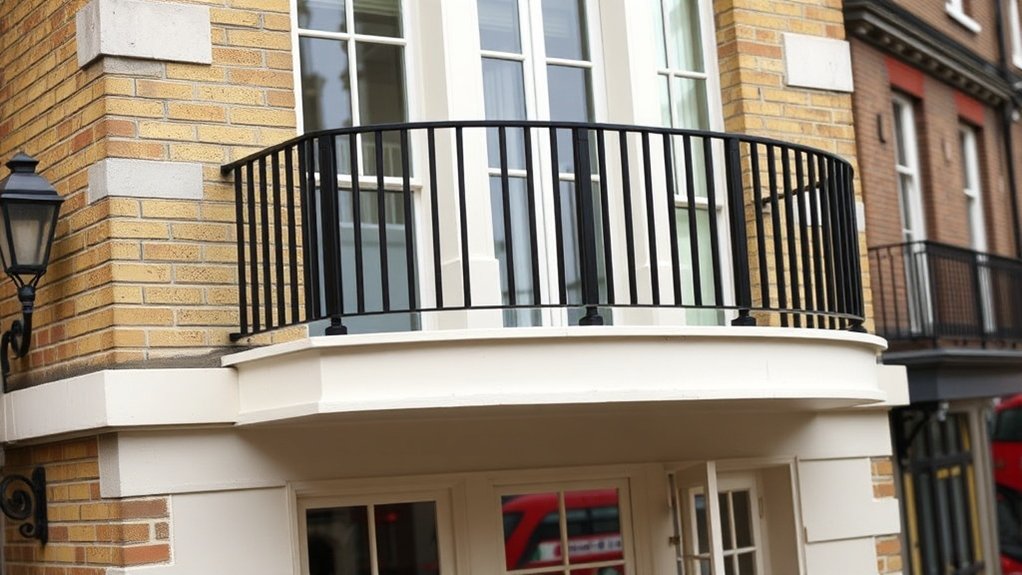
You install a Juliet balcony in London by first checking if you need planning permission , especially in conservation areas or listed buildings. You must meet UK Building Regulations for guarding height (at least 1100mm), loadings, impact resistance, and fire safety, including clear escape routes. A structural engineer should verify the wall, lintel, and fixings. Use corrosion‑resistant materials and certified installers. Next, you’ll see how permissions, structure, privacy and noise all affect your choices.
Key insights
- Check if you need planning permission, especially for conservation areas, listed buildings, or when altering the building’s external appearance.
- Ensure compliance with UK Building Regulations (Part A and K, BS 6180) for guarding height, loadings, and gap sizes.
- Have a structural engineer verify the wall, lintel, and fixing points can safely support the Juliet balcony.
- Select durable, corrosion-resistant materials (e.g., powder-coated steel, laminated toughened glass) suited to London’s climate and your building’s character.
- Use a specialist installer who provides tested fixings, torque-tested anchors, and weather-sealed interfaces to prevent water ingress and ensure safety.
What Is a Juliet Balcony and How Does It Work?
Ever wondered how you can enjoy full-height glazing upstairs without adding a full balcony structure? A Juliet balcony is fundamentally a guarding system fixed outside a door or large window opening, preventing falls while letting you open the façade fully. You don’t step out onto it; instead, you lean safely against it.
You anchor the frame—usually steel, aluminium, or structural glass—into the surrounding masonry or structure. To comply with UK safety expectations, you typically maintain a minimum guarding height around 1.1m and use toughened or laminated glass where specified. Historical influences come from Continental façades with inward-opening doors and slim railings, but you can reinterpret them with contemporary lines. Aesthetic considerations include fixing visibility, symmetry, and how the system aligns with existing fenestration.
Do You Need Planning Permission for a Juliet Balcony in London?
Although a Juliet balcony usually seems minor compared with a full walk‑on balcony, you still need to take into account planning rules carefully in London. You may not need formal planning permission if the balcony sits within existing openings and doesn’t project outward, but you must confirm this with your local planning authority.
Location, Historical context, and aesthetic considerations all affect consent. In conservation areas , listed buildings, or uniform façades, even a slim Juliet can require approval because it alters the external appearance. Planners will assess how your design relates to the street scene, overlooking risk, and any perceived impact on neighbours’ privacy.
To move fast yet stay compliant, you should obtain written confirmation (lawful development certificate) before ordering bespoke steel or glass.
Building Regulations and Safety Rules for Juliet Balconies in London
How do you make sure your Juliet balcony in London isn’t just attractive but fully compliant and safe to use? You start by aligning design and installation with the Building Regulations , especially Parts K and A. Guarding must reach at least 1100mm in height, with no gaps exceeding 100mm, so a child can’t slip through. You must fix the structure into sound masonry or a verified load‑bearing frame, using tested anchors with documented load calculations.
For period properties, you’ll balance historical preservation with modern safety, often by specifying slimline steel or glass systems that visually “disappear” while still resisting required loads. You should also integrate aesthetic considerations early, so fixings, handrails, and infill materials satisfy both structural logic and contemporary design ambitions.
Fire Safety, Escape Routes and Juliet Balconies
When you install a Juliet balcony in London, you must treat it as part of your fire strategy, not just an architectural feature. You’ll need to confirm that the design and materials comply with Building Regulations, especially any requirements affecting protected escape routes , fire resistance, and smoke spread. You should also guarantee the doors and balustrade arrangement allow safe, unobstructed operation for rescue access and occupant evacuation where relevant.
Building Regulations Compliance
Because Juliet balconies sit directly in front of full‑height openings, they interact closely with UK Building Regulations on fire safety and means of escape, so you can’t treat them as a purely decorative feature. You must verify whether each opening counts as an escape window and confirm the balcony design doesn’t obstruct the minimum clear dimensions or operability required by Approved Document B.
In London, you’ll often balance compliance with Historical preservation and aesthetic harmony. That means coordinating with Building Control and, where relevant, conservation officers to justify materials, fixing methods, and balustrade geometry. You should evidence fire‑resistant detailing at junctions, appropriate guarding heights, and load performance, using test data or third‑party certification, so the Juliet balcony upgrades your façade without compromising life‑safety strategy.
Safe Operation And Access
Rarely is a Juliet balcony just “nice to have” – it can sit on a critical escape route and directly affect how safely occupants can get out and firefighters can get in. You must guarantee doors open easily , without keys, and that any restrictors release quickly in an emergency while still protecting children.
Design the balustrade so it doesn’t obstruct rescue ladders or hose lines. Avoid fixed seating, planters, or storage that could block access to the opening. When you enhance garden privacy with screens or planting, maintain compliant openable widths and avoid combustible build‑ups near escape windows.
Specify balcony lighting that’s low‑glare, automatic, and failsafe , supporting safe egress in smoke. Integrate lighting controls and smart sensors without compromising fire-resisting construction or cable routes.
Can Your London Home Support a Juliet Balcony? Structural Requirements
Even a small Juliet balcony imposes specific loads on your building’s frame, so you must confirm that the wall, floor structure, and window opening can safely support it. In London, you’ll usually need a structural engineer to verify load paths, embed depths, and fixings into sound masonry , steel, or engineered timber.
They’ll assess your existing façade, factoring in historical preservation constraints, cavity construction, and any prior alterations. For innovative designs, they’ll check that slim profiles or minimal brackets still achieve compliant load‑bearing and deflection limits.
You must also consider material durability: corrosion‑resistant steels, properly specified fixings, and compatible interfaces with brick, stone, or cladding. All details should align with Building Regulations , particularly Parts A and K.
How Much Does a Juliet Balcony Cost in London?
Although every project is different, most Juliet balcony installations in London fall into clear cost bands driven by size, material, design complexity , and the condition of your existing façade. As a guide, you’ll typically invest £1,500–£3,000 for a compliant, professionally installed unit on a straightforward opening, rising to £4,000–£6,000+ where structural strengthening, bespoke fabrication, or challenging access is involved.
Material durability and safety performance drive much of this. Galvanised or powder‑coated steel often sits at the lower range, while marine‑grade stainless steel and structural glass occupy the premium brackets due to enhanced corrosion resistance, higher design loads, and cleaner detailing.
In conservation areas, Historical influences and planning constraints can add professional fees, approvals, and heritage‑sensitive fabrication , increasing total project cost.
How to Choose a Juliet Balcony Style for Your London Home
When you choose a Juliet balcony style for your London home, you’ll need to balance architectural character with material choice , typically glass, steel, or wrought iron. You should assess how each option affects safety performance, including compliance with UK Building Regulations for load resistance, balustrade height, and impact resistance. At the same time, you’ll want to take into account privacy and outward views, selecting a specification that controls overlooking while still allowing adequate light and sightlines.
Matching Architectural Character
How do you choose a Juliet balcony style that enhances your home’s look without conflicting with London’s strict planning expectations and safety rules? You start by reading the façade as a system: window proportions , brick bond, sill depths, and cornice lines define the “grid” your balcony must respect. In conservation areas, align detailing with historical preservation guidance, mirroring period profiles and avoiding visually heavy interventions.
You also consider garden integration and streetscape impact. Planning officers assess overlooking, light reflection, and perceived bulk, so you prioritise slim sightlines, secure fixings, and compliant guarding heights. Ensure the balcony aligns with existing vertical and horizontal rhythms, avoiding clash with lintels or rainwater goods. This way you achieve a clearly contemporary, yet contextually coherent, intervention.
Glass, Steel, Or Wrought Iron
Because each material behaves differently in London’s climate and under UK Building Regulations , you should treat the choice between glass, steel, and wrought iron as a technical decision as much as an aesthetic one. Start by checking local planning constraints and confirming your balcony will meet BS 6180 loadings and balustrade heights.
If you want a contemporary façade, glass and slimline steel fixings maximise innovation and Glass aesthetics while still delivering structural integrity, provided you specify laminated, toughened panels and corrosion‑resistant hardware.
For a sharper, engineered look, choose powder‑coated steel with certified welds and galvanised protection, ideal for exposed elevations.
If your building benefits from Wrought iron charm, select high‑quality, hot‑dip‑galvanised and coated iron, ensuring compliant bar spacing and secure anchoring into the primary structure.
Safety, Privacy, And Views
Safety, privacy, and views pull your Juliet balcony design in different directions, so you need to set clear priorities before you choose a style. Start with safety: confirm balustrade height, loading, and spacing comply with current Building Regulations and relevant British Standards, especially if you’re upgrading older openings.
Next, assess privacy. In dense London streets, consider frosted or reeded glass , angled bars, or partial screening that blocks sightlines while still admitting daylight and ventilation.
For views, minimise visual obstruction with slimline steel or structural glass, but guarantee robust fixings into the façade.
In conservation areas, balance innovation with historical preservation and neighborhood aesthetics, selecting profiles, colours, and fixing details that read as contemporary yet sympathetic to the original architecture.
Best Materials for Juliet Balconies in London
When you choose materials for a Juliet balcony in London, you need to balance structural strength , weather resistance, fall protection, and compliance with UK Building Regulations (notably Parts K and B). For contemporary projects, you’ll typically compare stainless steel, aluminium, and structural glass.
Marine‑grade stainless steel (usually 316) offers excellent durability and precise load performance, ideal if your garden aesthetics and outdoor furniture already use metallic finishes. Powder‑coated aluminium provides lighter weight, strong corrosion resistance, and broad colour customisation, while still achieving required line‑loads to resist impact.
Structural glass (toughened and laminated) maximises daylight and views while delivering a robust barrier, provided fixings and interlayers are properly specified. You should always verify test data, manufacturer certifications, and fire‑performance characteristics before final selection.
Juliet Balcony Design for London Period Homes
When you design a Juliet balcony for a London period home, you must preserve the original architectural character while complying with current building regulations and planning guidance. You’ll need to select sympathetic materials and finishes—such as matching ironwork patterns, profiles, and coatings—that respect the façade and meet durability and corrosion-resistance standards. At the same time, you must balance safety with elegance by achieving the correct balustrade height, loading performance, and spacing of infill elements without visually overloading the historic elevation.
Preserving Original Architectural Character
Although a Juliet balcony can modernise your home’s usability, its design should defer to the original architectural language of your London period property. You preserve value and comply with planning policy by treating historical preservation as a design constraint, not an obstacle.
Start by mapping existing proportions: sill height, window rhythm, and facade symmetry . Your balcony line and fixing points should respect these axes to achieve clean aesthetic integration. Check local authority guidance and, if applicable, conservation area or listed building controls before fixing through brickwork or stone.
Specify balustrade height, loading capacity, and spacing to satisfy Building Regulations Part K while visually echoing original patterns. Where possible, conceal fixings and support brackets to keep the historic elevation legible and structurally uncompromised.
Sympathetic Materials And Finishes
Instead of treating your Juliet balcony as a decorative bolt‑on, select materials and finishes that visually extend the existing fabric of your London period façade while still meeting modern performance and safety standards. You’ll want Sympathetic materials that echo original brick, stucco, stone, or joinery, yet comply with BS and Building Regulations for durability and structural integrity.
Prioritise high‑grade steel or aluminium with powder‑coated Finishes textures that reference historic ironwork without copying it literally. Consider laminated safety glass with slim, colour‑matched frames where a lighter aesthetic suits the elevation.
- Align metal profiles with existing sash bars or mullions
- Specify corrosion‑resistant coatings tested for urban pollution
- Coordinate colour, sheen, and textures with heritage paint palettes
Balancing Safety With Elegance
While a Juliet balcony should look light and refined on a London period façade, it must first satisfy strict fall‑protection and structural requirements under the Building Regulations and relevant BS standards. You’ll need a guarding height of at least 1100mm, secure fixing into the primary structure, and a system that resists prescribed line and point loads.
To balance safety with balcony aesthetics, you can use slimline steel or aluminium frames with laminated, toughened glass infill , keeping sightlines minimal while retaining robust containment. Specify balusters or glass gaps to prevent climbing and avoid openings exceeding 100mm. Prioritise material durability: select powder‑coated, marine‑grade metals, high‑performance coatings, and corrosion‑resistant fixings suited to London pollution. This way, you integrate regulatory compliance, longevity, and visual lightness.
Juliet Balcony Installation Step by Step
Before you pick up a drill or order fixings, break the Juliet balcony installation into clear, controlled stages that align with UK building regulations and the manufacturer’s instructions. Start by confirming structural adequacy of the wall, lintel, and cill, then verify safe fixing zones, especially around wiring for lighting fixtures. Mark bracket positions so the finished guarding height meets current Approved Document K.
Drill pilot holes with dust extraction, insert specified anchors, then torque-test fixings. Lift the frame into place with assistance, secure it, and check plumb, level, and projection. Finally, seal interfaces to prevent water ingress and protect any Outdoor plants below from runoff.
- Check glass/thickness and loading data sheets
- Use corrosion-resistant, site-suitable fixings
- Record torque, anchor type, and installer details
Overlooking, Privacy and Noise With London Juliet Balconies
When you plan a Juliet balcony in London, you must balance outward views with privacy and overlooking constraints set by local planning policy and Building Regulations guidance. You’ll need to evaluate screening options, glass type, and balustrade height so you protect neighbouring amenity without compromising safety. At the same time, you should specify acoustic glazing, sealing details, and frame systems that reduce traffic and street noise intrusion while maintaining compliant ventilation and safe operation.
Balancing Views And Privacy
A Juliet balcony in London must balance light, views, and ventilation against strict rules on overlooking, privacy, and noise. You need to maintain compliant sightlines while still enjoying openness, especially in dense streetscapes. Align window positions and railing height so you don’t create direct views into neighbouring habitable rooms or gardens, respecting London Plan and borough guidance.
You can use:
- Obscure or graded glass to preserve daylight while screening direct views at lower eye levels.
- Side privacy screens that protect neighbours without compromising your own outlook or ventilation solutions.
- Planters and green screens for subtle garden integration, softening the façade and filtering views without breaching height or loading limits.
Always record sightline diagrams to support planning and building control.
Noise Reduction Design Choices
Even if your Juliet balcony only projects a few centimetres, its glazing, frame, and door design can dramatically change how much traffic, rail, and neighbour noise reaches your home. You should specify laminated acoustic glass with certified dB ratings, not just standard double glazing. Combine this with thermally broken aluminium or uPVC frames, carefully sealed to avoid flanking paths.
Prioritise door sets with multi-point locking and continuous compression gaskets; they’ll improve airtightness and reduce low-frequency rumble. Integrate acoustic insulation within surrounding reveals and floor junctions so your soundproofing techniques perform as a system, not as isolated products. In London, coordinate with your designer to ensure any enhanced build-ups still comply with Part B fire egress and Part K guarding requirements.
Finding a Juliet Balcony Installer in London
Although Juliet balconies can appear straightforward to fit, you should treat choosing an installer in London as a safety‑critical decision rather than a purely aesthetic one. You’re fundamentally commissioning a structural intervention that must integrate with façade design, garden landscaping sightlines, and interior decorating schemes while complying with UK Building Regulations Part K and Part B.
Look for a specialist who can evidence:
- Structural calculations, load paths, and fixing methods appropriate to your wall construction
- Experience securing planning approvals with London boroughs and working on occupied properties
- Competence with modern materials—laminated glass, powder‑coated aluminium, slimline steels—and low‑vibration, acoustic‑aware fixings
Always ask for insurance details, manufacturer training certificates, and written warranties. A technically competent installer doesn’t guess; they provide drawings, test data, and a clear installation methodology.
Maintenance and Cleaning Tips for Juliet Balconies
While a Juliet balcony doesn’t give you a walk‑out platform to maintain, it still demands regular inspection and cleaning to stay safe, compliant, and visually sharp. You should schedule visual checks at least twice a year, plus after severe weather, confirming fixings are tight and corrosion‑free, especially where metal meets masonry or glazing.
Clean glass with a non‑abrasive, pH‑neutral solution to preserve coatings and maintain unobstructed sightlines to your garden design. For metalwork, remove contaminants, then apply manufacturer‑approved protective wax or sealant to prolong finish life.
Verify that outdoor lighting near the balcony doesn’t overheat fittings or compromise toughened or laminated glass. Keep drainage channels, sills, and weep holes clear so water can escape, reducing structural loading and preventing moisture‑related failures.
Common Mistakes to Avoid With Juliet Balcony Projects
Because a Juliet balcony directly affects fall protection and fire safety, seemingly minor decisions can create serious compliance and performance problems if you’re not careful. You shouldn’t prioritise aesthetics or balcony gardening ambitions over the load paths, fixing methods, and guard height required by London and UK standards.
You also need to integrate lighting enhancements without penetrating critical structural members, compromising fire-stopped zones, or causing glare that encourages unsafe use of the threshold as a standing platform.
Common pitfalls to avoid:
- Ignoring Part K and Part B when you alter cill height, door swing, or glass type
- Underspecifying fixings for masonry conditions or existing cavities
- Adding planters, screens, or lighting that exceed designed loads or obstruct safe egress
Frequently Asked Questions
Can a Juliet Balcony Increase My London Property’s Resale Value?
Yes, you can boost resale value if you specify a compliant, high‑quality Balcony design. You should select Material choices like powder‑coated steel, aluminium, or laminated safety glass that meet UK building regulations and wind‑load criteria. When you maximize daylight, improve ventilation, and align the balcony’s aesthetics with contemporary London architecture, you create a premium, low‑maintenance feature that appeals to design‑driven buyers seeking innovation.
Are Juliet Balconies Suitable for Listed Buildings in Central London?
Yes, they can be, but only if you treat the building like a rare manuscript you’re editing in pencil, not ink. You’ll navigate strict historical preservation rules , securing listed building consent and planning permissions before touching masonry. You must prove reversibility, minimal visual impact, and structural safety. Use finely detailed, sympathetic materials and concealed fixings, working with a conservation‑savvy engineer to align innovative design with heritage regulations.
How Do Juliet Balconies Affect Indoor Temperature and Energy Efficiency?
They influence temperature and efficiency mainly through glazing quality and how you manage openings. High‑performance glass and frames improve thermal insulation, reducing heat loss and solar gains. When you open the doors, you boost air circulation, enabling passive cooling but also potential heat loss in winter. You’ll need secure balustrades, compliant restrictors, and toughened or laminated glass, all installed to meet UK Building Regulations and align with low‑carbon, innovative design goals.
What Insurance Considerations Apply When Adding a Juliet Balcony in London?
You’ll treat this elegant upgrade as a structural alteration, so you must notify your home insurer before work starts. They’ll confirm how your insurance policies handle new load‑bearing elements, glazing and fixings. Make sure contractors hold robust liability coverage and provide written proof. After installation, update your rebuild value and photos, verify third‑party liability limits, and check exclusions around defects, water ingress, and wind loads to keep your innovative space fully protected.
Can I Install Plants or Window Boxes Safely on a Juliet Balcony?
You can install plants or window boxes, but you must treat them as structural loads. First, confirm Balcony weight capacity with your engineer or installer and include saturated soil and irrigation hardware. Prioritise Plant safety: use mechanically fixed brackets , secondary safety cables, and non-fragile containers. Make certain nothing can fall onto the street; comply with Part K guarding rules. Integrate drip trays and drainage so water doesn’t degrade fixings or façade materials.
Summary
When you plan your Juliet balcony in London, you’re not just adding a feature, you’re engineering a safe opening to the outside. Treat regulations, structure and fire safety like non‑negotiable design constraints, not obstacles. By checking planning rules, meeting loading and guarding standards, and choosing competent installers, you’ll avoid costly mistakes. Maintain fixings, glazing and coatings regularly, and your Juliet balcony will perform like a well‑calibrated instrument for light, air and secure views.