Terrace glass balustrades in London let you maximise space, light and skyline views while still meeting UK Building Regulations (Parts K, A and B) and local planning or conservation controls. You’ll choose between framed or frameless systems, base- or side-fixed channels, and toughened-laminated glass thicknesses sized to BS 6180 line loads and wind exposure. Options like frosted or fritted interlayers manage privacy and overlooking, and the next sections show how to specify the right system.
Key insights
- Terrace glass balustrades in London must comply with BS 6180 and UK Building Regulations Parts K, A, and B for fall, structural, and fire safety.
- Frameless and framed systems are available, using toughened-laminated glass with base-fix, side-fix, or point-fix channels to maximize views and space.
- Designs should consider wind exposure, privacy, overlooking, and structural capacity of existing parapets or slab edges before selecting glass thickness and fixing method.
- In conservation areas or listed buildings, visually recessive, reversible systems with slim metalwork and low-iron glass support heritage-sensitive approvals.
- Options include frosted, tinted, or fritted glass, integrated lighting, and coloured frames to balance privacy, daylight, and aesthetics for London terraces.
Is a Glass Balustrade Right for Your London Terrace?
Although glass balustrades suit many London terraces, you should first assess whether they align with your site conditions , planning constraints, and performance requirements. You’ll need to reconcile clean, minimal glazing with neighbouring Historical architecture, material palettes, and established Urban landscaping schemes.
Start by checking local conservation area guidance, listed-building status, and any Article 4 Directions that restrict contemporary terrace interventions. Evaluate wind exposure , privacy interfaces, and structural capacity of existing parapets or slab edges. Confirm that proposed fixing details can achieve required line loads under BS 6180 without overloading the substrate.
You should also consider reflection, potential bird-strike, and overlooking complaints. If you can integrate glass discreetly, with compliant heights, edge protection, and low-iron or coated glass where appropriate, a glass balustrade is likely suitable.
Space, Light and Safety Benefits of Glass Balustrades
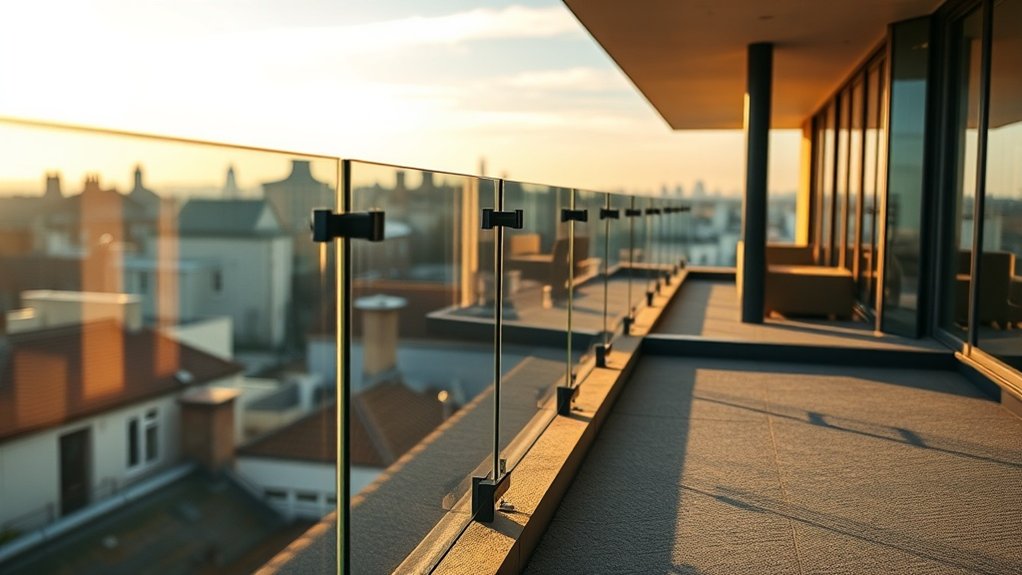
When you replace solid upstands or heavy railings with glass balustrades , you immediately uncover more usable space, daylight, and view without compromising safety performance. The transparent barrier visually extends your terrace floor plate, reduces enclosure, and improves perceived volume, which matters on constrained London plots.
You still meet or exceed safety standards by specifying laminated, toughened glass to BS 6180 with robust fixings and certified impact resistance . You can also tune privacy and aesthetics through coating technologies, Color options, and decorative patterns without losing luminosity.
- Increase daylight penetration to interior spaces.
- Maintain wind protection while preserving skyline views.
- Meet loading, height, and guarding regulations with engineered glass.
- Customise edge treatments, tints, and surface finishes for cohesive terrace design.
Framed vs Frameless Glass Balustrades for Terraces
Selecting between framed and frameless glass balustrades for a London terrace means balancing structural performance, visual impact, and regulatory compliance . With framed systems, you gain pronounced edge definition, reliable handrail continuity, and easier integration of decorative patterns within or on the glass. Frames can also discreetly conceal tolerances and allow you to coordinate color options with existing metalwork or window systems.
Frameless balustrades pursue a near-invisible envelope, maximising skyline views and daylight while still meeting London’s loading and containment standards when correctly specified. Here, glass thickness , interlayers, and edge treatments do more of the structural work, so you must precisely coordinate engineering calculations and product certification. You’ll typically rely on subtle hardware, keeping the glass surface visually continuous and future‑focused in appearance.
Glass Balustrade Fixing Methods: Base, Side and Point
Framed or frameless, the way you fix a glass balustrade to your terrace structure dictates performance , appearance, and compliance with London’s loading and edge‑protection standards. Your fixing choice also frames how you integrate decorative patterns, lighting, and references to historical styles.
-
Base‑fix channels clamp glass along the bottom edge, delivering clean lines and efficient load transfer into slabs or upstands. They suit long, uninterrupted runs on contemporary terraces.
-
Side‑fix brackets bolt to the slab edge, maximising usable floor area and keeping drainage paths clear.
-
Point‑fix bolts (stand‑offs) create minimal visual structure and let you “float” glass in front of masonry or metal.
-
You can hybridise methods, aligning fixings with façade rhythms or balcony steelwork to achieve regulatory robustness and expressive detailing.
Choosing Safe Glass Types and Thickness for Terraces
You can’t finalise a terrace balustrade specification in London without matching glass thickness to loading requirements and edge conditions set out in UK and BS standards. You’ll need to balance recommended thickness ranges with the choice between toughened, heat-soaked, and laminated safety glass, especially in frameless or structural applications. By understanding how these safety glass options perform under impact, line loads, and post-breakage, you guarantee your terrace remains both compliant and visually refined.
Recommended Glass Thickness Standards
How thick should terrace balustrade glass actually be to remain both safe and visually light? In London, you’ll typically align with BS 6180 and local building control, balancing glass durability with aesthetic integration. Your thickness choice depends on height above ground , wind exposure, and fixing system.
Use these indicative guidelines as a design-start, always verifying with structural calculations:
- 10 mm: Only for low-height barriers and internal terraces with minimal crowd loading.
- 12 mm: Standard for residential terraces up to typical fall heights, especially with continuous handrails.
- 15 mm: For higher wind zones, roof terraces, or longer, frameless spans.
- 17.5–21.5 mm: For premium, largely uninterrupted vistas where you’re pushing span length, crowd loading, or cantilevered edge details.
Safety Glass Options
Selecting the right safety glass for a London terrace balustrade means balancing impact resistance , post-breakage performance, and compliance with BS 6180 and Part K. You’ll typically specify toughened, laminated, or toughened-laminated glass. Toughened glass offers high impact strength but breaks into small fragments, so it’s best combined in laminated build-ups for critical edge zones and frameless systems.
Laminated glass, using PVB or SGP interlayers, delivers superior residual stability if a pane fails, maintaining a barrier while you arrange replacement. For design-led terraces, you can integrate frosted or printed decorative patterns within the laminate, preserving clean external faces. Tinted interlayers and back-painted panels expand color options, allowing you to coordinate with façade materials without compromising structural or regulatory performance.
Wind, Privacy and Noise With Terrace Glass Balustrades
When you specify terrace glass balustrades in London, you need to treat wind protection, privacy, and noise control as integrated performance criteria, not afterthoughts. Glass height, panel spacing, and fixing details directly influence wind loading, perceived comfort, and compliance with BS and local planning guidance. By selecting appropriate glass types, surface treatments, and acoustic strategies, you can enhance privacy and reduce noise without compromising transparency or architectural intent.
Wind Protection And Comfort
Ever noticed how a terrace can feel unusable on windy days, despite looking perfectly designed on paper? With glass balustrades, you can transform that exposure into controlled comfort. By specifying laminated, toughened panels, you gain material durability while maintaining aesthetic appeal and transparency to the skyline.
To optimise wind protection, you should evaluate:
- Panel height and thickness – tuned to local wind loads and BS 6180 requirements.
- Fixing system – base channels or point-fixings engineered to resist uplift and racking.
- Edge detailing – continuous runs limit turbulent eddies and cold downdrafts.
- Zoning strategy – varying heights to shield seating areas while keeping circulation breathable.
This approach turns your terrace into a consistently usable, comfortable outdoor room.
Enhancing Privacy And Acoustics
Although terraces are often designed as open, social spaces, you’ll frequently need your glass balustrades to deliver targeted privacy and noise control without compromising light or views. You can address privacy concerns by specifying frosted, gradient, or screen-printed interlayers that obscure sightlines at seated or standing eye level while maintaining transparency above.
For acoustics, you’ll enhance performance by selecting laminated glass with specialist acoustic interlayers, configured to reduce traffic and urban noise without excessive thickness or weight. Pay attention to edge sealing, post spacing, and junction details; poorly detailed gaps severely limit acoustic insulation. In London, you’ll also coordinate with local planning guidance on overlooking , ensuring balustrade heights, opacities, and reflections respect neighbouring amenity while still expressing a contemporary, minimal design language.
London Building Rules for Terrace Glass Balustrades
Designing terrace glass balustrades in London demands close alignment with UK Building Regulations and local authority guidance, particularly Parts K (protection from falling), B (fire safety), and A (structural safety). You must balance structural logic with Historical preservation and aesthetic integration, ensuring innovation never conflicts with compliance.
Key considerations include:
- Heights & Loading – Meet minimum barrier heights and line loads; specify laminated, toughened, or hybrid glass to satisfy impact and crowd-loading criteria.
- Edge Conditions – Detail base channels, point-fixings, and handrails to prevent glass detachment under failure scenarios.
- Fire Interfaces – Coordinate junctions with façades, escape routes, and compartment lines to avoid compromising fire strategy.
- Overlooking & Glare – Use fritting, tints, or obscure zones that respect neighbouring amenity while maintaining a contemporary, transparent language.
Glass Balustrades on Listed and Conservation Properties
When you introduce glass balustrades to listed buildings or properties in conservation areas, you work within a far tighter planning and heritage framework than on standard terraces. You must evidence Historical preservation as a primary objective, not an afterthought, demonstrating that the new intervention reads as reversible, lightweight, and visually recessive.
You’ll typically coordinate early with conservation officers, submitting detailed sections, fixing schedules, and visual impact assessments . Material compatibility becomes critical: choose glass, fixings, and handrails that don’t chemically or visually conflict with existing stone, brick, or metals. Low-iron or anti-reflective glass, slim stainless or bronze fittings, and minimally invasive anchoring help maintain original fabric. By aligning structural certification with heritage statements, you position your terrace upgrade as a sensitive yet progressive intervention.
Terrace Glass Balustrade Design Ideas for London Homes
Respecting heritage constraints on one project doesn’t limit what you can achieve elsewhere in London; it sharpens your eye for proportion, fixing detail, and material performance across all terrace types. You can push terrace glass balustrade design while still satisfying Building Regulations and overlooking rules.
Consider:
- Minimal-frame systems: Use slim aluminium channels with thermal breaks, keeping sightlines clear while maintaining line load and impact compliance.
- Color options: Specify ceramic-frit or laminated interlayers for subtle tints that modulate privacy and solar gain without breaching reflectivity guidance.
- Decorative patterns : Integrate laser-etched or screen-printed zones to control overlooking and wind without bulky privacy screens.
- Integrated lighting: Detail LED profiles within base channels or handrails, ensuring wiring routes and IP ratings align with external use and maintenance access.
London Glass Balustrade Costs, Timelines and Budget Drivers
Although every London terrace has its own constraints, glass balustrade costs follow clear patterns driven by specification, access, and compliance . You’ll budget primarily around glass type (toughened vs laminated), fixing method (post, channel, or point-fixed), and handrail configuration to meet BS 6180 load requirements. Higher Glass aesthetics—low-iron, fritting, or coloured interlayers—raise costs but can be offset by long-term value and visual impact.
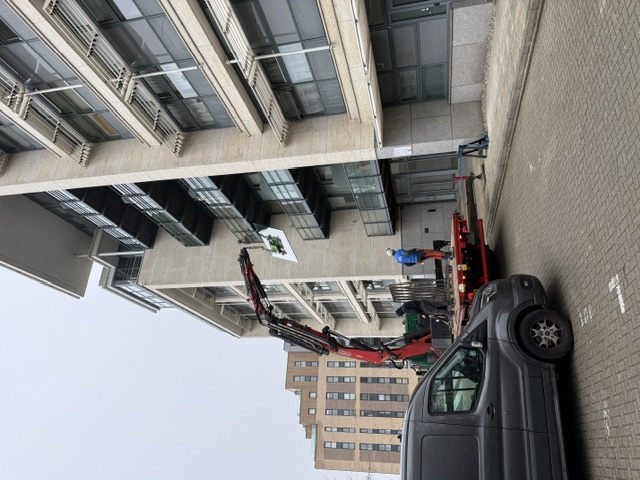
Material durability also shapes lifetime cost: marine-grade stainless, structural aluminium channels, and high-spec laminates reduce maintenance in polluted or exposed zones. Lead times typically run 4–8 weeks: survey, structural checks, fabrication, then installation, with planning or freeholder approvals extending timelines. Complex access, crane lifts, and bespoke detailing are the major budget drivers on tight London sites.
Choosing a Terrace Glass Balustrade Installer in London
When you choose a terrace glass balustrade installer in London, you need to assess credentials rigorously , from CSCS cards and glazing experience to evidence of compliance with BS 6180 and Building Regulations Part K. You should review design proposals in detail, checking glass specifications, fixing methods, drainage solutions, and interface details with your existing structure. Then you can compare costs on a like‑for‑like basis, ensuring quotations clearly itemise structural calculations, fabrication, installation, and any planning or building control support.
Assessing Installer Credentials
Before you sign a contract for a terrace glass balustrade in London, you need to interrogate the installer’s technical competence, regulatory understanding, and track record. You’re looking for a partner who can integrate contemporary glazing with historical architecture and align exterior lines with your interior decor strategy.
Evaluate credentials through four lenses:
- Regulatory literacy – Verify expertise with BS 6180, Part K, wind-load calculations, and edge-distance requirements.
- Structural proficiency – Ask for engineering calculations, fixing details, and glass specifications for your exact terrace conditions.
- Heritage and design sensitivity – Request case studies where they’ve resolved conservation constraints without compromising minimalism.
- Quality governance – Check for memberships (e.g., GGF), third‑party insurance, warranties , and documented installation/inspection protocols.
Comparing Design And Costs
How do you balance a clean, frameless aesthetic with the structural demands and cost realities of a London terrace? You start by comparing systems on three axes: engineering performance, fabrication complexity , and lifecycle value.
Ask installers to itemise costs for glass thickness, fixing method (base shoe, post, or point-fixed), and handrail options, then map these to required line loads under BS 6180 and local planning constraints. Higher-spec laminated glass and anodised aluminium shoes cost more upfront but often reduce maintenance and extend lifespan.
Interrogate material sustainability claims: recycled aluminium content, low-iron glass sourcing, and end-of-life recyclability . Finally, review aesthetic integration: edge alignment with thresholds, drainage details, and how brackets, caps, and transitions visually resolve against your façade and terrace finishes.
Glass Balustrade Cleaning and Long-Term Care
Although a terrace glass balustrade is engineered for durability, its performance and appearance depend on disciplined cleaning and long-term care aligned with manufacturer guidance and relevant British Standards. You’ll manage glass weathering proactively by setting defined cleaning schedules that reflect London’s pollution levels, coastal exposure, and orientation.
- Inspect quarterly for chips, delamination, loose fixings, and degraded seals; document findings to maintain BS 6180 compliance.
- Clean glass with pH‑neutral agents, microfiber pads, and deionised water; avoid abrasives that can compromise toughened or laminated surfaces.
- Maintain stainless or aluminium components with non-chloride cleaners to prevent crevice corrosion at clamps and base tracks.
- Review drainage paths and weep holes annually so trapped moisture doesn’t accelerate weathering or undermine structural performance.
Frequently Asked Questions
Can I Retrofit a Glass Balustrade Onto an Existing Terrace Without Major Structural Changes?
You usually can, but you’ll need a structural survey first. You assess load paths, edge conditions, and fixing depths, then select a base or side‑mounted system that respects historical preservation and aesthetic consistency. You’ll verify compliance with local balustrade regulations, impact resistance, and line‑load criteria. Where existing substrates are weak, you’ll introduce discreet steel plates or resin anchors, enabling an innovative glass solution without wholesale terrace reconstruction.
How Do Glass Balustrades Perform in London’s Polluted, Hard-Water Urban Environment?
They perform well if you specify correctly. You’ll need toughened or laminated glass with high‑quality coatings to resist pollutants, mineral deposits, and micro‑abrasion. Hard water spotting increases maintenance costs unless you use hydrophobic or self‑cleaning glass and well‑detailed drip edges. Precision-engineered stainless or coated aluminium fixings prevent corrosion. When detailed to BS 6180 and cleaned on a planned cycle, you retain long‑term aesthetic appeal and crisp, contemporary transparency.
Are There Eco-Friendly or Recycled Glass Options for Terrace Balustrades in London?
You can specify recycled-content glass, and it’s no coincidence this aligns with advanced Recycling processes and Eco friendly manufacturing. You’ll typically get 30–70% post-consumer cullet, laminated to meet BS 6180 and UKCA requirements. You should confirm EPDs, low-iron options, and local production to cut embodied carbon. Work with fabricators offering modular systems, so you can disassemble, re-temper, or re-laminate panels at end-of-life for circular reuse .
Can Terrace Glass Balustrades Incorporate Lighting, Heating or Smart Home Integrations?
Yes, you can integrate lighting, heating and smart home features directly into the balustrade design. You’ll typically embed low‑voltage LED lighting within the handrail or base channel, ensuring IP-rated components and concealed cabling. Smart integration lets you control brightness, colour temperature and schedules via automation platforms. For heating, you must position radiant elements away from glass edges, verify thermal-stress limits, and comply with electrical and building safety regulations.
What Insurance or Warranty Considerations Apply Specifically to Terrace Glass Balustrades in London?
You’ll need Insurance coverage that recognises structural glass as part of the building envelope and includes wind load, impact and public liability risks. Clarify if your policy covers glass breakage from thermal stress or fixing failure. For warranty protection, insist on 10-year guarantees on glass, hardware and finishes, plus installer workmanship. Verify compliance with UK Building Regulations and ask for documented calculations; insurers may require these for full risk acceptance.
Summary
As you step onto your terrace, the glass balustrade frames London’s skyline like a precisely engineered picture window—every line aligned with Part K, every fixing detail calculated, every panel designed to resist wind load and impact. You enjoy uninterrupted views, clean sightlines, and safe edges that meet current regulations. With the right specification, installer, and maintenance, your terrace becomes a crisp, contemporary platform—light-filled, compliant, and built to perform for decades.