You shouldn’t treat a glass balcony in London as a simple cosmetic upgrade. You’ll need planning permission in many cases, plus freeholder and managing agent consent. A structural engineer must verify load‑bearing capacity, anchoring, wind and impact resistance, and compliance with BS 6180 and EN standards. Specify toughened laminated glass, certified fixings, and robust drainage, then plan for safe access, cleaning, and inspections. From permissions to maintenance, every stage matters if you want to get it right.
Key insights
- Confirm structural capacity of slabs and façade with a structural engineer to support glass, steelwork, and live loads in line with BS EN and London guidance.
- Choose suitable balcony type (Juliet, bolt-on, frameless, or hybrid) and specify toughened laminated glass thickness to suit wind exposure and safety requirements.
- Ensure compliance with UK standards (e.g., BS 6180) for fixings, handrails, line loads, and edge protection using tested stainless steel and thermally broken frames.
- Obtain planning permission and freeholder/managing agent consent, addressing overlooking, appearance, loading, drainage paths, and fire strategy specific to the London borough.
- Plan professional installation, access, and ongoing maintenance, including regular inspections and appropriate glass cleaning to preserve safety, appearance, and warranties.
Is a Glass Balcony Right for Your London Home?
When you’re deciding whether a glass balcony suits your London property, you’ll need to balance aesthetics with structural and safety requirements . You must first confirm your existing slab or steelwork can support additional live loads, wind loads, and the weight of laminated or toughened glass. You’ll also need to evaluate exposure to pollution and rainfall, as these affect long‑term maintenance and slip resistance.
A glass balcony can transform your Interior decor by extending sightlines, maximising daylight , and visually enlarging compact spaces. It also supports innovative gardening options, such as slim planter rails, integrated irrigation, and load‑rated green walls, provided you verify point loads and drainage routes. Prioritise non-combustible fixings, certified balustrade systems, and compliant glass thickness to ensure robust edge protection.
London Planning Permission for Glass Balconies
You’ll need to confirm exactly when planning permission applies , as glass balconies often alter a building’s external appearance, structural load paths, and overlooking/privacy conditions. In London, you must align your design with your borough’s specific policies, conservation area constraints, and any listed-building controls before you submit drawings. By coordinating early with the local planning authority, you reduce safety risks from non-compliant structural details and avoid costly redesigns or enforcement action.
When Planning Permission Applies
Although glass balconies often look like straightforward upgrades, London’s planning rules treat them as structural alterations that can trigger formal planning permission . You’re not just changing balcony aesthetics or experimenting with glass color options; you’re modifying the building’s envelope, live-load capacity, and sometimes its fire strategy.
Planning permission typically applies when you:
- Create a new balcony platform where none exists, altering structural loads and overlooking relationships.
- Project further from the façade than the original balustrade line, increasing visual impact and wind loading.
- Change the use of a roof or ledge to a terrace , introducing regular occupancy, guarding, and drainage demands.
- Alter the external appearance in sensitive contexts, such as conservation areas , listed buildings, or uniform façades.
Navigating Local Authority Rules
Planning permission rules set the framework, but London’s 33 local planning authorities each apply those rules with their own policies, validation checklists, and risk tolerances. You’ll need to interpret both the London Plan and your borough’s design guides, especially where glass balustrades interface with façades, overlooking, and fire‑safety strategy.
Start by reviewing local SPD documents covering balconies, privacy, and streetscape. Align your proposal drawings, sections, and specs with these, highlighting impact on neighbouring amenity and daylight. Emphasise material durability: laminated, heat‑soaked safety glass, corrosion‑resistant fixings, and tested balustrade systems.
Where your balcony supports Interior design aims—light transmission, visual continuity, minimal framing—explain how you’ll still meet loading, guarding height, and containment requirements, referencing BS 6180 and relevant Approved Documents.
Permissions From Freeholders, Managing Agents and Neighbours
Before you specify glass thickness or post layouts, you must confirm that every party with a legal or practical interest in the building consents to the balcony. You’ll need written approvals that reference drawings, balcony materials, fixing methods, and drainage paths, so decisions aren’t left vague or reversible later.
-
Freeholder consent – Secure a formal licence to alter, detailing loading, fixing into the structure, and responsibility for future maintenance.
-
Managing agent approval – Coordinate access, warranties, insurances, and interface with communal services or façades.
-
Leaseholder coordination – Align internal finishes, thresholds, and airtightness to avoid cold-bridging or water ingress.
-
Neighbour consultation – Present 3D visuals showing sightlines, privacy, and neighborhood aesthetics to minimise objections and demonstrate design sensitivity.
Safety Regulations for Glass Balcony Installation
Why does a glass balcony in London feel simple on paper yet sit inside a tight mesh of safety rules once you look closer? Because you’re working inside a framework of Building Regulations , BS standards, and local authority guidance that all treat glass as a critical safety element, not just a visual upgrade.
You must use safety glass: typically toughened, laminated, or a combination, tested for impact and post-breakage performance . Balustrade height, glass thickness, edge protection, and handrail requirements follow precise measurements, especially where you specify frameless systems.
Decorative glass and artistic designs are acceptable, but only when they maintain optical clarity at key sightlines, avoid confusion with door openings, and don’t compromise edge strength. You’ll also need documented compliance certificates and installation records for sign‑off and insurance.
Structural Checks and Load-Bearing Requirements
Before you commit to a glass balcony in London, you must confirm that your existing building structure can safely accept the additional loads and fixing points. You’ll work with a structural engineer to inspect slabs, beams, and façade elements, checking concrete strength, reinforcement layout, and anchorage capacity. From there, the engineer will calculate safe load limits for the balcony, including dead loads, live loads, wind forces, and impact loads, ensuring full compliance with UK and London-specific standards.
Assessing Existing Building Structure
Although a glass balcony appears visually light, it imposes significant point loads and horizontal forces on the existing structure, so you must verify that the building can safely carry these new actions. In London, where historical architecture meets cutting‑edge interior design, this assessment is critical before you touch fixings or glass.
You should instruct a structural engineer to investigate:
- Primary structure – Identify floor slab type, beam directions, wall thickness, and materials; confirm load paths to foundations.
- Material condition – Check for carbonation, corrosion, moisture ingress, timber decay, and previous alterations or fire damage.
- Connection zones – Scan proposed fixing areas for reinforcement, voids, services, and hidden defects using non‑destructive testing.
- Movement and stability – Review existing deflection, cracking, and lateral stability elements to make certain the balcony won’t amplify serviceability or vibration issues.
Calculating Safe Load Limits
Once you’re confident the existing structure is sound, you must quantify exactly what loads the glass balcony will apply and verify that every supporting element can resist them with adequate safety margins.
You’ll calculate imposed live loads from occupants, furnishings, and potential crowding, then add dead loads from glass panels, fixings, and secondary balcony materials such as steel frames or aluminium profiles. Factor in wind loads, impact loads on the balustrade, and possible snow accumulation.
You should work to EN standards and London-specific guidance, applying partial safety factors to each load case. Check anchors, edge beams, and slab zones in bending, shear, and deflection so they don’t compromise glass aesthetics or cause serviceability issues. Document load paths, connection capacities, and allowable usage.
Glass Balcony Types: Juliet, Bolt-On and Frameless
When you plan a glass balcony in London, you’ll typically choose between Juliet, bolt-on, and frameless systems , each with distinct structural and safety implications. Your decision should balance glass aesthetics with balcony security, wind loading, and fixings into the primary structure.
-
Juliet balconies You mount glass directly outside full-height doors. They don’t create usable floor space but provide fall protection with minimal steelwork.
-
Bolt-on balconies You attach a projecting steel frame to the façade, then integrate glass balustrades, ensuring anchor design resists combined live and wind loads.
-
Frameless balustrades You clamp glass into a base channel, maximising transparency while relying on tested edge-retention systems.
-
Hybrid solutions You combine slim steel profiles with structural glass to fine-tune stiffness, deflection control, and visual lightness.
Best Glass Types and Thickness for London Balconies
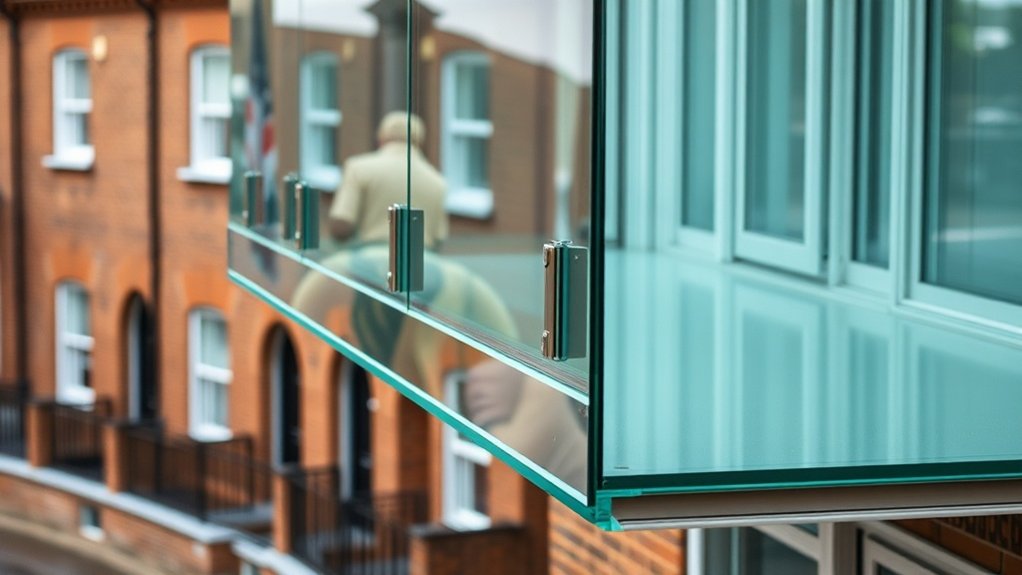
Choosing the right glass type and thickness for a London balcony isn’t just an aesthetic decision; it’s a structural and safety-critical one governed by wind loads, impact requirements, and edge support conditions. You’ll typically specify toughened laminated glass to guarantee redundancy: if one ply fails, the interlayer retains integrity and prevents fall-through.
For Juliet and bolt-on balconies , you’ll usually work within 13.5–17.5 mm laminated toughened glass, depending on span, exposure, and occupancy type. For fully frameless systems with higher wind pressures, 17.5–21.5 mm is often necessary after load calculations.
Low-iron glass improves glass aesthetics and clarity, while tinted or fritted interlayers can control solar gain and enhance balcony lighting, allowing you to engineer both performance and visual impact.
Fixings, Frames and Handrails for UK Standards
After you’ve defined the glass specification , the performance of your London balcony depends on how that glass is fixed, supported, and restrained in line with UK standards such as BS 6180 and BS EN 1991. You’ll balance structural reliability, corrosion resistance, and minimal visual clutter while allowing for innovative detailing and Decorative glass.
- Fixings – Use engineered Custom fixings (stand-offs, point-fixings, channels) in stainless steel 316, sized from structural calculations and pull‑out tests.
- Frames – Choose thermally broken aluminium or steel profiles, checked for deflection limits under crowd and wind loads.
- Handrails – Specify continuous, mechanically fixed rails capable of tying glass panels together and resisting line loads.
- Tolerances & Movement – Integrate slotted holes, packers, and isolation gaskets to accommodate building movement and avoid glass edge stress.
Balancing Privacy and Views in London Homes
Although a glass balcony can open up exceptional London views, you still need to control sightlines, overlooking, and light transmission to protect privacy and meet planning expectations. You start by mapping critical view cones from neighbouring properties, then specify glass types and heights that mitigate Privacy concerns without sacrificing view enhancement.
You can use frosted or acid‑etched glass to obscure direct overlooking zones while keeping clear panels at eye level facing long‑range vistas. Consider graduated opacity films or switchable privacy glass where you need dynamic control. Side screens with higher opacity reduce lateral overlooking in tight urban gaps. Model solar gain, reflectivity, and night‑time internal illumination to avoid glare and mirror effects. Always document these measures in planning drawings and safety risk assessments .
Glass Balconies in Flats vs Houses in London
When you compare glass balconies for London flats and houses, you need to assess how space constraints and structural layout affect fixing points, loading, and usable floor area. You’ll also face different planning rules, fire regulations , and guarding requirements depending on building height, means of escape, and proximity to neighbours. Finally, you must select glass types, balustrade systems, and screening solutions that control overlooking and reflect your privacy needs in dense urban settings.
Space Constraints And Layout
Because London properties vary so much in footprint and structure, you need to approach glass balcony design very differently in flats than in houses. In flats, you typically work with shallow projections , shared façades, and tighter load paths, so you prioritise clear space, slim fixings, and integrated drainage. In houses, you usually gain more depth, allowing flexible furniture placement and stronger links with your interior decor theme.
- Micro‑balconies in flats – Use cantilevered glass, minimal posts, and built‑in seating to preserve circulation width.
- Corner layouts – Exploit dual aspect with L‑shaped glass to expand the visual field.
- Terraced houses – Align balcony width with structural bays for efficient support.
- Detached houses – Use wider spans, zoned seating, and planters without obstructing sightlines.
Planning Rules And Safety
Even before you explore glass types or balcony layouts, you have to treat planning rules and safety standards as your primary design constraints, and these differ in essential ways between flats and houses in London . In flats, you’ll usually need full planning permission and freeholder/management consent, especially in conservation areas or buildings with listed historical architecture. Structural calculations, fire strategy, and strict balustrade load‑testing are non‑negotiable.
In houses, you may use permitted development rights , but cantilevered glass balconies still trigger structural and overlook assessments. You must specify laminated, toughened glass, minimum 1.1 m balustrade height, and compliant fixings with documented test data. Align the balcony with the building’s façade rhythm and interior design circulation, ensuring safe door thresholds, child‑safe gaps, and robust edge protection.
Design Choices And Privacy
How you balance transparency, privacy, and structural logic should drive every glass balcony design decision , and the trade‑offs differ sharply between London flats and houses. In flats, you’re managing overlooking, wind loading, and strict landlord or freeholder constraints; in houses, you typically have more freedom to sculpt views, edges, and screening.
-
Glass type and opacity – Use frosted, fritted, or tinted glass on side panels in dense flats, keeping front panels clearer on higher, less‑overlooked houses.
-
Balustrade height and framing – Optimise handrail profiles and post spacing to reduce sightlines without compromising Part K or BS 6180 compliance.
-
Plant integration – Specify load‑rated planters and integrated rails for vertical greenery screening.
-
Decorative lighting – Incorporate low‑glare, IP‑rated linear LEDs into the base channel or handrail for secure, subtle illumination.
Glass Balcony Installation Costs in London
When you budget for a glass balcony installation in London, you need to account for several cost drivers: structural design, glass specification (toughened, laminated, thickness), fixing system (post, button, or frameless channel), access constraints, and regulatory compliance. Structural calculations, pull-out tests, and load-path detailing add professional fees but ensure safety.
Glass aesthetics and performance influence price: low-iron panels, custom tints, or fritted privacy bands cost more than standard clear panes. Frameless channels demand heavier glass and precision alignment, raising labour and hardware costs but delivering a cleaner envelope for innovative Balcony landscaping and lighting.
You’ll also factor scaffold or MEWP access, party-wall or freeholder approvals, and Building Control sign-off, which safeguard compliance but add to overall project expenditure.
Step-By-Step Glass Balcony Installation Process
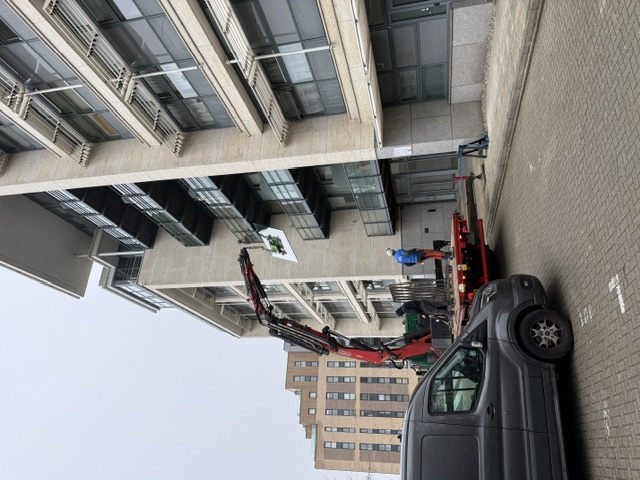
Before a single hole’s drilled, a safe, compliant glass balcony installation in London starts with a tightly controlled sequence: detailed survey and structural verification, measured drawings and glass setting-out , fixing layout and tolerance checks, temporary edge protection planning, and method statements that address manual handling, working at height, and glass breakage scenarios. You then coordinate logistics, crane access, and just-in-time delivery to minimise on-site glass exposure.
- Prepare structure and fixings – Install anchors or channels, verify pull-out values, and protect adjacent finishes.
- Position balustrade hardware – Align posts or base shoes using laser levels, then torque to spec.
- Install glass – Lift panes with suction gear, lock in setting blocks, apply structural seals.
- Finish and customise – Integrate glass tinting, decorative etching, and final compliance checks.
Maintenance and Cleaning for London Glass Balconies
When your glass balcony is in place, you need a structured maintenance routine to keep it safe, clear, and compliant with London’s environmental conditions. You’ll apply specific cleaning methods, tools, and products to prevent scratching, staining, and sealant degradation, while also protecting hardware from corrosion. Seasonal checks let you spot early signs of damage, manage weather-related stress, and extend the system’s service life.
Routine Cleaning Best Practices
Although your glass balcony is designed to withstand London’s variable climate, routine cleaning is vital to preserve visibility, structural integrity, and safety. A disciplined schedule also ensures the glazing complements surrounding historical architecture and contemporary interior design.
- Inspect glass, fixings, and seals monthly. Note edge chips, sealant gaps, or loose handrail brackets before washing, so you don’t worsen latent defects.
- Use a pH‑neutral, non-abrasive glass cleaner with deionised water and a microfiber applicator; avoid harsh chemicals that can attack coatings or stainless fixings.
- Rinse from top to bottom with low-pressure water, then squeegee immediately to minimise mineral spotting from London hard water.
- Clean balustrade bases and drainage channels, removing debris to prevent standing water, corrosion risk, and slip hazards.
Protecting Glass From Damage
Even with toughened or laminated specification, balcony glass remains vulnerable to impact, edge stress, and chemical attack, so your maintenance routine must actively protect it from damage rather than just keep it clean. You should treat every pane as structural glass artistry, not just a transparent barrier.
Start by inspecting edges where micro-chips propagate into critical cracks; keep fixings correctly torqued to prevent point loading. Specify UV-stable, pH-neutral cleaners; avoid hydrofluoric-based products that etch coatings. Install discreet bumper strips where furniture or planters could strike the glass. You can apply nano-ceramic sealants to reduce staining and micro-abrasion without compromising optical clarity.
Finally, align your interior decor and balcony layout so traffic flows don’t drive impact or twisting forces into the glass.
Seasonal Maintenance For Longevity
Because London’s climate drives rapid cycles of moisture, pollution, and temperature change, you should treat glass balcony care as a seasonal maintenance schedule rather than an occasional clean. Seasonal weather affects structural components first, then aesthetic performance, so you’ll prioritise checks that protect fixings, glass integrity, and drainage.
- Inspect all brackets, posts, and bolts each quarter; tighten to manufacturer torque values and log any corrosion or movement.
- Clean glass with pH‑neutral solution; avoid abrasives that compromise toughened or laminated surfaces and long‑term transparency .
- Flush drainage channels and balcony falls; remove debris that could cause ponding, freeze expansion, or slip hazards.
- Apply hydrophobic nano‑coatings annually for self‑cleaning behaviour, reduced limescale bonding, and durable aesthetic enhancements.
Common Glass Balcony Mistakes to Avoid
When you plan a glass balcony in London’s dense urban environment, small oversights can create serious safety, performance, and compliance problems. You risk structural failure if you ignore wind load calculations , edge distances, or anchor specifications for your substrate. Don’t compromise by choosing non-laminated or under‑thickness glass; impact resistance and post‑breakage integrity are critical.
Avoid fittings that clash with your intended glass aesthetics or trap water, accelerating corrosion . Poor drainage detailing leads to ponding, staining, and freeze–thaw damage. Never position balcony lighting without considering glare, light spill to neighbours, and thermal effects on seals. Skipping tolerances for building movement can cause glass stress and spontaneous cracking. Finally, don’t overlook handrail heights and line‑load criteria defined by UK standards.
Choosing a Reliable Glass Balcony Installer in London
How do you distinguish a genuinely competent glass balcony installer in London from a contractor who’s cutting corners on safety and compliance? You start by verifying how they engineer the system, not just how it looks. A reliable specialist will model Glass design , structural loads, and Material durability against London’s wind, occupancy, and edge conditions.
- Credentials & compliance – Check FENSA/GGF membership , insurance, and documented compliance with BS 6180 and relevant Eurocodes.
- Engineering detail – Ask for load calculations, fixing details, and substrate verification procedures.
- Material specifications – Insist on test data for laminated safety glass, hardware corrosion resistance, and warranty terms.
- Installation methodology – Review their method statements, quality checks, and post-installation inspection and maintenance guidance.
Frequently Asked Questions
How Long Does a Glass Balcony Installation Typically Take From Survey to Completion?
You’ll typically move from survey to completion in 3–6 weeks. First, engineers assess site conditions, load requirements, and material durability, then finalize drawings and approvals. The installation process itself usually takes 1–3 days, including fixing structural supports, setting laminated or toughened glass, and sealing joints. Expect safety checks, alignment verification , and drainage detailing before sign‑off, ensuring long-term performance and a sleek, innovative finish.
Can Glass Balconies Help Improve the Resale Value of My London Property?
Yes, you’re likely to boost resale value, and it’s no coincidence buyers now prioritise usable outdoor space. When you specify forward‑thinking balcony design with certified glass , corrosion‑resistant fixings, and tested Material durability, surveyors often rate the upgrade positively. You enhance natural light, views, and perceived floor area while maintaining safety compliance (BS standards, wind‑load calculations, laminated glass). That combination makes your property stand out in a crowded London market.
Are Glass Balconies Suitable for Listed Buildings or Conservation Areas in London?
You can install glass balconies on listed buildings or in conservation areas, but only with strict design and planning controls. You’ll need Listed Building Consent, a Planning Application, and detailed drawings proving Historical preservation and Structural integrity. Specify minimal, reversible fixings, laminated safety glass, and discreet stainless or structural glass supports. Work with a conservation-savvy structural engineer and planning consultant to guarantee compliance while still achieving a modern, innovative aesthetic.
How Does Wind and Noise in High-Rise London Buildings Affect Glass Balconies?
Wind and noise in high‑rise London buildings considerably influence glass balcony performance. You must analyse Wind impact through CFD modelling , dynamic load calculations, and compliant fixing design to prevent vibration, deflection, or glass breakage. For Noise mitigation, you’ll specify laminated acoustic glass, airtight balustrade interfaces, and possibly baffle panels or soffit treatments. You should also integrate aerodynamic detailing—rounded edges, staggered panels—to reduce wind buffeting, whistling, and occupant discomfort.
Can Integrated Lighting or Heating Elements Be Added to a Glass Balcony Design?
Yes, you can integrate LED lighting and heating elements, but you must treat the balcony like a small spacecraft. You’ll use low‑voltage, IP67‑rated LED lighting, routed in recessed channels with toughened diffusers to avoid glare and impact risk. Heating elements must be thermostatically controlled, RCD‑protected, and isolated from structural glass via thermal breaks, ensuring no hot spots, delamination, or thermal stress on fixings and laminates.
Summary
So after all this talk of structural calculations , wind loads, and laminated safety glass, a glass balcony almost sounds… dangerous, doesn’t it? Yet that’s exactly why you’ll insist on proper planning permission, rigorous load‑bearing checks, compliant balustrade heights, and certified installers. You’re not just adding a view of London’s skyline—you’re engineering a safe, code-compliant platform to stand on it. Ironically, the “lightest” feature of your home demands the heaviest scrutiny.