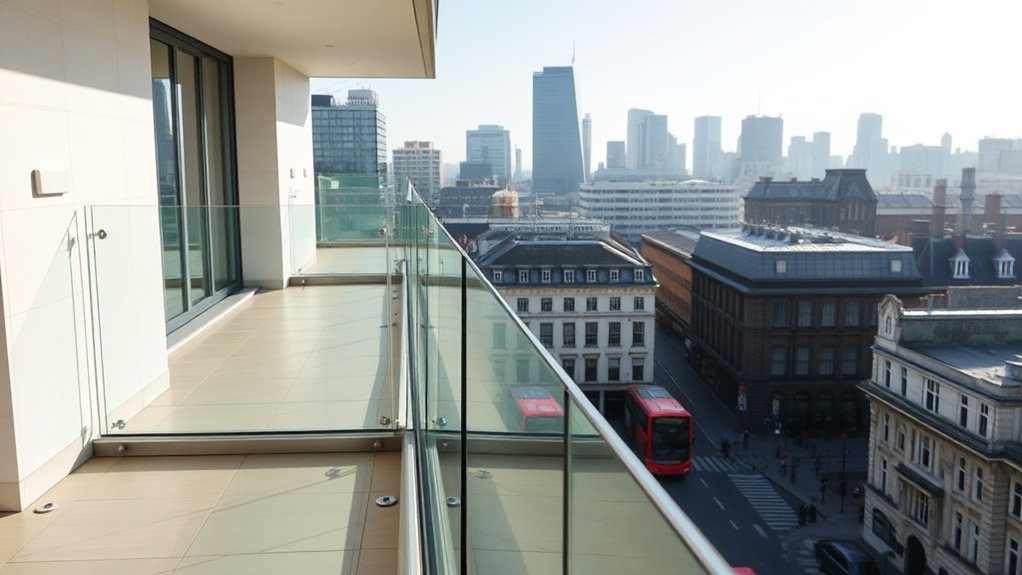
You choose commercial glass balustrades in London to maximise natural light, preserve lettable floor space and meet stringent UK standards such as Part K and BS 6180. You can specify post-and-rail, frameless channel, or bolt-fixed systems in laminated toughened or low‑iron glass, tuned to interior or exterior crowd-loads, heritage constraints and brand expression. You’ll also control cost, maintenance and compliance more effectively once you understand the key system types, specifications and installation practices.
Key insights
- Commercial glass balustrades in London maximise natural light, usable floor area and high-end aesthetics while meeting demanding safety and performance requirements.
- Main system options include post-and-rail, frameless, channel/base-clamped and bolt-fixed, selected according to design intent, structure and heritage context.
- Interior and exterior balustrades differ in glass clarity, height, fixing robustness and weathering detail, tailored to offices, retail, hospitality and roof terraces.
- Systems typically use laminated toughened or heat-soaked glass, engineered channels or point-fixings, and structural handrails, designed to BS 6180 and relevant Eurocodes.
- London installations must comply with Building Regulations Part K and B, covering barrier heights, line and point loads, impact resistance, containment and fire strategy.
Key Benefits Of Glass Balustrades For London Businesses
From energy-efficient offices in the City to boutique retailers in Shoreditch, glass balustrades deliver a combination of structural performance, regulatory compliance, and visual impact that’s hard to match with traditional metal or timber systems. You gain high light transmittance, improving daylight factors and reducing reliance on artificial lighting, which directly cuts operational energy use and environmental impact.
You also maximise usable floor area with slimline profiles and cantilevered fixing details, freeing up lettable space. In conservation zones and alongside historical architecture, you can meet safety standards without visually competing with heritage façades, because low-iron and anti-reflective glasses keep interventions discreet. Laminated, toughened glass enhances post-breakage integrity, while precision-engineered handrail interfaces support Part K and BS 6180 compliance across multi-storey commercial assets.
Main Types Of Commercial Glass Balustrade Systems
When you’re selecting a commercial glass balustrade in London, you’re typically choosing between four primary system types: post-and-rail , frameless (or “structural glass”), channel or base-clamped, and bolt-fixed (button-fixed) assemblies.
Post-and-rail systems use stainless or powder-coated posts with handrails, giving you predictable loading performance and straightforward detailing around historical architecture. Frameless systems rely on laminated toughened glass as the primary structural element, ideal when you want minimal visual interruption and high-end branding.
Channel or base-clamped systems embed glass in aluminium or steel channels, enabling long, clean runs and fast installation, often with recyclable , eco friendly materials. Bolt-fixed systems use discrete stainless “buttons” that anchor each panel, delivering a lightweight, engineered aesthetic suited to contemporary refurbishments.
Interior Vs Exterior Glass Balustrades In London
When you compare interior and exterior glass balustrades in London, you have to balance visual impact with strict performance requirements under local building standards and exposure conditions. You’ll assess how design intent, fixing methods, and glass specification change when systems must withstand wind loads, driving rain, temperature fluctuation, and higher slip or impact risks. You also need to factor in different safety classifications, edge treatments, and maintenance regimes so your installation remains compliant, durable, and visually consistent over its service life.
Design Considerations And Aesthetics
Although both applications rely on the same core material, interior and exterior glass balustrades in London demand different design priorities regarding glass specification, fixing methods , and visual intent. Internally, you can prioritise ultra-clear low-iron glass, slimline channel systems, and minimalist handrails that align with brand-led aesthetics. Externally, you’ll typically emphasise bolder sightlines, higher panels, and more robust fixing geometries that visually anchor façades.
You should treat color options as a design tool: subtle tints , gradients, or ceramic-frit patterns can manage privacy, glare, and wayfinding without sacrificing transparency. For exterior lines, coloured interlayers can echo corporate palettes across multiple elevations.
Installation techniques also influence aesthetics. Hidden base shoes, point-fixings, and rake-adjustable systems let you maintain crisp, continuous glass planes even on irregular substrates and complex geometries.
Durability, Safety, And Maintenance
Design intent sets the tone, but long-term performance in London’s climate depends on how you specify glass types, interlayers, edge treatments , and fixing systems for durability, safety, and maintainability. For interiors, you’ll typically prioritise laminated toughened glass with discreet point-fixings, abrasion-resistant coatings, and minimal deflection under line loads. Exteriors demand higher-spec interlayers, drained base channels, and corrosion-resistant stainless steel to address freeze–thaw cycles, airborne pollutants, and wind.
- Durability – Specify heat-soaked toughened laminated glass, polished exposed edges, and A4/316 stainless fixings to prevent delamination and staining.
- Safety – Design to current BS 6180, accounting for historical context of failures that drove today’s containment and impact criteria .
- Maintenance – Use low-iron, hydrophobic-coated glass and accessible channels to cut cleaning, lifecycle costs, and environmental impact.
London Building Regulations And Safety Rules Explained
When you install glass balustrades in London, you must align your design and specification with core UK standards such as the Building Regulations (Part K, Part B where relevant) and BS 6180. You’ll need to follow defined safety compliance steps , including correct glass type selection, load calculations, fixing methods, and edge protection to satisfy both planning and Building Control. Ongoing inspection and maintenance duties also sit with you as the property owner or manager, ensuring fixings, glass panels, and handrails remain structurally sound and compliant over the balustrade’s life cycle.
Key UK Regulatory Standards
How do you navigate the maze of UK regulations that govern glass balustrades in London? You start by aligning cutting‑edge design with hard technical standards. You’re balancing historical architecture constraints with modern glass manufacturing capabilities, while staying inside a tight regulatory envelope.
-
Building Regulations (England) – Part K & Part B You must achieve compliant barrier heights , load resistance, impact performance, and edge protection, plus fire‑safety interfaces at floor edges and escape routes.
-
BS 6180:2011 This standard defines line loads, point loads, and glass thickness , dictating fixing types for internal, external, and frameless systems.
-
BS EN 1991 & BS EN 12600 Eurocodes and impact‑classification rules govern crowd loading, breakage behaviour, and post‑fracture integrity, especially critical in public or high‑traffic commercial spaces.
Essential Safety Compliance Steps
Before you sketch a single balustrade line, you map the compliance route just as rigorously as the structural load path . You start by identifying the use class, occupancy density, and fall height, then align them with London Building Regulations and BS standards for glass type, thickness, and fixing systems. You verify containment and line-load requirements, ensuring laminated safety glass and tested channels or point-fixings.
Next, you coordinate with conservation officers where historical architecture is involved, justifying transparency, reflectivity, and fixing visibility. You document fire performance , barrier continuity at junctions, and edge protection at stair cores and terraces. Finally, you model environmental impact: solar gain, bird-strike risk, recyclability, and whole‑life carbon, so your compliant balustrade also advances sustainable, future-ready design.
Inspection And Maintenance Duties
Compliance doesn’t end at sign-off; London’s building control and health and safety framework expect you to operate a formal inspection and maintenance regime for glass balustrades throughout their life. You’re required to evidence planned inspections , not just reactive repairs, particularly in high-traffic commercial environments and sensitive historical architecture.
-
Scheduled inspections – Implement 6–12 month structural checks : fixings torque-tested, interlayer integrity inspected, and edge conditions reviewed, especially on cantilevered and point-fixed systems.
-
Cleaning and surface care* – *Use non-abrasive, pH‑neutral agents to preserve coatings and artistic glasswork; document access methods to comply with Work at Height Regulations.
-
Defect logging and traceability – Maintain digital records of chips, impact marks, and deflection readings; trigger immediate engineer review where glass performance deviates from design assumptions.
Choosing The Right Glass Specification
When you specify glass for a balustrade in London, you’re not just picking a thickness; you’re balancing structural loading, edge conditions, fixing method, building use, and current standards such as BS 6180 and BS EN 1991. You’ll typically choose laminated toughened glass as the baseline, then refine interlayer type and pane thickness to deliver both glass aesthetics and material durability.
Consider crowd-load categories, barrier height, and residual stability after breakage. For high-traffic commercial zones, you’ll usually move to thicker laminates or “sentinel” panes with stiffer interlayers for reduced deflection. Low-iron glass improves transparency on prestige façades, while fritting or tints help manage solar gain and visual privacy. Always coordinate glass make-up with fire strategy , impact risk zones, and cleaning access.
Key Fixing Methods And Hardware Options
When you specify the balustrade’s structure, you’ll first choose between base-fixed and side-fixed systems, each affecting load paths, edge conditions, and visual impact. For a minimal aesthetic, you may opt for frameless channel systems that clamp the glass at the base using engineered aluminum or steel profiles with tested wedge or screw-clamp mechanisms. You’ll then coordinate handrails and connectors—ranging from continuous capping rails to point-fix brackets—to guarantee compliance with London’s loading standards while maintaining alignment, stiffness, and clean sightlines.
Base-Fixed Versus Side-Fixed
Although both systems secure glass with structural integrity, base-fixed and side-fixed balustrades use fundamentally different load paths, hardware, and detailing that affect performance and appearance . With base-fixed rails or shoes, you anchor into the slab top, simplifying setting-out but increasing reliance on edge cover, waterproofing, and accurate installation timing around floor finishes. Side-fixed systems anchor into the slab edge or steel, freeing the floor zone, sharpening sightlines, and exposing more hardware for custom Color options.
You’ll typically compare:
- Structural behaviour – cantilever action, deflection limits, and fixing density.
- Buildability – tolerance for slab deviation, access for drills/anchors, sequencing with trades.
- Aesthetic integration – visible brackets versus recessed bases, alignment with façade lines.
Frameless Channel Systems
Frameless channel systems concentrate all restraint and adjustment into a continuous aluminium or stainless-steel base profile, so the fixing strategy and hardware selection largely determine performance, tolerances, and long-term stability. You’ll typically specify either cast-in channels for new slabs or surface-mounted profiles with mechanical anchors and packers for refurbishments.
For precision Channel installation, you can use dry-glaze wedges, torque-controlled clamps, or hydraulic-adjustment shoes to plumb each glass pane without visible fixings, preserving frameless aesthetics. Oversize fixing slots , EPDM isolators, and shims let you fine‑tune line and level while accommodating slab deviation and thermal movement.
On high-load applications, you should upgrade to heavier-gauge channels, closer anchor spacing, and tested wedge kits to maintain deflection limits and serviceability.
Handrails And Connectors
Beyond the base channels, handrails and their connectors form the primary load path for crowd loads and impact, so you need to treat them as structural components rather than decorative trims. You’ll specify Handrail materials and Connector types in combination, not isolation, to achieve performance, compliance, and visual intent.
-
Handrail materials Use stainless steel (316 for external London façades), aluminium with hard anodising, or minimalist laminated timber caps. Each option must be structurally verified to act compositely with the glass edge.
-
Connector types Combine slotted rails with silicone bedding, point-fix brackets, or clamped profiles. Prioritise tested systems with EN 1991 load data .
-
Fixing strategies Deploy continuous mechanical splices, adjustable corner connectors, and expansion-capable joints to accommodate building movement without glass edge stress.
Privacy, Light And Acoustic Control With Glass Balustrades
When you’re specifying glass balustrades for a London project, managing privacy, daylight transmission and acoustic performance becomes a tightly interlinked design exercise that hinges on glass type, thickness, interlayers and fixing details. You’ll treat privacy screening and light filtration as controllable parameters, using ceramic frits, acid‑etching or gradient patterns to shield sightlines while preserving luminance levels and solar gain.
For acoustic control, you’ll typically select laminated glass with specialist PVB or ionoplast interlayers tuned to target dB ratings for circulation spaces, terraces or mezzanines. Thicker make‑ups and continuous base channels reduce flanking paths, while structurally bonded joints minimise gaps. You can integrate switchable or tinted laminates to modulate transparency and glare without compromising safety performance or compliance.
Glass Balustrade Design Ideas For London Offices
How do you turn a standard office floorplate into a visually continuous, code‑compliant workspace using glass balustrades as primary architectural elements rather than afterthoughts? You start by treating the balustrade as a structural, daylight‑modulating spine that negotiates between open collaboration and controlled circulation.
- Integrate low‑iron, laminated glass with discreet linear fixings to preserve views while meeting line‑load requirements and DDA‑compliant handrail geometry.
- Inherit cues from London’s historical architecture by aligning glass with existing cornice lines, brick reveals, or cast‑iron columns, using point‑fixed brackets that respect heritage substrates.
- Specify Eco friendly materials: high‑recycled‑content glass , anodised aluminium shoe channels, and FSC‑certified timber capping rails, pairing them with interchangeable frit patterns to future‑proof agile workspace reconfigurations.
Glass Balustrades For Retail, Hotels And Leisure Venues
Office schemes show how glass balustrades can structure circulation and protect edges without sacrificing light; in retail, hotel, and leisure venues across London you apply the same principles under far higher demands for footfall, branding, and experiential impact. You’re managing complex flows between entrances, atria, mezzanines, and vertical connections, so you need robust, impact-tested systems with tightly specified deflection limits and slip-resistant cappings.
In heritage-sensitive contexts , you integrate low-iron glass with minimal point-fixings to respect historical architecture and preserve sightlines to features of cultural significance. For roof terraces, pool decks, and sky bars, you’ll combine laminated glass with concealed base channels, drainage detailing, and corrosion-resistant hardware, ensuring wind-load compliance while maintaining panoramic views and a rigorous, contemporary aesthetic.
Branding Opportunities With Commercial Glass Balustrades
Far from being a neutral safety element, a commercial glass balustrade can operate as a primary brand carrier , integrating graphics, lighting, and material cues directly into the circulation route. You can embed brand identity via ceramic-frit patterns, interlayer films, LED edge-lighting, and precision-etched typography without compromising structural performance.
-
Artistic integration Use laminated graphic interlayers or digitally printed glass to translate your visual language into repeatable, durable motifs along stairs and mezzanines.
-
Material + lighting choreography Synchronise handrail finishes, fixings, and tunable-white LEDs with your brand palette, creating dynamic wayfinding and immersive environments.
-
Context and Historical preservation In heritage-sensitive London sites, apply subtle ghosted logos, archival imagery, or restrained colour accents, ensuring brand presence respects listed façades and conservation guidelines.
Cost Factors And Budgeting For London Installations
While branded glass balustrades expand your design toolkit, they also introduce specific cost drivers you need to quantify early in a London project. Your cost analysis should separate structural glass, interlayers, coatings, fixing systems, and access requirements, then overlay London-specific premiums such as congestion, night work, and restrictive delivery windows.
Material choices—laminated vs toughened-laminated, low‑iron glass, fritting, or digital printing—can shift square‑metre rates dramatically. Complex geometries, curved glass, and bespoke stainless components further increase fabrication time and waste factors.
Robust budgeting strategies model several specification tiers, testing each against lifecycle performance, cleaning regimes, and replacement risk. You should also carry allowances for test samples, mock‑ups, and Building Control queries, ensuring your commercial scheme remains both compliant and financially predictable.
Choosing A Specialist Glass Balustrade Installer In London
Because glass balustrades are safety‑critical structures , selecting a specialist installer in London isn’t a simple subcontract award but a technical procurement decision. You need a contractor who understands BS 6180, local authority requirements, and complex interface details with steel, concrete, and existing historical architecture.
Look for installers who can:
- Demonstrate technical competence – Provide structural calculations, glass specification schedules, test data, and details for point‑fixed, channel, and post‑mounted systems.
- Integrate with heritage contexts – Prove experience delivering contemporary glass within listed or conservation settings without compromising character or sightlines.
- Quantify environmental impact* – Offer low‑iron or recycled content glass, efficient logistics, and end‑of‑life recycling strategies, with clear *Environmental Product Declarations.
You should also insist on BIM capability , robust QA processes, and in‑house installation teams rather than generic subcontract fitters.
Maintaining Commercial Glass Balustrades In London
Once you’ve appointed a competent glass balustrade specialist in London, long‑term performance depends on a disciplined maintenance regime that goes beyond routine cleaning. You’ll need a planned schedule of inspections covering glass integrity, interlayer condition, fixings, and drainage paths, especially where systems interface with historical architecture or complex façades.
Prioritise non‑abrasive, pH‑neutral agents compatible with Eco friendly materials, and specify microfibre or soft‑pad systems to avoid micro‑scratching and iridescence. Inspect silicone seals, gaskets, and point‑fixings for UV degradation and movement, particularly on exposed roof terraces and atria.
Integrate maintenance with digital asset registers: log panel IDs, impact events, and replacement history to support lifecycle modelling. In high‑traffic commercial zones, adopt quarterly safety audits, torque‑testing structural connections and verifying compliance with current British Standards.
Frequently Asked Questions
How Do Glass Balustrades Perform in London’s Polluted, Urban Environments Long Term?
They perform reliably long term if you specify correctly. You leverage toughened or laminated glass for high glass durability, paired with marine‑grade stainless fixings to resist corrosion from particulates and de-icing salts. Hydrophobic coatings minimize staining, preserve urban aesthetics, and reduce maintenance cycles. You’ll schedule periodic decontamination to remove pollutants and metal oxides. With compliant edge cover and tested anchoring systems , structural performance remains stable over decades in dense, polluted environments.
Can Existing Metal or Timber Balustrades Be Retrofitted to Glass Without Major Disruption?
You can usually retrofit existing metal or timber balustrades to glass with minimal disruption, provided construction compatibility is verified. You’ll assess substrate integrity, fixings, and load paths, then integrate engineered glass channels or point-fix brackets. This approach upgrades balustrade aesthetics, optimizes light transmission, and aligns with contemporary regulations. Phased installation, off-site fabrication, and precision surveying let you maintain occupancy while achieving a high-spec, future-ready balustrade system .
What Are the Typical Lead Times for Commercial Glass Balustrade Projects in London?
You’re typically looking at 4–10 weeks from approved drawings to site installation. Shorter lead times (4–6 weeks) apply to standard systems with minimal design flexibility; complex geometries, bespoke fixings, or laminated structural glass push you towards 8–10 weeks. Factor in survey, structural checks, procurement, and fabrication. Installation challenges—access, sequencing with other trades, and temporary edge protection—can also extend programme durations if not coordinated early.
How Do Glass Balustrades Impact Building Insurance or Liability Requirements for Businesses?
You’ll find glass balustrades can gently reshape your insurance implications and liability considerations. Insurers typically want evidence of BS 6180 compliance, structural calculations, certified fixings, laminated safety glass, and documented maintenance regimes. When you meet these, you often access more favourable premiums and clearer public liability positions. You must also update your risk assessments , emergency egress plans, and cleaning procedures to reflect impact resistance, line‑load performance, and edge‑protection integrity.
Are There Sustainable or Recycled Glass Options Suitable for Commercial Balustrades in London?
Yes, you can specify sustainable or recycled glass for commercial balustrades. You’ll typically use toughened or laminated safety glass with high post-consumer recycled content, sourced through certified recycling programs to maintain structural integrity and optical clarity. You can also specify low‑iron or energy-efficient glass with eco friendly coatings that reduce solar gain and extend service life, while still meeting BS 6180 loading , impact, and edge stability requirements.
Summary
When you specify commercial glass balustrades in London, you’re not just ticking a compliance box—you’re engineering a hyper-efficient, ultra-visible safety system that can quite literally transform a dead corridor into a showroom runway. By obsessing over glass type, fixing method, loading class, and maintenance, you’ll create a balustrade solution so robust, low‑profile, and brand-enhancing that anything less will feel almost medieval by comparison.