You install glass railings in London by pairing code‑compliant design (to BS 6180 and Approved Document K), the right glass specification (typically toughened‑laminated panels sized to your spans and loads), and a fixing system engineered for your structure. You’ll also allow for planning rules, drainage, wind and privacy, plus London’s tight access and crane restrictions. If you want to understand options, costs, installation steps and maintenance, the next sections walk you through each decision.
Key insights
- Ensure your glass railing design complies with UK Building Regulations (Parts K and B) and BS 6180; London planners may require permission for external or street-facing installations.
- Choose suitable glass types and thicknesses (typically 10–21.5 mm toughened/laminated) based on use, span, and required barrier line loads (0.74–3.0 kN/m).
- Decide between frameless and framed systems: frameless needs precise substrates and laminated glass; framed options offer easier maintenance and more flexible fixing arrangements.
- Confirm your London installer provides structural calculations, test data, and warranties for glass, fixings, handrails, and base channels, including post-breakage safety performance.
- Plan logistics early: check access, lifting routes, and site constraints; use modular panel sizes and drainage detailing suitable for balconies, terraces, and roof edges.
Are Glass Railings Right for Your London Home?
Before you commit to glass railings for your London home, you should evaluate how they perform on structural safety , code compliance, maintenance, and aesthetics. You’re choosing a system, not just a look. Start by examining wind exposure, loading patterns, and fixing substrates; these drive glass thickness, hardware selection, and long-term material durability.
Next, align performance with visual intent. Decide whether you want clear, tinted, or frosted glass; these Color options influence privacy, light levels, and how the railing reads against brick, concrete, or steel. Consider how often you’re willing to clean: frameless systems showcase views but reveal marks faster. Finally, think about lifecycle value—higher-spec laminates, premium fittings, and corrosion-resistant metals reduce future failures and preserve a sharp, contemporary aesthetic.
UK and London Rules for Glass Balustrades
When you plan a glass balustrade in London, you must align your design with UK Building Regulations such as Approved Documents K and B, plus any local authority amendments. You’ll need to verify that the glass type, fixing methods, and load performance meet the relevant BS/EN safety standards and codes. You also have to check whether your project triggers planning permission, especially for external balconies, roof terraces, or changes to the building’s appearance.
Building Regulations Compliance
Although a glass balustrade can look simple, its design, fixing, and materials must comply with UK Building Regulations and, where relevant, London-specific planning and safety requirements. You’ll reference Approved Documents K and M, plus BS 6180 , then align them with borough planning guidance, especially in conservation areas or near historical architecture.
You must demonstrate that line loads, glass type, and fixing details satisfy the use class of the space, while preserving sightlines and daylight. In London, you’ll often justify your design via calculations, test data, and manufacturer certifications to streamline approval.
You should also evidence how your specification limits environmental impact: optimised glass thickness, low-iron or solar-control options, and recyclable metal fixings help balance regulatory compliance with low‑carbon, future-ready design.
Safety Standards And Codes
Even a straightforward balcony or terrace upgrade in London must sit squarely within a tight framework of UK safety standards and local rules governing glass balustrades. You’ll work primarily with BS 6180 (barriers in and about buildings), BS EN 1991 (imposed loads), and BS EN 12600/BS EN 12150/BS EN 14449 for glass performance.
You must specify laminated safety glass in critical locations, ensuring post-breakage integrity and verified material durability under wind and crowd loads. For domestic guarding, barriers typically need to resist 0.74 kN/m line load ; higher categories demand up to 3.0 kN/m.
Handrail requirements, fixing details, and edge clearances must prove structurally sound without compromising aesthetic appeal. Always demand test evidence, structural calculations, and warranty-backed systems.
Planning Permission Considerations
Before you sign a contract for glass balustrades in London, you need to confirm whether your proposal is “permitted development” or requires full planning permission under the Town and Country Planning Act and local borough policies. Check height, position, and overlooking impacts against GPDO criteria, then cross‑reference your scheme with the local plan and any supplementary design guidance.
If your property sits in a conservation area , listed building, or strategic view corridor, planning officers will scrutinise historical preservation and aesthetic integration. You’ll need drawings, sections, material specifications, and fixings details that demonstrate minimal visual intrusion and compliance with safety codes. Engage your architect or structural engineer early to coordinate planning, Building Regulations, and structural calculations into a single, approval‑ready package.
Glass Railing Options for London Properties
You now need to choose between frameless and framed glass railing systems, matching each option to your structural, loading, and maintenance requirements. For London properties, you’ll assess how these systems perform in different contexts: internal stairs and galleries , external balconies, roof terraces, and garden boundaries. In the next sections, you’ll map these configurations to compliance with BS 6180, wind-loading, and fall-protection criteria for each application.
Frameless vs Framed Designs
Wondering whether a frameless or framed glass railing is the right specification for your London property comes down to structure, load paths, and fixing details rather than just appearance. You’ll weigh how each system transfers forces to the substrate, the tolerances achievable on site , and how the assembly interfaces with adjacent finishes.
Frameless systems rely on laminated toughened glass clamped in base channels or point-fixings, demanding precise setting-out, robust substrates, and high‑quality installation tools to meet BS 6180 and relevant Eurocodes . You gain minimal visual interruption but tighter engineering margins.
Framed railings distribute load through posts and handrails, offering greater flexibility on glass thickness, fixings, and color options for the metalwork, while simplifying maintenance, component replacement, and future adaptation.
Indoor and Outdoor Applications
Whether you’re detailing a stair core, a roof terrace, or a Juliet balcony, glass railing specifications in London diverge quickly once you consider indoor versus outdoor exposure , occupancy class, and maintenance regimes. Indoors, you’ll typically prioritise minimal hardware, slim profiles, and refined color options integrated with floor finishes and wall linings. You can use standard laminates, lighter load criteria, and concealed fixings without severe weather penalties.
Outdoors, you must address driving rain, freeze–thaw, and pollution. Material durability becomes critical : marine‑grade stainless, UV‑stable gaskets, and structural laminates with heat‑soaked toughened glass. You’ll reference BS 6180 and wind load assessments, then coordinate drainage at base channels and slip resistance at interfaces. For balconies and terraces, specify privacy bands or tints without compromising sightlines.
Glass Types, Thickness and Finishes Explained
Although glass railings look simple on the surface, performance and compliance in London depend heavily on selecting the correct glass type , thickness, and finish for the specific application. You’ll usually choose between toughened (tempered), laminated, or toughened-laminated glass, balancing Glass durability, impact resistance, and post-breakage behaviour to satisfy BS 6180 and local Building Control.
For residential balustrades, 10–15 mm is common; for higher loads (roof terraces, commercial spaces, crowd areas), you’ll step up to 17.5–21.5 mm laminated. Thickness is always engineered from load category, fixing method, and panel span, not aesthetics.
Finishing techniques—polished edges, sandblasting, acid-etch, ceramic frit, or digital print—optimize light diffusion, privacy, and slip-visual safety while maintaining structural performance and ease of cleaning.
Framed vs Frameless Glass Railings in London
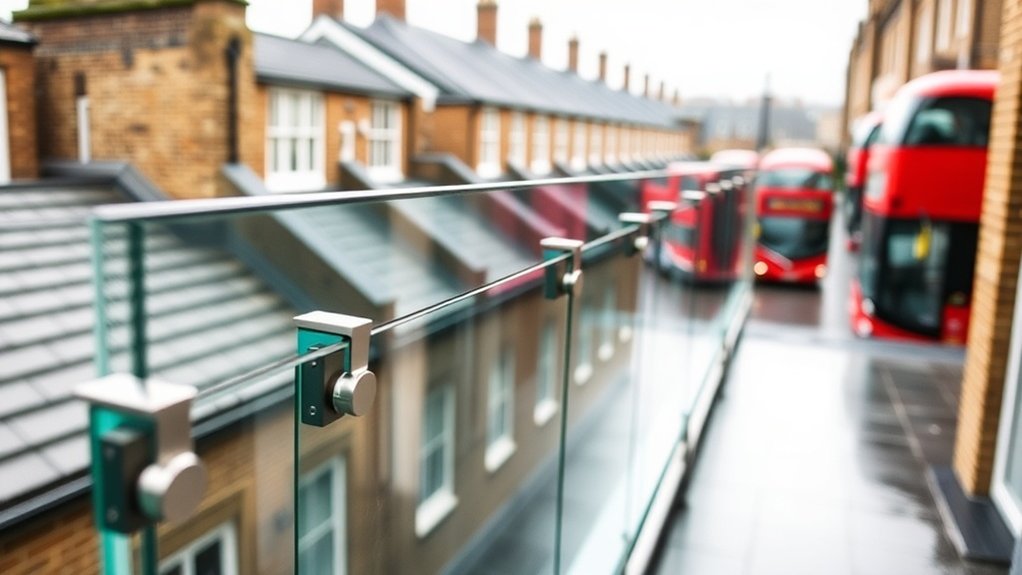
When you compare framed and frameless glass railings in London, you’re really choosing between two distinct structural strategies for supporting and transferring load. In framed systems, the metal posts and handrails act as the primary structure , so the glass mainly resists in-plane forces and impact, enhancing railing durability through redundancy. You’ll typically use thinner glass, with more mechanical fixings and visible hardware.
Frameless systems invert that logic: the glass becomes the key structural element, clamped in channels or point-fixed with engineered fittings. Here, glass aesthetics and edge clarity dominate, but you must specify thicker laminated glass , rigorously detailed base channels, and compliant anchorage to meet UK Building Regulations. You’ll weigh higher installation precision against a cleaner, more future-forward visual outcome.
Designs for Balconies, Stairs and Roof Terraces
How do you translate a glass railing specification into a solution that actually works on a balcony, stair, or roof terrace in London’s built environment? You start by mapping line loads, fixings , and glass thickness to each use case, then verifying against BS 6180 and Part K.
For balconies, you’ll typically deploy point-fixed or base-channel systems, coordinated with fall lines and thresholds, allowing for drainage and movement joints. On stairs, you must resolve transitions at winders and landings with tightly toleranced bracketry, continuous handrails, and consistent riser protection.
Roof terraces demand uplift-resistant anchoring , compatible waterproofing details, and corrosion-resistant hardware. Throughout, you can embed decorative accents in the glass or capping profiles and plan lighting integration via handrail LEDs or base-channel washes.
Wind, Privacy and Noise With London Glass Railings
If you treat glass railings as façade elements rather than just edge protection, you can actively manage wind, privacy, and noise on London projects instead of reacting to them late in the build. You’re effectively scripting micro‑climate , views, and acoustic behavior with each panel specification.
- Use laminated glass thickness and height to tune wind resistance while complying with BS 6180.
- Specify frosted or screen‑printed zones for privacy enhancement that still pass daylight targets.
- Vary panel spacing and overlap to disrupt corner vortices on tall elevations.
- Integrate acoustic interlayers near traffic corridors to attenuate mid‑frequency noise.
- Coordinate fixing details with structural engineers to avoid resonance and rattle under cyclic wind loading.
Glass Railing Installation Steps in London
Treating each glass panel as a micro‑climate and performance element only works if the installation sequence supports that intent, step by step, on site. You start by verifying structural substrates, setting out fixing points to align with BS 6180 load paths, and confirming edge cover, drainage falls, and fall‑protection zones.
Next, you install and level bases or channels, using isolators to prevent bimetallic corrosion and protect material durability. You dry‑fit laminated panels, check tolerances, then lock them with calibrated torque on clamps or wedge systems, ensuring Glass aesthetics aren’t compromised by over‑compression or twist.
Finally, you seal interfaces with compatible silicones or gaskets, validate line and plumb, then load‑test representative sections and document outcomes.
London Site Constraints, Access and Logistics
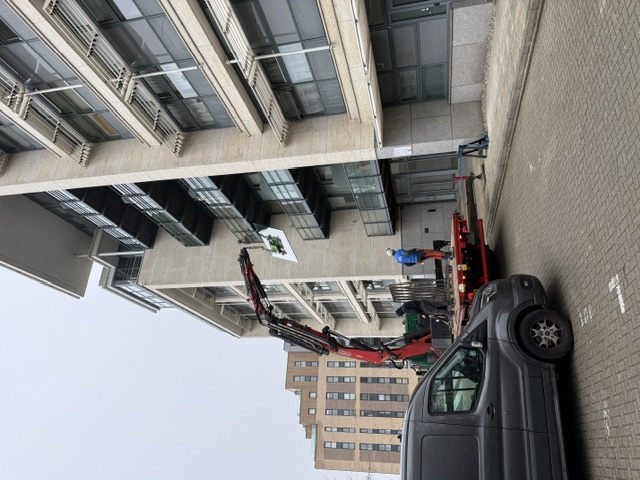
When you plan glass railing installation in London, you must treat urban access constraints as hard project parameters, not afterthoughts. You’ll need to map vehicle routes, time-restricted access windows, and crane or hoist positions against council rules and building management protocols. At the same time, you should specify delivery sequencing and on-site storage zones so glass units, fixings, and hardware arrive just-in-time without breaching safety clearances or obstructing critical escape routes.
Urban Access Challenges
Finding your way through London’s dense streets , tight rear access routes, and controlled parking zones turns glass railing installation into a logistics problem as much as a construction task. You’re not just moving glass; you’re reconciling Urban aesthetics, historical preservation, and hard physical constraints encoded in local regulations.
To keep your project buildable, compliant, and efficient, you should:
- Map access in advance using GIS and council datasets
- Model component sizes against stair cores and corridors in BIM
- Sequence works to align with local traffic and noise restrictions
- Specify modular glass and hardware to suit constrained handling paths
- Coordinate with neighbours and building management for time-bound access
Deliveries and On-Site Storage
Although delivery looks like a simple drop-off on the programme, in London it’s a tightly timed, regulation-driven operation that governs how your glass railing project can be sequenced and detailed. You’ll need Delivery scheduling aligned with local traffic orders, Section 278 constraints, and any CTMP requirements, so vehicles hit site precisely within booked slots and emissions windows.
You should design glass panel sizes, crate weights, and lifting strategies around your access route, crane capacity, and maximum vehicle dimensions. On site storage must comply with CDM and temporary works requirements: racking systems, exclusion zones, and edge protection for stillages. Minimise storage by sequencing just-in-time deliveries floor-by-floor, matching install rates. Integrate RFID or QR tracking so logistics, installation, and snagging share real-time data.
Costs of Glass Railing Installation in London
Because glass railing projects in London vary widely in scope and specification , you should treat costs as a function of several tightly coupled variables: glass type (toughened, laminated, or structural), thickness, support system (post, channel, or stand-off), fixing method, and site complexity. You’re effectively engineering a mini façade, so budget behaves like a parametric model.
Key cost drivers you should quantify:
- Glass aesthetics vs. Material durability trade‑offs (low‑iron, tints, coatings).
- Structural glass thickness increments and load-path requirements.
- Hardware specification: marine-grade stainless, bespoke brackets, stand-offs.
- Substrate preparation: steelwork, concrete upstands, or balcony edge reinforcement.
- London-specific constraints: access, craneage, parking, and out-of-hours installation.
Treat your cost plan like version-controlled code: define assumptions, run options, then lock a specification before seeking fixed-price quotations.
Maintaining London Glass Railings and Safety Checks
How do you keep a glass balustrade performing like the engineered barrier it is, rather than a decorative afterthought? You treat glass maintenance and safety inspections as part of your building’s operational protocol, not an aftercare extra.
Schedule quarterly visual checks for chips, delamination, loose fixings, and corrosion at base shoes or standoff points. Verify handrail continuity, glass alignment, and any movement under load. Log each inspection with photos and defect notes.
Annually, torque‑test mechanical fixings, re‑seal perimeter joints, and clean with pH‑neutral agents to preserve clarity and coating performance. For London sites, factor in pollution, wind loading, and public use; increase inspection frequency for high‑traffic terraces and stair cores. When in doubt, commission a qualified engineer for a formal safety audit.
Frequently Asked Questions
Can Existing Metal or Timber Railings Be Retrofitted With Glass Panels in London?
Yes, you can retrofit existing metal or timber railings with glass panels, provided you first verify structural compatibility and load-path continuity. You’ll assess post capacity, anchorage, and deflection limits, then design new glass clamps, channels, or point-fixings to current codes. In conservation zones, you must address historical preservation constraints, selecting discreet fixings and low-iron or laminated glass that respects sightlines while still delivering a clean, innovative, high-performance upgrade.
How Does London’s Pollution Affect Long‑Term Appearance of External Glass Railings?
You’ll notice pollution buildup gradually etching into the glass surface, so it doesn’t stay crystal‑clear; London’s particulates, NOx, and soot cling like there’s no tomorrow. Over time, they increase micro‑abrasion risk, staining, and rainbowing under UV. You prevent this by specifying low‑iron, toughened glass with hydrophobic nano‑coatings, defining a quarterly wash cycle, and using pH‑neutral cleaners—essentially treating maintenance like a scheduled cron job for optical performance.
Are Special Insurance Considerations Needed for Properties With Glass Balustrades in London?
You do need special insurance considerations. You’ll assess Insurance requirements for structural glass, impact resistance, and compliance with BS 6180. You should disclose glass balustrades explicitly, guarantee public liability coverage for falling glass or injuries, and verify defects and consequential damage are included. Add periodic inspection clauses and documented maintenance logs, almost like versioned code, so you can evidence due diligence if a liability considerations claim or dispute arises.
Can Glass Railings Integrate With Smart Home Systems or Automated Shading in London Homes?
Yes, you can integrate glass railings with smart home integration and automated shading systems. You embed LED strips, sensors, and rail-mounted control modules that talk via Zigbee, Z-Wave, or KNX. You then map railing zones to blinds or electrochromic glass using automation scenes (e.g., presence + lux thresholds). You’ll coordinate wiring routes, low-voltage power, and IP-rated components, ensuring compatibility with your existing hub and future firmware updates.
Do London Conservation Areas Restrict Visible Fixings or Hardware on Glass Railings?
Yes, many London conservation areas restrict visible fixings and hardware under Historical preservation and aesthetic compliance policies—think of it as UI constraints in legacy code. You must treat brackets, bolts, and clamps as low-visibility components: recess them, use slim-profile channels, or specify structural glass with hidden base shoes. You’ll coordinate early with conservation officers, submitting detailed drawings and fixings “specs” to negotiate an innovative yet compliant solution.
Summary
When you specify glass railings for your London home, you’re choosing clarity, compliance, and contemporary character. By matching glass type, thickness, and fixing systems to Part K and BS 6180, you guarantee safe, sturdy, and structurally sound results. Plan access, logistics, and load paths like a well-structured codebase, then commit to regular inspections. Do that, and your balustrade will deliver lasting light, low-maintenance performance, and legally robust protection for your property.