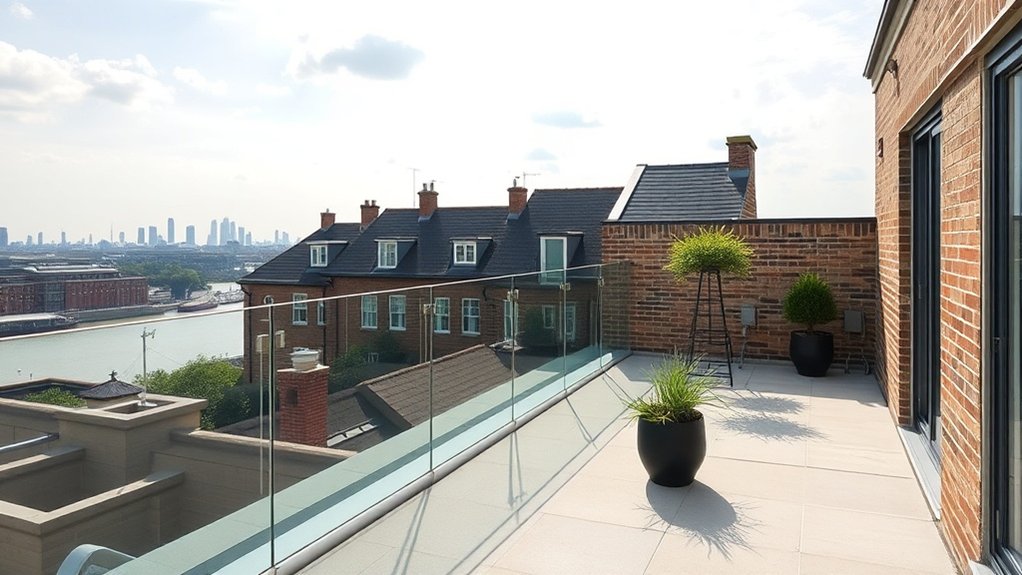
Frameless glass balustrades in London let you maximise light and views while still hitting Part K and BS 6180 line-load and impact requirements, as long as they’re properly engineered and installed. You’ll typically use laminated toughened glass set in a structural base shoe or edge-clamp system, with slab fixings verified by structural calcs and EN 1090-compliant hardware. Correct glass thickness, anchorage and drainage detailing are critical, and the next sections explain how to specify and install them correctly.
Key insights
- Frameless glass balustrades in London must comply with UK Building Regulations, BS 6180, and EN 1090, with project-specific structural calculations for safety and approval.
- Specify laminated toughened glass, typically 17.5–25.5 mm thick, increasing to 25.5 mm+ for high-rise or crowd-loaded London terraces and balconies.
- Choose fixing systems—base channels, point-fixings, or edge-clamp profiles—based on structure type, wind exposure, and whether it’s a new build or retrofit project.
- Coordinate balustrade levels with door thresholds and finishes to achieve continuous, minimal sightlines on London balconies, roof terraces, and internal galleries.
- Ask London suppliers for tested system data, drainage details, and full installation drawings, not just visuals, to ensure long-term performance and compliance.
Are Frameless Glass Balustrades Right for Your London Home?
When you’re evaluating whether frameless glass balustrades suit your London property, you need to weigh structural performance, fixing options , and compliance with local Building Regulations as much as aesthetics. You’ll first decide on load requirements and glass spec: laminated, toughened, or heat-soaked, typically 15–21.5 mm, depending on edge conditions and occupancy class.
Next, assess fixing methods : base shoe channels, point-fix stand-offs, or concealed edge steel. Each demands precise substrate preparation, tolerance control, and drainage detailing. You’ll also choose glass textures—clear, low-iron, satin, fritted—to manage privacy, slip-risk near stairs, and maintenance.
Robust installation techniques matter: accurate survey, laser-set levels, packer configuration, structural silicone where warranted, and documented test data to evidence compliance for sign-off.
Light, Space and Value: Key Benefits in London
Because London homes often struggle with tight floorplates and limited natural light, frameless glass balustrades deliver a tangible uplift in daylight penetration , perceived volume, and long-term asset value. By removing bulky posts and handrail profiles, you maximise visible floor span and achieve clean sightlines that make compact plans read as open-plan.
You can specify low-iron glass, bespoke Color options on channel trims, and tinted interlayers to fine‑tune light levels while maintaining transparency. Toughened and laminated glass systems provide high material durability, impact resistance , and compliance with current BS standards, which surveyors and buyers increasingly scrutinise. Precision-setting the base channel and using structural silicones or concealed fixings ensures a premium, future‑proof finish that enhances resale values across London’s competitive residential market.
Best Indoor Locations: Stairs, Landings and Mezzanines
Although frameless glass balustrades can be deployed across most circulation zones, they deliver the greatest functional and visual gains on stair runs , intermediate landings, and mezzanine edges. On stairs, you can run continuous glass from tread nosing to soffit line, minimising newel posts and maintaining clear sightlines for CCTV and artificial lighting design.
On landings, a top-mounted or recessed shoe channel keeps floor finishes uninterrupted while achieving compliant line loads. Mezzanines benefit from full-height glass that doubles as a fall barrier and acoustic screen, especially in mixed-use or workspace fit-outs. You can specify decorative hardware—stainless steel end caps, bespoke handrail brackets, or coloured interlayers—to align with your architectural language while still meeting Part K and BS 6180 performance criteria.
Frameless Balustrades for London Balconies and Terraces
On London balconies and terraces, frameless glass balustrades maximise edge-to-edge glazing while still delivering the line loads demanded by BS 6180 and exposed urban locations. You get uninterrupted sightlines while meeting duty-of-care and wind-load criteria. Specify heat-soaked, laminated toughened glass for enhanced glass durability and post-breakage integrity, particularly on higher elevations.
You’ll typically run:
- Base shoe channels mechanically fixed into concrete or steel upstands
- Drainage and fall detailing to stop standing water at the track
- Structural interlayers tuned for impact, deflection and acoustic attenuation
- Discreet top capping or no handrail, depending on your risk assessment
- Satin or low-iron glass to balance aesthetic appeal with privacy and reflectivity
With the right fixing methodology, you achieve minimal visual mass and maximum performance.
Period Homes: Styles That Suit London Classics
When you’re working on London’s period stock – from Georgian stucco terraces to Victorian villas and Edwardian mansion blocks – you have to detail balustrades as sympathetically as you’d tie in new cornicing or sash replacements. You’re reading façades first: proportion, rhythm, and sightlines set by the Historical architecture .
You’ll typically run a low‑profile, base‑shoe channel recessed into stone cills or timber fascias, so the frameless glass reads as a light intervention against heavy Victorian design. Specify laminated, polished‑edge glass with minimal iron content to keep elevations crisp, and align panel joints with existing pilasters or window bays. Use heritage‑tone cappings or discreet handrail extrusions only where Part K demands, keeping fixings concealed to preserve profiles while still delivering a future‑proof, high‑spec installation.
Modern Designs for New-Builds and Penthouses
When you're specifying balustrades for new-builds and penthouses, you need systems that deliver seamless contemporary lines, flush fixings , and minimal visual interruption. You’ll prioritise slimline glass profiles, cantilevered edge details, and low-iron toughened or laminated glass to maximise views and daylight penetration. From bespoke channel systems to point-fixed panels and custom handrail integrations, you can tailor glass solutions to match structural load requirements and premium interior finishes.
Seamless Contemporary Aesthetics
How do you achieve a clean, uninterrupted line from floor finish to skyline in a London penthouse or new-build terrace? You start by treating the balustrade as a continuous architectural detail, not an add‑on. A flush‑mounted, structurally bonded channel lets the glass rise directly from the deck build‑up, maintaining slab edge alignment, color coordination, and sightline discipline. You’re aiming for a zero-clutter junction: concealed fixings, minimal capping, and precise datum control.
- Specify low-iron, heat-soaked glass for crisp edges
- Use anodised or powder-coated channels to sync with façade palettes
- Coordinate drainage slots within the track extrusion
- Select recycled aluminium systems to boost material sustainability
- Set out with laser levels to guarantee perfectly true glass runs
Maximising Views And Light
Once the balustrade reads as a single continuous detail, you can start exploiting it as a daylight and view engine for the apartment. You’ll run full-height, low-iron panels, minimising green edge and colour cast, so the horizon line stays sharp and your interior lighting strategy isn’t compromised.
Specify toughened, heat-soaked laminated glass to balance transparency with glass durability under wind load and thermal stress, critical on London penthouse terraces. Keep base channels flush with the finished floor build-up and coordinate drainage to avoid standing water reflecting onto the glass.
Use minimal capping or a dry-joint system to avoid shadow lines. Align mullion-free spans with primary sightlines from key furniture positions, so every seated and standing viewpoint reads as uninterrupted.
Tailored Luxury Glass Solutions
Although the structural logic stays the same , luxury glass balustrades for London new-builds and penthouses demand project-specific detailing: you’re not picking a system, you’re building a bespoke envelope line. You coordinate Glass durability, fixing geometry, and drainage with your façade package, MEP penetrations, and terrace build-up. You’re looking for minimal hardware, maximum transparency, and precise aesthetic integration with thresholds and cappings.
- Specify laminated, heat-strengthened glass with SGP interlayers for slim profiles and long-span Glass durability
- Use base-shoe channels pre-aligned to screed levels for millimetre-true sightlines
- Integrate concealed rainwater routes beneath track for clean stone or porcelain finishes
- Coordinate balustrade datum with sliding-door heads and jambs for continuous bands
- Prefabricate corner returns and step progression to reduce onsite cutting and snagging
London Building Regs and Part K for Glass Balustrades
When you design or install glass balustrades in London, you’ve got to treat Approved Document K of the Building Regulations as your primary compliance blueprint, defining minimum barrier heights, line-loads, point-loads , and containment requirements for domestic and non‑domestic settings. You’re not just ticking boxes; you’re engineering a safety-critical edge protection system.
You must coordinate Glass durability with fixing geometry, edge cover, and substrate capacity so the barrier achieves the specified kN/m performance without excessive deflection. Your installation techniques need to control tolerances on channel alignment, packer placement, and clamping pressure, so loads transfer cleanly into the structure. Always cross‑check Part K against project‑specific specs, wind loading, crowd loading, and any planning conditions unique to London’s high‑rise environments.
Safety Glass Types and Thicknesses Explained
Part K tells you what performance the barrier must achieve ; the glass make‑up and thickness are what actually deliver that performance on site. You’re typically choosing between fully toughened, heat‑soaked toughened, and laminated toughened panels. For frameless balustrades, you’ll usually run laminated toughened as your primary line of defence, with thickness standards driven by span, loading zone, and fixing detail.
You’re aiming for Glass durability under long‑term line loads and impact, not just a pass on day one. That means checking test data, not guessing off a table.
- 10–17.5 mm: internal residential, short spans
- 17.5–21.5 mm: common domestic edge‑mounted
- 21.5–25.5 mm: high‑traffic residential / light commercial
- ≥25.5 mm: commercial, crowd‑loading scenarios
- Always specify laminate interlayer type, not just thickness
Fixing Systems for Frameless Glass Balustrades
Because the glass spec is only as good as the way you anchor it, fixing systems for frameless balustrades in London revolve around three main approaches: base‑channel (shoe) systems, point‑fixed (button/spider) brackets, and continuous edge‑clamp profiles. You’ll typically run a structural aluminium shoe, resin‑grout or mechanically wedge the panes, then fine‑tune alignment with dry‑glaze wedges. That gives rapid install and clean datum control.
Point‑fixed fixing systems demand accurate drilling, high‑grade stainless hardware, and robust backing structure, but they showcase maximum transparency. Edge‑clamp profiles suit retrofit and mixed substrates, spreading loads without full‑depth recessing.
In every case, you protect glass durability by detailing drainage, isolating dissimilar metals, and specifying tested assemblies with documented load paths and deflection limits.
Privacy, Wind and Noise Performance of Frameless Balustrades
A frameless glass balustrade in London doesn’t just manage edge protection; it also controls sightlines, airflow and acoustic comfort along the façade or terrace edge. You resolve privacy concerns by specifying fritted, acid‑etched or bronze‑tinted glass on critical zones, often with stepped progression points at party lines. You mitigate wind effects with wind-tunnel–informed panel layouts and staggered joints that break up vortices rather than creating a sail.
- Use laminated glass with acoustic interlayers to dampen traffic and crowd noise.
- Increase glass thickness or stiffness on high‑exposure corners to limit deflection and whistling.
- Detail base channels with continuous gaskets to avoid flanking noise paths.
- Integrate return panels to reduce corner turbulence and draughts.
- Coordinate panel height with CFD studies to balance shelter and transparency.
Cost of Frameless Glass Balustrades in London
When you cost a frameless glass balustrade in London, you’re mainly paying for glass spec (thickness, lamination, coating), fixing system (base shoe, stand-offs, or channel), and site variables like access, edge details, and substrate prep. You’ll typically see London rates quoted per linear metre, with premiums for complex layouts, custom hardware, and tight programming. By understanding these price drivers, you can specify smarter, standardise details, and trim unnecessary extras to keep the install within budget.
Key Price Factors
How do you pin down the cost of a frameless glass balustrade in London without blowing the project budget or compromising on spec? You start by isolating the variables that actually move the needle during design and installation, then value‑engineer around them rather than stripping out performance or aesthetics.
Key price drivers typically include:
- Glass spec: thickness, lamination, low‑iron clarity, and any fritting or decorative accents.
- Fixing method: base‑channel, side‑fix, or point‑fix with bespoke brackets and structural steelwork.
- Site conditions : access, substrate build‑up, tolerances, and integration with waterproofing.
- Compliance: loading class, Part K, balustrade height, and heritage or historical preservation constraints.
- Detailing: corner junctions, transitions to stairs, handrail terminations, and hidden drainage.
Typical London Price Ranges
Budgeting a frameless glass balustrade in London means working with realistic, installed‑to‑site rates rather than headline “per‑metre” prices that ignore access, fixings, and compliance. For standard residential runs using 15–21.5mm toughened laminated glass in a base‑channel system, you’ll typically see £450–£650 + VAT per linear metre fully installed .
If you specify point‑fixed (button‑fit) balustrades, expect £550–£750 + VAT per metre due to increased templating, drilling tolerances, and stainless hardware. Roof terraces and garden privacy screens often climb to £700–£900 + VAT per metre, reflecting wind‑load calculations, uprated glass thickness, and complex access.
Adding decorative accents such as coloured interlayers, etched motifs, or low‑iron glass usually adds £80–£150 + VAT per metre on top of the base specification.
Balustrade Cost-Saving Tips
Those London installed‑to‑site rates can look steep, but you can control costs by making smart specification and detailing choices rather than cutting corners on safety. You trim spend by rationalising glass modules , simplifying fixing details, and coordinating early with your installer so they can value‑engineer the support structure.
- Standardise panel widths to reduce cutting, waste, and on‑site snagging.
- Use off‑the‑shelf base shoes and point fixings instead of bespoke fabricated sections.
- Optimise glass thickness for loading class to balance balustrade durability, weight, and cost.
- Prioritise high glass transparency only where sightlines matter; use more economical make‑ups elsewhere.
- Pre‑set tolerances in your drawings so the installer can set out quickly and avoid re‑drilling or remedials.
Planning Permission for Frameless Balcony Balustrades
When you specify frameless balcony balustrades in London, planning permission often hinges on three factors: the building’s classification, the elevation facing public views, and the impact on neighbours’ privacy. You’ll need drawings that clearly detail balustrade materials, fixing centres, glass thickness, and parapet heights to evidence compliance with Part K and BS 6180 .
Planning officers scrutinise sightlines, reflectivity, and overlooking risk. Use frosted or tinted glass where privacy is sensitive and flag this in your submission. Specify engineered channels, point-fix brackets, or base shoes, and show anchorage into the slab with structural calcs. Your installation techniques must demonstrate robustness under crowd loads and wind uplift. On listed buildings or in conservation areas, expect stricter controls on edge profiles and visible hardware.
Maintenance and Cleaning Tips for London Conditions
Although frameless balustrades are relatively low‑maintenance, London’s pollution, hard water, and wind‑driven grime demand a defined cleaning regime and inspection schedule to keep glass clarity and hardware performance within spec. You’ll get the best lifecycle performance by pairing correct detergents with disciplined visual checks, especially where Eco friendly materials interface with stainless fixings on heritage façades subject to historical preservation constraints.
- Use pH‑neutral, non‑abrasive cleaners; avoid hydrofluoric or strong alkalis on glass edges and channels.
- Rinse with low‑pressure mains water, then squeegee to counter limescale spotting.
- Inspect base shoes, wedges, and gaskets quarterly for creep, corrosion, or displacement.
- Clear drainage slots and weep holes to prevent ponding around structural fixings.
- Document every clean/inspection to align with O&M manuals and warranty conditions.
Choosing a Frameless Glass Balustrade Installer in London
Because frameless balustrades are structural safety elements as much as architectural features, selecting a London installer shouldn’t be a lowest‑price exercise but a verification of competence, accreditation, and site experience. You need a contractor fluent in BS 6180 , EN 1090, and London borough approvals, with a track record in both new‑builds and historical preservation.
Interrogate their fixing methodology: base‑channel vs side‑mounted shoes, structural silicone, drilled versus cast‑in anchors, drainage detailing, and movement joints. Ask for structural calculations , glass specifications, and test data, not just glossy visuals or Artistic innovations.
Check they self‑deliver: in‑house surveyors, CAD technicians, and CSCS/SSSTS‑qualified fitters, not generic subcontractors. Demand site‑specific RAMS, warranty terms, and a snagging protocol aligned with your project’s performance brief.
Common Mistakes to Avoid With Frameless Glass Balustrades
When you specify frameless glass balustrades, you can’t afford to ignore safety regulations, structural load paths , and Part K compliance. If you rush the set‑out, tolerate poor fixing, or accept out‑of‑tolerance alignment, you’ll introduce glass edge stress, uneven load transfer, and long‑term movement. You also need to reject low‑quality hardware, as sub‑standard channels, fixings, and clamps compromise impact resistance, corrosion performance, and overall system integrity.
Neglecting Safety Regulations
Even before you look at glass thickness or fixing details, ignoring the regulatory framework is the fastest way to end up with a non‑compliant, unsafe frameless balustrade. In London, you can’t shortcut Building Regulations , BS 6180, or local authority requirements without creating serious safety hazards and project delays. You need regulatory compliance baked into the design brief, not bolted on at sign‑off.
- Check use class, line loads, and impact categories at concept stage.
- Verify minimum barrier heights for balconies, stairs, and internal voids.
- Specify laminated toughened glass with proven post‑breakage performance.
- Confirm edge distances and substrate build‑ups meet test data assumptions.
- Document calculations, test certificates, and installation method statements.
Poor Fixing And Alignment
Poor fixing and sloppy alignment turn a frameless balustrade into a stressed glass line just waiting to fail. If your base channel isn’t laser‑true, you’ll induce torsion into the panes, compromise edge integrity , and invite spontaneous breakage under crowd load. Always set the track on a fully cured, level structural substrate; pack and shim to tolerance before resin‑grout or wedge‑clamp lock‑off.
Misaligned glass kills sightlines and makes even premium decorative patterns look second‑rate. Check verticals with a digital inclinometer and run a string line along the nosing to pick up any creep. Maintain consistent glass gaps, especially where LED details or aesthetic enhancements run through, otherwise you’ll see light stepping and shadow banding that cheapens the whole installation.
Choosing Low-Quality Hardware
Get the alignment right, then back it up with hardware that can actually hold the system under load. If you cheap out on components, your frameless glass balustrade becomes a weak link, not a flagship feature. Hardware quality dictates structural performance, long-term stability , and compliance.
You should specify tested systems with documented load data, not generic brackets or unbranded channel. Prioritise material durability: marine-grade stainless, high-tensile fixings, and UV-stable gaskets as baseline, especially for London’s polluted, moisture-heavy environment.
- Avoid zinc-plated fixings in external or semi-exposed locations
- Insist on 316 stainless for clamps, spigots, and base shoes
- Check ETA/BS EN test certification for the full hardware set
- Use compatible alloys to prevent galvanic corrosion
- Verify manufacturer-backed warranties on hardware performance
Frequently Asked Questions
Can Frameless Glass Balustrades Be Retrofitted Into Existing Railings Without Major Structural Changes?
Yes, you can often retrofit frameless glass balustrades into existing railings if the substrate offers adequate load paths and fixing depth. You’ll strip out the old balusters, core-fix or surface-mount new base channels, then laser-line and pack for plumb glass alignment. You’ll balance design aesthetics against cost considerations: structural glass specs, drilling, edge polishing, and custom hardware all impact budget, but deliver a cleaner, future‑proof install.
How Do Frameless Glass Balustrades Perform in Fire Safety and Emergency Escape Scenarios?
They don’t provide fire resistance; you mustn’t treat the glass as a fire barrier. Under heat, panes can crack and fixings can deform, so you design escape routes assuming balustrades may fail locally. For compliant emergency egress, you coordinate with Part B, maintain protected stair cores, and detail continuous handrails, anti-trip thresholds, and break-out routes that don’t rely on the glass line for structural integrity during evacuation.
Are There Eco-Friendly or Recycled Glass Options for Frameless Balustrade Installations in London?
You can specify eco friendly materials and recycled glass options on most frameless balustrade packages. You’ll typically use laminated safety glass with a recycled content sheet, matched to BS 6180 and EN 14449. Check with your fabricator for low‑iron, high‑recycled‑content laminates, then pair them with 316 stainless or aluminium base channels, thermal breaks, and EPDM gaskets to keep performance tight while pushing a low‑carbon, design‑led installation.
Can Frameless Glass Balustrades Integrate With Smart Home or Automated Shading Systems?
Yes, you can integrate frameless balustrades with smart home control and Automated shading. You specify laminated glass with compatible sensor films, low‑voltage cable routing in the base channel, and discrete bracketry for motorised blinds. Smart integration typically runs via KNX, Loxone, or Zigbee bridges, linking sun sensors, timers, and occupancy logic. You’ll coordinate wiring first fix, datum setting, and access for future actuator or driver maintenance.
What Insurance Implications Arise When Installing Frameless Glass Balustrades on London Properties?
You trigger insurance implications around structural glazing risk , warranty compliance, and premium loading. With glazed elements linked to 35% of façade claims, you must notify your insurer, update Insurance coverage schedules, and evidence BS 6180-compliant design. Specify laminated, heat‑soaked panels, documented fixing details, and engineer sign‑off to contain liability considerations. Insurers may mandate periodic inspections and maintenance logs to keep public liability and building policies fully responsive.
Summary
When you weigh up frameless glass balustrades for your London property, you’re not just picking a finish, you’re future‑proofing the build. If you get the specs, glass thickness, fixing method, and drainage right, you’re ahead of the game on compliance and longevity. Partner with an installer who can produce load‑calcs, detail drawings, and test data, and you’ll get a system that’s safe, code‑compliant, and cleanly integrated into your structure.